Bush, Iran, and the Bomb
October 21, 2007
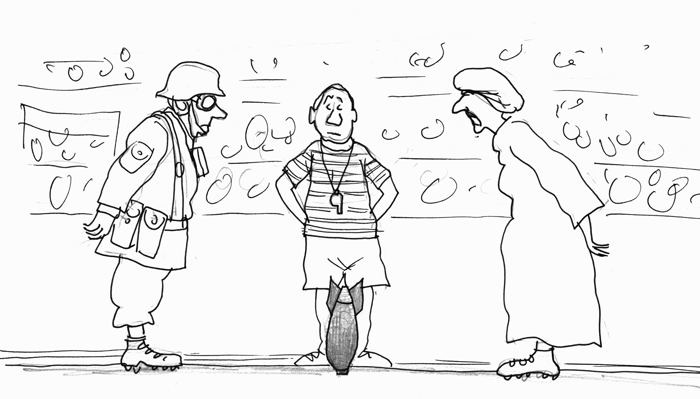
This is the title of Eric Laurent's latest book, published by Plon. Add the subtitle "Investigation into a War That Was Preprogrammed." If you want to completely demoralize yourself, read this book. Laurent speaks like a man who has met many people at high levels and gathered firsthand information and statements. The book teems with phrases and anecdotes. I quote a passage, page 59:
**
Bush, Iran, and the Bomb
A former White House aide, until early 2004, who broke with the administration for political reasons, believes: "The greatest danger posed by Bush lies in his certainty, combined with a phenomenal lack of curiosity. In meetings with his aides, Bill Clinton would ask questions, challenge their analyses, and push them to their limits. George G. W. Bush never does. He listens and moves on. I've never seen him read a news magazine, let alone a newspaper. He claims to love history and be interested in it, but in a childish way, because he imagines himself possessing historical stature. And that's the worst: he has a few references, but no real culture. He launches wars—yesterday against Iraq, perhaps tomorrow against Iran—without knowing anything about the history, psychology, or politics of these countries. Deep down, he imagines their future to be similar to that of Puerto Rico, a U.S. territory. It's terrifying." (Eric Laurent says he gathered these remarks in February 2007.)
During this period, the former Secretary of State, Henry Kissinger, aged 82, became one of the unofficial advisors, a "night visitor," highly listened to, and who reinforced Bush's intransigence. Cheney, long fascinated by the former Secretary of State, introduced him to the White House. Kissinger compares Iraq to Vietnam and pushes for firmness, even in the face of an increasingly hostile public opinion. The Vietnam conflict was lost, he explains, because there was a lack of determination and energy to carry out the desired policy. He seems to have forgotten that he was the first to push for abandoning South Vietnam.
Bush, Iran, and the Bomb
A former White House aide, until early 2004, who broke with the administration for political reasons, believes: "The greatest danger posed by Bush lies in his certainty, combined with a phenomenal lack of curiosity. In meetings with his aides, Bill Clinton would ask questions, challenge their analyses, and push them to their limits. George G. W. Bush never does. He listens and moves on. I've never seen him read a news magazine, let alone a newspaper. He claims to love history and be interested in it, but in a childish way, because he imagines himself possessing historical stature. And that's the worst: he has a few references, but no real culture. He launches wars—yesterday against Iraq, perhaps tomorrow against Iran—without knowing anything about the history, psychology, or politics of these countries. Deep down, he imagines their future to be similar to that of Puerto Rico, a U.S. territory. It's terrifying." (Eric Laurent says he gathered these remarks in February 2007.)
During this period, the former Secretary of State, Henry Kissinger, aged 82, became one of the unofficial advisors, a "night visitor," highly listened to, and who reinforced Bush's intransigence. Cheney, long fascinated by the former Secretary of State, introduced him to the White House. Kissinger compares Iraq to Vietnam and pushes for firmness, even in the face of an increasingly hostile public opinion. The Vietnam conflict was lost, he explains, because there was a lack of determination and energy to carry out the desired policy. He seems to have forgotten that he was the first to push for abandoning South Vietnam.
- Surreal, isn't it? *
I am like millions of people. I try to gather bits and pieces of information, to try to understand what is happening, what is being prepared. For a long time, many people have said, "People like Bush and those around him are nothing but puppets. Others pull the strings."
But who are these others? What? How does the world work?
I remember a long phone call in January 2006. I will never forget the moment of realization I had that day. For a quarter of a century, we had believed in a wall of silence, in coordinated actions, in a deliberate brake. We had believed that people followed orders, "coming from above." I am referring here to my research on MHD. Well, no. The Wall of Silence never existed except in my imagination. The obstacle was of a different nature: incompetence, stupidity, short-sightedness.
Suddenly, I think of an album I published in 1990, seventeen years ago, titled "Joyous Apocalypse." You can find it, downloadable for free, at:
http://www.savoir-sans-frontieres.com/JPP/telechargeables/Francais/joyeuse_apocalypse.htm
I wonder if it isn't one of the best books I've ever written. It's the story of humanity. The Zuns clan lives in caves. They eat what they find and have only their teeth as blunt instruments. When it rains, they get cold and catch colds. On page 5, one of the characters discovers the first blunt instrument, simply... a pointed object. By imitating animals, he discovers its multiple uses.
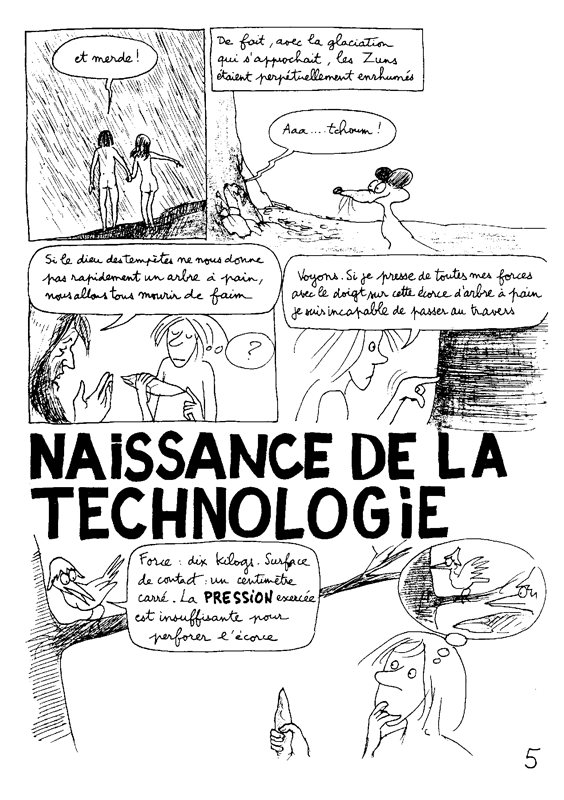
A shard of stone becomes a scraper, a blade, a weapon. Thanks to these weapons, conflicts between tribes become more deadly. There is a series of films, which I believe have been converted into DVDs, illustrating how Australian gold prospectors, the Leahy brothers, projected into the twentieth century the Papuans, who lived in the Waagi Valley, deep in the interior of Papua New Guinea and isolated from everything, into the Stone Age, the age of fire, sweet potato cultivation, and pig farming. Fantastic acceleration. A generation later, they return to their tribal warfare habits. But this time, they fight with crude rifles made from central heating pipes into which they slide shotgun cartridges struck with a nail.
Read the book by Bob Connolly and Robin Anderson, titled "First Contact," published in 1987 by Gallimard (if it's still available). It's one of my favorite books.
Back to Joyous Apocalypse. On page 17, humans have invented armies and now fight in a more organized, technical, and sophisticated way. The Zuns fight against the Zautres, another tribe, of course an enemy.
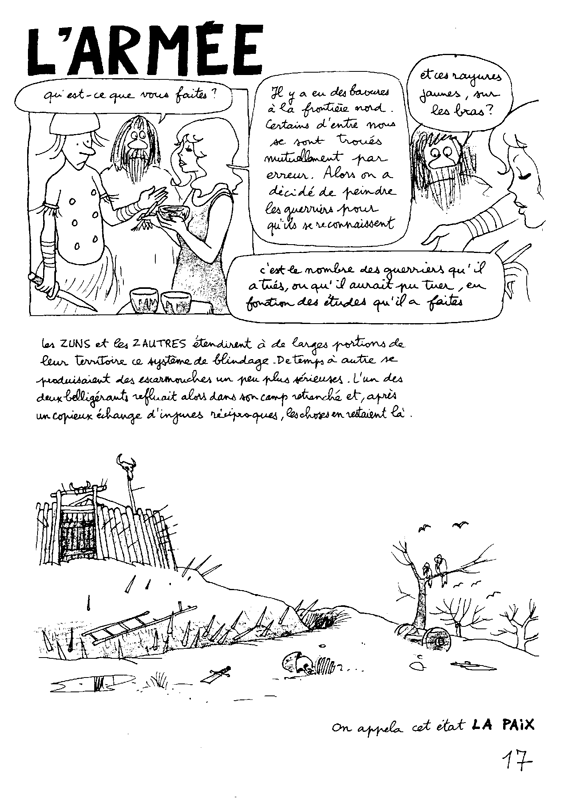
The rest of the book discusses the rise of the art of killing one's neighbor. When I composed it at the end of the 1980s, Ronald Reagan was President of the United States. This reminds me in passing of a scene from the movie Doc Hollywood:
- You say you come from the future? What's to stop me from thinking you're a fraud, a fantasist...
- Yes, yes, I assure you, test me... (I can't remember the year the scene is supposed to take place.)
Doc tries a test:
- If you come from the future, tell me who is President of the United States in your time?
- Ronald Reagan.
- What! A Western actor! You're joking...
You all know it wasn't a joke. The President of the world's most powerful nation is necessarily a historical figure, or one capable of becoming one. In Reagan's case, that wasn't true. He left no lasting impression. The only thing people remember is his Star Wars project. He ended his term without glory, consumed by Alzheimer's disease.
The Star Wars war never happened. Lucky break. The skirmishes continued, however, no matter what. Genocide here, economic war there. Iraqis versus Iranians, Sunnis versus Shiites, Tutsis versus Hutus, Zuns versus Zautres. Trivialities compared to what humanity, over the past half-century, has been capable of doing.
It's the end of the album that's interesting. I imagined Reagan having a dream. He found himself in a strange, gigantic spaceship—the... ship of history. He meets someone who seems to be its captain and asks:
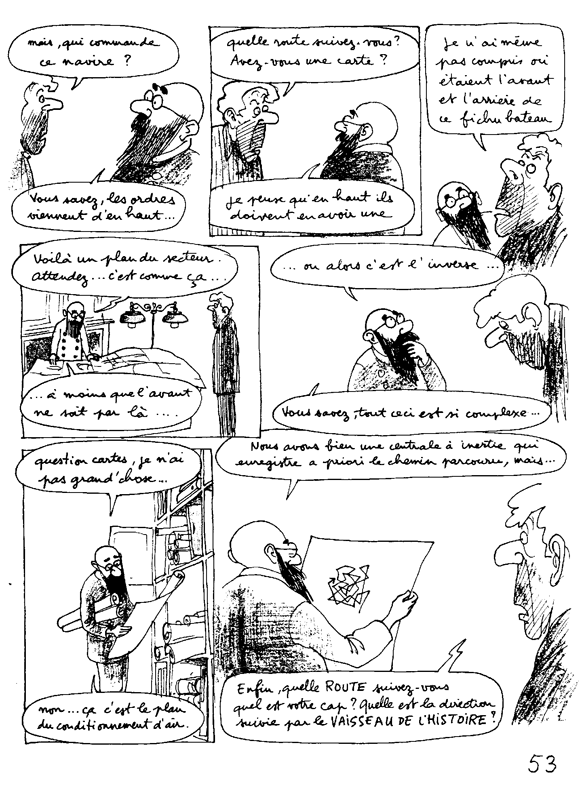
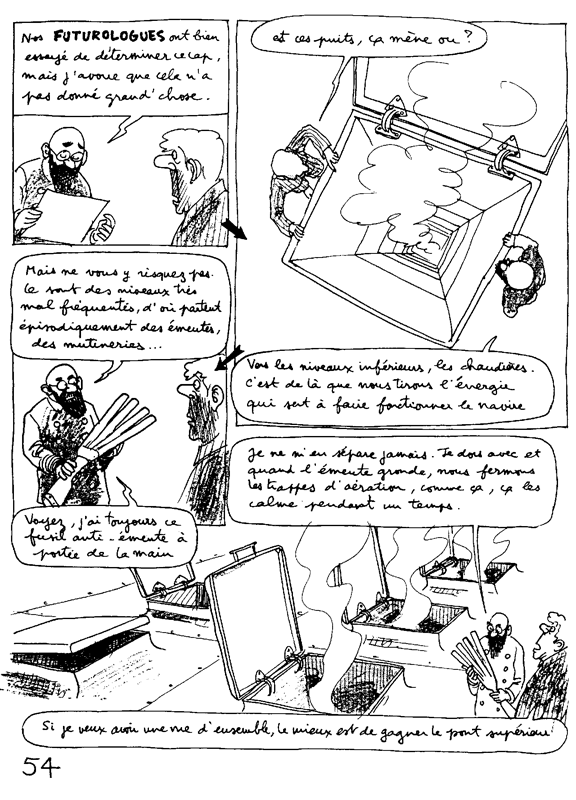
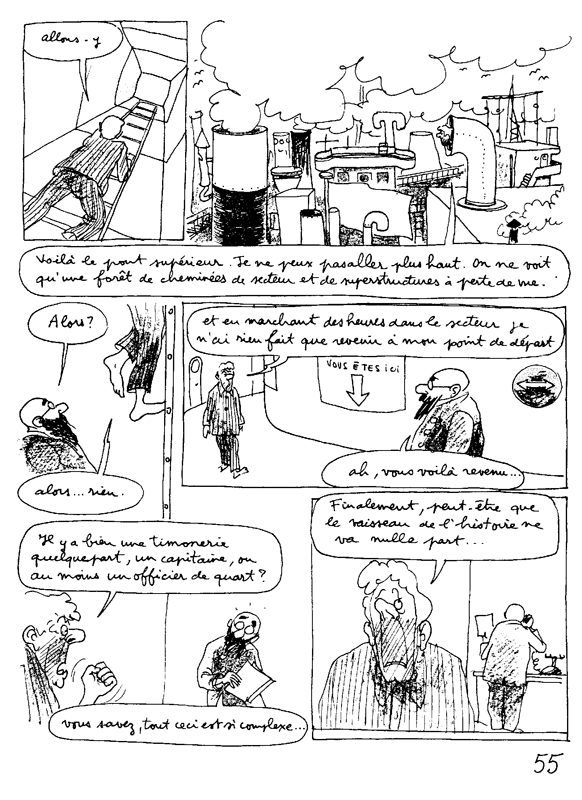
We're near the end of the album. In his dream, Reagan discovers that the ship of history is going nowhere. It has neither past nor future. There are no maps. Life aboard is paced by "horizontal" conflicts, at different levels, and "vertical" conflicts between those above and those below.
Life is short. Look at our politicians, our thinkers, our decision-makers, our religious leaders, our wealthy. Look at them pass, live, act, deteriorate, perish. It's grotesquely absurd. Mitterrand, knowing he was doomed, didn't know how to negotiate his exit. He studied powerful phrases spoken by famous figures before passing on, searching for his own, which he never found. He would have liked to end up in the Panthéon. I don't even know where he's buried. The last thing he managed to stage was his photo, dead, on a double-page spread in a magazine. Beautiful lighting, nice angle. Centuries ago, kings offered themselves marble tombs. Today, the leader of a powerful nation can only afford... a double-page spread in a magazine, which will end up in a dentist's waiting room. A... pathetic end for a man who had served two presidential terms.
Sic transit gloria mundi
Go see the mummy of Ramses II in the Cairo Museum. What a struggle for such a powerful pharaoh! Throughout Egyptian history, during a turbulent period, a caste of priests had to recover the gold from royal tombs to pay mercenaries and repel invasions. There was no pharaoh strong enough to lead troops into battle. So they had to pay the Bob Denard figures of the time to repel invaders. After paying the men with gold, jewels, everything was sold. At one point, a group of pharaohs was moved to a cache at the end of a mountain path overlooking the Valley of the Kings. This cache was discovered by a goat herder. He, his family, and his descendants sold the contents of the cache for generations. Then, when there was nothing valuable left to sell, they sold the cache itself to archaeologists, who brought the mummies back to a beautiful hall in the Cairo Museum.
There they are, our mighty pharaohs, divinized, lined up like sardines in a small room, at the mercy of the curiosity of anyone who passes by. If their psychic essence survives thanks to this withered vessel, I imagine Amenophis III saying to Ramses II, at night, after visitors have left and silence has fallen over the museum:
- Finally... it's over! You saw, Ramses, those two American women who wouldn't stop jabbering with their silly remarks. In the Dar-el-BAhri cache, at least we had peace.
It was Woody Allen who said:
As long as man is not eternal, he cannot truly be relaxed.
There's truth in all this. History goes round in circles, like the ship in my comic, and humans run after nonsense, like dogs chasing their tails.
Scientists are no better than other humans. They too will suck dandelions by the root.
What can we hope for at best? To have our name carved in marble, be cited, sung, read? For how long? We keep coming back to this essential problem of eternity. Everything is a matter of duration. Take cemeteries, for example. You can buy a plot for thirty years. After thirty years, the cemetery administration reclaims the space. You're removed without ceremony. They call this "skeleton reduction." The municipality that manages the cemetery just piles everything up somewhere. Do you know how many Parisians were thus "stored" in the catacombs in the 19th century? Eight million. There was no more room in the cemeteries. In the 19th century, in all Parisian cemeteries, whenever someone dared to dig with a shovel somewhere, they'd hit a skull, a tibia. One day, they decided to descend these tenants into the galleries of the old quarries running under all of southern Paris, thirty meters below. Paris is located in the "Paris Basin." A sedimentary region, with a limestone substrate. On Denfert-Rochereau Square, there's a paid entrance for tourists. You can visit, discover tens of thousands of Parisians lined up, packed together. There are hundreds of kilometers of galleries running under the capital. Go up to the Boulevard Saint-Michel, near the Luxembourg Garden. There are "manhole covers." Through the hole, you can toss a pebble or a coin. Count the fall time. If it's about one second, this cover leads to the sewers, nine meters below. If it's longer, the shaft leads to the catacombs, twenty-five meters below.
Eight million Parisians lie there, scattered. Jaws and skulls are mismatched, tibias are anywhere.
We are nothing but very temporary assemblages, which doesn't stop us from fighting like ragpickers, killing each other in the name of ideologies, of various gods. Nothing changes. And all this for what, for what purpose? What are we doing on this planet?
I'll refer again to one of my albums, Big Bang, downloadable at:
http://www.savoir-sans-frontieres.com/JPP/telechargeables/Francais/big_bang.htm
We're at the end of page 47, in a kind of interlude, between helium synthesis and the resumption of nucleosynthesis with the birth of galaxies and stars. The characters question:
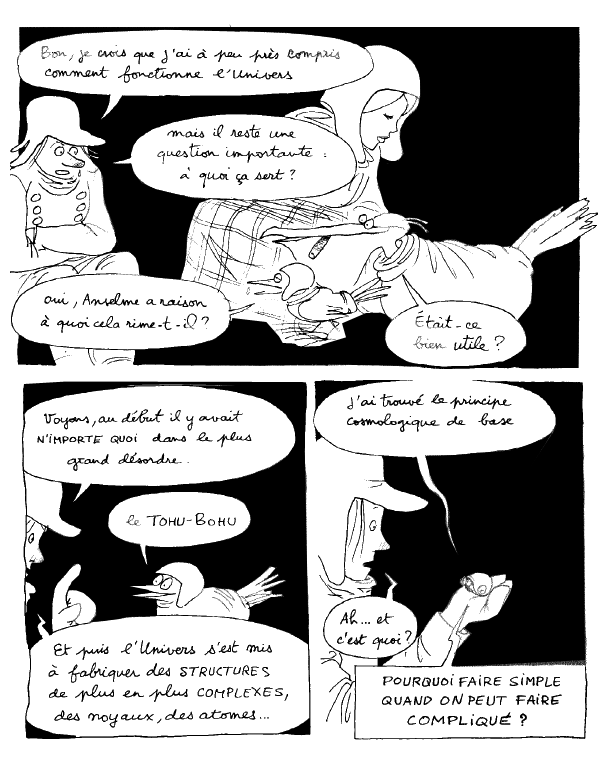
Phenomenologically speaking, what we witness goes, at least during the time spans we can appreciate, from simple to complex. The primordial morphogenetic force is gravity. It's what gathers atoms into clumps. Gravitational energy is transformed into thermal energy, into the motion of nuclei and electrons. Collisions between nucleons produce nuclei, increasingly complex, through fusion. This is nucleosynthesis. It's the massive stars, the supernovae, that explosively fill in the boxes of Mendeleev's table. It's quite well done, really. Some think "it's meant to be" (Brandon Carter's anthropic principle, from anthropos, man). Even scientists can be something-centered. We've known geocentrism (centered on Earth). Then heliocentrism (everything centered on Helios, the Sun). Carter created a "scientist-centered" anthropocentrism. The anthropic principle amounts to saying:
- The universe was created so that man could appear
I'll go even further. Brandon Carter, astrophysicist, is ipso facto at the top of the evolutionary pyramid by stating this principle. He should have called his principle:
The Brandocentric Principle
Indeed, the very particular, sharp choice of the constants of physics allowed the appearance of masses, their atoms, molecules, planets, life; man, and finally Brandon Carter who stated this principle.
We are here
In the south, there's a succulent plant called agave. When it flowers, it means it's going to die. When a supernova transforms into spores, they die, dispersing across the cosmos the means to create even more complex things: molecules.
When a supernova explodes, it produces a lot of things right away. Stable atoms and unstable atoms, with varying half-lives. Things with short half-lives are radioactive atoms, which will decay. You'll notice one thing. These supernovae emit different isotopes, including uranium-238 and uranium-235. Uranium-238 has a half-life of four and a half billion years. It decays into thorium-234 and helium-4. You know the use that can be made of uranium-235, present in trace amounts (0.7%) in natural uranium ore. It's suitable for a chain reaction. Explanations in pages 17, 18, and 19 of my comic "Energétiquement vôtre," downloadable for free at:
http://www.savoir-sans-frontieres.com/JPP/telechargeables/Francais/energetiquement_votre.htm
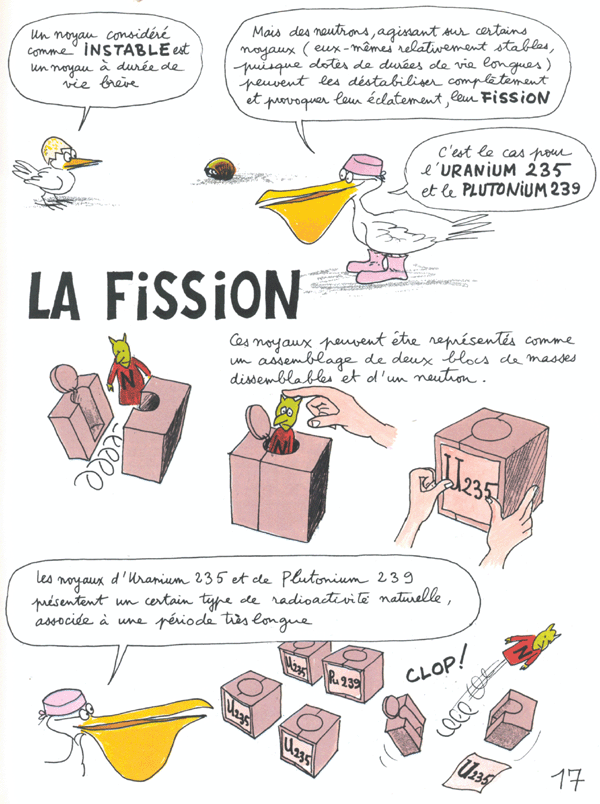
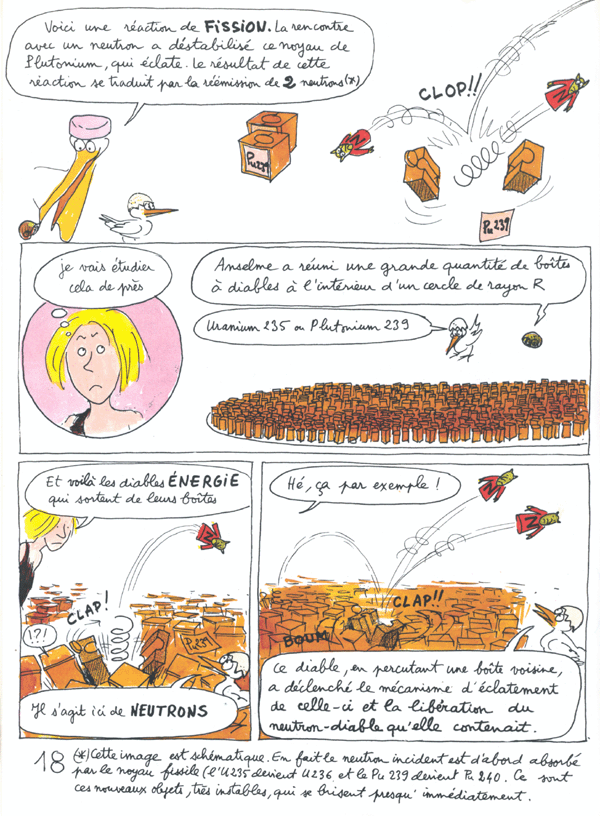
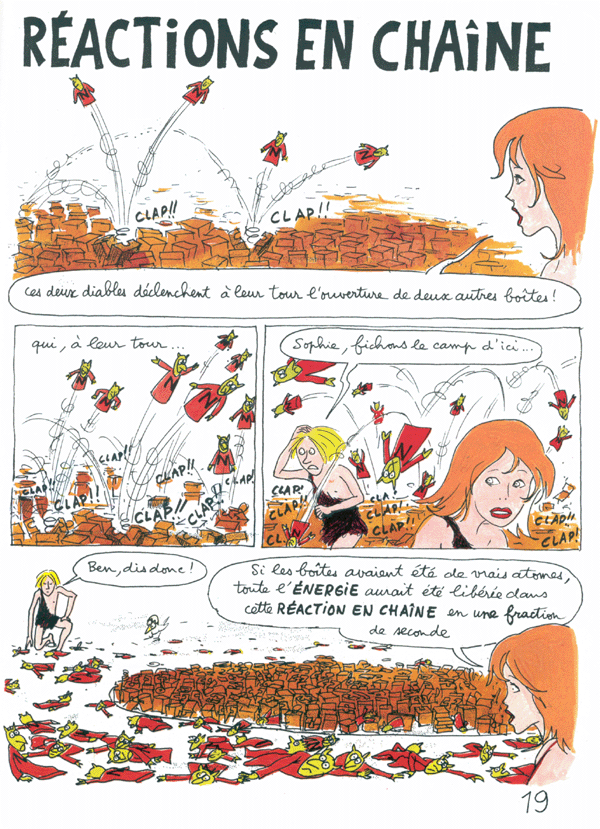
I've given a 2D image of what happens in 3D in an atomic bomb. Neutrons emitted by the natural decay of uranium-235 are susceptible to being reabsorbed by other 235 nuclei, immediately unstable, which explode, releasing energy and more neutrons, which in turn... etc. There's a chain reaction if the dimensions of the uranium mass exceed the neutron reabsorption length L. Calculate the volume of a sphere with radius L, multiply by the density of uranium, and you get the critical mass. If the mass of uranium-235 is less, that is, if the sphere is smaller, neutrons can escape without creating secondary reactions, etc. In 2D, this sphere becomes... a circle. See the drawings above.
If the neutron reabsorption length for fission had been, for example, ten times greater, the critical mass would have been a thousand times higher. Think about it: under these conditions, the atomic bomb would never have existed. It's that simple. In fact, it was "by getting the factor of ten wrong" that Heisenberg convinced the Nazis, during the war, that Hitler could never consider making an atomic bomb with this uranium, which many already knew had the property of being "fissile." With a critical mass a thousand times higher, this bomb would have been untransportable. This energy source, concluded Heisenberg, "could be used to propel large-tonnage ships." Read The Heisenberg Affair, published by Albin Michel. Had Heisenberg made a mistake in his calculations? Of course not. But, with Von Weisacker, leading the small group studying uranium before and during the war, he judged it preferable to hide from Hitler that he had, by completing the Nazis' fantastic advance in space (the V2!), the means to dominate the entire world. With more V2s and atomic bombs, Hitler could have brought all countries to their knees. His physicist specialists wouldn't have taken long to develop fusion, and then the terrible F-F-F weapon (fission-fusion-fission), with which he wouldn't have hesitated to poison vast territories. He would have thus settled accounts with the Russians, then, developing intercontinental missiles, would have pulverized the United States. Remember, though, that it was Von Braun who led the Mercury project, even if in the film "The Making of Heroes" filmmakers preferred to make the contribution of Nazi science less explicit.
Heisenberg wasn't wrong, since the very next day, locked in Farm Hall, in an English estate where all German atomists had been gathered after the collapse of the Axis, he gave a seminar explaining the principles of the bomb's operation! I tell you: if there's one man who would deserve posthumously the Nobel Peace Prize, it's him! But how could he explain this betrayal of the German people, after they had been crushed under Anglo-American bombs?
This particular point made me, many years ago, propose to complement Brandon Carter's anthropic principle with a thanatotropic principle (from thanatos, death, and tropos, tending). By what chance did nature leave within reach of humans the means to self-destruct?
With a neutron reabsorption length ten, or even a hundred times greater: no atomic bombs, no plutonium, and even... no nuclear reactors! In the third millennium, we'd simply be prolonging systems of energy production directly from the nineteenth century.
Did God (or nature, it doesn't matter what name you use) negligently leave matches and dynamite cartridges lying around?
Unless... (see my question at the end of the page)
Back to our supernova matter. Everything the star ejects resembles things with hooks, eager to assemble. You've understood: complexity is built into the program. Go see the Chronologicon, page 19, downloadable at:
http://www.savoir-sans-frontieres.com/JPP/telechargeables/Francais/chronologicon.htm
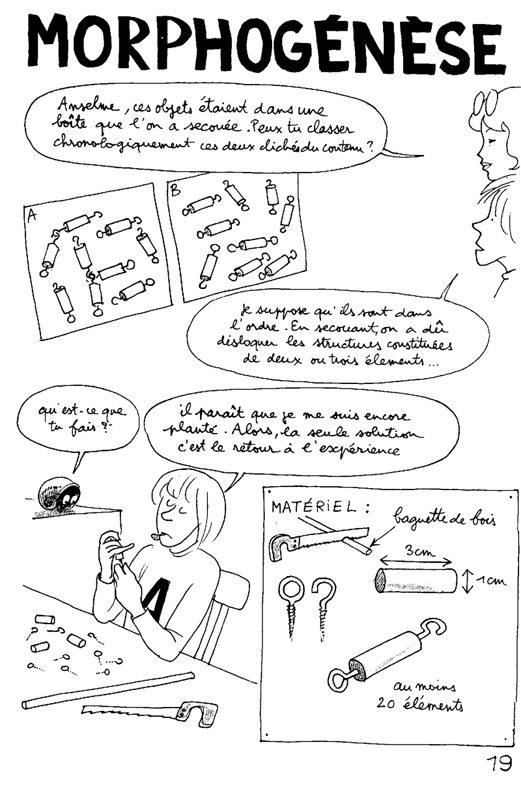
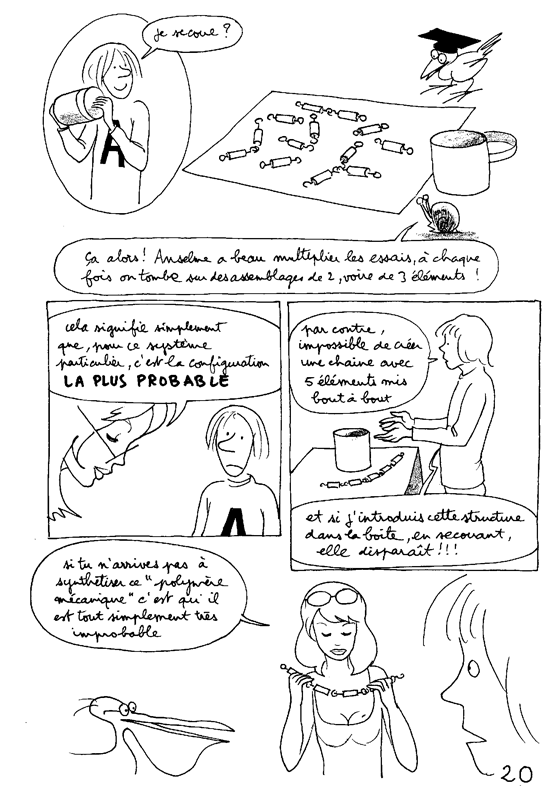
The drawings speak for themselves. These objects are like atoms, which are... hooked. Except for the noble gases, helium, neon, argon, krypton, which don't combine with anything, not even with their own kind (noble gases are the nuclear version of autism). In short, the complex is more probable than the simple. Chance does not generate disorder. Not everything tends toward maximum disorder, but toward the most probable physical states. It sounds like Master Plangloss.
If things exist, it's because they were probable. Therefore, they couldn't not exist.
Elementary, my dear Watson.
There is a sociology of atoms and molecules called physics-chemistry. It takes us quite far, pushing us to explain many things. Thus, when the wind blows, it's not because the god Aeolus is involved, but because sunlight has created a pressure difference between two points on the globe. When you limit yourself to nineteenth-century or early twentieth-century physics, you feel clever. When you try to manage the astronomical observations sent by space telescopes today, you become downright foolish.
I wrote a long time ago that science, like any form of thought, is merely an organized system of beliefs. It seems to be the case in all fields, including the ivory tower of mathematics. In the 1930s, the mathematician and logician Kurt Gödel showed that in any formal system, any linguistic construction, there is at least one undecidable proposition (neither true nor false). Fantastic twist. Thus, we are doomed to say foolish things, to have to settle for fragments of science. You'll find a popularized presentation of Gödel