Chronicle of an Announced Catastrophe
Chronicle of an Announced Catastrophe
April 20, 2005
More and more people are beginning to think that the global situation is deteriorating rather quickly. The only "antidote" to this catastrophic thinking is to imagine that a new balance might emerge.
But what is a geopolitical balance? It is the result of an antagonism, the result of the opposition between two opposing ideological and economic currents. However, there is currently only one ideology in play: the most savage liberalism. The European Constitution, in fact, establishes the principle of free competition as a true dogma, "no one being allowed to hinder it."
Jean Ziegler, in his book "The Empire of Shame" published in April 2005 by Fayard, provides some clarification, although not explicitly. It is indeed surprising that no economist or political scientist has really detected this deep cause of global imbalance. He explains the sudden intensification of the plundering of the South by the North, which Ziegler exposes in a harrowing way over the 320 pages of his book. I recall that this Swiss national is a UN rapporteur on food issues. I had difficulty finishing his book because the presentation is so demoralizing. One must really hold on to each chapter, as it is an uninterrupted account of organized crimes, environmental and social destruction, and human lives, famine being used as a weapon to bring entire peoples to their knees, to exert political pressure, to impose the looting of local resources and raw materials. I will summarize the book on the page devoted to it. But let's focus on page 163, titled "The Green Famine." On page 169 we read:
Coffee is the main export source for Ethiopians.
Since 2000, we learn, the price of coffee at export has collapsed from $3 per kilo to 86 cents, that is, it has been divided by a factor of 3.5.
Why, "such a collapse"? Simply because, in relation to the market economy, this export price had been maintained at an "abnormally high" value. Liberalism functions on the principle of free competition, on the mode: I buy as cheaply as possible (or more precisely "we buy as cheaply as possible," with a strategy of coordination among trusts). For over thirty years, the coffee market had been regulated by the ICA, the International Coffee Agreement. The ICA had modeled its functioning on that of OPEC, the organization of oil-exporting countries, with fixed quotas and prices: a minimum of $1.20 to $1.40 per kilo, at export.
But in 1989, the ICA disappeared, giving free rein to the new moral law of the globalized economy: the law of the market.
Why this date? The answer is extremely simple: it coincides with the collapse of the Soviet Union. As Ziegler notes, page 173: "As long as the bipolarity of the planetary society lasted, as long as two politically and economically antinomic systems were confronting each other, it was essential to prevent millions of farmers from succumbing to the temptation of voting or joining communism. The same obsession, the same constant threat, regarding countries like Brazil, Colombia, El Salvador, or Rwanda, of suddenly turning toward the "Soviet bloc.""
In Ethiopia, 95% of coffee is produced by family-owned farms (for the entire world, 70% of production comes from properties of less than ten hectares).
Since 1989, the Soviet Empire has collapsed, it has disintegrated. Concerned with their own survival, the Russians can no longer exert any pressure when countries, in the world, are being extorted. If a country hesitates, for example, it refuses to pay its debt, all means of retaliation are acceptable. It is an embargo, the seizure of ships operating exports, at the request of local banks that no longer receive the interest on the credits they have granted. It is the coordinated deprivation of essential manufactured products. In the face of this, the Soviet Union can no longer exert a counterbalance. The response in terms of blackmail is immediate and effective. I add that it was with Ziegler's book that I, an Westerner, discovered the meaning of the word "debt of the Third World." Let's be frank. What does this word evoke for us? The idea that the Third World countries, poorly managed, have benefited from "aid" in the form of loans, which we imagine "at zero percent." Disguised gifts as loans. Well, no. These are indeed loans, granted by both public and private lenders, which require the recovery, in the end, of interest and capital. However, Third World countries are unable to repay anything. Every year, a significant part of their gross national product is dedicated not to getting out of this debt, which is a real octopus, but to paying a part of the interest owed. We find at the level of countries the phenomenon of over-indebtedness that affects individuals in our "developed countries." And you know very well what happens when someone cannot pay "what they owe." The interest due is capitalized. A "debt restructuring" is introduced. The individual begins to pay "interest on the interest." Many countries, which Ziegler cites, are in this situation, including Brazil.
What do you do when a person no longer has the means to pay "their debts"? You seize their assets and sell them at auction. You throw them out of their apartment, their house, their land. In countries in permanent bankruptcy, their natural resources are auctioned, they are looted legally, with the blessing of the International Monetary Fund.
- He can't pay? Then I'll take it!
That's all. International law protects the lender, who has often loaned at rates that can be called usurious. It is profitable "to help the Third World countries," to lend to them. Not because these people can repay the money they borrow or pay hefty interest, but because after having deliberately driven them into bankruptcy, one can legally plunder them. One organizes scarcity, famine. One says, "Instead of feeding a man with a fish, teach him to fish." One does the opposite. Countries, in an attempt to escape an overwhelming debt, abandon food crops to produce ... more profitable cotton, or anything else. More profitable, yes: for the external and internal looters, their accomplices. One cuts down entire forests, the lungs of the planet.
The only "point of balance" is in terms of supply and demand. The only law is that of the market.
Until 1989, the export price of coffee had been "overvalued" if one considers that the laws of the market are the only ones, in liberalism, that can set these prices. However, Ethiopian coffee is imported by five multinationals: Nestlé, Procter & Gamble, Sara Lee, Tchibo, and Kraft (owned by Philip Morris). Maxwell belongs to Kraft, Nescafé and Nespresso to Nestlé (Swiss company).
In 2000, the year when export prices began to collapse, Sara Lee's profits increased by 17%, Nestlé's by 26%, and Tchibo's by ... 47%.
What do these companies do? They have conspired to lower coffee prices. Coffee cultivation requires significant expertise. The beans are harvested by hand, one by one. Ethiopians are forced to import their food. In many family businesses, the cost of production has exceeded the revenue. These people have therefore been plunged into poverty.
On the distribution side, at the other end of the chain, the coffee market is doing well. Better and better, one could say. Companies like Nestlé or Maxwell have diversified their products. Pre-packaged Cappuccinos are a big success.
Watch the TV commercials.
- We have chosen the best Arabica for you
Remember that South American music, so catchy and cheerful, accompanied by images of the Western buyer shaking hands with the local producer. "Ah, what coffee!" But the reality is completely different: At the other end of the chain, the producers ... are sinking into poverty. In the logic of the market economy, with the maximization of profit, raw materials must be bought at the lowest possible price. This is the law of supply and demand. For thirty years, the threat of communism has distorted this game of free competition (one should rather say of free extortion). Today, coffee producers can no longer exert any pressure on prices.
Ziegler then questions Hans Joehr, director of the agriculture division at Nestlé (whom the author calls the "octopus of Vevey"). He writes:
- Better than most people, he knows the violence that falls on coffee growers. Joehr, responsible for purchases at Nestlé, feels some regret. But he attributes it "to the global forces of the market" and adds: "men have no part in it." He sympathizes with the victims and wants to help them. His proposal is clear: of the 25 million coffee-producing families in the world today, at least ten million must accept to "disappear." It is about "cleaning up the market."
Ah, the market, great misfortune! ...
For a man like Joehr, Ethiopians must simply "retrain." In fact, they have no choice but to ... starve to death, which they do diligently.
Thus, the Soviet Empire, with all its flaws (regardless of the judgment one may have of this system), represented a protection for poor countries against predators, champions of free competition (of the "free predation"). Its collapse has left the countries of the South at the mercy of those Ziegler calls the "cosmocrats" of the planet. The movement is accelerating in an astonishing way.
I no longer remember who, Marx or Engels, wrote the book "On the Self-Destruction of Capitalism." This title would now make people smile. I read today that Marx dedicated his book to Darwin. In the end, what did Marx say? That terrestrial societies were like herds exploited by predators, which they could easily do without, as a regulatory system, which could be replaced by a planned economy. The formula failed everywhere, including in Mao's China. Never before have predators been so powerful and the global capitalism so flourishing.
Chinese Parenthesis
Meanwhile, what is extraordinary is that the Chinese are following suit. No hope for poor countries to find help from this side. The plan, devised by Deng Xiaoping, the successor of Mao, is brilliant. Use the coercive apparatus of the party, with its cadres, its army, its police and its neighborhood committees (now equipped in cities with numerous surveillance cameras). An apparatus that maintains social stability through iron discipline (18,000 capital executions in the country in 2004). Thanks to this, give confidence to foreign investors by offering the lowest wages in the world. Democracy: zero. Unions: absent. Chinese workers live in dormitories, in groups of twelve. Their private living space is limited to the surface of their bed. Outside, showers, a canteen. 10 to 12 hours of work per day. Salary: 60 euros per month, which allows them to send money to their family, still in the countryside. Social coverage: zero. Severance pay: zero. These are workers who are housed and fed, that's it. Consumption: reserved for the upper echelons. How to compete with such a workforce? Chinese wages are 3 to 5 times lower than those ... of the Mexicans!
A Chinese friend told me, "You have to place this situation in its context. In 1960, a famine in China caused 30 million deaths. Eighty percent of the Chinese are farmers, and a large part of them are poor. For them, a salary of 60 euros per month, a bed, 11 hours of work per day, and the possibility of sending some money to the family, but it's ... unthinkable." Ten years ago, China still lived with the fear of famine sewn into its belly. The vast majority of the Chinese people do not aspire to live well, but simply "less badly." But this situation, which makes them accept working conditions that represent a total loss of a century of social achievements for a Westerner, makes this mass into an army of ants, a marching army, devouring jobs. How can one be surprised that Chinese textile imports increased by 540% in France in 2005, while Raffarin triumphantly announces that France has sold six Airbus 380 to the Middle Kingdom.
The French economy is saved! I sold them six Airbus 380
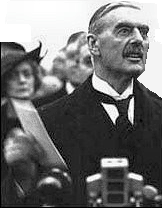
This brilliant economist knows that these same Chinese learn so quickly that in ten years they will ... sell us airplanes! For those who doubt China's entry into the high-tech market, remember that it has become the third country to send a man into space, which represents an extremely powerful and organized technical and scientific background. China, which had never been known as a shipbuilder, has taken over the market for the construction of the giant ship that transports the fuselage, wings, and tail of the Airbus 380 manufactured in Ireland (lower labor costs) to Toulouse. The (young) Chinese engineers worked under the direction of French people. They learn everything, eagerly. One hears:
- Europeans will have to adapt and retreat into specific niches....
But which ones? China is a universe of its own. It can learn everything, produce everything, including "French wine." Look at French viticulture, harmed by California champagne and soon by "offshore" crus, perfectly competitive.
China has now taken its place in the top group for television production, soon for mobile phones (it is ongoing). Believe me, Taiwan, Japan, is child's play compared to what is preparing beyond the Great Wall. It would be wrong to see these people as unskilled labor, suitable only for sewing bags, pants, or assembling toys (number one in the world for a long time). With capital, advanced technological tools, and a large appetite for knowledge, China can produce ... absolutely anything. It has learned the "laws of the market." These people, unlike the Russians, the messy Slavs, quick to be corrupted, are legendary merchants.
Regarding birth rate: the one-child policy remains the general rule. Distribution of condoms in abundance, by neighborhood committees.
Meanwhile, the Chinese power is supported by privileged classes. It is no longer about apparatchiks, political parasites like in the Soviet Union, but about productive, creative individuals, carefully selected. Social promotion is therefore possible. China is betting on its winning youth. The fossilized gerontocracy of Mao is gone. The production chief can benefit from an apartment and a company car. Promotion is based on results. The Chinese have opted for a bonus for results obtained. In research and development companies, ten percent of engineers are fired and sent back to nature, without compensation, every year. You have to be good or you are out. And this applies all the way to the highest level. Being rich, extremely rich, is not a stigma in modern China, if you are efficient, if you develop a multinational.
The army of ants is on the move
The Chinese have been inspired by the American strike force, in addition to aligning salaries at the lowest level, imposed by the simple prohibition of any trade union activity. Demands have been crushed (1000 deaths in 1989 during the demonstrations in Tiananmen Square). Deng: "Pluralism would weaken China." A one-party dictatorship, but a paradox: this dictatorship is that of ... efficiency. Capitalists, the new rich, are welcome at the ... central committee. China is equipping itself with "red billionaires." If poverty still exists in remote areas, crime is crushed by the death penalty (for simple drug possession, for example).
Mao, the Great Helmsman, died in 76. Deng then gradually de-collectivized the countryside, in a few years, and it proved ... productive. Farewell to the Little Red Book, a collection of boring and absurd ideas conceived by a "literary." Defossilization of China. The rules of the market economy are applied, full throttle. Pursuit of maximum profit. Privatization of public services (...). Class struggle? It's over. In 5 years, Deng Xiaoping succeeded in his bet at the price of an unprecedented ideological sleight of hand. He died in 1997, but his successors continue his work. The secret of China's success is its political stability, linked to a strict discipline imposed by the party. This is what attracts foreign capital and leads to our "offshorings." The Westerners are in the process of providing the Chinese with the means (among other things through technology transfers) to crush them in a few decades. France has even broken the arms embargo. Alliot-Marie is delighted. The market is "juicy." "I fill my pockets and after me, the Deluge."
The Russians have been extremely inventive in space technology and their rockets remain the most reliable in the world, due to their proven ruggedness. But they are geniuses of improvisation, not merchants. They have never had the reputation. The Chinese, on the other hand, have. Moreover, the Soviet Empire was composed of a patchwork of ethnicities that were eager to secede. This is not the case with China. The Chinese are also extremely creative. In the history of science, they have preceded us in many fields.
China is Japan, plus imagination and creativity (which are completely lacking in the Japanese, who have to import ideas) ---
**End of this Chinese parenthesis. **
With such a context, poor countries are completely left behind, abandoned to themselves, have no door to knock on, except to that of radical Islam, for some of them. It is simply ... this or nothing. It is a medieval system, a "framework" against ... nothing.
What is the conclusion of Ziegler's book after he has drawn a very depressing assessment, speaking of a refeudalization of the world, showing that indebted countries can only sink deeper every day? He dreams of ... a new revolution in the style of 1789, straight up. He cites Babeuf on page after page.
One remembers the words of Louis XVI:
- What is happening? Is it a revolt? - No, sire, it's a revolution.
A revolution is a revolt with something behind it, an ideology, a plan, a model of society. Today, between the liberal model that "allows anything" and the return to an Islamic Middle Ages, nothing. Ziegler did not experience May 68, this mountain that gave birth to a mouse. It has still benefited some. Cohn Bendit became a European Green deputy. Many of the leaders of these hundreds of thousands of men who marched down the Champs Elysées, forcing de Gaulle to flee to Germany by helicopter, fearing to be kidnapped by the masses, eventually found good positions.
May 68 brought nothing, nothing good. The self-management of companies was nonsense. Burning its "mandarins" on its pyres, the French university collapsed, passing under the control of mediocre people organized in "committees." The baronies gave way to mafias.
Ziegler writes on page 321:
- The war for global social justice is coming. What will the victories or defeats be made of? What will be the outcome of this final battle? [...] No one today knows the answers. However, one conviction inhabits me. All these future battles will echo this call of Gracchus Babeuf, the leader of the Egaux conspiracy, carried bloodied to the scaffold on May 27, 1791: "Let the battle begin on the famous chapter of equality and property! Let the people overthrow all barbaric institutions!"
Ziegler therefore wants the people to take to the streets. Why? Where to? Without an "ideological platform"? It recalls the phrases of the bearded 68ers:
- Stop everything and think.
What Ziegler suggests is not a revolution, it is called a jacquerie and one knows how it ends. The author seems to have no idea of the means of coercion that capitalist powers (they are all, now!) are beginning to equip themselves with. Even our project for a European constitution shows, on this point, surprisingly foresight, which already provides, not for disarmament, but for the strengthening of our military arsenal. Moreover, one can cite:
Article II-62, which says that:
-
Everyone has the right to life.
-
No one can be condemned to the death penalty, nor executed.
but in the annexes, see page C310-425 and 426, article 2, paragraph 2, of the ECHR:
"Death is not considered to be inflicted in violation of this article in cases where it results from the use of force rendered absolutely necessary:
c) to suppress, in accordance with the law, a riot or an insurrection.
Source : http://europa.eu.int/eur-lex/lex/LexUriServ/site/fr/oj/2004/c_310/c_31020041216fr04200464.pdf
To the discerning reader...
God is dead, Marx is dead, and I myself do not feel very well...... ---
April 26, 2005 : Many readers are outraged by such an outburst of pessimism. But I don't know what else to tell them. No matter how we approach the problem, it seems to have no solution. The planet is beginning to resemble a jungle, ruled by the law of the strongest. "Currents" are forming. I read that if countries were to charge all oil transactions in euros, the dollar could fall by half. A currency is only fiduciary. It behaves like a stock on the stock market, with the difference that for global trade to function, it needs "a reference currency" that offers a certain guarantee of stability. This is simply provided by the ... demand. For decades, the dollar has been imposed as a reference currency, simply because there was no other candidate. But suddenly a challenger has appeared: the euro, whose stability is linked to the formidable inertia resulting from the fusion of all European economies. The choice of the euro can also coincide with a political act: to weaken the dollar. The problem is that war is a classic response to monetary and economic problems.
Some think that the United States are preparing to launch a new military operation against Iran, accused in turn of preparing "mass destruction weapons." A Frenchman living in England told me that the British media, which are close to the American system, seem to be preparing the public by subtly demonizing Iran. Blair, re-elected without the shadow of a problem, would he be asked to send a new expeditionary force into some new war adventure? To be followed.
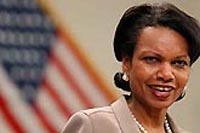
" Candy Rice (in English, Candy means candy and rice). Ex-CEO of the oil company Exxon
But we know that war is a kind of response to the problems posed by a money and economy that is increasingly shaky. The feet of the colossus are made of clay. In the USA, inflation is rampant. The dollar's course is falling. The cost of the "Iraq" operation is growing without the profitable returns coming in (if we except the powerful profits made by the military-industrial lobby, for whom, "the more you break, the more you collect"). The Americans had thought of everything except the fact that it is very easy to blow up a pipeline. Hostage-taking (which now hits the Australian partner) hinders "Iraq's entry into the market economy," despite the systematic privatization of all its public services (...).
China will develop at a pace that no one currently can imagine. However, it is useful to look back at the past, remembering how Japan suddenly industrialized by jumping into the modern world. Like China, Japan was a country that had to import practically all its raw materials and energy resources. Before Japan launched the war against the United States, what had happened? "They" had tried to limit its expansion with an embargo. The response was war, almost immediate.
Some say that the United States, in trying to get hold of the oil resources of many parts of the world, are trying to control the rise of the Chinese dragon.
The problem is that there is no counter-ideology, except the refuge in medieval fundamentalisms. I heard on TV that the new Pope once said, "We have defeated Marxism. We now have to deal with Buddhism." Read the interview he gave to Express in 1997.
A side note. I have decided to invade the Chinese market on my own. If I find little help, it will be done. Indeed, there is a product against which the market economy is defenseless. A product that defies all competition. Consider:
- No problem with raw materials or energy. - No problems with labor. No social charges. - No risk of unsold goods, no accounting problems, no tax problems, no import duties. - A guarantee of being able to respond instantly to any demand.
But what is this magical product, which has all the virtues?
It is the free product, in "soft" form. It is the book in the form of a pdf, like all those currently available, in foreign languages, downloadable for free on my website. It is the book, the music, any form of art or speech. It is knowledge, culture. Subsidiarily, the product "Lanturlu" is amusing because it is uncopyable. All those who have tried to mix science and comics have only produced second-rate albums. The Russians had loved "What do Robots Dream About," translated by my friend Vladimir Golubev, who wrote to me twenty years ago:
- Dear Jean-Pierre, our book is a bestseller. The 200,000 copies were sold in two months.
Yesterday, a Turkish researcher sent me the translation of my comic "If We Could Fly?" ( [pdf *Find translators capable of translating my scientific comic books into Chinese. And we will invade the country. *
There is not a lot of text in my comic books. But it is highly likely that we will have difficulty finding translators who are willing to translate these albums into Chinese. If we pay them, it could be different. So I am launching the question to the public. Could you find people capable of translating these albums into proper Chinese? And in that case, how much would they ask? With a proper quotation (the cost of translating a comic book into English is about 150 euros), we could look for a sponsor or sponsors, on the theme: "Sponsor the translation of a scientific comic book into Chinese to make it a free product." On page 2 of the pdf file, we could list the names and photos of the translator and the sponsors who funded this translation. A "virtual" way to visit China.
All of this is just a joke, a "cultural last stand." I saw these days our foolish journalists interviewing the minister of agriculture, facing the problem of the bombings carried out by the "farmer extremists." There was an interview with farmers in hoods who said, with a strong regional accent:
*- What else can we do to be heard, to earn a few cents? Should we go on strike? Should we "occupy the means of production" by sitting in the middle of our fields? But everyone doesn't care! *
Then came a documentary about the departure of new "pioneer" farmers to Romanian, Ukrainian, or other eldorados. There, with euros, one can buy a thousand hectares at once, said one of them.
*- What do you want, said a Strasbourg farmer recently settled there. In France I could no longer expand (...). I could no longer find land to buy (...). Here the soil is incredibly fertile, you can buy or rent it for a song, it's one of the richest lands in the world. *
There is a difference between these capitalist farmers, who are looking for where to invest their "disposables" and these poor families of over-indebted farmers.
The man and his small team were very well received by local municipal authorities, providing a docile and unlimited workforce... for 60 euros a month. In the next part of the program, José Bovet was interviewed, who had "risen in rank", established himself as a leader of an international peasant confederation, advocating for the right of peasants to impose on their land the right to grow subsistence crops, feeding the population and not enriching a handful of exporters. A praiseworthy endeavor. But not a word about the French issue, which seems to have suddenly lost interest for our mustachioed one. Yet it would have been simple to comment on the matter in a few well-chosen sentences:
- What are we seeing develop today in these future granaries? A capitalist agriculture alongside the emergence of a land proletariat. French agriculture is simply doomed. If you arrive in Romania saying "I bring capital and my know-how," they will answer: "Go ahead, we provide you with an abundant agricultural proletariat with ridiculous wage costs and no social charges. You will make a fortune in a few years and it will employ some of our guys." But imagine a French peasant family arriving there saying "we just want to buy some land and try to survive here." They would answer "you're not in the game, old chap. Take the train or plane as soon as possible. Here, if you don't have pockets full of euros to develop large-scale agriculture, you're not welcome."
Bovet remained silent courageously. I'm beginning to wonder if he's not just... ambitious and if he won't one day become the Koutcher of the agricultural world. "Agriculture without Borders" could be a good stepping stone.
I reread my lines and find only pessimism. We have gathered. We have searched for solutions and we find none, except for formulas that don't break free from the ideas of 68th generation mini-communities. There already are such movements in France, trying to live outside our "consumer society." But... everyone couldn't care less.
Ziegler calls for "the insurrection of consciences." But how to do it when you don't have any ideology, any political and economic system to replace it? You take the Bastille (or, symbolically, Chirac's castle), you occupy the Winter Palace. And after that, what do you do? Do you "give all power to the soviets"? Do you move to self-management?
At least more and more people are losing confidence in politicians in general, "from all sides" (but are there still two sides, between right-wing liberalism and left-wing liberalism?). They lose confidence in their journalists, who at best have no brains and at worst deliberately lie, actively or by omission. They lose confidence in their technoscience, which prepares them for troubling tomorrows. Probably, one day, in the long term, it will be noticed that there is a significant increase in brain cancers, linked to the intensive use, from the youngest age, of mobile phones and the multiplication of microwave ovens, whose emission levels (radar) far exceed the acceptable threshold for air traffic controllers.
Isn't that a beautiful science?
The increase in cancers is very likely related to the change in our diet, which neglects the anti-cancer substances that were naturally present in the food of the past, among other things in sweet fruits, you know, those that spoil so easily. A phenomenon that will only accelerate with the expansion of GMOs, the consumption of "fresh products" sterilized by irradiation. People lose confidence in their intellectuals, including those from the "caviar left." They lose confidence in scientists who would be better off devoting their efforts to developing renewable energy sources rather than gathering around new "toys" like ITER, which will never work, or "Megajoule," which will also never work but "will create jobs in the region," as in Cadarache. They build powerful telescopes to examine the cosmos at billions of light-years distance, bringing back data they don't know how to interpret. But their adaptive optics mirrors are nothing more than spin-offs from the development of observation satellites, or even directed energy systems. The Hubble satellite has never been anything more than the civilian version of military observation stations, long ultra-secret, capable of reading the headlines of a newspaper from 250 km away.
I had dinner with some Buddhists recently. One of them, who had conscientiously frozen her toes at Darem Salah, reported the latest news from the top of the sky. The predictions were very bleak.
- So, what do your lamas advise? - They advise us to meditate. If the catastrophe is inevitable, at least this activity will ensure us a better reincarnation...
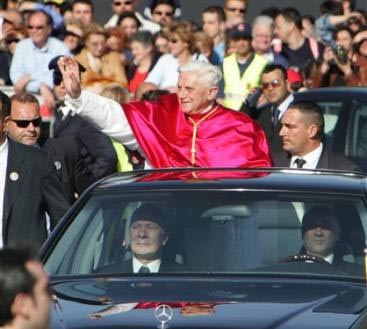
That's one perspective. We have a new pope, the former "Panzer Cardinal." Here he is in his Mercedes, surrounded by his goons. What an image!
[Image: /legacy/Presse/dessins/benoit_XVI.jpg]
If Buddhism is appealing, it's because it appears as a possibility to touch infinity, to reach happiness without having concrete religious obligations. A kind of spiritual auto-eroticism. Someone had indeed predicted, in the 1950s, that the challenge for the Church in the 20th century would not be Marxism, but Buddhism.
Radzinger, March 1997. The complete interview, given to Express
Here is a man of 78 years old, from the Bavarian petite bourgeoisie, who has never held a parish, a sort of "ENA" of faith whose brain is as flexible as reinforced concrete of a bunker. I wonder what link there could be between such a person and Christ, whom he claims to represent. Go read the words of the dreadful anarchist. Strange story. Here is a guy who arrives, from who knows where, and whose timeless sentences crack like whips. He overturns the stalls of merchants of time, insults the Pharisees, who "think they are holy." He receives prostitutes, dines with tax collectors, whom he turns and makes into disciples. He heals the servant of a Roman centurion, declares that he did not come for the healthy but for the sick. Incidentally, he restores sight to the blind, allows a paralytic to walk, drives out the demons that torment the head of a young man, and brings the dead back to life.
Would the afterlife not have a substitute Messiah, regardless of the current he claims to belong to? A Messiah-man or a Messiah-woman, it doesn't matter. It would be welcome. To avoid him knowing the end of a Martin Luther King, it would be better for him to express himself... on television. With some miracles here and there, he would attract huge crowds by simply saying "love one another." We have slogans, displayed at the head of our municipalities. "Three words engraved in stone," sang Souchon: Liberty, Equality, Fraternity. But who would dare to whisper them even now?
Yes, a genuine Messiah would be very welcome these days. A very earthly one. Because the aliens don't care about us, believe me. Nothing to expect from people who have such a huge evolutionary gap with us that they consider us... as simple animals, even though they build, for psycho-social experimentation purposes, extensive dossiers, designed and managed for decades by their artificial intelligence systems, just as we play with bonobos with "informational protocol interfaces." Read "The Year of Contact".
[Image: /legacy/images/couverture_annee_contact_site.jpg]
Scientifically coherent and even fruitful dossiers, referring to a very well-documented planet, but which unfortunately never existed anywhere other than in the memories of an artificial intelligence. Neighbors so close, in space and time, with a technological and scientific gap of thousands of years? You're joking! In a galaxy that is fifteen billion years old, a million years is a fraction of a second. That's what the astrophysicist says. That being said, even if the dossier is a clever fiction, it may contain scientifically usable information, as well as fragments of exotic cultures, possibly belonging to stories of distant planets. The AI takes care of everything, even... telephone communications (we ourselves are not far from that).
Ten million years away from us, on one side, the monkeys, on the other? ... Communication is impossible between monkeys and us. At best, we manipulate them, we deceive them, we "stroke them the right way" before releasing them back into the wild or making them "piss." I think that for our visitors, we are just... animals, nothing more. At best, test subjects. In thirty years everything has gone that way. The pill is bitter, but that's its taste. I know it's difficult for us, who imagine ourselves at the top of the cosmic evolutionary pyramid, to take a step down, to conceive ourselves as... animals for other beings whose feelings, level of consciousness and thoughts will remain forever inaccessible to us. Never will a monkey be able to unravel the mystery of our thoughts.
There remains the study, the manipulation, the setup using decoys, which can be writings, since we know how to read. If the monkeys knew how to read, we would send them letters. Words like sympathy, mercy, brotherhood have no meaning between the experimenter and his test subject, over whom he takes all rights, indifferent to his physical and mental integrity. Sorry to disappoint you.
No, apart from the arrival of a Messiah, I really don't see any solution.
Back to Guide Back to Home Page
Number of consultations since April 20, 2005: