European Constitution
The European Constitution
or the New Order of Things
For weeks, I've been flooded with emails asking me to put something on my site about this subject. People prefer watching a video rather than reading a text. A reader just sent me this one. I think this man points out perfectly real things, like the mention of Europe's commitment to NATO, written in the constitution, among others.
Interview with Jean-Pierre Chevènement (video of 4 megabytes)
In the different texts, different performances, we catch what we can. We are bombarded with information. Realizing the increase in my audience, people send me more and more things and I end up resembling the editor of a newspaper who no longer knows where to look. There are many interesting things in everything I receive and each time I need several hours to organize and structure it all.
Returning to this question of the European Constitution, in the general confusion, some sentences strike us. The inhabitants of Europe are called upon to express their opinion on a lengthy text, which practically no one has read and which will greatly condition our future. What about the "debates" on television? I followed one organized in the previous days between Chevênement and a supporter of the "yes", Michel Barnier, the "playboy" of the right. He kept coming back to his main argument, addressing Chevênement:
*- You have the same position as Le Pen! *
It is not a debate, but an attempt to provoke reactions in the viewer's mind, through images. This one was "voting no is voting for Le Pen, therefore voting for the far right, and so on..."
And that's what television is. With Christine Ockrent fluttering in the background, trying to appear an "intellectual above the parties". An hour later, we were no further ahead. It reminded me of what a journalist from the magazine Actuel once told me:
- On television, it's not what you say that counts, it's what you emit.
I watched the video corresponding to the interview with Chevênement and I retained a sentence:
- If you say yes to the European constitution, you are saying yes to a sort of European government. We will then end up with an "European" way of managing defense and international policy issues, a "global" management of current affairs. Then it will no longer be about taking a "national" position, but aligning with a "common European attitude". Take the example of the war against Iraq. Through Chirac's voice, France clearly declared itself against and refused to send a contingent to join the Americans. It turned out that the facts were on their side. On the other hand, the Spaniards, the Italians and others followed as one man. Chirac expressed a purely French position on this issue. If we had been immersed in a European constitution, such a "national" position would no longer have been possible. We would have had to align with the majority European position.
I am in favor of a strong Europe... the UN must be reformed...
Here, I think Chevênement's statement is strong and very convincing. For this simple reason, as for many others, I think we should refuse to adhere to this project of merging the positions of different countries into a single foreign policy.
The European Constitution also means putting economic motivations above political ones, believing blindly that unrestrained liberalism and submission to the unchangeable rules of free competition will solve all problems. It is a profession of faith, a creed, which suits professional politicians who have never been immersed in the "world of work" but have never done anything else but politics, starting with Chirac, for example. For this man, who lives in a castle whose renovation was paid for by the French taxpayer, whose foundation Georges Pompidou, supposedly humanitarian, offered him the surrounding land, which it had bought with its own money "so that the couple would not be disturbed", who escaped justice thanks to a providential re-election
the world of work, social issues are complete abstractions
Our politicians are, in their majority, people who have never done anything else in their lives. Politics has become for them a job like any other, often profitable in the process. The friend Gaymard, our worthy ex-minister of finance, whose signature appeared on the tax declaration that we all recently filled out, is there to testify. But that is not the worst. I once had lunch with a minister of research and industry who had never done any research or managed any company. I heard him deliver a "standard" speech, full of wind and empty words, while we presented him with extremely concrete projects, with an excellent quality/price ratio (I had designed a CAD software, computer-aided design, which was the first and remained the only one to run on a ... microcomputer with a 48 K central memory. We were in 1983. A system that eliminated hidden parts, played with "object-oriented programming", the management of a "virtual memory", and could be used by a twelve-year-old. I wasted my time with this idiot who thought I was presenting him with a video game, while the goal was to spread this product, free of charge, in technical schools so that young people could become familiar with this new tool). The minister didn't care, being too busy ... listening to himself. I wanted to shout, "but, for heaven's sake, stop reciting what you say on television to the average man. You are here in front of professional computer scientists who are presenting you with concrete, cutting-edge international, useful, operational things that don't require big investments. Let's get out of these empty speeches!". (Same failure, years later, with Edith Cresson.) I heard words from a man completely cut off from reality, scientific, technical and industrial. And this man, well known, is still "active", displays his positions and beliefs, with the same conviction. When you hear him, you have the impression of hearing the Pope talking about sexuality, although he may never have held a woman in his arms.
So we see politicians expressing their support for the "yes" without really knowing why. Anyway, if this choice has negative consequences, they won't suffer from them because they live "outside the world" and its constraints. I believe that this "no" surge among the French also expresses a distrust towards their political class, both right and left, which I fully share.
Moi, je voterai NON
Below, I reproduce two texts in pdf format. The first is the constitution itself, on which you will have to express your opinion. At least, before going to vote, read this text. Who would sign a contract without having read it?
To download the constitution project in pdf:
http://europa.eu.int/constitution/download/print_fr.pdf
The second text is a commentary written by a computer science professor from my region, Etienne Chouard, from Marseille, to which I adhere.
http://etienne.chouard.free.fr/Europe/Constitution_revelateur_du_cancer_de_la_democratie.pdf
See also his website!
http://etienne.chouard.free.fr
In the end, the decision depends only on you. But remember:
***Learn to think for yourself. If you don't, others will do it for you. ***
Chirac completely missed his chance in front of the young people on television. They must have been selected. At one point, the head of state exclaimed, "the young people, for heaven's sake, must face their future with courage!" Remarkable words from a man who has never known the world of work, has never done anything else but politics, had his castle renovated at the expense of the taxpayer, whose surrounding land was given to him by the Pompidou foundation, supposedly humanitarian. A man who owes his re-election only to escaping a trial for abuse of social benefits. Fantastic clowning. But how could one of these kids have come up with all that? The journalistic community would have immediately come to the aid of the head of state by stating "that it was not the subject of the show this evening".
let's stay on topic!
I learned something, which the press has echoed. The young people invited to the set installed at the Elysée, in front of the French President, were of course selected. Among the selection criteria was the fact of not having read the European Constitution project. Those who knew the text were systematically excluded. That makes sense. When French politicians want to anesthetize the French, they say that things have not been explained well enough and they start to "inform" them. In the minds of the organizers of the meeting, the President did not come to debate but to inform, to enlighten the youth.
With Raffarin, who is trying to look like an authoritarian high school principal, they make a pair. But the others, Hollande, Sarkozy, Barnier, are no better. Language games, demagogy, appearance, opportunism, total lack of imagination and even simply of competence. Political emptiness is the word that fits.
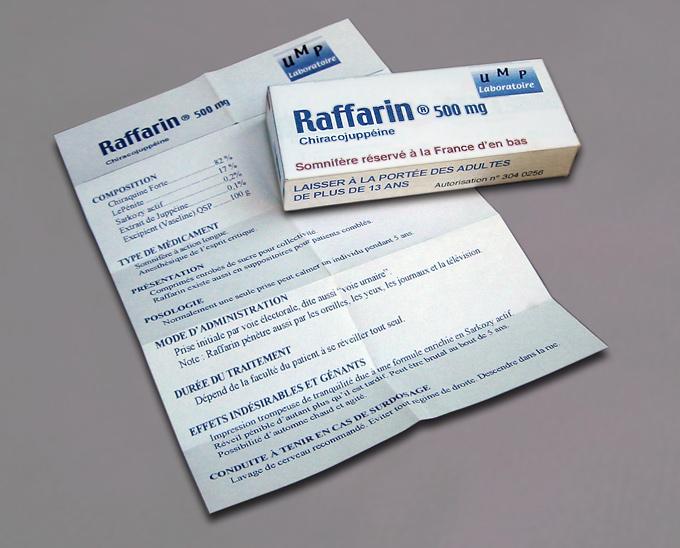
One wants to say to all these people:
*- What is your job, exactly? *
In fact, they are suppository pushers, pill fillers, specialists in general anesthesia. They are only the tip of the iceberg of people determined to get rich quickly. Some, indeed, few, will be able to make a lot of money with this new Europe. The tragedy is that they think all their fellow citizens can imitate them. On his television set, Chirac appeared as a model for the young.
follow my example...
What I saw during this show was young people, even when they have degrees, now doubting their elders and the future they offer. Downcast eyes, silence. Because this Europe is the one of unemployment, corruption, and the widening gap between the rich and the poor, under the pretext of "competitiveness". That's how it is. No doubt "The New Order of Things".
All industrialists, all distribution chains will jump on RFID, chips that allow remote identification of products. This will mean the disappearance of the profession of saleswoman. Tens of thousands will be unemployed while, at night, in empty supermarkets, robots will replace the misplaced items or obediently restock the shelves.
Do you have in mind these empty factories where robots now build cars? Do you know that artificial intelligence is about to emerge? It will kill the remaining jobs, practically in all areas. A way of outsourcing. It will particularly invade the services. We will be presented with it as the ultimate solution to fight against Chinese competition. We will end up in a "market" where an army of intelligent robots, owned by multinational companies, will fight tooth and nail against the Chinese hive while the number of the assisted, the left behind in France and other European countries, will only grow. I believe that no one suspects what is in the making in this regard, which is called "adaptive robotics" and which originates from very advanced studies in the military sector, focused on the behavior of combat robots. An inevitable evolution.
In the past, they tried to make people believe that with the emergence of robotics, we would end up in a "leisure civilization". Liberty, equality, fraternity? Who would dare to claim these republican values, which would now make everyone smile. I see what I see: a "civilization of inequality, growing every day".
The New Order of Things**
After thinking about it, the best way to warn people about what is coming is to make the comic strip I published in ... 1982, twenty-three years ago:
May 10, 2005: A comment from a reader, who prefers to remain anonymous and who is not lacking in relevance:
Hello
A few days ago, Dominique Strauss-Kahn, the champion of the "yes", tried to make the television viewer swallow that if the European constitution was full of restrictive rules in favor of the market economy (strange for a constitution), it was in the name of modernism and efficiency, to fit as closely as possible to the context of the current world, taking into account all aspects, the French constitution being, according to him, quite old-fashioned and too vague.
But strangely, none of the 300 lovers of human rights, freedom and democracy, who wrote the European constitution for 2 and a half years, thought to take into account a key element of our modern society: the media!
Nothing about press freedom, about its ethics, no safeguards to prevent newspapers, radios, TVs from falling one after another into the hands of industrial or financial groups and suffering their pressures, etc.
And also strangely, none of the "no" supporters, who complain about the censorship they are subjected to during this campaign, found anything to say about these omissions.
How distracted they can be, sometimes, all of them
Sincerely
E.B, Nice
Hello
A few days ago, Dominique Strauss-Kahn, the champion of the "yes", tried to make the television viewer swallow that if the European constitution was full of restrictive rules in favor of the market economy (strange for a constitution), it was in the name of modernism and efficiency, to fit as closely as possible to the context of the current world, taking into account all aspects, the French constitution being, according to him, quite old-fashioned and too vague.
But strangely, none of the 300 lovers of human rights, freedom and democracy, who wrote the European constitution for 2 and a half years, thought to take into account a key element of our modern society: the media!
Nothing about press freedom, about its ethics, no safeguards to prevent newspapers, radios, TVs from falling one after another into the hands of industrial or financial groups and suffering their pressures, etc.
And also strangely, none of the "no" supporters, who complain about the censorship they are subjected to during this campaign, found anything to say about these omissions.
How distracted they can be, sometimes, all of them
Sincerely
E.B, Nice
**An editorial by Bernard Casse, published in Yahoo News on May 9, which I reproduce: ** ****
Editorial by Bernard Cassen: "Propaganda"
(Paris) - The media system has turned into a propaganda machine for the "yes" in the referendum.
And for this purpose, all means are good: a caricatural imbalance between the time given to supporters and opponents of the ratification of the "Constitution" (71% and 29% respectively, from January 1st to March 31st); commentators in block for the "yes" on public radio channels (Alexandre Adler, Alain-Gérard Slama and Olivier Duhamel on France Culture; Bernard Guetta, Pierre Le Marc and Jean-Marc Sylvestre on France Inter); positions for the "yes" by Laure Adler, still director of France Culture, and by Jean-Pierre Elkabach, new head of Europe 1; except for L’Humanité and Politis, unanimity for the "yes" among national daily and weekly newspapers; interviews of pure complacency of Lionel Jospin and Jacques Chirac, which are the ridicule of the foreign press; an extreme bias of Christine Ockrent in her weekly program France Europe Express.
This last case is particularly revealing. The "queen Christine" let, without reacting, François Bayrou and Martine Aubry, among other "yes" supporters, utter blatant factual falsehoods about the content of the "Constitution". On the other hand, she constantly harassed and practically prevented Henri Emmanuelli from speaking, who, unlike the others, knew it.
The scandal is so big that nearly 150 journalists and other staff from France 2, France 3 and Radio France have signed a petition against these practices contrary to the most elementary code of ethics. On Monday, May 9 at 6 p.m., the French Media Observatory (OFM), supported by more than a hundred organizations, including three journalists' unions, will celebrate the Day of Europe in its own way by organizing a gathering in Paris, Place de l'Europe precisely, "to demand from the media an honest and pluralistic debate".
Bernard Cassen
Holder of a Jean-Monnet chair in political science, Bernard Cassen is an emeritus professor at the Institute of European Studies of the University of Paris 8. He is also a journalist and general director of "Le Monde diplomatique". Every day, he offers critical analyses on the treaty establishing a Constitution for Europe and on the debate it provokes in France and in the rest of Europe on Yahoo Actualités.
Editorial by Bernard Cassen: "Propaganda"
(Paris) - The media system has turned into a propaganda machine for the "yes" in the referendum.
And for this purpose, all means are good: a caricatural imbalance between the time given to supporters and opponents of the ratification of the "Constitution" (71% and 29% respectively, from January 1st to March 31st); commentators in block for the "yes" on public radio channels (Alexandre Adler, Alain-Gérard Slama and Olivier Duhamel on France Culture; Bernard Guetta, Pierre Le Marc and Jean-Marc Sylvestre on France Inter); positions for the "yes" by Laure Adler, still director of France Culture, and by Jean-Pierre Elkabach, new head of Europe 1; except for L’Humanité and Politis, unanimity for the "yes" among national daily and weekly newspapers; interviews of pure complacency of Lionel Jospin and Jacques Chirac, which are the ridicule of the foreign press; an extreme bias of Christine Ockrent in her weekly program France Europe Express.
This last case is particularly revealing. The "queen Christine" let, without reacting, François Bayrou and Martine Aubry, among other "yes" supporters, utter blatant factual falsehoods about the content of the "Constitution". On the other hand, she constantly harassed and practically prevented Henri Emmanuelli from speaking, who, unlike the others, knew it.
The scandal is so big that nearly 150 journalists and other staff from France 2, France 3 and Radio France have signed a petition against these practices contrary to the most elementary code of ethics. On Monday, May 9 at 6 p.m., the French Media Observatory (OFM), supported by more than a hundred organizations, including three journalists' unions, will celebrate the Day of Europe in its own way by organizing a gathering in Paris, Place de l'Europe precisely, "to demand from the media an honest and pluralistic debate".
Bernard Cassen
Holder of a Jean-Monnet chair in political science, Bernard Cassen is an emeritus professor at the Institute of European Studies of the University of Paris 8. He is also a journalist and general director of "Le Monde diplomatique". Every day, he offers critical analyses on the treaty establishing a Constitution for Europe and on the debate it provokes in France and in the rest of Europe on Yahoo Actualités.
April 13, 2005: the argumentation of René
Arnaud, professor at the Faculty of Sciences in Marseille
Read other arguments by going back to the top of this web page
"European social model"... I don't really understand the meaning of this expression. »
(Frits Bolkestein, France Inter, 6.04.05)
« Personally, I am opposed to any referendum.»
(Frits Bolkestein, Le Figaro, 7.04.05)
« Democracy is not made for people who are afraid. »
(Frits Bolkestein, in Marianne, 16.04.05)
« On the social, there is not much, but what little there is is not to be neglected. »
(Elisabeth Guigou, AFP, 24/06/04)
« Never before has a European treaty assigned to the construction of Europe objectives as close to those of the socialists. »
(Dominique Strauss-Kahn, Le Nouvel Observateur, 11.11.04)
« The adoption of the European Constitution will give rise to an ambitious Europe that will resolutely choose a top-down social harmonization, that is, the rejection of social dumping. »
(Jacques Chirac at the Sorbonne, 26.04.05)
« The effort of rationality required by the adherence to the Constitution remains to be built in public opinion. »
(Pierre Le Marc, France Inter, 8.9.04)
« If there is one person who ardently wishes for the weakening of Europe today, it is the President Bush. »
(Michel Rocard, Libération, 2.7.04) which is to be compared with:
« America has everything to gain
from a partnership with a stronger Europe, allowing the building of a better and safer world. »
(Condoleeza Rice, in Euractiv.com, 9.2.05)
« What should make us wary of the arguments of the no, is their purity. »
(Philippe Vial, Charlie Hebdo, 6/06/05)
« The battle for the "yes" will obviously be the great battle for the freedom of our continent, and I hope it will be the great defeat of all these anti-globalists who have both the naivety and the impudence to declare themselves "anti-liberals", let's say simply enemies of freedom. »
(Alexandre Adler, Le Figaro, 20.10.04)
« Those who, within the Socialist Party, are against the market and against competition, what are they for? Are they for something more authoritarian than today's communist China? »
(Alain Duhamel, RTL, 15.11.04)
« What was not expected, is that the people could refuse what the governments propose. »
(Michel Rocard, International Herald Tribune, 28.7.92)
« Many people still do not understand Europe. And what people do not understand well, they do not vote well. »
(Daniel Bilalian, TV Magazine, 13.6.04)
« It (ndr: the TCE project) is not very complicated but a bit complicated, it is long... at least a third, half of it is useless... we were forced not to have the void... »
(Valery Giscard d'Estaing, France 2, 21.04.05)
« It is an easily readable, clear and quite nicely written text: I say it all the more easily because I wrote it... »
(Valery Giscard d'Estaing, France 2, 21.04.05)
« As we saw during the internal PS referendum, all the media and all the government parties, without forgetting the economic establishment, will campaign for the yes. »
(Éric Zemmour, Le Figaro, 31.12.04)
"We have invested too much in this Constitution to accept its failure."
(Inigo Mendez de Vigo, European deputy, Le Monde, 5.1.05)
« Sometimes, a simple yes is more effective than a complex no and vice versa. »
(Jean-Pierre Raffarin, in Marianne, 9.4.05)
« If France votes no, we will be deprived of the Olympic Games. »
(Jack Lang, RTL, in Marianne, 9.4.05)
« If you vote "no" in the referendum, you expose yourself to the risk of war. »
(Pierre Lellouche, in the show "tout le monde en parle" on france2, 26.04.05)
« The internal debate within the PS on the European Constitution project must be calm and controlled, aware that [its] role is to ensure that the debate takes place in respect of people. »
(François Hollande, in Lommes, on September 11, 2004), but, eight months later:
« The comrades who took a stand for the no will have to account, and their attitude will be politically condemned. »
(François Hollande, Radio J, in Marianne, 23.04.05)
« If the no wins, many people will leave France. We, the French, cannot remain outside of Europe. That would be going backward, it would not be good. I feel European, I am well everywhere in Europe: in Italy, in France, in Spain, in Morocco. »
(Johnny Hallyday, member of the Support Committee for the Yes of Jack Lang, France Info, 03.05.05)
To remember, the sentence of Mr. Rocard:
« What was not expected, is that the people could refuse what the governments propose. »
The "Appeal of the 200" launched by the Copernicus Foundation was known, and it served as a basis for the creation of numerous collectives for the "No" throughout France.
The "Yes" can now also rely on a prestigious Appeal: indeed, it only has 100 signatories, but signatories who "weigh" hundreds of billions of euros. The Institute of Enterprise, a subsidiary of the Medef, has indeed mobilized its prestigious address list to support a text titled "Enterprises and the Constitutional Referendum".
Among these citizens (there are indeed only men) who presumably sign their first petition, we find the names of Lindsay Owen-Jones, CEO of L'Oréal (salary 2004 of 6.6 million euros); Antoine Zacharias, CEO of Vinci (salary 2004 of 3.43 million euros); Thierry Desmarest, CEO of Total (salary 2004 of 2.79 million euros, and whose group made a profit of 10 billion euros last year, five times the amount of the Pentecost Monday work deduction); Jean-François Dehecq, CEO of Sanofi Aventis (salary 2004 of 2.74 million euros); Henri de Castries, CEO of Axa (salary 2004 of 2.54 million euros); Henri Lachman, CEO of Schneider Electric (salary 2004 of 2.16 million euros); Michel Pébereau, chairman of BNP Paribas and of the Institute of Enterprise (salary 2004 of 1.93 million euros). We stop here with these borrowings from the social register.
The "Appeal of the 200" launched by the Copernicus Foundation was known, and it served as a basis for the creation of numerous collectives for the "No" throughout France.
The "Yes" can now also rely on a prestigious Appeal: indeed, it only has 100 signatories, but signatories who "weigh" hundreds of billions of euros. The Institute of Enterprise, a subsidiary of the Medef, has indeed mobilized its prestigious address list to support a text titled "Enterprises and the Constitutional Referendum".
Among these citizens (there are indeed only men) who presumably sign their first petition, we find the names of Lindsay Owen-Jones, CEO of L'Oréal (salary 2004 of 6.6 million euros); Antoine Zacharias, CEO of Vinci (salary 2004 of 3.43 million euros); Thierry Desmarest, CEO of Total (salary 2004 of 2.79 million euros, and whose group made a profit of 10 billion euros last year, five times the amount of the Pentecost Monday work deduction); Jean-François Dehecq, CEO of Sanofi Aventis (salary 2004 of 2.74 million euros); Henri de Castries, CEO of Axa (salary 2004 of 2.54 million euros); Henri Lachman, CEO of Schneider Electric (salary 2004 of 2.16 million euros); Michel Pébereau, chairman of BNP Paribas and of the Institute of Enterprise (salary 2004 of 1.93 million euros). We stop here with these borrowings from the social register.
Before reading this text from a "Yes" perspective, read the following:
http://europa.eu.int/constitution/download/print_fr.pdf
In the European constitutional project:
============================================================================
Article II-62
Right to Life
- Everyone has the right to life.
- No one can be condemned to death or executed.
============================================================================
And much further down (1), the way to apply it:
============================================================================
a) Article 2, paragraph 2, of the ECHR:
"Death is not considered to be inflicted in violation of this article in cases where it results from the use of force made absolutely necessary:
a) to ensure the defense of any person against unlawful violence;
b) to carry out a lawful arrest or to prevent the escape of a person lawfully detained;
c) to suppress, in accordance with the law, a riot or insurrection."
b) Article 2 of Protocol No. 6 attached to the ECHR:
"An State may provide in its legislation the death penalty for acts committed during war or in the imminent danger of war; such a penalty will only be applied in the cases provided for by this legislation and in accordance with its provisions..."
All of this can be found in the complete text you can find at http://europa.eu.int/constitution/print_fr.htm
(1): page 434 of the document
And of course, this "clarification" is not found in the text distributed to citizens to form their opinion. The death penalty does not exist, but may be "reinstated" in an "imminent war" situation, at times when historically the most abuses have been committed.
We close the front door, and reintroduce everything through the window...
Therefore, when we commit an act considered illegal, when we resist an arrest, or when a demonstration is qualified as a riot, it is allowed to shoot. It is, after all, more efficient, waiting for the declaration of a State of Emergency, and being able to assassinate in the proper way...
It is shocking that socialists and unionists have approved this text!
Philippe Looze
Brussels
Belgium
To provoke a bloodbath and establish a state of emergency, and then a dictatorship, it is sufficient, when law enforcement and demonstrators are face to face, to detonate a bomb placed in a car or a trash can, using a simple remote control, killing a dozen police officers to make the others open fire on people who have become "rioters". Personally, I think that the mere presence of these lines in this constitutional project should be enough to say "do over", immediately, that is to say to vote NO to reject such a text. I believe it is beyond doubt that many "Yes" activists, like Cohn Bendit, have simply not read the full text.
I recently heard Jack Lang's plea, contenting himself with saying with a patronizing air: "you will vote for the 'Yes' on this constitutional project, because it is a good constitution". In fact, during the various television debates, I don't even know if one of the participants raised this "minor point", as Le Pen would say. Either people prefer to ignore this text or ... they simply haven't read it, which is even worse!
In the European constitutional project:
============================================================================
Article II-62
Right to Life
- Everyone has the right to life.
- No one can be condemned to death or executed.
============================================================================
And much further down (1), the way to apply it:
============================================================================
a) Article 2, paragraph 2, of the ECHR:
"Death is not considered to be inflicted in violation of this article in cases where it results from the use of force made absolutely necessary:
a) to ensure the defense of any person against unlawful violence;
b) to carry out a lawful arrest or to prevent the escape of a person lawfully detained;
c) to suppress, in accordance with the law, a riot or insurrection."
b) Article 2 of Protocol No. 6 attached to the ECHR:
"An State may provide in its legislation the death penalty for acts committed during war or in the imminent danger of war; such a penalty will only be applied in the cases provided for by this legislation and in accordance with its provisions..."
All of this can be found in the complete text you can find at http://europa.eu.int/constitution/print_fr.htm
(1): page 434 of the document
And of course, this "clarification" is not found in the text distributed to citizens to form their opinion. The death penalty does not exist, but may be "reinstated" in an "imminent war" situation, at times when historically the most abuses have been committed.
We close the front door, and reintroduce everything through the window...
Therefore, when we commit an act considered illegal, when we resist an arrest, or when a demonstration is qualified as a riot, it is allowed to shoot. It is, after all, more efficient, waiting for the declaration of a State of Emergency, and being able to assassinate in the proper way...
It is shocking that socialists and unionists have approved this text!
Philippe Looze
Brussels
Belgium
To provoke a bloodbath and establish a state of emergency, and then a dictatorship, it is sufficient, when law enforcement and demonstrators are face to face, to detonate a bomb placed in a car or a trash can, using a simple remote control, killing a dozen police officers to make the others open fire on people who have become "rioters". Personally, I think that the mere presence of these lines in this constitutional project should be enough to say "do over", immediately, that is to say to vote NO to reject such a text. I believe it is beyond doubt that many "Yes" activists, like Cohn Bendit, have simply not read the full text.
I recently heard Jack Lang's plea, contenting himself with saying with a patronizing air: "you will vote for the 'Yes' on this constitutional project, because it is a good constitution". In fact, during the various television debates, I don't even know if one of the participants raised this "minor point", as Le Pen would say. Either people prefer to ignore this text or ... they simply haven't read it, which is even worse!

** ** --- **** ** ** ** **
May 23, 2005. Testimony from a "Yes" supporter
Fifteen days before the May 29 election, I believe it is my duty as a citizen to contribute some elements drawn from my personal experience to the public debate. I did not have the courage to do so before, I do it now without pleasure.
Initially naturally in favor of the European Constitution project - a "Yes of the heart" - I spent all the time of the campaign inside one of the main "Yes" headquarters until, gradually confronted with the text itself by the need to answer the arguments of the "No", I came to realize that this Constitution project was dangerous for the republican democracy. Informed by the argumentative inconsistencies of the "Yes", it was rather the arguments in favor of the "No" that imposed themselves on me, never heard before, which turned me and led me to resolutely support a "Reasoned No". If they convinced me when I was in favor of the "Yes", perhaps they can serve others.
My name is Thibaud de La Hosseraye, I am 28 years old and have a commercial education (HEC, specialization "Europe") and a philosophical one (D.E.A). On the supposed merits of these degrees (and, perhaps, of a prize from the Academy of Moral and Political Sciences) (1), I was recruited in December 2004 by the Dialogue & Initiative club to voluntarily participate in their work. A think tank of the thought current of Jean-Pierre Raffarin, therefore a true "brain trust" of the Prime Minister, Dialogue & Initiative is structured into Commissions charged with deepening different themes in order to feed the reflection of the parliamentarians who recognize themselves in this political sensitivity (2).
I joined the Europe Commission. But what I had not anticipated is that, instead of a fundamental reflection on the content of European identity, we would soon be fully engaged in the referendum campaign. From January 2005, it was no longer a question of thoughtfully reflecting on the definition of "the best possible Europe", we were actively mobilized to produce arguments in favor of the "Yes".
Being always very favorable to the European construction and not having any reluctance about the idea of equipping it with a Constitution, I willingly adapted, and I began to study this Constitution project closely to produce supporting arguments. This was, after all, consistent: it was because my supposed specialty was argumentation that I was now primarily tasked with writing arguments.
While I was doing my best to fulfill the work entrusted to me, I was disturbed during the campaign, during one of our weekly Monday meetings (3), to hear the most authoritative participant state with the tone of an obvious truth that "as we cannot counter the arguments of the No, we must discredit it, make it outdated" (4) without any protest from the participants. Apart from its deontological questionable character, this strategy seemed to me to be based on a resignation to a theoretical defeat: for my part, it was because I was convinced of the greater relevance of the "Yes" arguments that I accepted to campaign in its favor.
But, from the day I noticed that those who loudly proclaimed their attachment to the Constitution project did not hesitate to recognize the theoretical superiority of the "No" arguments, without drawing any consequences for themselves, I had the right to question their real motivations for supporting their camp. If it was not out of conviction, then for what reason?
No one can say for sure. But, for the political leaders themselves, whose participants in Dialogue & Initiative meetings are only their faithful collaborators (more or less direct), it is enough to note how their feverish commitment to a "Yes" that does not convince them seems at least to support the hypothesis that their spontaneity in choosing their side is limited by their direct interest in this Constitution being ratified: in case of a "No" victory, they would be the first to suffer the consequences, as they would be definitively discredited for renegotiating any new Constitution.
And indeed, if this Constitution, for which both right and left governments are responsible (5), does not pass, the problem is not that it cannot be renegotiated (6), but only that it cannot be done by them (cf. argument 11). Therefore, it becomes imperative, for any professional politician, say, minimally concerned about their future, to use all available means to pass this Constitution, whether or not they are convinced of its benefits.
This is what we are witnessing.
For my part, the consideration of this irrational (7) nature of the support for the Constitution project has led me to a higher intellectual demand: since the arguments of authority that had previously impressed me in favor of the Constitution no longer seemed acceptable, being parasitized by personal calculations, I could no longer rely, to support my "Yes", on arguments properly grounded in reason.
In other words, this revealing remark made aloud in the meeting, combined with my regular contact with cabinet members (during our weekly meetings), gave me a brief but sufficient knowledge of the context that led me to a more careful, more literal reading of the text itself. For my work on the arguments, they did not ask for anything else, and then, had I not been recruited also for the independence of mind that allows for an authentic intellectual work?
But indeed, going back to the text, just the text, I could only be intrigued by its disparate nature, mixing curiously institutional provisions and economic policy prescriptions that have no business being in a Constitution. Why on earth have the constitutional message been blurred with economic prescriptions belonging to another legal order, that of a framework law? And what conclusion to draw, except that this Constitution clearly pursues other objectives than strictly constitutional ones?
It is through such a reasoning, as scrupulously impartial and documented as possible, that I gradually realized something that shocked the democrat in me, the hidden function of the Constitution project: to serve as an exclusive and definitive accreditation machine for a determined political ideology, that of liberalism. It seems as if the authors of this Constitution, from both the right and the left, sought to take advantage of a necessary reform of European institutions - that no one disputes in an enlarged Europe of 25 members - to quietly constitutionalize the economic policy they were unanimously in favor of.
It is unnecessary to say that I am not therefore passing from the social liberalism (with a humanist vocation) that characterizes the Raffarin current to socialism, even liberal, of a Cohn-Bendit or a DSK. For me, liberalism is quite defensible, at least in the medium term, as an economic policy orientation that is salutary in a given economic context, but only as long as it is not claimed to be the absolute principle guiding all other economic orientations (8). I believe that the whole strength of Gaullism resided precisely in this capacity for theoretical openness, eminently democratic and pragmatic, allowing to combine, according to the circumstances and the areas, even the extremes of capitalism and planning.
What is unacceptable in the Constitution project is that liberalism is not only present as a policy among others, but as the sole normative principle of a process that declares itself irreversible and explicitly subordinates all declared objectives, including social ones (9). And, even more unacceptable, all precautions are taken to conceal it from an honest reading (10).
It is therefore the realization that this Constitution had the function of being a constitutional smoke screen for a determined ideology that appeared to me as a serious danger for democracy, and that converted my "Yes of the heart" into a "Reasoned No". Although liberal references and constraints run through all its parts (I, II, III, and IV), what is primarily to be constitutionalized in this Constitution is part III, which is a reprise of previous treaties and thus elevates their content to the level of Constitution.
I explain:
The official objective of this Constitution is to provide the European Union with the institutional changes that will allow it to function with 25 members. But very quickly, it becomes clear that this objective is surpassed, and serves as a pretext to pass something much more important (11). Indeed, the Constitution devotes 60 articles to institutional matters and the rest - if we exclude the long and inefficient "Charter of Fundamental Rights" (54 articles) - to the definition of the Union's policies, that is 325 articles out of a total of 448! This shows how much this Constitution describes less institutions than policies, less a container than contents. The unofficial, real objective is to finally consolidate in a single reference text more than 10 years of European drift towards a tendentious, exclusively liberal economic model, and in that sense, highly ideological by its claim to exclude any real possibility of alternative.
Therefore, we are actually being asked much more than our opinion on simple institutional changes: we are being asked whether or not we want to constitutionalize this text that, in addition to institutional provisions, includes exclusive liberal economic prescriptions.
Therefore, it does not seem too much to speak of democratic manipulation, inasmuch as a subterfuge (12) (the promotion of institutional changes, dressed in a reassuring social and humanist rhetoric) is used knowingly to finally ratify, without appearing to do so, what is clearly a very suspect economic doctrine in the eyes of the French public (due precisely to the French people's continued attachment to the social and republican ideal inherited from the 1789 Revolution and defined in the program of the Resistance launched by General de Gaulle as early as 1945). It is precisely because of its notoriety of being incompatible with the specificity of the French social project that the right and left European leaders, anticipating the French people's resistance to sanctifying the liberal economic doctrine if it were clearly requested, found it clever to entrust Valéry Giscard d'Estaing, a keen observer of French realities and a skilled tactician, with the task of drafting a Constitution that skillfully slips what could be contested among uncontested institutional amendments (13). It is nothing less than an attempt to force the hand of the peoples, and first of all of that one whose social priority is probably the most demanding.
In conclusion, everything indicates that this Constitution was written with the very specific purpose of involving the popular will - and especially the French - in the constitutionalization of a certain economic doctrine, excluding all others, even though the very nature of a democratic Constitution, or even a genuinely liberal one, is to allow the sovereign people to choose between different economic theories. If, after the adoption of this Constitution, the people no longer have a choice but between liberalism and liberalism - whether or not one is in favor of it, that is not the question - where is the freedom?
Therefore, the responsibility of the French people in the vote of May 29 is as follows: to endorse or not, by their vote, developments that exclude any possibility of going back (14), and therefore any possibility of making other choices in economic matters in the future. Do we want, yes or no, to definitively tie our neck to an economic doctrine, whatever its future deviations or failures?
It is the magnitude of this danger that I will now try to show, through the presentation of 15 arguments, as far as I know, unprecedented, in favor of the "No". By my role at Dialogue & Initiative, I have some familiarity with the arguments of the "No", but the following points, it seems to me, have never been raised, despite their importance, in my opinion, decisive. What is the reason that they are still unprecedented? I can't explain it. Perhaps it was first necessary to have the distance of a long-standing position in favor of the "Yes" to allow their emergence, then the numerous debates that have clarified their contours.
OUTLINE OF THE ARGUMENTATION
The 19 arguments in this list can be grouped according to 6 successive themes, each including 4 arguments, the last of which is also the first of the next group: this is a presentation that aims to highlight the organic cohesion of the themes addressed by combining as much as possible the analytical order (of the arguments) and the synthetic order (of the themes), in a continuous progression:
1- On a supposed incompatibility of the "No" within the "No", and the resulting impossibility of extracting a univocal meaning for an alternative project: arguments 1-2-3-4.
2- On the reversal of the objection (previously refuted) by highlighting the inconsistency of the "Yes", particularly that of the left "Yes": arguments 4-5-6-7.
3- On the attempt at a coup of retroactive legitimization of previous treaties, with only the alternative of ratifying them or... keeping them!: arguments 7-8-9-10
4- On the illegitimacy of the self-negation of national power, even in the name of a supranational power that this Constitution, in any case, prohibits: arguments 10-11-12-13
5- On the initially anti-European character of this Constitution, from which the only finality that can be deduced is:
arguments 13,14,15,16.
6- On the clarification, from this highlighting, of the true meaning of the theoretical inconsistency of the left "Yes", in a strategic perspective: arguments 16, 17, 18, 19.
The arguments articulating the themes will be "colored" in red.
SUMMARY OF THE ARGUMENTS
France is recognized, distinguishable in the world not only for the ideals of freedom, equality and fraternity from 1789, but also for the specificity of the social project, from the Resistance, which follows. On this basis:
. Argument 1 shows that a rejection by France of the Constitution project would have a particular meaning: it would mean the demand for more social in the European project. Hence its highly positive, constructive value.
. Argument 2 notes that between supporters of the "Yes" and those of the "No", there is agreement on the subject of disagreement: all recognize that it is the liberal content of part III of the Constitution project that is problematic.
. Argument 3 shows that the meaning of the sovereignist "No" is also anti-liberal.
. Argument 4 notes this homogeneity of the "No" and, by contrast, the fundamental difference between the right "Yes" and the left "Yes": one accepts the form of liberalism established by the Constitution, the other claims to be able to correct it.
. Argument 5 shows that, because of the social meaning of a French "No", the left takes a major strategic risk by supporting the "Yes": that of leaving the initiative of the "No" to a country giving it a lesser social meaning.
. Argument 6 shows that the previous argument is never invoked precisely because a more liberal Constitution seems, even to the left, difficult to achieve.
. Argument 7 shows that, because of its explicit subordination to national legislation, the Charter of Fundamental Rights has no normative value: it is not legally binding for the member states.
. Argument 8 notes that since it is the liberal content of part III of the Constitution that is most debated and appears as the decisive point on which voters will express themselves, it would be a particularly flagrant denial of democracy to apply it regardless of the election outcome, disregarding the expression of the people's will.
. Argument 9 shows that voters are presented with a fait accompli: the excessive liberalization of the European economy. By explaining that nothing can be done against it, even though we are asked to vote for it, we are actually asked to make a fact into law.
. Arguments 10 and 11 show that the leaders who today claim that the Constitution cannot be renegotiated discredit themselves in advance for any possible renegotiation tomorrow. In this way, the vote of May 29 is also a national political issue, on the choice of our leaders for tomorrow.
. Argument 12 notes how the denunciation of a "French-French" debate on the Constitution reveals a conception of Europe that negates national identities.
. Argument 13 shows that the exclusively liberal content of the Constitution project leads to the dilution of Europe, without distinguishing the free trade governing relations between its member states from that promoted elsewhere by globalization (15).
. Argument 14 shows that the definitive commitment to NATO marks the death sentence of the European project.
. Argument 15 shows that the benefits of Europe praised by the supporters of the "Yes" argue against the rejection of this Constitution.
. Argument 16 shows in what sense one is led to say that this Constitution has no other purpose than to subvert even the foundations of the rule of law.
. Arguments 17, 18 and 19 explain how the supporters of a "Left Yes" deliberately practice the politics of the worst to better impose themselves in national politics. Their arguments for rejecting the Bolkestein directive are a perfect example.
EXPOSITION OF THE ARGUMENTS
1/ A French "No" will first, in the eyes of Europe and the world, be that of France and in that sense, it will speak for itself because of the French social project that characterizes it and the historical tradition in which it is rooted, at least since the program - Gaullist-Communist - from the Resistance, which is exactly what the European Constitution challenges in the concept of public service (16).
2/ The supporters of the "Yes", both right and left, have first clarified the meaning of the "No" since they have constantly tried to convince the French that this Constitution is not liberal. It is precisely the recognition that what is problematic is its liberalism, and this for everyone (17).
3/ The sovereignist "No" is also anti-liberal (at least in the sense of the liberalism imposed by this Constitution) since, claiming the specificity of the French nation, it refuses the impossibility of a directed or even only protective economic policy, which is inevitable in the face of the excesses of globalization.
4/ Regarding the French rejection of the EU Constitution, there is therefore no difference between a left-wing "No" and a right-wing "No" (at least in European terms), whereas there is a radical divergence in substance between a right-wing "Yes" and a left-wing "Yes" (even though it is no longer the same right wing - nor perhaps the same left wing) because the right supports liberalism as standardized by the Constitution, while the left only accepts and consents to constitutionalizing it in the perspective of correcting, completing, diverting or circumventing it, that is to say, that with much less consistency than the right, it strongly supports a Constitution...which it already assures us it will do everything to neutralize!
5/ The left should realize that by voting "Yes", the French would take a huge risk of leaving the "No" voice to another Nation, necessarily less social or more liberal than France. And this "No" would then clearly mean a demand for more liberalism and less social union (or the possibility of national independence in the choice of a social policy in the French sense). A "Yes" from France would therefore not only be a "Yes" to this Constitution, but also a "Yes" to the possibility of its rejection in order to further restrict the residual minimum of social constraints that can be found in it, although still subordinated to the best functioning of an exclusively liberal economy.
6/ Why is this last argument never invoked, except because implicitly, everyone agrees on the improbability of a Constitution even more liberal than this one? (18)
7/ The social-liberals of the PS and the Greens constantly argue that the Charter of Fundamental Rights offers protection against any "ultra-liberal drift" (since they have nothing against liberalism) while they claim to reduce part III, the framework law determining the economic and social policy of the EU, to a simple summary "for memory" of previous treaties, without real constitutional value (even though they do not dare to go as far as this falsehood, they try to suggest it through rhetorical tricks). The truth is the opposite: the Charter has no legally binding value since, although it is incorporated into the Constitution, it simultaneously includes an explicit restriction that none of its articles can prevail, in any of the Member States, over the institutional practices of that State (cf. II-111-2, II-112-4 and 5 and the preamble) (19). On the contrary, part III itself presents itself as absolutely binding and is literally normative. If it is integrated into the Constitution, it is not as a foreign body (which is the case, however, for the Charter) but indeed to bind the adoption of the Constitution to a commitment to respect the principles of the liberal ideology it clearly outlines and the practical consequences implied by these principles, which it details in detail.
8/ Now precisely because part III is more constitutional or constitutionalized than part II, saying "No" to this Constitution, logically means saying "No" to part III much more than to the Charter. It is therefore scandalous to claim that the "No" would apply only to the other parts without the obligation to renegotiate this one, and that we would simply be returned to the status quo, that is to say, to what would have been rejected without doubt, at least in France, according to even the supporters of the "Yes", since J-P Raffarin dared the sophism that those opposing the Constitution would only end up keeping from the Union exactly what they reject. This would be an unprecedented denial of democracy, which should be enough to discredit all those who support its possibility (20).
9/ The blackmail is as follows: under the threat of returning to the status quo, the people are asked to elevate the historical fact (the liberal evolution of the European construction) into a founding right, to bind themselves definitively to what they have endorsed, to prevent them in the future from denouncing what they have themselves signed. But the "No" is not a return to the status quo: even in the hypothesis that it would not lead to any positive effect, the people would have expressed their opposition to what could no longer be imposed on them, despite their declared will: in reality, in the option of the "No", instead of binding themselves to a lion's contract, the people keep their hands free and even acquire a new right, that of opposing their own government and overthrowing it by insurrection if it continues to impose a rule or regulation contrary to their suffrage. The renegotiation of the Constitution in case of a "No" victory (and therefore also, and even primarily, of the previous treaties as they are included in its part III), if it is a "No" from France, is therefore an obligation, and legal, and democratic, and political in the most radical sense, which is absolutely unavoidable.
10/ Those who claim that the current organization of the EU is unrenegotiable choose already to not comply with the national will and already betray their own nation in case the "No" wins, since they see themselves only pleading guilty and constrained to keep a low profile for any potential future renegotiation. This is exactly what is called a betrayal, regardless of the outcome of the vote.
11/ In this sense, the stakes of the referendum are also essentially internal to France, and the politicians using this kind of argument have chosen to gamble their careers on this vote, consciously or not. They will have to take this into account. The people will be entitled to demand it and to force them to do so.
12/ The denunciation of a so-called "French-French" debate presupposes that France should think about Europe while abstracting from France: it is based on a conception of Europe founded on the denial of national reality, particularly French. One does not build the Union with one or more others through hatred of oneself.
13/ But the first argument to consider for those who really want Europe, whether it is a Union of Nations or supranational, is that while limiting the power of Nations, this Constitution is first and foremost anti-European: it standardizes an internal free trade identical between the Member States to that of the entire set of Member States with the rest of the world and which tends to open the borders of Europe according to a strictly similar mode to that by which it opens the borders of its Member States within Europe. The economic subjugation of Nations to the liberal logic of the Union serves only to subject the Union itself to a global free trade in which neither its lack of cohesion, economic as well as political, nor its normative refusal of any planning or monetary strategy, can only lead it to dissolve at an accelerated pace for the sole benefit of capital holders of origin and destination indifferent (21). It seems as if we are no longer witnessing the construction of Europe, but the methodical programming of its dilution.
14/ Because this Constitution is also the very negation of Europe as a distinct and independent political entity. It makes it an Amero-Europe entirely tied to those of its States that are tied to NATO - and constitutively (22), which was all the less necessary to engrave this temporary link in the marble of a Constitution, since it requires unanimity for any defense and security policy of the Union. This amounts to relying on the current involvement of certain States in NATO to clarify the normative and definitive necessity of the entire Europe's subordination to NATO, even in the hypothesis that one or more of its States, or even all of them, wanted to disengage from NATO in favor of a primarily European commitment! This Constitution prohibits this possibility by placing the entire Europe under the protection of NATO. This is the very negation of the affirmation of the Gaullist principle: Europe will be European or it will not be.
15/ It has already been noted that all the praises of Europe that claim to base the "Yes" on the Constitution on a "Yes" to Europe praise an Europe WITHOUT a Constitution. We need to go further: the inventory of the benefits of Europe only refers to the benefits of the absence of a Constitution, that is to say, an evolving and open Europe, with variable geometry, which is today more necessary than ever for the "smooth" integration of the new Eastern entrants. But it is precisely this mobility of Europe that the Constitution aims to freeze or fix: in particular by limiting the dynamic principle of the European construction so far, which has been that of strengthened cooperation, by subordinating its initiative to the rule of unanimity, and its implementation to the participation of at least one third of the Member States (i.e., nine).
16/ In the end, this Constitution has only one purpose, which is also its absolute originality: to establish, for the first time in the world, a Counter-Law (23). It does so by elevating competition to the rank of a normative principle. Law opposes the law of the strongest and the perpetual state of war where the strongest is constantly having to prove that he is. The Counter-Law of competition says the opposite: "Fight, and the strongest wins!" Obviously, the strongest has no need of any law to win. However, he needs that Law not be opposed to him. He therefore needs a Counter-Law, a counter-fire to Law, a law that opposes Law as counter-fire opposes fire, by cutting the ground from under it. The Counter-Law does not only say that war is a right (nothing original about that, nor contrary to Law); it does not simply define rules for the practice of war (such as those of the Geneva Convention); it declares the priority of the war of all against all...for the best profit of each ("Fight, kill each other...but don't hurt each other!").
17/ It is time to ask why this such a paradoxical offensive "Yes", the "left-wing" one. Why this such a pink-green push? Usually, one simply answers that the socio-eco-liberals "in government" cannot recant, having been involved in the liberal orientation of the evolution of the Union as established by the Constitution. But this answer does not explain the surprising ease with which they denounce one day the Nice Treaty they supported the day before. One has to fear that the truth is less shining: the institutionalized liberalism will allow them to present themselves as a remedy and a necessary corrective (at the national level first) against the strong tendency towards liberalism and its ultra-liberal deviations [which they have allowed to be ratified], which they do not even deny that the Constitution is indeed carrying.
18/ It is indeed Sarkozy whose strategy is both the most direct and the most honest (or cynical) in view of the referendum issue. And this is illustrated by the opposite of the huge misinformation of the left-wing "Yes" when it dares to present the Constitution as the best means to fight against measures such as the Bolkestein directive: if this one were contrary to the Constitution, why would one need to demand that the Commission commit itself to its "restarting" before the French vote on May 29? Why not rely instead on its anti-constitutional character to make it an additional, and unquestionable, argument in favor of the "Yes"? Why could one only obtain this simple "restarting" (which does not commit to anything definite, as the current President of the Commission has already warned)? And how come the defenders of this directive (since there are some!) are all in the "Yes" camp? This is at least an irrefutable illustration of the deep divergence among the supporters of the "Yes" (cf. argument 2).
19/ In reality, the liberals know very well that the Bolkestein directive comes from part III (articles 144-150) and the socio-liberals imagine that they can take advantage of its devastating consequences to present themselves as a necessary safeguard against the ultra-liberalism that will result from it, which, while absolving them of any social retreat, will allow them to present as a political achievement the slightest mitigation of its effects at the national level. It is the party of the worst policy. It is also the worst policy.
1- The reader will excuse this biographical mention, perhaps not unnecessary at a moment in the electoral campaign when ad hominem attacks and arguments of pure authority seem to have taken precedence over the strict consideration of the contents, to which I now turn immediately.
2- In the framework of the electoral campaign, Dialogue & Initiative organizes the support for the Constitution project of ministers (Dominique Perben, Dominique Bussereau) and parliamentarians (François Baroin, Valérie Pécresse) linked to this club, through the organization of dinner-debates, the creation of a website (www.lesamisduoui.com), the production of argumentaries, small humorous films and "scratch cards".
3- Composed of members of ministerial cabinets, members of the Government Information Service (SIG), a member of the Prime Minister's Cabinet, members of the staff of Dialogue & Initiative, as well as members of the European Commission.
4- It was at this precise moment in the electoral campaign that, in the face of the rise of the "No" in the polls, it was decided to fight not on the terrain of ideas but by discrediting the "No" camp (we were just informed of this change of strategy, decided elsewhere). For this, it was necessary to "launch the charge" by influential personalities from civil society (intellectuals, athletes, stars of all kinds) who influence public opinion, while allowing the use of questionable methods in their principle and dubious in their expression, such as personal attacks or these "scratch cards" that Le Monde reported on May 8. One might say that this is the lot of any electoral campaign: certainly, but it does not authorize to be satisfied with it and to not seek to distinguish oneself.
5- through the signature, for some decades, of previous treaties that are integrated into part III. The unanimous chorus of support for the Constitution project, from François Hollande to DSK, from Jacques Chirac to Nicolas Sarkozy, surprisingly united, shows how the right and the left liberal, in their entirety, recognize themselves as responsible for a text they have been calling for for more than a decade. They even explicitly claim it.
6- This is even very explicitly provided for by the Declaration A 30 of the final act of the text "concerning the ratification of the Treaty establishing a Constitution for Europe" (p. 186 in the copy of the constitutional treaty sent to all French citizens).
7- since the arguments of reason were no longer listened to
8- This lethal liberalism, which dogmatically restricts economic freedom of choice, condemns itself by contradicting itself. Indeed, in 1952, de Gaulle already criticized the absurd claims of a "liberalism that liberates no one."
9 - That any other consideration be subordinated to this liberal principle is indeed undeniable: for the first time in a European treaty, the principle of a "free and undistorted competition" is elevated to the rank of an objective of the Union. This was previously only a simple means (cf. the consolidated Treaty of the European Community, article I-3-g). Article I-3-2 defines the realization of a "single market where competition is free and undistorted" as the second most important objective of the Union, to which all others consequently are subordinated.
10 - This is evident in several aspects: in its unreadability for the general public (which has the advantage of forcing the citizen to rely, for his decision, on the arguments of authority of the "experts" and "personalities" rather than on his reason), in the fact that, on the contrary, it proclaims a "Charter of Fundamental Rights" to immediately empty it of its content (cf. argument 4), that it curiously combines institutional provisions and economic political provisions, etc.
11- The proper constitutional part (i.e., that which concerns the distribution of powers within the Union) only concerns parts I and IV of the text. Part III, which reiterates the economic policies defined in previous treaties, is sneakily slipped in to receive the approval of the citizens at the same time: we are assured naively that since it only reiterates previous treaties, it adds nothing new. Yes, except that it is the first time that we are asked for our opinion on this part of the European treaties, and that, above all, we are asked to elevate to the rank of Constitution what was previously only simple international treaties. These economic policies contained in part III have no place in a Constitution, unless, of course, other objectives are pursued than those that are proclaimed.
12- Aware of the reservations of some peoples, and of the French people in particular, in the face of the liberal developments of society, they resort to a trick to pass (and inscribe in the long term, in the name of the generosity of the idea of a European union) a somewhat difficult pill to swallow.
13- The growing discrepancy between the demand for an ambitious traditional social project traditionally supported by France and the Brussels liberal ideology that we are asked to ratify is becoming increasingly evident: it is in France that the Bolkestein directive caused the greatest outcry (to which the politicians only joined later to avoid being overtaken). One can be sure that this directive, currently "put on hold" in Brussels, will resurface as soon as the French referendum is over (cf. argument 18).
14- In practice, any possibility of going back is ruled out since it is a Constitution that can only be modified by a double unanimity: on the one hand, that of all the heads of state, on the other hand, that of all the peoples. In addition to the extreme technical difficulty of modifying the European Constitution (but this is relatively understandable if one wishes to ensure its stability as a Constitution), it goes without saying that, since the French people is the most socially demanding of the European peoples, it will very likely not be followed by the unanimity of the European peoples when it expresses a desire for social progress that erodes the liberal orthodoxy.
15- The great powers of the world, starting with Japan and the United States, pursue voluntary and pragmatic economic policies, without worrying about whether they conform to any particular dogma of liberal orthodoxy. Typically, the United States, the champions of liberalism, do not prohibit protectionism (by keeping customs duties - where the Constitution instead organizes their progressive abolition - and by setting up barriers to protect their industry), nor do they prohibit Keynesian stimulus through the occasional intervention of the State in the economy. Europe, on the other hand, dogmatically refuses this and thus exposes itself without protection, as it discovers with the invasion of Chinese textiles since the end of import quotas on January 1, 2005.
16- by depriving the national community of its management autonomy over any public service that could be subject to "free and undistorted competition" (EDF, transport, etc.), that is to say, by equating the public ownership of such services to private ownership aimed solely at maximum profitability: so that, in the end, there is only a disadvantage to its remaining public (hence the progressive and irreversible substitution, for every public enterprise, of "public service missions", offered as prey to the competition of private companies).
17- except for Sarkozy and an increasing number of representatives of the governing majority who, facing the impossibility, now, of remaining credible by denying this liberal character, think it more strategic, in the short and long term, to openly claim it, to attribute the shortcomings of its management to the "French model," and rather than to remedy them, to propose to "change France through Europe" (that is to say, to continue to rely on Brussels to exonerate themselves of what the French do not want)
18- One should not also be taken in by the false argument of the urgency of a need for a Constitution, which would not be satisfied before 2009. It is always a suspicious practice to pressure someone to sign a contract...
19- Art. II-111-2: "This Charter does not extend the scope of application of Union law beyond the competences of the Union, nor does it create any new competence or task for the Union and does not modify the competences and tasks defined in the other parts of the Constitution." One cannot be more explicit than this article 111-2, which sterilizes the entire Charter by emptying it of its meaning. It is therefore a mirage, a smoke screen. For example, the repeated violations of Turkey's "fundamental rights" stated in the Charter would not be legally subject to sanctions, if it were part of the European Union, and this simply because it would be its "traditions" (art. II-112-4).
20- It is indeed the first time that the French have the opportunity to express their opinion on the resolutely liberal orientation (without any safeguards in any field: the mere possibility of a minimum of protectionism or customs duties, as in the United States, is explicitly rejected), of the European construction. The only previous referendum, that of Maastricht in 1992, was only about the transition to a single currency.
21- that is to say, that one is prevented from being able to control whether these capitals will actually be invested in the benefit of the economic and political power of Europe.
22- cf. article I 41-2 and 7
While the nature of Law is to be a bulwark for the weak against the strong, the Counter-Law established by the constitutionalization of legal liberalism would legalize the natural vulnerability of the weak to the strong. It is certainly in the interest of the strong (economically at least) to finally put an end to Law, which sets a limit to the extent of their power.
thibaud.delahosseraye@wanadoo.fr
May 23, 2005. Testimony of a "Yes" voter
Fifteen days before the electoral deadline of May 29, I believe it is my duty as a citizen to contribute to the public debate some elements drawn from my personal experience. I did not have the courage to take the time before, I do it now without pleasure.
Initially naturally in favor of the European Constitution project - a "Yes of the heart" -, I spent the entire campaign time within one of the main headquarters of the "Yes" until, gradually confronted with the text itself by the need to answer the arguments of the "No", I came to realize that this Constitution project was dangerous for the republican democracy. Informed by the argumentative inconsistencies of the "Yes", many arguments in favor of the "No" emerged, never heard before, which turned me and committed me to strongly support a "Reasonable No". If they convinced me when I was in favor of the "Yes", perhaps they can serve others.
My name is Thibaud de La Hosseraye, I am 28 years old and have a commercial education (HEC, specialization "Europe") and a philosophical one (D.E.A). On the supposed merits of these diplomas (and, perhaps, of a prize from the Academy of Moral and Political Sciences) (1), I was recruited in December 2004 by the club Dialogue & Initiative to participate voluntarily in their work. A think tank of the thought current of Jean-Pierre Raffarin, therefore a true "brain trust" of the Prime Minister, Dialogue & Initiative is structured in Commissions charged with deepening different themes to feed the reflection of the parliamentarians who recognize themselves in this political sensitivity (2).
I myself joined the Europe Commission. But what I had not anticipated is that, from a fundamental reflection initially aimed at defining the content of the European identity, we would soon be fully engaged in the referendum campaign. From January 2005, it was no longer a question of thoughtfully reflecting on the definition of "the best possible Europe", we were actively mobilized to produce arguments in favor of the "Yes".
Being always very favorable to the European construction and not having any reservations about the idea of giving it a Constitution, I willingly adapted and began to study this Constitution project closely to produce supporting arguments. This was, after all, consistent: it was because my supposed specialty was argumentation that I was now mainly assigned to the writing of arguments.
While I was doing my best to fulfill the work that had been entrusted to me, I was disturbed during the campaign, at one of our weekly Monday meetings (3), to hear the most authoritative participant state in a matter-of-fact tone that "since we cannot counter the arguments of the "No", we have to discredit it, make it outdated" (4) without that causing the slightest wave of protest among the participants. Apart from its deontologically questionable character, this strategy seemed to me to be based on resignation to a theoretical defeat: but for me, it was precisely because I was convinced of the greater relevance of the arguments of the "Yes" that I accepted to campaign in its favor.
But, from the day I realized that those who loudly proclaimed their attachment to the Constitution project did not hesitate, at the same time, to recognize the theoretical superiority of the arguments of the "No", without drawing any consequences for themselves, I had the right to question their real motivations for supporting their camp. If it was not out of conviction, then for what reason?
No one can say for sure. But, for the politicians themselves, whose participants in the meetings of Dialogue & Initiative are only the faithful collaborators (more or less direct), it is enough to note how their feverish commitment in favor of a "Yes" that does not convince them seems at least to support the hypothesis that their spontaneity in choosing their camp is limited by the direct interest they have in this Constitution being ratified: in case of a "No" victory, they would be the first to suffer the consequences, as they would be definitively discredited for renegotiating any new Constitution.
And indeed, if this Constitution, for which governments of both right and left have taken responsibility (5), does not pass, the problem is not that it cannot be renegotiated (6), but only that it cannot be done by them (cf. argument 11). Therefore, it becomes imperative, for any professional in politics, to use all available means to pass this Constitution, whether or not they are convinced of its benefits.
This is what we are witnessing.
For my part, the consideration of this irrational (7) nature of the support for the Constitution project led me to an increased intellectual demand: since the arguments of authority that had previously impressed me in favor of the Constitution no longer seemed acceptable, being parasitized by personal calculations, I could no longer rely, to support my "Yes", on arguments properly grounded in reason.
In other words, this revealing remark made out loud in the meeting, combined with my regular contact with the members of ministerial cabinets (during our weekly meetings), gave me a brief but sufficient knowledge of the context that led me back to a more careful, more literal reading of the text itself. For my work on the arguments, one did not ask for anything else, and then, had I not been recruited also for the independence of mind that allows for an authentic intellectual work?
But precisely, returning to the text, nothing but the text, I could only be intrigued by its disparate nature, curiously mixing institutional provisions and economic policy prescriptions that have no place in a Constitution. Why on earth have they confused the proper constitutional message with economic provisions belonging to another legal order, that of a framework law? And what conclusion to draw, except that this Constitution clearly pursues other objectives than strictly constitutional ones?
It is through such a reasoning, as scrupulously impartial and documented as possible, that I gradually realized a thing that shocked the democrat in me, the unspoken function of the Constitution project: to serve as an exclusive and definitive accreditation machine for a determined political ideology, that of liberalism. It seems as if the authors of this Constitution, from the right and the left, have tried to take advantage of a necessary reform of the European institutions - which no one disputes in an enlarged Europe of 25 members - to quietly constitutionalize the economic policy they were unanimously in favor of.
It is needless to say that I am not thereby passing from social liberalism (with a humanist vocation) that characterizes the Raffarin current to socialism, even liberal, of a Cohn-Bendit or a DSK. For me, liberalism is entirely defensible, at least in the medium term, as an orientation of a salutary economic policy in a given economic context, but only as long as one does not claim to absolutize it as the exclusive guiding principle of any other possible economic orientation (8). It seems to me that the whole power of unity of Gaullism resided precisely in this capacity for theoretical openness, eminently democratic and pragmatic, allowing to combine, according to circumstances and areas, even the extremes of capitalism and planning.
What is unacceptable in the Constitution project is that liberalism is not only present as a policy among others, but as the unique normative principle of a process that asserts itself as irreversible and that explicitly subordinates all declared objectives, including social ones (9). And, even more unacceptable, all the precautions are taken to conceal it from an honest reading (10).
It is therefore the awareness that this Constitution had the function of being a smoke screen, constitutionalizing a determined ideology, that appeared to me as a serious danger for democracy, and which transformed my "yes of the heart" into a "no of reason." Although liberal references and constraints run through all its parts (I, II, III and IV), what is primarily sought to be constitutionalized in this Constitution is part III, which is a reprise of previous treaties and thus elevates their content to the status of Constitution.
I explain myself:
The official objective of this Constitution is to provide the European Union with the institutional changes allowing it to function with 25 members. But very quickly, one realizes that this objective is surpassed, and serves as a pretext to pass something much more important (11). Indeed, the Constitution devotes 60 articles to properly institutional questions and the rest - if we exclude the long and inefficient "Charter of Fundamental Rights" (54 articles) - to the definition of the Union's policies, that is 325 articles out of a total of 448! This shows how much this Constitution describes less institutions than policies, less a container than contents. The unofficial, yet real, objective is to finally consolidate in a single reference text more than 10 years of European drift towards a tendentious economic policy, exclusively liberal, and thus eminently ideological by its claim to exclude any possibility of real alternative.
Therefore, we are actually asked much more than our opinion on simple institutional changes: we are asked whether or not we want to constitutionalize this text which, alongside proper institutional provisions, adds exclusive liberal economic prescriptions.
It therefore does not seem too much to speak of democratic manipulation, insofar as one deliberately uses a subterfuge (12) (the promotion of institutional developments, dressed in a reassuring social and humanist rhetoric) to finally get ratified, without seeming to touch it, what one knows to be a very suspect economic doctrine in the eyes of the French public opinion (due precisely to the always manifest attachment of the French people to the social and republican ideal inherited from the Revolution of 1789 and clarified in the program of the Resistance launched by General de Gaulle as early as 1945). It is precisely because of its notoriety of being incompatible with the specificity of the French social project that right and left European leaders, anticipating the French people's reluctance to sanctify the economic liberalism doctrine if it were asked clearly, found it clever to entrust Valéry Giscard d'Estaing, a keen observer of French realities and a skilled tactician, with the task of drafting a Constitution that skillfully slips in what could be contested among uncontested institutional arrangements (13). Nothing less than forcing the hand of the peoples, and first of all of that one whose social priority is probably the most demanding.
In conclusion, everything indicates that this Constitution was drafted with a very precise aim: to involve the popular will - and especially the French one - in the constitutionalization of a certain economic doctrine, excluding all others, even though the very nature of a democratic Constitution, or even simply an authentically liberal one, is to allow the sovereign people to choose between different economic theories. If, after the adoption of this Constitution, the people no longer has any choice but between liberalism and liberalism - whether one is in favor or not, that is not the question - where is the freedom?
Therefore, the responsibility of the French people in the vote of May 29 is as follows: to endorse or not, by their vote, liberal developments that exclude any possibility of reversal (14), and therefore any possibility of making other choices in economic matters in the future. Do we want, yes or no, to tie our neck definitively to an economic doctrine, whatever its future deviations or failures?
It is the magnitude of this danger that I will now try to show, through the presentation of 15 arguments, unknown to me, in favor of the No. By my role at Dialogue & Initiative, I have a certain familiarity with the arguments of the No, but the following points, it seems to me, have never been raised, despite their importance, in my view decisive. Why are they still unknown? I can't explain it. Perhaps it was first necessary to have the distance of a long-standing position in favor of the Yes to allow their emergence, then the numerous debates that have clarified their contours.
OUTLINE OF THE ARGUMENTATION
The 19 arguments in this list can be grouped into 6 successive themes, each including 4 arguments, the last of which is also the first of the next group: this is a presentation that aims to highlight the organic cohesion of the themes addressed by combining as much as possible the analytical order (of the arguments) and the synthetic order (of the themes), in a continuous progression:
1- On a supposed incompatibility of the No within the No, and the resulting impossibility of extracting a univocal meaning for an alternative project: arguments 1-2-3-4.
2- On the reversal of the objection (previously refuted) by highlighting the inconsistency of the Yes, particularly that of the left-wing Yes: arguments 4-5-6-7.
3- On the attempt at a coup de force of a retroactive legitimization of previous treaties, with only the alternative of ratifying them or...keeping them!: arguments 7-8-9-10
4- On the illegitimacy of the self-negation of national power, even in the name of a supranational power that this Constitution, in any case, prohibits: arguments 10-11-12-13
5- On the initially anti-European character of this Constitution, from which can be deduced the only finality that can give it meaning:
arguments 13,14,15,16.
6- On the clarification, from this highlighting, of the true meaning of the theoretical inconsistency of the left-wing Yes, in a strategic perspective: arguments 16, 17, 18, 19.
The arguments articulating the themes will be "colored" in red.
--
SUMMARY OF THE ARGUMENTS
France is recognized, distinguishable in the world not only for the ideals of freedom, equality and fraternity from 1789, but also for the specificity of the social project, from the Resistance, which follows from it. On this basis:
. Argument 1 shows that a rejection by France of the Constitution project would have a particular meaning: it would mean the demand for more social in the European project. Hence its eminently positive, constructive value.
. Argument 2 notes that between supporters of the Yes and those of the No, there is agreement on the subject of disagreement: all recognize that it is the liberal content of part III of the Constitution project that is problematic.
. Argument 3 shows that the meaning of the sovereignist No is also anti-liberal.
. Argument 4 notes this homogeneity of the No and highlights, by contrast, the fundamental difference between the right-wing Yes and the left-wing Yes: one accepts the form of liberalism established by the Constitution, the other claims to be able to correct it.
. Argument 5 shows that, because of the social meaning of a French No, the left takes a major strategic risk by supporting the Yes: that of leaving the initiative of the No to a country giving it a lesser social meaning.
. Argument 6 shows that the previous argument is never invoked precisely because a more liberal Constitution seems, even to the left, difficult to achieve.
. Argument 7 shows that, by virtue of its explicit subordination to national legislation, the Charter of Fundamental Rights has no normative value: it is not legally binding on the member states.
. Argument 8 notes that since it is the liberal content of part III of the Constitution that is most debated and appears as the decisive point on which voters will express themselves, it would be a particularly flagrant denial of democracy to apply it regardless of the outcome of the vote, disregarding the expression of the people's will.
. Argument 9 shows that voters have been presented with a fait accompli: the excessive liberalization of the European economy. By explaining that nothing can be done against it, even though we are asked to vote for it, we are in fact asked to make a fact into law.
. Arguments 10 and 11 show that the leaders who today claim that the Constitution is not renegotiable discredit themselves in advance for any potential renegotiation tomorrow. In this way, the vote of May 29 is also a national political issue, on the choice of our leaders for tomorrow.
. Argument 12 highlights how the denunciation of a "French-French debate" on the Constitution debate reveals a conception of Europe that negates national identities.
. Argument 13 shows that the exclusively liberal content of the Constitution project leads to the dilution of Europe, by not distinguishing the free trade governing relations between its member states from that promoted elsewhere by globalization (15).
. Argument 14 shows that the definitive commitment to NATO marks the death sentence of the European project.
. Argument 15 shows that the benefits of Europe praised by the supporters of the Yes argue instead for the rejection of this Constitution.
. Argument 16 shows in what sense one is led to say that this Constitution has no other purpose than to subvert even the foundations of the rule of law.
. Arguments 17, 18 and 19 explain how the supporters of a "left-wing Yes" deliberately practice the politics of the worst to better impose themselves in national politics. Their arguments for rejecting the Bolkestein directive are a perfect illustration.
EXPOSITION OF THE ARGUMENTS
1/ A French No will first, to the eyes of Europe and the world, be that of France and in that sense, it will speak for itself because of the French social project that characterizes it and the historical tradition in which it is inscribed, at least since the program -gaullo-communist- from the Resistance and which is exactly what the European Constitution challenges in the notion of public service (16).
2/ The supporters of the Yes, both right and left, have first clarified the meaning of the No, since they have continuously tried to convince the French that this Constitution is not liberal. This is the recognition that what is problematic is its liberalism, and this for everyone (17).
3/ The sovereignist No is also anti-liberal (at least in the sense of the liberalism imposed by this Constitution) since, claiming the specificity of the French nation, it refuses the impossibility of a directed or even only protective economic policy, yet inevitable in the face of the excesses of globalization.
4/ On the French rejection of the EU Constitution, there is therefore no difference between a left-wing and a right-wing No (at least European), while there is a radical divergence on the substance between a right-wing and a left-wing Yes (even if it is not the same right - nor perhaps the same left) since the right approves the liberalism as normalized by the Constitution while the left only accepts and consents to constitutionalize it in the perspective of correcting, completing, diverting or circumventing it, that is to say that with much less coherence than the right, it strongly supports a Constitution...which it already assures us it will do everything to neutralize its orientation!
5/ The left should rather realize that by voting Yes, the French take a huge risk of leaving the voice of the No to another nation, necessarily less social or more liberal than France. And this No would then clearly mean a demand for more liberalism and less social Union (or the possibility of national independence in the choice of a social policy in the French sense). A Yes from France would therefore not only be a Yes to this Constitution, but to a Yes to the possibility of its rejection in order to restrict even more drastically the residual constraints of social policy that can be found in it, although still subordinated to the best functioning of an exclusively liberal economy.
6/ Why is this last argument never invoked, unless implicitly, everyone agrees on the improbability of a Constitution even more liberal than this one? (18)
7/ The social liberals of the PS and the Greens constantly argue the Charter of Fundamental Rights to see a protection against any "ultra-liberal drift" (since they have nothing against liberalism) while they claim to reduce part III, the framework law predetermining the economic and social policy of the EU, to a simple summary "for memory" of previous treaties, without real constitutional value (even if they do not dare to go as far as this counter-truth, they try to suggest it through rhetorical devices). The truth is the opposite: the Charter has no legally binding value since, while being inscribed in the Constitution, it simultaneously inscribes the explicit restriction that none of its articles can prevail, in any of the member states, over the institutional practices of that state (cf. II-111-2, II-112-4 and 5 and the preamble) (19). On the contrary, part III itself presents itself as absolutely binding and is literally normative. If it is integrated into the Constitution, it is therefore not as a foreign body (which is the case, however, for the Charter) but indeed to link the adoption of the Constitution to an engagement to respect the principles of the liberal ideology it clearly expresses and the practical consequences implied by these principles and detailed in detail.
8/ Now precisely because part III is more constitutional or constitutionalized than part II, to say No to this Constitution, it is logically to say no to part III much more than to the Charter. It is therefore scandalous to claim that the No would be a No that would apply only to the other parts without the obligation to renegotiate it and that we would simply be returned to the status quo, that is to say to what would have been rejected without contest, at least in France, according to the opinion of the supporters of the Yes, since J-P Raffarin dared the sophism that those who oppose the Constitution would only get to keep from the Union precisely what they refuse. This would be an unprecedented denial of democracy, which should be enough to discredit all those who support its possibility (20).
9/ The blackmail is as follows: under the threat of returning to the status quo, the people are asked to make the historical fact (the liberal evolution of the European construction) into a founding right, by definitively linking themselves to what they have sanctioned, by prohibiting them in the future from denouncing what they themselves have signed. But the No is not a return to the status quo: even in the hypothesis that it is not followed by any positive effect, the people would have expressed their opposition to what could no longer be imposed on them, despite their declared will: in reality, in the option of the No, instead of binding themselves to a lion's contract, the people keep their hands free and even acquire a new right, that of opposing their own government and overthrowing it by insurrection if it persists in imposing a rule or regulation contrary to their suffrage. The renegotiation of the Constitution in case of a No victory (and therefore also, and even primarily, of the previous treaties as they are taken up in its part III), if it is a No of France, is therefore an obligation, and juridical, and democratic, and political in the most radical sense, which is absolutely unavoidable.
10/ Those who claim that the renegotiation of the current organization of the EU is unthinkable choose to conform to the national will and already betray it by weakening their own nation in case the No wins, since they only see themselves pleading guilty and constrained to keep a low profile for any potential future renegotiation. This is exactly what is called a betrayal, and this, regardless of the outcome of the vote.
11/ In this sense, the referendum issue is also essentially internal to France and the politicians using this kind of argument have chosen to gamble their careers on this vote, consciously or not. They will have to take this into account. The people will be entitled to demand it and to force them to do so.
12/ The denunciation of a supposed "French-French debate" presupposes that France should think about Europe by making an abstraction of France: it is based on a conception of Europe founded on the denial of national reality, particularly French. One does not build the Union with one or more others on the basis of self-hatred.
13/ But the first argument to consider for those who really want Europe, whether it is a Union of Nations or supranational, is that while limiting the power of Nations, this Constitution is first and foremost anti-European: it normalizes an internal free trade identical between the Member States to that of the entire set of Member States with the rest of the world and which tends to open the borders of Europe according to a strictly similar mode to that by which it opens the borders of its Member States within Europe. The economic subjugation of the Nations to the liberal logic of the Union has the function of subjugating the Union itself to a global free trade in which neither its lack of cohesion, economic as well as political, nor its normative refusal of any planning or monetary strategy can but lead it to dissolve at an accelerated pace for the sole benefit of capital holders of origin and destination indifferent (21). It seems as if we are no longer witnessing the construction of Europe, but the methodical programming of its dilution.
14/ Because this Constitution is also the negation of Europe as a distinctive and independent political entity. It makes it an Euramerica entirely linked to those of its States that are linked to NATO - and constitutively (22), and it was all the less necessary to engrave this temporary link in the marble of a Constitution that requires unanimity for any defense and security policy of the Union. This amounts to relying on the current involvement of certain States in NATO to specify the normative and definitive necessity of the entire Europe's subordination to NATO, even in the hypothesis that one or more of its States, or their total, would want to disengage from NATO in favor of a primarily European commitment! This Constitution forbids this possibility by placing the entire Europe under the protection of NATO. This is the negation of the affirmation of the Gaullist principle: Europe will be European or it will not be.
15/ It has already been noted that all the praises of Europe that claim to base the Yes on the Constitution on a Yes to Europe praise an Europe without a Constitution. We must go further: the inventory of the benefits of Europe only concerns the benefits of the absence of a Constitution, that is to say an evolving and open Europe, with variable geometry, which is today more necessary than ever for the "smooth" integration of the new Eastern entrants. But it is precisely this mobility of Europe that the Constitution has as its purpose, at least as an explicit object for its supporters, to freeze or fix: in particular by limiting the dynamic principle of the European construction so far, which has been that of reinforced cooperation, by subordinating its initiative to the rule of unanimity, and its realization to the participation of at least a third of the Member States (that is nine).
16/ In conclusion, this Constitution has only one purpose, which is also its absolute originality: to institute, for the first time in the world, a counter-law (23). It does so by elevating competition to the rank of a normative principle. Law opposes the law of the strongest and the perpetual state of war where the strongest is constantly having to prove that he is. The counter-law of competition says the opposite: "Fight, and the strongest wins!" Obviously, for the strongest, there is no need for any law. However, it needs that one does not oppose the Law. It therefore needs a counter-law, a counter-fire to the Law, a law that opposes the Law as the counter-fire opposes the fire, by cutting the ground from under it. The counter-law does not only say that war is a right (nothing original in that, nor contrary to the Law); it does not simply define rules for the practice of war (such as those of the Geneva Convention); it declares the priority of the war of all against all...for the best profit of each ("Fight, kill each other...but don't hurt each other!").
17/ It is time to ask why such an offensive enthusiasm of the most paradoxical Yes, that of the "left." Why such a pink-green push? Usually, one simply answers that the socio-eco-liberals "in government" cannot recant, having been a party to the liberal orientation of the evolution of the Union as established by the Constitution. But this answer does not explain the surprising ease with which they denounce one day the Treaty of Nice that they supported the day before. There is reason to fear that the truth is less shining: the institutionalized liberalism will allow them to present themselves as a remedy and a corrective all the more indispensable (at the level of national politics first) against the trend towards liberalism and its ultra-liberal deviations [which they have allowed to be ratified], which they do not even deny that the Constitution is actually carrying.
18/ It is, however, Sarkozy whose strategy is both the most direct and the most honest (or cynical) in view of the referendum issue. And this is illustrated by the opposite of the huge misinformation of the left-wing Yes when it dares to present the Constitution as the best way to fight against measures such as the Bolkestein directive: if this one were contrary to the Constitution, why would one need to require the Commission to commit to its "restarting" before the French vote on May 29? Why not rely instead on its anti-constitutional nature to make it an additional, and unquestionable, argument in favor of the Yes? Why could one only obtain this simple "restarting" (which does not commit to anything definite, as the current President of the Commission has already warned)? And how come the defenders of this directive (since there are some!) are all in the Yes camp? This is at least an irrefutable illustration of the deep divergence of the Yes supporters (cf. argument 2).
19/ In reality, the liberals know very well that the Bolkestein directive stems from part III (articles 144-150) and the socio-liberals imagine that they can take advantage of its devastating consequences to position themselves as a necessary safeguard against the ultra-liberalism that will result from it and which, while absolving them of any social retreat, will allow them to present as a political achievement the slightest mitigation of its effects at the national level. It is the politics of the worst. It is also the worst of politics.
1- The reader will excuse this biographical mention, perhaps not unnecessary at a time in the electoral campaign when ad hominem discredits and arguments of pure authority seem to have taken precedence over the strict consideration of the contents, to which I now turn immediately.
2- In the framework of the electoral campaign, Dialogue & Initiative organizes the support for the Constitution project of ministers (Dominique Perben, Dominique Bussereau.) and parliamentarians (François Baroin, Valérie Pécresse.) linked to this club, by organizing dinner-debates, creating a website (www.lesamisduoui.com), producing argumentaries, small humorous films and "scratch cards".
3- Composed of members of ministerial cabinets, members of the Government Information Service (SIG), a member of the Prime Minister's cabinet, members of the staff of Dialogue & Initiative, as well as members of the European Commission.
4- It was at this precise moment of the electoral campaign that, faced with the rise of the No in the polls, it was decided to fight not on the terrain of ideas but by discrediting the No camp (we were just informed of this change of strategy, decided elsewhere). For this, it was necessary to "launch the charge" by influential personalities from civil society (intellectuals, athletes, stars of all kinds) who influence public opinion, while allowing the use of questionable methods in their principle and doubtful in their expression, such as personal attacks or these scratch cards that Le Monde of May 8th reported on. One might say that this is the lot of any electoral campaign: undoubtedly, but it does not authorize to be satisfied and not to try to distinguish oneself.
5- through the signature, for some decades, of previous treaties that are integrated into part III. The unanimous chorus of supporters of the Constitution project, from François Hollande to DSK, from Jacques Chirac to Nicolas Sarkozy, surprisingly united, shows how right and left liberals alike recognize themselves as responsible for a text they have been calling for more than a decade. They even explicitly claim it.
6- This is even very explicitly provided for by the Declaration A 30 of the final act of the text "concerning the ratification of the Treaty establishing a Constitution for Europe" (p. 186 in the copy of the constitutional treaty sent to all French citizens).
7- since the arguments of reason were no longer listened to
8- This liberal, life-destroying liberalism, which dogmatically restricts economic choice, condemns itself by contradicting itself. Indeed, already in 1952, de Gaulle criticized the absurd claims to absolutize a "liberalism that liberates no one."
9 - That any other consideration should be subordinate to this liberal principle is indeed undeniable: for the first time in a European treaty, the principle of "free and non-falsified competition" is elevated to the status of an objective of the Union. This was until now only a simple means (cf. the consolidated Treaty of the European Community, article I-3-g). Article I-3-2 defines the realization of a "single market where competition is free and non-falsified" as the second most important objective of the Union, to which all other objectives are consequently subordinated.
10 - This is evident in several aspects: in its unreadability for the general public (which has the advantage of forcing the citizen to have to rely on the arguments of "experts" and "personalities" rather than on his own reason), in the fact that it proclaims a "Charter of Fundamental Rights" and immediately empties it of its content (cf. argument 4), that it strangely combines institutional and economic political provisions, etc.
11- The constitutional part proper (that is, the one concerning the distribution of powers within the Union) only concerns parts I and IV of the text. Part III, which reiterates the economic policies defined in previous treaties, is subtly slipped in to receive the approval of the citizens at the same time: we are assured naively that since it only reiterates previous treaties, it adds nothing new. Yes, except that it is the first time that we are being asked to...
Ask for our opinion on this part of the European treaties, and especially, to elevate what was until now merely international treaties to the rank of Constitution. These economic policies contained in Part III have no place in a Constitution, unless one is pursuing other objectives than those that are proclaimed.
12- Being aware of the reluctance of certain peoples, and especially the French people, towards the liberal evolution of society, a trick is used to pass (and make it last, in the name of the generosity of the idea of a European union) a somewhat difficult pill to swallow.
13- The growing gap between the traditional demand for an ambitious social project, historically supported by France, and the liberal Brussels ideology that we are asked to ratify is becoming increasingly evident: it was in France that the Bolkestein directive caused the greatest outcry (to which the politicians only joined later, to avoid being left behind). One can be sure that this directive, currently "put on hold" in Brussels, will resurface as soon as the French referendum is over (see argument 18).
14- In practice, any possibility of going back is ruled out, since it is a Constitution that can only be modified by a double unanimity: on one hand, that of all the heads of state, on the other hand, that of all the peoples. Therefore, aside from the extreme technical difficulty of modifying the European Constitution (but this is relatively understandable if one wants to ensure its stability as a Constitution), it goes without saying that, since the French people is the most socially demanding among the European peoples, it will most likely not be followed by the unanimity of the European peoples when it expresses desires for social progress that erode liberal orthodoxy.
15- The great powers of the world, starting with Japan and the United States, pursue voluntary and pragmatic economic policies, without worrying about whether this is in line with any particular dogma of liberal orthodoxy. Typically, the United States, the champions of liberalism, do not prohibit protectionism (by maintaining customs duties - where the Constitution instead provides for their progressive elimination - and by setting up barriers to protect their industry), nor do they prohibit Keynesian stimulus through the occasional intervention of the state in the economy. Europe, on the other hand, refuses this dogmatically and thus exposes itself without protection, as it has discovered with the invasion of Chinese textiles since the end of import quotas on January 1, 2005.
16- By depriving the national community of its management autonomy over any public service that could be subject to "free and non-falsified competition" (EDF, transport, etc.), it is as if the public ownership of such services were equated with private ownership aimed only at maximum profitability: so that in the end, there would only be disadvantages to keeping them public (hence the progressive and irreversible substitution of "public service missions" for all public enterprises, offered as a target to private companies).
17- Except for Sarkozy and an increasing number of representatives of the governing majority, who, facing the impossibility, now, of remaining credible by denying this liberal character, think it more strategic, in the short and long term, to openly claim it, to attribute the shortcomings of its management to the "French model," and instead of trying to correct them, propose to "change France through Europe" (that is, to continue relying on Brussels to absolve themselves of what the French do not want).
18- One should also not be taken in by the false argument of the urgency of a need for a Constitution, which would not be satisfied before 2009 anyway. It is always a suspicious practice to pressure someone to sign a contract...
19- Art. II-111-2: "This Charter does not extend the scope of application of Union law beyond the competences of the Union, nor does it create any new competence or task for the Union, nor does it modify the competences and tasks defined in the other parts of the Constitution." One cannot be clearer than this article 111-2, which sterilizes the entire Charter by emptying it of its meaning. It is therefore a mirage, a smoke screen. For example, repeated violations by Turkey of several "fundamental rights" stated in the Charter would not be legally punishable, if it were part of the European Union, and this simply because it would in fact be its "traditions" (art. II-112-4).
20- Indeed, it is the first time that the French have the opportunity to express their opinion on the resolutely liberal orientation (without any safeguards in any area: the mere possibility of a minimum of protectionism or customs taxation, as in the United States, is explicitly rejected) of European construction. The only previous referendum, that of Maastricht in 1992, concerned only the transition to a single currency.
21- That is to say, one is prevented from being able to control whether these capitals will actually be invested in the benefit of Europe's economic and political power.
22- See article I 41-2 and 7
23-
While the nature of Law is to be a shield for the weak against the strong, the Counter-Law established by the constitutionalization of liberalism would legalize the natural vulnerability of the weak against the strong. It is obviously in the interest of the strong (economically at least) to finally put an end to Law, which sets a limit to the extent of their power.
thibaud.delahosseraye@wanadoo.fr
Political figures are endowed with truly inexhaustible energy. I was told that Raffarin, despite his recent gallbladder operation, has not lost hope of one day being able to walk through China.
Counter initialized on April 15, 2005. Number of consultations: