Society, politics, history, ideology
Picking the Daisy
Translated by Vicenç Solé
October 24, 2004
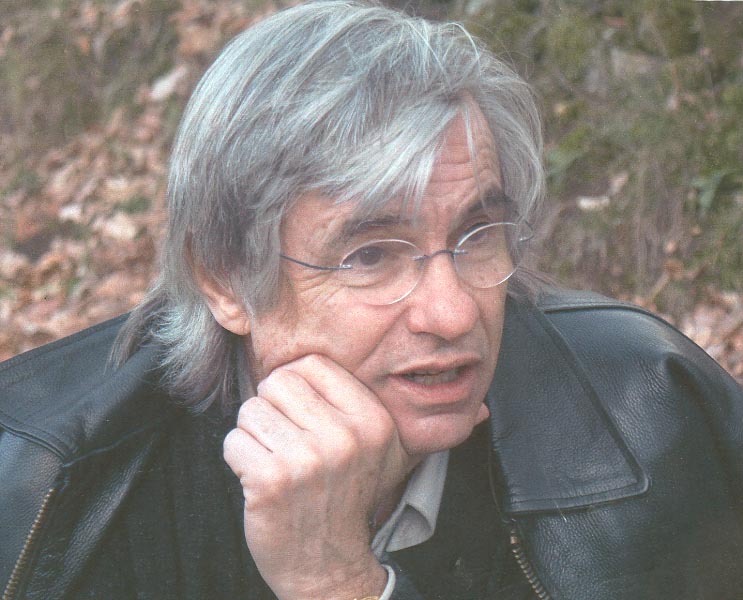
Jean-Pierre Petit, astrophysicist, 2004
People of my generation will remember that this was a film starring Brigitte Bardot. But that is not the daisy I am thinking about now. I am thinking of an idea offered by one of my readers. In France and many other countries, people pluck daisies petal by petal. Power systematically strips away freedoms and social achievements, one after another. With no unity, no party or union capable of defending individuals or workers, everything collapses into silence. Each petal fails to react when its neighbor is pulled, unaware that it will be the next one.
There is no visible alternative, and this is utterly despairing. Periodically, Arlette Laguiller runs for election, delivering her monotonous, shrill little speech. She talks about the "workers' party" and "employers." While she denounces obvious social injustices and the erosion of social rights, her political message is impoverished, to say the least nonexistent—just like all those who claim to be "left-wing," whether they eat caviar or not. Some speeches revive the theme of "self-management," a fashionable idea in 1968 and one of the most beautiful absurdities ever imagined in our social history. No, companies do not function when run by workers' soviets. Communism did not work either. But of course, things are more complex. Even if there was good will (and honest people) in the USSR, this empire, built on the most violent autocracy—Stalin, the butcher—died economically, forced by the United States to develop an arsenal that consumed most of its gross domestic product. The USSR never had the chance to enjoy both "butter and guns." Everything collapsed like a house of cards, and Russians seem incapable of shifting from one extreme to the other—from a planned economy to a market economy. It's as if they've absorbed all our flaws at once, without being able to harness any of the strengths of their own system. Today, the halls of Russian train stations are filled with young miners who prostitute themselves, and in markets, elderly people sell their personal belongings just to survive. The Soviet social safety net has been replaced by misery. In Cuba, American mafia, expelled early by Castro, will not take long to reestablish itself in what was once its headquarters. Mao's China inherited the iron fist of its great leader. There, drug offenses are punished by execution without mercy—even for possession of the smallest amount of hallucinogenic substance. China is the result of the extravagant fantasies of its guru-leader, a flesh-hungry man, a writer who deceived steelworkers with the efficiency we know. For those unaware: he decided that peasants must produce their own steel in the furnaces of their villages. Meanwhile, on the other side of the world, Stalin deceived agronomists by declaring, at the end of the war, that the country's agricultural yields would dramatically improve by plowing the soil to a depth of one meter, using converted cars turned into tractors. The result, in vast regions, was turning fertile land into barren wasteland, as productive soil was buried a meter deep, while infertile soil was brought to the surface.
In Arab countries, anxiety is exploited by religious leaders who offer their followers the veil and the burqa as salvation belts against Western confusion regarding customs. It's a simple idea that has worked for over a thousand years. It provides a rigid, clearly defined way of life, an ultra-stable social system capable of accommodating all inequalities and offering solutions to existential angst. Everything is predetermined. While Westerners cope with the issue through antidepressants or randomly launching missiles at various targets, applying another law—the biblical law of retaliation—others offer a way out for the most desperate: suicide, guaranteed with full beatification in the afterlife. Unstoppable. But in Arab countries, as in the United States, political leaders do not send their own children to slaughter. Death is always reserved for the poor, in any era.
The system of Islamic fundamentalism is imposing itself even as an international force. This kamikaze system is unstoppable. It is "the atomic bomb of technologically undeveloped societies," against which cowboys armed with lances and nuclear weapons, backed by supersonic spy planes and GPS-guided bombs, are completely defenseless. Never before has such a situation existed. Historically, it is extraordinary. As for European countries, they appear as mere straw men, ready to burn. The Algerian war is a clear example of how quickly things can deteriorate. The moment the first bomb explodes, the far right will revive its dormant OAS. Whose initiative? A good question. Who is pulling the strings? Who will trigger the first wave of attacks in one or another European country? Religious leaders—or perhaps the Americans themselves, seeking a way to force Europeans to join them in a crusade against terrorism?
Have American hawkish leaders precipitated events through a totally Machiavellian self-attack, the infamous September 11? A clever move in international politics, freeing their hands and plunging the world into insoluble and humanly catastrophic situations. Iraq is Russia's retreat. Historically, these two situations are comparable.
Science offers no solutions either and closely collaborates with military-industrial lobbies (it seems that this activity today is the clearest "research and development" endeavor). It primarily serves to achieve the highest possible profit margins and also serves power structures, monopolies, with total irresponsibility, rushing headlong into GMOs and similar ventures. Occasionally, the public questions the great priests of science—bearded men with suspenders or disabled men in wheelchairs—who behave like gurus, promising anything, the same ones developing theories that "will surely be useful in a few centuries," since "they are too advanced for our current era," and that evoke a "TOE," a Theory of Everything. Truly lamentable.
I have nothing to offer. It's merely a statement of fact. What cries out to heaven is the behavior of what we call the media. But what is a media outlet? The Larousse definition is vague. One can read "dissemination of mass culture." But that's not all. Media outlets are the windows through which information professionals should show us what's happening in the rest of the country and the world. Instead, we are flooded with trivial stories designed to further dumb us down. Every day, our news broadcasts drown us in trivial events that conceal the real international situation, summarized in just a few minutes. The Arte channel is the "alternative channel" where "major issues" are addressed...