On Homo sapiens
Praise of Ignorance
1st Part
January 24, 2004
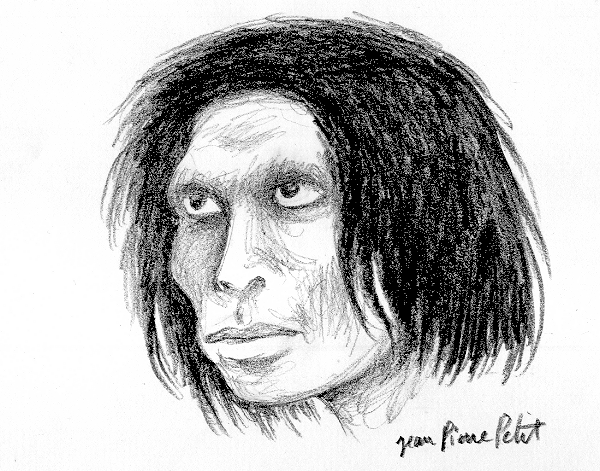
I watched the documentary on human prehistory, supervised by paleontologist Yves Coppens, which was broadcast on television in January 2005. To be certain of what I had seen, I rewatched the film on the CD, widely sold in numerous retail outlets immediately following its first broadcast.
This film, which employed enormous resources, is remarkably mediocre in many respects, which we shall now highlight. It aims to trace the saga of Homo sapiens, of whom we are supposedly descendants. Technically—something we will return to later—it is poorly made, due to the awkward alternation between clumsy, scripted scenes depicting prehistoric humans, and sequences in which specialists from various countries merely posture in the most pedantic manner possible, with Yves Coppens himself being the central figure of this paleo-circus.
First observation: all essential problems concerning the dawn of our humanity are simply evaded or quickly glossed over. The film begins with a one-minute evocation of Coppens’s cherished theory: that bipedalism arose due to the disappearance of forests in a region of the globe, replaced by savannas. In a fraction of a second, we learn that the two beings supposedly ancestral to us were named Aurora and Toumaï. After that, they are never mentioned again—like a hair falling into soup. Soon, directors Malaterre and Fougeas show us a tribe of Homo erectus, meaning "upright men." The crucial question of hominization is, if not eliminated, at least swiftly brushed aside.
At the cost of an extremely heavy-handed commentary, we first see a female Homo erectus giving birth while standing upright, delivering a... hairless, rosy Homo sapiens. This scene would have deserved commentary, explanation. But on this precise, extremely important point, your search will remain fruitless.
Until very recently, Coppens had distinguished himself by trying to promote his own theory of hominization, based on climatic considerations. Since this theory ultimately collapsed, he now prefers to sidestep it (except in the film’s first minute), as well as the issue itself, despite its crucial importance. Let us recall his thesis.
In East Africa, Leakey discovered the australopithecine, a creature of very small stature, barely one meter tall. "Pithecus" meaning "ape," the term can be translated as "southern ape." The scientific community reacted immediately, as this creature appeared at once to them as a possible ancestor of humans. This evocation brings back memories from my own past: in the early 1970s, as a safari guide, I used to lead clients on extensive trips through Kenya and Tanzania. It was during one of those journeys that I traveled to Olduvai, where, as far as I recall, the first skeleton of Australopithecus africanus was exhumed. Before we consider the possible lineage connecting this small anthropoid to humans, I can tell you what emotion I felt when, in the museum on-site dedicated to it, I entered the room where its habitat had been displayed, exactly where it had been found. There, one saw a living area filled with numerous animal bones, generally partially crushed. This, in fact, led to the conclusion that this creature was a necrophage, a scavenger. This "dining area" measured about two meters in diameter. I remained for a long time fascinated, contemplating these modest remains—undisputed evidence of the creature's activity. The museum did not display any bones belonging to its skeleton, as none had been found at that precise location. One could consider this space its "dining room," where our australopithecines had evidently not bothered to clean up. Paleontologists analyzed the site and concluded that this species used stones to break bones and extract marrow, which likely formed part of its diet. The more or less round pebbles found in abundance in this dining room appear to constitute the very first elements of the technology later developed by humans. The term "pebble culture" is used—literally, "pebble culture." I cite these details from memory, hoping not to make an error.
Thus, a humanoid creature, over a million years ago, used these stones as kitchen tools. Since these stones were also found gathered in formations resembling half-moons, it was speculated that they might have served as throwing weapons, for defense against predators.
When confronted with all this, one remains truly fascinated.
Paleontologists soon unearthed remains of other individuals belonging to the same species, then discovered remains of other beings, slightly different in form but still possessing the same brain capacity, which—unless I am mistaken—was around 400 cc. The dentition of this new species of australopithecines was also different, better suited to crushing objects, indicating a diet more oriented toward herbivory, consisting of berries. They named this species Australopithecus robustus.
Coppens’s thesis, which he has now abandoned himself—something we will return to later—consisted in attributing the transition from an arboreal lifestyle to a locomotion he wished to interpret as bipedalism, to a geological and climatic event. Indeed, the site where the first australopithecines were discovered lies within the African Rift, a vast zone corresponding to a tectonic collapse.
In the same region of East Africa, further north, visitors will find the remarkable site of Lake Manyara, oriented roughly north-south. Geologically and ecologically speaking, it is an astonishing curiosity.
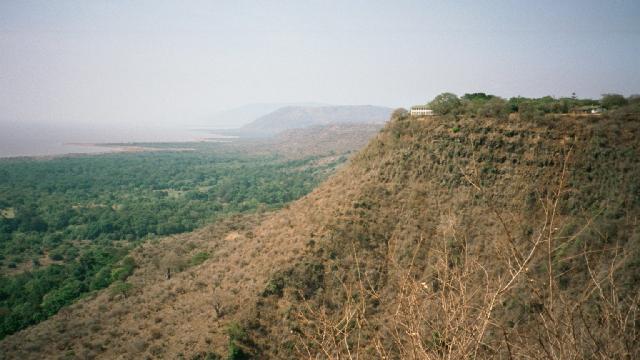
Lake Manyara and the Rift Escarpment
It is a zone of collapse, with its central part occupied by water. There, one finds fauna and flora corresponding to a lacustrine ecosystem. But just a short distance from the shores, the ground rises. I don’t think I’m mistaken in saying that the shores of Lake Manyara are organized into bands, each no wider than a few hundred meters. This "stratified" ecosystem, structured in bands, ends at the foot of a cliff, which, as a significant natural barrier from a meteorological standpoint, intensifies the contrasts between these microclimates. When visiting the shores of Lake Manyara, one can, depending on one’s distance from the lake’s edge, move through completely different ecosystems. One finds, for instance, a mini-savanna inhabited by several lion families, then a wooded vegetation that grows richer the closer one approaches the cliff, which obviously concentrates humidity.
Lake Manyara National Park is famous because the...