Prehistoric Thoughts about Homo sapiens
Praise of Ignorance
2nd Part
January 24, 2005
When moving through the trees, it's good to be able to orient your "lower hands" in all directions. In a hominoid like a chimpanzee or a human, and in many other species, the femur rolls on what is called a "tibial plateau."
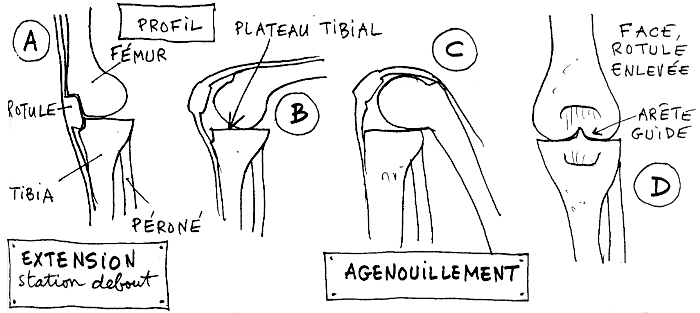
Tibial Plateau. Note what the "patella" is for: tendon attachment shift and anterior locking
The lower part of our leg is composed of two twin bones: the tibia and the fibula. But the femur only rests on one of them. The way the femur and tibia remain constantly in contact is indeed a true marvel of mechanics and involves a very remarkable mathematical curve. Try to imagine a joint without a rotational axis, made only with relatively rigid ligaments to maintain contact between the two bones. The solution "found by nature" is absolutely remarkable. I believe, making a small digression, that what impressed me the most in the human skeleton is the shoulder joint, which allows an absolutely remarkable spatial positioning of the arm regarding its angular range (which is measured in terms of "solid angle").
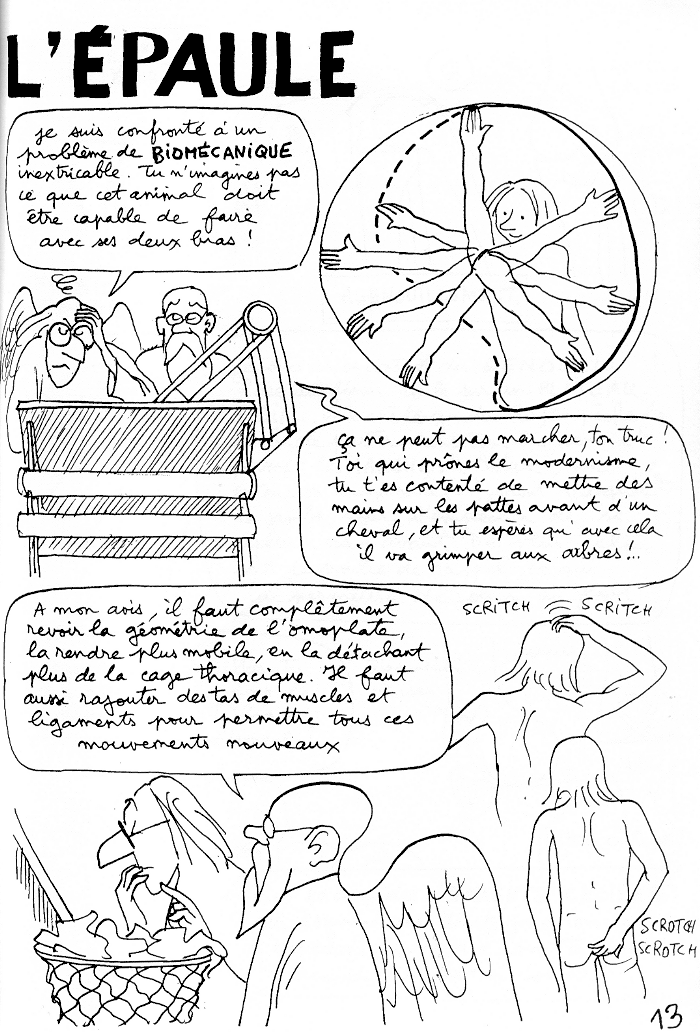
This was made possible by an invention, that of a mobile, "floating" joint support: the scapula, a real discovery.
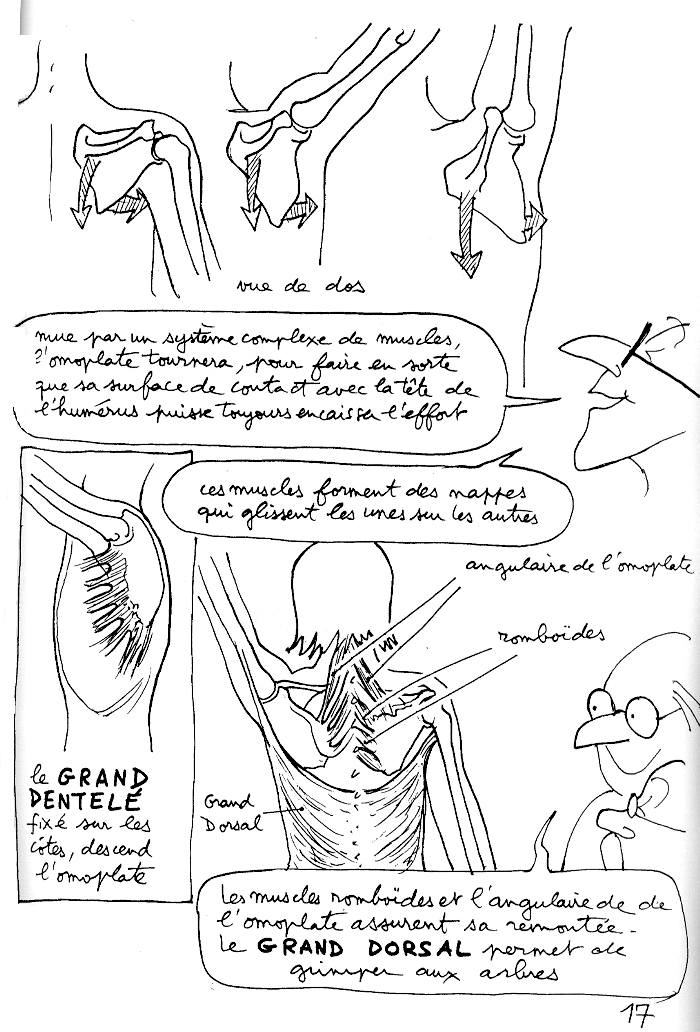
This scapula allows the weightlifter to lift incredible loads and hold them above his head with his arms without his arms coming off and falling into his pants!
The femur-pelvis joint is made with a "femoral head" that fits into a socket. It is of the patellar type (although this has nothing to do with the patella of our knees, which plays a completely different role, as we saw earlier).
The femur-pelvis joint of the australopithecus was immediately closer to that of an arboreal creature than to that of a biped, which was not immediately noticed. The same applies to the structure of its tibial plateau, as far as I remember. Ours has a ridge that greatly limits the angular displacement of the tibia relative to the femur. Approximately five degrees, if my memory serves me right. On the other hand, and I refer here to a conversation I had once with my old friend Louis David, former director of the Guimet Museum in Lyon, this ridge would be either practically absent or much less developed in arboreal species, allowing an angular displacement of about sixty degrees. The ankle joints would be quite different, always due to the chosen mode of locomotion.
Climb or walk, you have to choose
We are fairly acceptable climbers. I myself have done some high mountain climbing and was once an assistant climbing instructor at the Université Libre de Belgique. In terms of arm strength, relative to weight, we are far behind the chimpanzee and even more so the gibbon. Lacking prehensile feet, we have equipped ourselves with shoes capable of exploiting the slightest grip. But I still remember that when we met Jean Lecomte and his wife Lulu on the island of Riou, facing the Calanques of Marseille, an empty island at the time (1960) where the couple had come to climb and we were looking for a wreck of amphorae, we had no shoes. Not even sneakers. The horn served as a sole. We then climbed the "Tours de Riou" barefoot, which shows that even without shoes, humans can still manage quite well. But, in terms of flexibility, we are still far behind the apes.
Jean-Pierre Petit and Jean-Claude Mitteau in 1960 in the Calanques
The tibial ridge is either almost absent in the australopithecus:
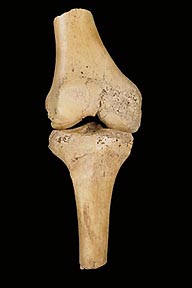
Femur - tibial plateau joint in the australopithecus
Fifteen years ago, my friend David doubted the bipedal qualities of what was considered a pre-hominin because of this. It should be added that studies by Yvette Deloison in her book "The Prehistory of the Walker" showed the existence of an "opposable toe." This muscle has persisted in our foot, but it is atrophied. And she concludes that the emergence of man as a biped remains a complete mystery.
The presence of an opposable toe would be a new argument to doubt the bipedalism of the australopithecus. Finally, subsequent discoveries have completely destroyed the idea around which Coppens' international fame was built. It was eventually discovered that very old australopithecus skeletons, more to the west, in areas that were clearly forested.
Out with the theory of bipedality as an adaptation to the environment.
Hominization is a key issue. It's not only the mode of locomotion that differentiates humans from apes. There is also the ability to communicate using a spoken language. To emit modulated sounds, one must have vocal cords attached to sphenoid bones. Simians have neither. When did these bones appear? Before, after, or at the same time as the appearance of bipedality? Another vast field of ignorance. However, we do know, after discovering and studying the abilities of these dwarf chimpanzees, the Bonobos, that even deprived of the ability to phonate, these beings are very intelligent, capable of distinguishing the past from the future, of remembering promises made by their human companions, of learning sequences of gestures by watching them on video screens, etc. It is really there that one is tempted to say, "They just lack speech!"
Talking about the origins of man without mentioning this question of hominization, for which we have no answer, and where no one seems even capable of formulating the question properly, is a bit of a joke. When you watch this film, you get the impression that scientists are reluctant to say "we don't know." The documentary is filled with many performances by recognized scientists, mandarins well established who strut around in often very luxurious premises, while paleoanthropology, one of the many poor relatives of science, often grants its researchers only a vague wardrobe and a corner of a table in an already occupied office.
Coppens participated in a book written in collaboration with Hubert Reeves and Joël de Rosnay, titled "The Most Beautiful Story in the World," a book where the journalist interviews "these three great figures of science." Among the three, neither Reeves nor de Rosnay have ever discovered anything personally, but this book is "from quark to man," a real monument of preconceived ideas. Coppens was developing the theory around which his career had centered, which had made him famous. But today, this idea is no longer defensible. Rather than admit ignorance, he has chosen to start the story of man with the homo erectus (so... already standing).
In the film supervised by Coppens, there is a surprising scene. A female homo erectus gives birth standing up to a ... homo sapiens. This is not innocent. Is Coppens endorsing this hypothesis, which is nothing more than that of a sudden, resolutely non-Darwinian transition from the first species to the second? It seems that, in this way, he is leaving all possible exits open by this subtle reference, in case the wind, suddenly, turns around this question. Indeed, the brain volume would suddenly jump from 600 cc to 1200. The orbital fat would disappear. The facial angle is deeply modified, the chin appears, etc.
This sequence is introduced because it is necessary, in one way or another, to explain the emergence of the central character of this film: the homo sapiens. Instead of simply saying:
- We have fossils of several hominids. Among these, the homo sapiens, which appeared about a hundred thousand years ago in the Middle East, seems very close to modern humans in many respects and whose emergence, in our current knowledge, is a mystery.
It remains to be specified, as is done in the film, that the homo erectus, having left Africa, knew how to make "bifaces." We are already far from this very primitive "pebble culture." The homo erectus also mastered ... fire, which is not nothing (400,000 years before our era. Some paleontologists say this number could be doubled). By constructing his film this way, Coppens avoids the essential, central question:
- Where, when, and how does hominization begin?
At one point, a Chinese paleontologist, Professor Wu Xin Zhi, is given the floor, who talks about "the man of Java" and "the man of Peking," who populated the Asian continent 500,000 years ago. The Chinese doubts the "sinization" of imported homo sapiens and points out that Asian characteristics (flat face, extended cranial structure on the cheeks) already existed in the most primitive specimens, implying that the emergence of the homo sapiens could have occurred in very distant parts of the globe (polyphyletic origin of man, according to several branches). But the film does not really focus on this key question.
Coppens rides the dominant theory based on a monophyletic origin of man (with "a single branch"). This theory is nothing more than ... a simple belief. Until a recent date, when Coppens' theory about the origin of bipedality collapsed, this single origin of man and his ancestors was the official theory in Western paleontology. In fact, on the leaflet accompanying the CD-ROM, there is a diagram of the spread of the planet, starting from a single cradle: the African rift. This is the theme of "out of Africa." There is no measure in the statements of Coppens or others who speak in this film, no distance, no doubt.
- This happened, then they did that ...
The film is full of manifest absurdities, which Coppens in fact endorses. I will cite an example. To give the whole thing a bit of a storyline, they make an old man reveal his origin to his grandson. The ancestor confesses that he was raised by wolves. A scene is shown where homo sapiens come across a pack of wolves, accompanied by a child who seems to be at least five or six years old. Integrated into the tribe, the child keeps a "somewhat wild" attitude for a while, but after a very short time, learns to speak and ends up becoming the wise, the shaman of the tribe.
When you advance something, you must be able to rely on some facts, if possible. There have been cases in history of children who survived living integrated into a pack of various animals. In India, there are several cases of children who apparently were raised by wolves. In one case, the child, by mimicry, adopted a makeshift quadrupedal gait, running on his elbows, which had developed impressive calluses. In France, we have the case of Victor of the Aveyron, a child found naked in the department of the Aveyron, feeding on berries and acorns, whom it is thought may have adopted the lifestyle of wild boars.
In all cases, no reintegration has ever been possible. Humans go through stages where they acquire different behavioral attributes, including the ability to handle language. When you miss this good period, it seems it is no longer recoverable. This was observed with Victor of the Aveyron, who, despite the commendable efforts of the doctor trying to re-adapt him to a human social life, proved incapable of uttering a word.
The sequence presented in the film is therefore pure fiction, which goes against the little experience we have in this matter. In fact, there are many fictions. A paleontologist friend reminded me of the sequence where the screenwriter thought it was good to show a group of homo sapiens crossing a high mountain pass, on the suggestion of a "shaman woman." Shivering from the cold, they are ... saved by Neanderthals! In fact, if the homo sapiens passed through France, it was by quietly following the seashore and not by venturing into a landscape borrowed from high mountains. But it makes "beautiful images." False, absurd, but romantic images.
These same paleontologist friends regret that the screenwriters did not devote even a single sequence to showing the size of the flint stones, by percussion, while we are not lacking in people in France who have perfectly reconstituted these extraordinary gestures of efficiency. But how could you ask that of a ... choreographer, in charge of coordinating the gestures and vocalizations of those who are supposed to be our ancestors?
In fact, when you see the whole film accompanied by a comment as boring and uninterrupted as it is, you inevitably think of the excellent film by Annaud: "The War of Fire." Annaud is an extremely talented director, author of extremely varied films, including this masterpiece, "In the Name of the Rose." In this adaptation of the book written in 1912 by Rosny Aîné on the wanderings of a group of homo rerectus, Annaud, who had the luxury of captivating us for two hours and making us understand a lot of things in a film where the words spoken are in "prehistoric, unsubtitled." He took advice from good specialists and his film is not tainted with the numerous errors that litter the one sponsored by Coppens. It is worth noting that Annaud turned to ethnologists and not to paleontologists.
Another example taken from the film where Coppens, as stated in the credits, is presented as "Scientific Director": At one point, we see homo sapiens working together with Neanderthals (…), attacking … mammoths with wooden spears tipped with stone points. "They scare the animals with torches." From my little experience in Africa, I know that this fear of fire, for many species, exists only … in the imagination of writers (like the fear of the "red flower" in "The Jungle Book"). In a risky area of Kenya or Tanzania, I would not advise anyone to sleep peacefully next to a fire, imagining that they are thus protected from potentially very aggressive animals like hyenas.
When you want to make a film about prehistory, isn't the simplest thing to go and observe people who really live in that time, like the Bushmen or the Papuans. Among the hunting techniques, there are some that Coppens and his team do not mention and which must have appeared very early, given their effectiveness: poison, widely used on Earth, by the Amazonians or the Bushmen, for example (these hunt with bows that look like toys, whose tips actually behave like "syringes"). There is another scene (indeed, the film seems to be an uninterrupted succession of absurdities) where we see homo sapiens attacking gazelles with spears. One is hit … on the buttock. It is then said that it is "mortally wounded," and indeed, in the next sequence, we see it lying dead, in the same place, on the ground. This is absolutely not credible. Coppens seems to have no idea of the resistance of bush animals. With such a wound, an antelope of this weight would be capable of running dozens of kilometers, eventually dying later from infection or under the claws of a predator.
Before presenting this scene where a dozen of homo sapiens, working hand in hand with Neanderthals, attack a "young mammoth" and finally manage to overcome it by driving their spears "into the most vulnerable areas, like the anus or the flanks," did anyone in this brilliant team think of asking the Maasai (who have, themselves, metal-tipped spears) whether it has ever happened that people from their ethnic group have managed to overcome an elephant? Does Coppens realize that the skin of even the smallest elephant is at least two good centimeters thick and that before hoping to pierce it with flint points, one can always get up early.
Or, to hunt the mammoth, you need two people. You first approach the animal from behind, downwind, without it noticing, when it is grazing. The first hunter then quickly lifts the animal's tail while the second one inserts his spear directly into the anus. If the spear is long enough, by pushing hard he has a chance of reaching the heart. The animal then collapses on the spot, struck down.
One could have said many more relevant things and scripted them intelligently, as Annaud did in his film. For example, it is possible that the integration of the wolf into hunting techniques came from the collection of young ones, after their parents had been exterminated by a tribe. The animal is then "de-natured," "tamed." The man who tries to integrate a wild animal into his environment puts into practice the ideas of Conrad Lorenz, the inventor of imprinting. According to Lorenz, for many species, the first being they see (or feel) at the moment of their birth is identified as their parents. Thus, geese could be made to consider a simple ... lawnmower as their mother.
If a dog obeys a man, it is because it considers him a "dominant" being. When a brave "dog-dog" lies on its side and offers its belly, it actually adopts a submissive attitude, offering the most vulnerable part of its body. The domestication of the wolf was probably a long process. But there are examples in Africa of surprising symbioses between humans and species considered, a priori, extremely dangerous. Without knowing exactly why, I have observed it myself, it is possible to camp on the shores of Lake Baringo in Kenya and see the camp invaded by "peaceful hippos" that come to graze next to the tents. I assure you that it makes a very strange effect to open the door of your tent and see the muzzle of this huge animal, weighing several tons, considered dangerous in Africa (it is excluded to approach them, for example, near the Mara River where they live in large numbers).
I have passed many times at "Klein’s camp" near the Mara reserve, where buffaloes coexist with humans, sleeping between their huts and concrete houses. No one in this camp, run by rangers, would dare to caress them, but that's the way it is. I was an eyewitness. Having become a bit too confident, I had even driven away a buffalo from our camp by throwing stones at it, after which the ranger asked me, "Do you treat buffaloes this way in your country?"
I have known many similar examples.
Returning to these so-called mammoth hunts, we must acknowledge that we have found huts built with tusks and bones of these animals. But what proves that they were killed by humans? In Kenya, in Tanzania, I have found full skeletons of elephants, anywhere.
How do elephants and in particular, elephants die? They are little vulnerable to predators. They don't sleep lying down. They take short naps, standing, but they feed practically 24 hours a day, given the amount of vegetation they need to ingest and their low "food efficiency." The big cats don't dare to attack them. Their weak point is their dentition. They have two successive sets of molars during their life. But when the second set falls out or wears down, they are doomed to die of starvation, practically, becoming unable to chew. Old elephants then frequent the marshes, where the shoots are softer. They can get stuck there, and it is under these conditions that prehistoric men could have claimed to have overcome these mountains of flesh.
It would have been simpler, more rational, to present this kind of scene, more plausible. The archaeological data are not lacking in tangible and spectacular elements regarding hunting strategies. We know the rock of Solutré where prehistoric men drove wild horses into a precipice where they broke their legs, providing them with fresh meat reserves without too much risk. The men only had to scare the animals.
Therefore, I will express a very negative opinion on the film directed by Coppens, which seems to testify to a great ignorance of the world of men living in conditions technically very close to those of men of the Stone Age. The presentation is crude, like in "Tarzan films." The prehistoric man speaks in growls, has brutal gestures, eats like the worst of pigs, is dressed in scraps of skin. Whereas we know that so-called primitive tribes are often equipped with very sophisticated social organizations, very complicated initiation rites, and elegance is in place. Coppens and his collaborators seem to take the "primitive men" for complete fools, whereas they were people full of resources. If I were in his place, I would have shown, for example, how they could, by cutting a skin in a spiral using a simple flint shard, obtain a "rope" of good length and give their bows strength and flexibility by treating them with fire. I will not take the example of the Papuans since they were already, when the Australians discovered them in 1932 in the Waagi valley, at the stage of agriculture (sweet potatoes) and livestock (black pigs).
There are many extraordinary moments in Annaud's film, the war of fire, or the evocation of technical progress, skillfully integrated into the plot, which do not need any comments. After learning to make fire, Naoh returns with his companions to his native habitat, the cave they had left. He then encounters one of his tribe members and his brothers, heavily armed and very strong, who block his way. The confrontation is inevitable. And there we see Naoh and his companions quickly overcoming the three others by using an accessory unknown to them: the propeller, which allows shooting at a greater distance. The organizers of the ambush are thus killed by Naoh's and his brothers' arrows without even having been able to get far enough to use their own weapons. The demonstration is remarkable.
If one wanted to "be scientific," it would have been more appropriate to create a film with more unity, without constantly mixing the present and the past, even if it meant reusing (in a CD-ROM) sequences from the film and commenting on them, drawing the attention of the inattentive viewer to details. But that would have been too much to ask of mandarins more concerned with appearing than allowing the viewer to make a tremendous plunge into the past.
In Coppens' film, everything breathes of improvisation, lack of unity, and improvisation. In the package offered, there are two CD-ROMs. One contains a "film about the film," which explains how it was conceived and made. It is a Franco-Canadian production. The French producer is Barthélémy Fougeas. The screenwriters are the directors Malaterre and Michel Fougeas, presumably the producer's relative. These say that "Coppens led them through knowledge." They should rather say that he led them through our ignorance. As for Coppens, he specifies that after giving "some technical advice," it was good for the directors to do their work as authors, which they did with the help of a ... choreographer, a certain Grégory (Annaud had secured the help of ethnologists). The "film about the film" tells us that there are "80 leading roles" and extras. That's a lot of people.
Ah, I noticed when rewatching this document that Coppens gives his definition:
| - Of man: | the container of thinking matter.... | . | - Of consciousness: | A certain level of reflection to
| calm an anxiety |
|---|
result of half a century of patient reflection.
The result, cinematographically speaking, can be qualified as "non-professional" compared to the excellent work done by Annaud (who, let's recall, required the advice of more ethnologists than prehistorians). The actors directed by him really "looked like they were in their time." Those of Coppens' film, despite great efforts made for their makeup, resemble extras, and are not in their roles. Why wasn't Annaud asked to manage this project, or at least to serve as a consultant for a production that certainly benefited from a substantial budget?
I pass over the mediocrity of the comic strip, some pages of which accompany the CD-ROM. It will probably fall from our hands. Honestly, rush to your bookseller and buy the book "Les Temps Préhistoriques," published by Hachette, in the series "la vie privée des hommes," you will find better on all counts, including thanks to the illustrations of a real magician of shapes and colors: Pierre Joubert.
Making films, composing comic strips, is a profession. It is even not a question of technical means, but above all of ideas. I don't know the "service records" of these two directors, Malaterre and Fougeas.
Remember the first image of Annaud's film "The War of Fire." What do we see? Almost nothing. The forest, at night. But, as the camera pans, in the middle of all this darkness, suddenly appears a tiny fire, which ignites our imagination. All our Promethean society is concentrated in this short sequence, remarkably supported by its sound track. The fire is there, which will be at the center of the entire story, the quest of these men who suddenly lose it and start looking for it. What a fantastic theme, completely lost from view by Coppens' team (...). But the theme is Homo Sapiens. Or, in principle, the homo erectus already knew fire and had tools. It's a pity, fire has certainly played a very important role in prehistory. But there, it's "off-topic."
I imagine how the comic strip, which was planned to accompany the film directed by Coppens, must have been composed. The paleontologists, Coppens at the head, looked for a "illustrator," whose talent was quite mediocre, who did his best to transform the words of these learned characters and the result will be extremely boring. This is already visible on the four pages accompanying the CD. Similarly, a professor at the Collège de France, if he can fascinate a disciplined audience, will become a mediocre actor if he is integrated into a document that wants to be a film, with a script.
Take an example. Before the appearance of "The World of Silence," films about the underwater world were only simple ... documentaries. Suddenly, in this film, the images become magical, memorable, they come alive. I remember the first sequence. We see three divers descending into the abyss, carrying underwater torches emitting streams of bubbles. The images are extraordinary, as well as this view where we see the anchor of the Calypso slowly sliding on the bottom before rising to the surface. There was that and a thousand other things, with obviously thought-out angles of view, fairy-tale lighting. But why, suddenly, this qualitative leap, this emergence of an artistic work in the middle of kilometers of rather boring documentaries?
Because the director was none other than the young Louis Malle, who made this film for Cousteau in exchange for his participation in a fascinating world tour.
Similarly, in ethnology, there suddenly appeared a researcher at the CNRS, the sympathetic, charismatic Jean Rouch, recently deceased. There has only been one like him, who was both an ethnologist and a filmmaker, just as Louis Malle was a filmmaker and a diver. Today, at the CNRS, we have the SERDAV, the "Service d'étude et de réalisation de documents audio-visuels," founded by Jean-Michel Arnold, which has never managed to produce anything that could be broadcast and that is worth remembering, while every film by Jean Rouch is an anthology document.
I believe I am the only one who can claim to be both a high-level scientist and a professional in the field of comics. When you try to hang little Mickeys on an academic speech, it doesn't work. It has never worked. There have been many attempts that have only yielded mediocre results compared to the Lanturlu series. The director of the film on prehistory did what he could, advised, guided, led by prehistorians who had no idea what an image, sound, set, movement, lighting, or script were, and who only knew how to do what they were used to: stand on a platform in a suit, tie, beard, and talk... talk.
Beyond this alternation of scenes that aim to be "realistic," the ramblings of "figures of paleontology" disrupt the entire rhythm of the documentary. Cinematically, it's very clumsy. An image must always be meaningful. Image is a real profession. The sequences where our modern scientists strut around are uniformly boring; these characters are not cinematic in the least, any more than the sets that serve as backdrops, which are there only to emphasize their social success. But vanity is often the great weakness of academics. Wasn't the goal, beyond what I believe was a totally failed popularization, to show off?
There are many scenes in Annaud's film that evoke the condition of prehistoric man and the problems related to encounters between two ethnic groups with different cultural and technological levels. Without being explicitly stated, Annaud's film suggests a confrontation between Homo erectus, the Naoh tribe, living in caves, and Homo sapiens, who teach them the art and way of producing fire themselves. One of the strongest scenes in the film is when Naoh watches another prehistoric man (who, I believe, is actually a Maasai) rubbing a wooden stick rapidly between his palms to make fire. The scene is not staged and takes place in real time before the viewer's eyes. This is really how these people light their fire. The tools are authentic. One can imagine that it probably happened this way in our past. And it is precisely because this scene is totally plausible that it literally explodes the screen. There is an emotional, deep aspect in Annaud's film, which is completely absent in Coppens' film. Let's say that Annaud, in a film without intelligible words, manages to convey and explain more things than our scientists, who often try to make us swallow pills as big as menhirs.
I was looking forward to seeing this film. I was very disappointed.
The distant past of man is fascinating, full of many mysteries. Coppens wants to give it a planetary technological and cultural homogeneity, whereas today this is not even the case. Until 1932 ( ! ... ) at a distance of about a hundred kilometers, the distance separating the Waagi valley from the coast, long settled, there coexisted modern men, of Australian origin, and others living 30,000 years in their past. Why would the history of our distant ancestors have shown the homogeneity suggested in Coppens' film? Civilizations probably flourished and then died out, as was the case at the time when what we call history actually began. How can one imagine that during the Middle Ages, Egypt was inhabited by men who had absolutely nothing in common, technologically and culturally, with those who occupied the land a thousand years earlier?
I told you: essential questions are ignored. Like the thesis regarding hominization, the upright stance has long been abandoned, so they try to paint a history of planetary settlement, obsessively monophilic, while we know nothing about it. Coppens paints a romance between a Homo sapiens and a Neanderthal woman. All the scenarios are weak. The essential, fascinating question disappears behind an anecdotal, often baseless, uninteresting, and incredible script. We have no archaeological basis to claim that the two groups, Neanderthals and Sapiens, ever intermingled. No graves have ever been found where Sapiens and Neanderthals were buried nearby. On the contrary, the fascinating question is: "Were they genetically compatible?" The film mentions that no remains have ever been found suggesting hybridization, even though more than five hundred Neanderthal skeletons have been uncovered.
At the same time, two human species, possibly genetically incompatible, coexisted, both possessing the art of stone carving, fire making, weapon design, hunting techniques, burial of the dead, creation of ornaments, etc. One survived, the other disappeared. Did it "die out" or was it eliminated by its rival?
There are not only "noble savages" all over the world. The colonizers eliminated many ethnic groups, but sometimes it was tribal wars that led to the disappearance of entire groups. The Watusis, tall Nilotic people over two meters tall in northern Kenya, have completely disappeared, and you will only find traces of them in the film "The Mines of King Solomon" with Stewart Granger, a true ethnological document. The Papuans engage in permanent, chronically deadly territorial battles, the effects of which were only barely contained by the late 1970s. Before being farmers and herders, they were primarily warriors. Modern man is aggressive and territorial. His ancestor was too, and the Neanderthals may have simply been decimated by the Sapiens. In his film, Coppens does not show what is indeed a reality in certain regions of the world inhabited by technologically very primitive people: the state of war, periodic or permanent. Think of the recent genocide between the Tutsi and Hutu, a conflict that has lasted several centuries, or even longer.
When the Maasai invaded Kenya and Tanzania several centuries ago ( &&& at what time? ), they slaughtered everything they found in their path with military efficiency. I have often wondered, given the shape of their spears, reminiscent of the Roman pilum, their combat discipline (compared to the disorganized deployment of other tribes), their large purple cloaks, the way they sculpt their hair with mud, sometimes giving it the look of helmets, their sandals, and the way they draw lines of mud on their calves resembling lacing, whether they were not the remnants of mercenaries trained by the ... Romans at a time when they still occupied North Africa. An idea, just like that.
At one point, Coppens' film evokes what remains a completely opaque mystery for ancient peoples: the erection of menhirs, the manipulation of impressive megaliths. In Antequarra, Spain, men built porches and covered alleys with monstrous stones. The back slab weighs 600 tons, and the total of the 31 stones is 1300 tons!
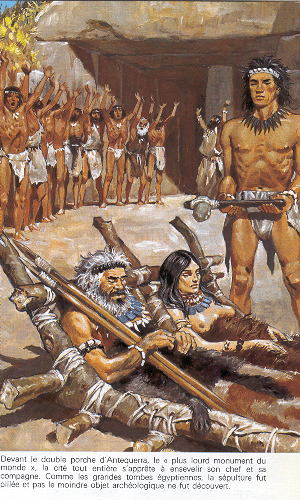
**Image extracted from the excellent book "Les Temps Préhistoriques", published by Hachette in its series "la vie privée des hommes", beautifully illustrated by Joubert **
How, why? All of this is evoked in a hurried manner in a few seconds, or one sees men dressed in rags pulling, of course without tools, monstrous stones.
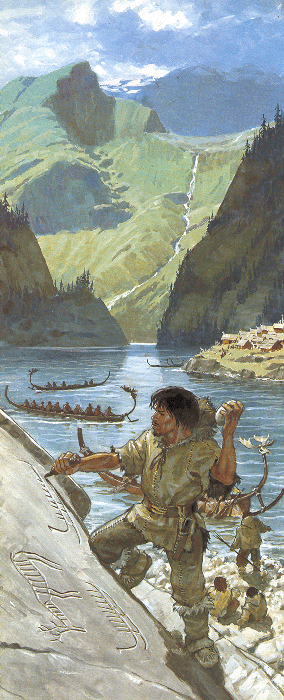
In another sequence of the film, Coppens evokes the way different regions of the globe may have been populated by sea, including Australia. One then witnesses a pitiful scene. Some prehistoric men climb onto a raft made of vague pieces of bamboo tied together and let themselves be carried by the currents. No oars, nothing to face the sea. While very old carvings, discovered on stone in Norway, describe canoes already quite elaborate. Once again, our prehistorians underestimate their distant ancestors. But generally, everything in our distant past is systematically underestimated, sacrificed on the altar of gradualism at any cost.
I think of the trouble Thor Heyerdahl had in gaining credibility for his thesis of a Pacific crossing on balsa rafts, under sail. At any moment, the prehistorian takes his ancestor for a fool, while his own brain is no better equipped than that of his ancestor, who was endowed with the same powers of observation, imagination, reflection, and elaboration, as well as great manual skill. In Coppens' film, our prehistoric shipwrecks are truly pitiful. At every moment, the inability to be modest, to say "we know very little. The data we have are few. It is possible that large parts of our prehistory escape us" is evident.
This image is extracted from the excellent book published by Hachette, titled "Les temps préhistoriques", in the series "la vie privée des hommes".
The truth is that we know very little about our prehistory and that our planet is full of remains that are absolute mysteries to us.
Regarding the settlement of North America, it should be remembered that recently, some carved stones were found, which, if I recall correctly, date back to the Périgordian (end of the last glaciation). However, we know that rituals and techniques can be perpetuated over an impressive number of generations, over millennia, not necessarily due to a lack of imagination but because the construction of manufactured objects, and later metallurgy, may have been intimately linked to a worldview, to magical rituals (among the ancient Egyptians, the manipulation of stone had a religious aspect. Sculpting it was "touching the body of Amun"). Therefore, it is not unthinkable that, at least partially, the New World may have been populated by men who crossed the Atlantic. How? But simply on foot, following an ice sheet that extended very far south, like the brave Eskimos they were, fishing at the edge and merely expanding their territory. Between twelve thousand years before Christ and six thousand, this ice sheet completely receded. Among these men, some remained in these cold regions, while others, having adapted to the milder climate, descended southward. Until a very recent date, no one had even thought of this original way of crossing the Atlantic: on foot.
It sometimes happens that men find themselves at the intersection of two disciplines. I regret that the excellent films by Jean-Pierre Cuny, about the behavior of living species, butterflies, frogs, worms, snails, are no longer available on video cassettes, although they are true masterpieces of intelligence, originality, and humor. I believe that never before have films emerged that are small masterpieces with a team reduced to two or three people and a near-total lack of resources (except for buying sequences of zoology and ethology from German research teams). In any production, there is talent. This is absent from the film made by Malaterre and Faugeas and supervised by Coppens. There are not men of talent, whether in image, popularization, or storytelling, who are expressing themselves, but men and women of apparatus, who claim to be the sole guarantors of knowledge, who possess the keys to power, thus the keys to funding, and who above all want to show off. I have nothing against Coppens, with whom I have never had any contact. I even found it quite pleasant that he himself took the initiative to publicly denounce his own theory about the emergence of bipedalism. But I am really disappointed that such important resources were invested in such an exciting subject for such an incoherent and mediocre result, which is also scientifically very questionable.
January 26, 2005. **Noted by Frédéric Baudemont, interesting bibliographic references: **
http://ma.prehistoire.free.fr/bibliosite.htm
Back to Guide Back to Home Page
**Number of visits to this page since January 24, 2005: ** ---