Jean Ziegler Empire of Shame UN hunger famines world order feudal
The Empire of Shame
 empire_de_la_honte_eng.htm
March 27, 2005 - Updated March 2008
Jean Ziegler, UN rapporteur (60,000 officials) for food issues has just published, at Fayard Editions, a book translated into 14 languages, titled:
The Empire of Shame. Fayard Editions
In the 11 megabytes video you can see below, which corresponds to his recent TV5 interview, he presents his book. He explains that at the time of the French Revolution, the idea of providing enough food for all men on earth was still an utopia, a dream, but today it would be technically possible. However, it is impossible because of the capture of wealth by a small number, whom he calls the Economic War Lords. These people establish a Feudal Order and their armed arm is none other than the American military power, which now operates without the approval of the UN, without any control. The United States now practices torture and assassination as "a necessary thing" and has withdrawn from the Geneva Convention. The author points out that the appointment of Wolfowitz to the head of the World Bank is another catastrophe, because now the World Bank, instead of trying to move towards justice, will serve the most powerful.
Ziegler recalls that Bush signed a decree authorizing American commandos to operate outside the USA, eliminating not suspects, but simply physical targets. He talks about a New Barbarism and an "Organization of Hunger" serving a New World Order, murderous and absurd. Ziegler talks about the need for a moral uprising.
The tone of the man is impressive. The interview on the TV5 channel takes place at a time of high audience.
*Listen to what this man says, read his book, spread his message. It is about your future as a human being: *
http://www.jp-petit.com/VIDEOS/L_Empire_de_la_Honte_Jean_Zigler.wmv
The Full Interview
Jean Ziegler:
"We are heading towards a refeudalization of the world"
In his new essay, "The Empire of Shame" (Fayard), the Swiss subversive sociologist and intellectual - currently the UN special rapporteur on the right to food - attacks the "transnational private companies". Accused of maintaining hunger, destroying nature and subverting democracy, they extend their control over the world and want to nullify the achievements of the Enlightenment. To resist them, we must recover the spirit of the French Revolution and raise our heads, as already done in Brazil by President Lula da Silva.
Your book is called "The Empire of Shame". What is this empire? Why "of shame"? What is this shame?
Jean Ziegler:
In the favelas of northern Brazil, at night, mothers put water in the pot and put stones in it. To their children who cry from hunger, they explain that "the meal will be ready soon...", while hoping that the children will fall asleep in the meantime.
Do we measure the shame felt by a mother in front of her children tortured by hunger and who is unable to feed them?
Or the murderous order of the world - which kills 100,000 people a day by hunger and epidemics - does not only cause shame among its victims, but also among us, Westerners, whites, rulers, who are complicit in this massacre, aware, informed, yet silent, cowardly and paralyzed.
The empire of shame? This could be the generalized feeling of shame caused by the inhumanity of the world order. In fact, it refers to the empire of transnational private companies, led by the cosmocrats.
The 500 most powerful among them controlled 52% of the world's GDP last year, that is, all the wealth produced on the planet.
In your book, you talk about a "structural violence". What do you mean by that?
Jean Ziegler:
In the empire of shame, governed by organized scarcity, war is no longer occasional, it is permanent. It is no longer a crisis, a pathology, but the norm. It no longer equates to the eclipse of reason - as Horkheimer said - it is the very reason for the empire. The economic warlords have devastated the planet. They attack the normative power of the states, contest the popular sovereignty, subvert democracy, ravage nature, destroy men and their freedoms. The liberalization of the economy, the "invisible hand" of the market, is their cosmogony; the maximization of profit, their practice. I call this practice and cosmogony "structural violence."
You also speak of an "agonizing of the law." What does this phrase mean?
Jean Ziegler:
Now, the endless preventive war, the permanent aggression of the lords, arbitrariness, structural violence reign without hindrance. Most of the barriers of international law are collapsing. The UN itself is drained. The cosmocrats are above all laws.
My book recounts the collapse of international law, citing numerous examples directly from my experience as a UN special rapporteur on the right to food.
You qualify hunger as a "weapon of mass destruction." What solutions do you propose?
Jean Ziegler:
With debt, hunger is the weapon of mass destruction used by the cosmocrats to crush - and exploit - the peoples, especially in the Southern Hemisphere.
A complex set of measures, immediately feasible and described in the book, could quickly end hunger.
It is impossible to summarize them in one sentence. One thing is certain:
World agriculture, in its current level of productivity, could feed twice the current human population. Therefore, there is no fatalism: hunger is made by human hands.
Some countries are crushed, you say, by an "odious debt." What do you mean by "odious debt" and what solutions do you propose?
Jean Ziegler:
Rwanda is a small peasant republic of 26,000 km2, located on the crest of Central Africa, separating the waters of the Nile and the Congo, and cultivating tea and coffee. From April to June 1994, a terrible genocide, organized by the Hutu government allied with France under François Mitterrand, caused the death of more than 800,000 Tutsi men, women and children. The machetes used in the genocide were imported from China and Egypt, and largely funded by the Crédit Lyonnais. Today, the survivors, poor peasants like Job, have to repay the banks and creditor governments for the credits used to buy the genocidaires' machetes. This is an example of odious debt. The solution is immediate and unconditional cancellation, or at least an audit, as advocated by the Socialist International or as done by President Lula in Brazil, to then renegotiate each item. Indeed, in each item, there are elements of wrongdoing - corruption, overcharging, etc. - which must be reduced. International audit companies, such as PriceWaterhouseCooper or Ernst & Young, can certainly handle it, as they check the accounts of multinationals every year.
You repeatedly cite President Lula da Silva as a model. What inspires this consideration of his actions?
Jean Ziegler:
I feel both admiration and concern when considering the political goals and actions of President Lula: admiration because he is the first president of Brazil to accept that his country has 44 million citizens who are seriously and permanently undernourished and wants to put an end to this inhumane situation; concern, also, because with a foreign debt of 235 billion dollars, Lula does not have the means to end this situation.
In your book, you also speak of a "refeudalization of the world." What do you mean by that?
Jean Ziegler:
On August 4, 1789, the deputies of the French National Assembly abolished the feudal system. Their action had a universal impact. Today, however, we are witnessing a tremendous step back. September 11, 2001 not only provided George W. Bush with the opportunity to expand the United States' influence over the world, but the event also justified the systematic destruction of the peoples of the Southern Hemisphere by the large transnational private companies.
In your book, you often refer to the French Revolution and some of its protagonists (Danton, Babeuf, Marat...): in what way do you think it still has something to offer, two centuries later, and in a world so different?
Jean Ziegler:
Read the texts! The Manifesto of the Enraged by Jacques Roux sets the horizon for any fight for global social justice. The founding values of the republic, even of civilization itself, date back to the time of the Enlightenment. However, the Empire of Shame destroys even the hope of realizing these values.
In your book, you criticize the global war on terrorism for diverting resources from other more important battles, such as the fight against hunger. Do you think that terrorism is a false threat, cultivated by some states? If so, what makes you think that? Do you think this threat is not real or deserves a different treatment?
Jean Ziegler:
State terrorism by Bush, Sharon, Putin... is as despicable as the group terrorism of the Islamic Jihad or other bloodthirsty fanatics of this type.
They are the two faces of the same barbarism.
They are both real, since Bush kills and Ben Laden kills. The problem is the eradication of terrorism: it can only be achieved by a total upheaval of the Empire of Shame.
Only global social justice can cut the jihadists from their roots and deprive the lackeys of the cosmocrats of the pretexts for their responses.
In 2002, you were appointed UN special rapporteur on the right to food. What reflection did you draw from this mission?
Jean Ziegler:
My mandate is fascinating: in complete independence - responsible to the UN General Assembly and the Human Rights Commission -, I must make justiciable, through statutory or conventional law, a new human right: the right to food. It's a Sisyphean task! It progresses millimeter by millimeter. The essential place of this battle is collective consciousness.
For a long time, the destruction of human beings by hunger was tolerated in a sort of frozen normality.
Today, it is considered intolerable. Public opinion is pressuring governments and intergovernmental organizations (WTO, IMF, World Bank, etc.) to take elementary measures to defeat the enemy:
agricultural reform in the Third World, fair prices paid for agricultural products from the South, rationalization of humanitarian aid in case of sudden disasters, closing the Chicago Agricultural Commodities Exchange, which speculates on the rise of major foods, fighting the privatization of drinking water, etc.
In your book, you appear as a defender of the "altermondialist" cause, or even as a spokesperson for this movement. Why do you intervene so rarely in "alter" demonstrations and are generally not considered an "alter" intellectual?
Jean Ziegler:
How so? I spoke in front of 20,000 people at the "Gigantino" in Porto Alegre in January 2003. I feel like an organic intellectual of the new global civil society, of its multiple fronts of resistance, of this formidable fraternity of the night. But I remain faithful to the principles of class revolutionary analysis, to Jacques Roux, Babeuf, Marat and Saint-Just.
You seem to attribute all the misfortunes of the world to multinational corporations and a handful of states (United States, Russia, Israel...): isn't that a bit reductive?
Jean Ziegler:
The current world order is not only murderous, it is also absurd. It kills, destroys, massacres, but it does so for no other necessity than the pursuit of maximum profit for a few cosmocrats driven by an obsession with power, boundless greed.
Bush, Sharon, Putin? Servants, auxiliaries. I add a postscript on Israel: Sharon is not Israel. He is its perversion. Michael Warshavski, Lea Tselem, the "Rabbis for Human Rights" and many other resistance organizations embody the true Israel, the future of Israel. They deserve our total solidarity.
Do you think that morality has a place in international relations, which are rather dictated by economic and geopolitical interests?
Jean Ziegler:
There is no choice. Either you opt for development and normative organization or you choose the invisible hand of the market, the violence of the strong and arbitrariness. Feudal power and social justice are radically antinomic.
"Forward to our roots," demands the German Marxist Ernst Bloch. If we do not urgently restore the values of the Enlightenment, the Republic, international law, civilization as we have built it over two and a half centuries in Europe will be covered, submerged by the jungle.
Since the departure of the Taliban, the Middle East and the Arab-Muslim world seem to be swept by a wave of more or less spontaneous democratization (elections in Afghanistan, Iraq, Palestine, opening of the presidential election to other candidates in Egypt...). How do you judge this and do you think that democracy can be exported to these countries? Or do you believe that they are doomed to have despotic regimes?
Jean Ziegler:
It is not about "exporting democracy". The desire for autonomy, democracy, and popular sovereignty is inherent to the human being, wherever he is born. My friend the great Syrian sociologist Bassam Tibi wants to live in democracy and has the right to do so. However, for thirty years, he has been living in Germany, in exile from the terrible dictatorship in his country. Elias Sambar, a Palestinian writer, another of my friends, has the right to a free and democratic Palestine, not to an occupied Palestine, nor to a life under the rule of obscurantist Islamists. Tibi, Sambar, and I want the same thing and have the right to it: democracy. The problem is the cold war, the instrumentalization of the regimes by the great powers, and finally the cowardice of Western democrats, their lack of active and real solidarity, which has allowed the tyrants of the Middle East, Saudi Arabia, Egypt, Syria, the Gulf, and Iran to last until today.
Gian Paolo Accardo
Source: La Libre Belgique:
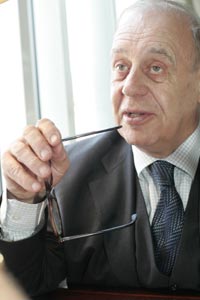
«The empire of shame», according to Ziegler
OLIVIER MOUTON
Special UN rapporteur, the Swiss publishes a new fierce indictment against globalization.
The United Nations, he says, are threatened with disappearance.
Alexis Haulot
INTERVIEW
Special UN rapporteur for the right to food, the Swiss Jean Ziegler publishes a new indictment against globalization, "The Empire of Shame" (1).
This book is marked by your experience at the United Nations...
Totally. I have an observation post like never before. And I am very concerned. The United Nations is 60 years old this year and is threatened with death. On the one hand, by its bureaucracy, with its 62,000 officials. On the other hand, by its inefficiency in some major crises: Srebrenica, the Rwanda genocide, all of which is unforgivable. Its charter contains the essential elements of civilization: collective security, global social justice, and human rights. However, these three pillars are attacked by the unilateralism of the current American regime, which denies collective security in Iraq, sends Wolfowitz to the World Bank and denounces the Convention on Torture that the Americans had signed. Since the first Bush legislature, a cell has been installed in the basement of the White House to monitor all senior UN officials. Anyone who has an interest contrary to the immediate interests of the United States is fought. At this rate, the United Nations risk disappearing...
The Secretary-General Kofi Annan has just presented a reform of the UN. Do you think this is a way to save it?
His proposals are courageous. Kofi Annan is a very, very good person. He is attacked on all fronts through smear campaigns, they try to destroy him psychologically, but he wants to go to the end of his term and carry out the Millennium Development Goals. This goes against the interests of American imperialism and private capital. When it is proposed to reduce extreme poverty by two - two billion people live with less than one dollar a day - it implies land reforms, control of the profits of multinationals, reduction of pharmaceutical prices, food sovereignty...
Your book is a plea for the cancellation of the debt.
Yes, everything is there. It is the noose that creates hunger and prevents development. Take the example of Brazil. There are 180 million inhabitants, of whom 53 million are seriously and permanently undernourished. These are official figures. President Lula, elected with 61% of the votes in October 2002, has an incredible democratic legitimacy, but he can do nothing. He has set up a program called "Zero Hunger" which requires funding. However, he does not have a single cent due to a debt of 235 billion dollars. If he cannot find a solution, he is doomed. But for that, he must negotiate with the IMF. If he makes this decision unilaterally, the first Brazilian ship to dock abroad would be immediately seized.
That said, the simple cancellation of the debt is not the only solution. There are corrupt regimes. The civil society - the NGO "Jubilee 2000" in particular - has proposed a mechanism that would convert the debt of the 49 least developed countries into local currency to contribute to development, under the supervision of the IMF. This is a way. But there is a real hypocrisy in saying that if the countries of the Third World do not pay their debt, the global banking system would collapse. However, the figures show that this is absolutely false. During the last stock market crisis, capital that was 14 times higher than the total debt of the 122 countries of the Third World was destroyed. The economy perfectly digested that.
Who benefits from this hypocrisy?
The cosmocrats. The 500 largest transnational companies in the world controlled more than 54% of the world GDP last year. We are living in the refeudalization of the world! The new feudal lords have a power infinitely more powerful than any pope or emperor in history. A great concern is expressed everywhere about this direction of the world. And Europe remains, in my view, too silent, while it has the means to propose another model.
(1) Ed. Fayard, 323 pp, 20€
March 19, 2008
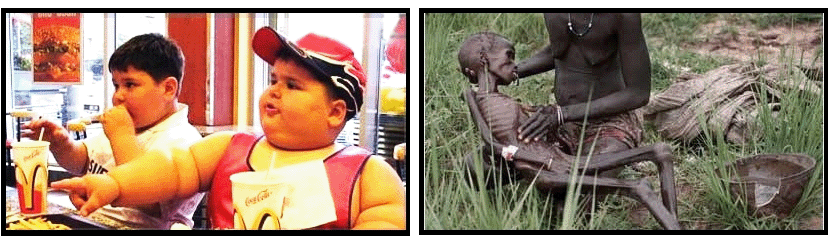
Jean Ziegler: Hunger and human rights «The destruction of millions of Africans by hunger is carried out in a sort of frozen normality, every day, and on a planet overflowing with wealth. In sub-Saharan Africa, between 1998 and 2005, the number of people seriously and permanently undernourished increased by 5.6 million.» Jean Ziegler reminds that the right to food is the first of human rights and calls for a "more equitable distribution of goods, which would satisfy the vital needs of people and protect them from hunger." by Jean Ziegler, Mondialisation.ca, March 18, 2008 Text by Jean Ziegler at the occasion of the Forum What agriculture for what food?
I. Every five seconds, a child under ten dies of hunger or its immediate consequences. More than 6 million in 2007. Every four minutes, someone loses their sight due to a lack of vitamin A. This is 854 million people who are seriously undernourished, permanently mutilated by hunger. [This happens on a planet that is overflowing with wealth. The FAO is led by a man of courage and great competence, Jacques Diouf. He notes that at the current stage of its agricultural production forces, the planet could feed without problem 12 billion human beings, twice the current world population. Conclusion: this daily massacre by hunger is not due to any fatalism. Behind each victim, there is an assassin. The current world order is not only murderous. It is also absurd. The massacre is indeed taking place in a frozen normality.
The equation is simple: whoever has money eats and lives. Whoever does not has to suffer, becomes disabled or dies. There is no fatalism. Whoever dies of hunger is murdered.
II. The largest number of undernourished people, 515 million, live in Asia, where they represent 24% of the total population. But if we consider the proportion of victims, it is sub-Saharan Africa that pays the heaviest price: 186 million human beings are permanently seriously undernourished, that is 34% of the total population of the region. Most of them suffer from what the FAO calls "extreme hunger," their daily ration being on average 300 calories below the survival diet under acceptable conditions.
A child lacking adequate food in sufficient quantity from birth to the age of five will suffer lifelong consequences. With delicate therapies carried out under medical supervision, it is possible to bring back to a normal life an adult who has been temporarily undernourished. But for a child under five, it is impossible. Deprived of food, their brain cells will have suffered irreparable damage. Régis Debray calls these children "the crucified from birth." Hunger and chronic malnutrition constitute a hereditary curse: every year, hundreds of thousands of undernourished African women give birth to hundreds of thousands of children irreversibly affected. All these undernourished mothers who, despite that, give life, recall these damned women of Samuel Beckett, who "give birth on a grave ... The day shines for an instant, then it is night again." A dimension of human suffering is missing from this description: that of the relentless and unbearable anguish that torments every hungry being from the moment they wake up. How, during the day that begins, will he be able to provide for his family, feed himself? Living in this anguish is perhaps even more terrible than enduring the multiple diseases and physical pains affecting this undernourished body.
The destruction of millions of Africans by hunger takes place in a sort of frozen normality, every day, and on a planet overflowing with wealth. In sub-Saharan Africa, between 1998 and 2005, the number of people seriously and permanently undernourished increased by 5.6 million.
III. Jean-Jacques Rousseau wrote: "Between the weak and the strong, it is freedom that oppresses and it is the law that liberates." In order to reduce the disastrous consequences of the liberalization and extreme privatization policies practiced by the masters of the world and their mercenaries (IMF, WTO), the United Nations General Assembly has decided to create and make justiciable a new human right: the right to food.
The right to food is the right to have regular, permanent and free access, either directly or through monetary purchases, to a food that is quantitatively and qualitatively adequate and sufficient, corresponding to the cultural traditions of the people from which the consumer comes, and which ensures a physical and psychological life, individual and collective, free of anxiety, satisfying and dignified.
Human rights - alas! - do not fall under positive law. This means that there is still no international court that would do justice to the hungry, defend his right to food, sanction his right to produce his own food or to obtain it through monetary purchases, and protect his right to life.
IV. Everything is fine as long as governments like that of President Luis Inacio Lula da Silva in Brasilia or that of President Evo Morales in La Paz mobilize by their own will the resources of the state to ensure each citizen his right to food. South Africa is another example. The right to food is enshrined in its Constitution. The Constitution creates a National Human Rights Commission, composed equally by members appointed by civil society organizations (Churches, trade unions and various social movements) and by members designated by the Parliament. The Commission's powers are extended. Since its inception five years ago, the Commission has already achieved important victories. It can intervene in all areas related to the denial of the right to food: eviction of peasants from their land; authorization given by a municipality to a private company for the management of the water supply, resulting in prohibitive taxes for the poorest inhabitants; diversion by a private company of irrigation water to the detriment of farmers; failure to control the quality of food sold in slums; etc.
But how many governments, especially in the Third World, have the daily priority of respecting the right to food of their citizens? Yet, 4.8 billion of the 6.2 billion people on earth live in the 122 so-called Third World countries.
V. The new masters of the world hate human rights. They fear them like the devil fears holy water. Because it is evident that an economic, social, financial policy that fully realizes all human rights would break the absurd and murderous order of the current world and necessarily produce a more equitable distribution of goods, satisfy people's vital needs and protect them from hunger and a large part of their anxieties.
In their completion, human rights therefore embody a totally different world, solidary, free from contempt, more favorable to happiness.
Human rights - political and civil, economic, social and cultural, individual and collective - are universal, interdependent and indivisible. They are today the horizon of our struggle.
Jean Ziegler: Hunger and Human Rights "The destruction of millions of Africans by hunger occurs in a sort of icy normality, every day, on a planet overflowing with wealth. In sub-Saharan Africa, between 1998 and 2005, the number of people who were severely and permanently undernourished increased by 5.6 million." Jean Ziegler recalls that the right to food is the first of human rights and calls for a "more equitable distribution of goods, which would satisfy people's basic needs and protect them from hunger." by Jean Ziegler, Mondialisation.ca, March 18, 2008 Text by Jean Ziegler for the Forum "What Agriculture for What Food?"
I. Every five seconds, a child under ten years old dies of hunger or its immediate consequences. Over six million in 2007. Every four minutes, someone loses their sight due to a lack of vitamin A. That is 854 million people who are severely undernourished, permanently mutilated by hunger. [This occurs on a planet that is overflowing with wealth. The FAO is led by a man of courage and great competence, Jacques Diouf. He notes that, at the current stage of its agricultural production forces, the planet could easily feed 12 billion human beings, double the current world population. Conclusion: this daily massacre by hunger is not due to any fate. Behind each victim, there is an assassin. The current world order is not only murderous. It is also absurd. The massacre is indeed taking place in an icy normality.
The equation is simple: whoever has money eats and lives. Whoever does not suffer, becomes disabled or dies. There is no fate. Whoever dies of hunger is murdered.
II. The largest number of undernourished people, 515 million, live in Asia, where they represent 24% of the total population. But if we consider the proportion of victims, it is sub-Saharan Africa that pays the heaviest price: 186 million human beings are permanently severely undernourished there, representing 34% of the region's total population. Most of them suffer from what the FAO calls "extreme hunger," with their daily ration averaging 300 calories below the survival level under acceptable conditions.
A child who lacks adequate food from birth to the age of five will suffer the consequences for life. With delicate therapies performed under medical supervision, it is possible to return an adult who has been temporarily undernourished to a normal life. But it is impossible for a child under five. Deprived of food, their brain cells will have suffered irreparable damage. Régis Debray calls these children "the crucified from birth." Hunger and chronic malnutrition constitute a hereditary curse: every year, hundreds of thousands of severely undernourished African women give birth to hundreds of thousands of children irreversibly affected. All these undernourished mothers, who, despite that, give life, recall the damned women of Samuel Beckett, who "give birth on top of a grave... The day shines for an instant, then it is night again." One dimension of human suffering is missing from this description: the incessant and unbearable anguish that torments every starving person from the moment they wake up. How will he be able to provide for his family during the day, and feed himself? Living in this anguish may be even more terrible than enduring the multiple physical illnesses and pains affecting this undernourished body.
The destruction of millions of Africans by hunger occurs in a sort of icy normality, every day, on a planet overflowing with wealth. In sub-Saharan Africa, between 1998 and 2005, the number of people who were severely and permanently undernourished increased by 5.6 million.
III. Jean-Jacques Rousseau writes: "Between the weak and the strong, it is freedom that oppresses and it is the law that liberates." In order to reduce the disastrous consequences of the liberalization and extreme privatization policies practiced by the masters of the world and their mercenaries (IMF, WTO), the United Nations General Assembly has decided to create and make justiciable a new human right: the right to food.
The right to food is the right to have regular, permanent, and free access, either directly or through monetary purchases, to a food supply that is quantitatively and qualitatively adequate and sufficient, corresponding to the cultural traditions of the people from which the consumer comes, and which ensures a physical and psychological life, individual and collective, free from anxiety, satisfying and dignified.
Human rights - alas! - do not fall under positive law. This means that there is still no international court that would do justice to the hungry, defend their right to food, sanction their right to produce their own food or to obtain it through monetary purchases, and protect their right to life.
IV. Everything is fine as long as governments, such as that of President Luis Inacio Lula da Silva in Brasilia or President Evo Morales in La Paz, mobilize the resources of the state by their own will, in order to ensure every citizen their right to food. South Africa is another example. The right to food is enshrined in its Constitution. This Constitution creates a National Human Rights Commission, composed equally of members appointed by civil society organizations (Churches, trade unions and various social movements) and members appointed by Parliament. The Commission's powers are broad. Since it was established five years ago, the Commission has already achieved important victories. It can intervene in all areas related to the denial of the right to food: eviction of peasants from their land; a municipality granting a private company the right to manage the supply of potable water, resulting in prohibitive taxes for the poorest residents; a private company diverting irrigation water to the detriment of farmers; failure to control the quality of food sold in slums; etc.
But how many governments, especially in the Third World, have as their daily priority the respect for the right to food of their citizens? Yet, in the 122 so-called Third World countries, 4.8 billion of the 6.2 billion people on earth live today.
V. The new masters of the world hate human rights. They fear them as the devil fears holy water. Because it is evident that an economic, social, and financial policy that fully realizes all human rights would break the absurd and murderous order of the current world and necessarily produce a more equitable distribution of goods, satisfy people's basic needs, and protect them from hunger and a large part of their anxieties.
Therefore, in their completion, human rights embody a totally different world, one that is solidary, free from contempt, more favorable to happiness.
Political and civil, economic, social and cultural, individual and collective human rights are universal, interdependent, and indivisible. They are today the horizon of our struggle.
Back to Guide Back to Home Page
**Number of consultations since March 27, 2005: ** ---