Hurricane Katrina. A Testimony
Katrina: A Testimony
September 21, 2005
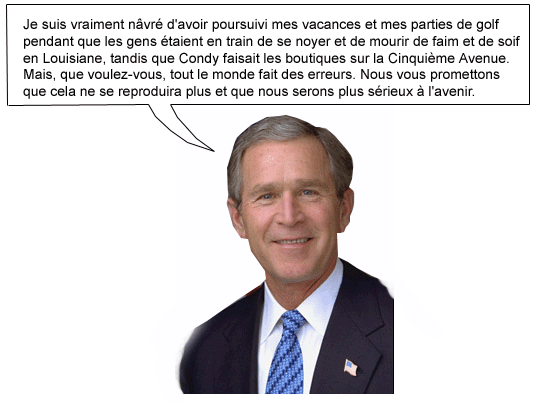
Documents flooded the web following the catastrophe that struck Louisiana. It was difficult to relay them all at once for lack of indisputable evidence. There are rumors that military personnel dynamited the levees to relieve wealthy neighborhoods by flooding poor ones. Possible. Others say that the destruction of wooden houses in Louisiana will facilitate real estate takeovers in poor neighborhoods. In these neighborhoods, three-quarters of the residents were uninsured due to lack of means. When poor Black people lived in wooden shacks, one wonders if, after such a catastrophe, they will still be able to produce property titles. It is possible that even these titles disappeared in the flood. I believe that when it comes to seizing buildable land, one can trust "J.R. Ewing" over there. When interests and dollars are at stake, quite a few things can happen in America. As in France, but on a different scale, with perhaps increased cynicism, as if, ultimately, Americans have always represented an image of our future (drugs, violence, delinquency).
The general impression is that "things did not go well there following the passage of Hurricane Katrina. The leadership team is trying to justify itself by saying that its services were not prepared for a catastrophe of such magnitude. But one can be skeptical. America has very powerful resources. Was everything done to come to the aid of these people? One can doubt it.
Depending on whether you are powerful or miserable...
Here is a testimony that appears reliable.
Thanks to the person who translated this account.
CounterPunch
PO Box 228
Petrolia, CA 95558
1-800-840-3683
counterpunch@counterpunch.org mailto:counterpunch@counterpunch.org
Trapped in New Orleans, First by the Floods, Then by Martial Law
September 6
By Larry Bradshaw and Lorrie Beth Slonsky
LARRY BRADSHAW and LORRIE BETH SLONSKY work for EMS (emergency medical services) in San Francisco and contribute to Socialist Worker http://www.socialistworker.org/ http://www.socialistworker.org/ . They were attending an EMS conference in New Orleans when Hurricane Katrina struck the city. They spent nearly a week trapped by the floods—and the cordon established by martial law surrounding the city.
Two days after Hurricane Katrina struck New Orleans, the Walgreens store at the intersection of Royal and Iberville streets remained locked. The dairy section was visible through the windows. It had been 48 hours without electricity and running water. The milk, yogurts, and cheeses were rotting in 40-degree Celsius heat. The owners and managers had locked up the food, water, diapers, and prescriptions and fled the city. Outside the Walgreens windows, the hunger and thirst of residents and tourists were growing.
The aid promised by federal, state, and local governments never materialized, and Walgreens' windows were smashed by looters. There was an alternative. The police could have broken a small window to distribute peanuts, fruit juices, and bottled water in an organized and systematic manner. But they did not. Instead, they spent hours playing cat and mouse, momentarily chasing away the looters.
We suspect the media are flooded with heroic images of National Guardsmen, soldiers, and police officers struggling to help the "victims" of the hurricane. What you will not see, what we witnessed, is that the heroes and heroines of the true effort to solve the hurricane's problems were: the working class of New Orleans. Construction workers who used a forklift to transport the sick and disabled. Engineers who started and maintained generators. Electricians who improvised extension cords across neighborhoods to share the little available energy to free cars stuck on parking garage roofs. Nurses who took charge of mechanical ventilators and spent hours manually forcing air into the lungs of unconscious patients to keep them alive. Bellhops who saved people trapped in elevators. Refinery workers who entered boat warehouses, "stealing" them to save their neighbors clinging to roofs in the floodwaters. Mechanics who helped start every car they could find so they could transport people out of the city. And food service workers who recovered whatever they could to improvise communal meals for hundreds of abandoned people. The majority of these workers had lost their homes and had not heard from their families, but they stayed and provided the only infrastructure for the 20% of the city that was not submerged by water.
On Day 2, approximately 500 of us remained in the hotels of the French Quarter. We were a mix of foreign tourists, conference attendees (like the two of us), and city natives seeking safety by taking refuge in hotels. Some of us had contact via cell phone with family and friends outside New Orleans. They told us again and again that all kinds of resources, like the National Guard and several dozen buses, were arriving in the city. The buses and other resources must have been invisible because none of us ever saw them.
We decided to save ourselves. So we pooled our money and reserved $25,000 to bring in ten buses to take us out of the city. Those who did not have the $45 needed for a ticket were subsidized by those who had more money. We waited 48 hours for the buses, spending the last twelve hours outside, sharing the little water, food, and clothing we had. We created a priority boarding zone for the sick, the elderly, and newborns. We waited until late at night for the imminent arrival of the buses. They never came. Later we learned that the minute they reached the city limits, they were requisitioned by the army.
On Day 4, our hotels had no more fuel or water. Hygiene was dangerously abysmal. As frustration and despair rose, crime and the water level also rose. The hotels evicted us and closed their doors, telling us that the "authorities" had asked us to join the Convention Center to wait for buses there. When we entered the Center, we finally encountered the National Guard. The guards told us we would not be allowed into the Superdome since the city's main shelter had degraded into a humanitarian and sanitary hell.
The guards also told us that the city's only other shelter, the Convention Center, was also descending into chaos and that police were forbidden from letting anyone in again. Naturally, we asked: "If we cannot go to the city's only two shelters, what is our alternative?" The guards told us that was our problem and that they had no water to give us. This was the first of our many encounters with inept and hostile "law enforcement."
We walked to the police station at Harrah's on Canal Street, and there we heard the same thing: we should fend for ourselves and they had no water to give us. Our group now numbered several hundred people. We held a general assembly to decide what action to take. We agreed to camp in front of the police station. We would be exposed to the media, and this would constitute a visible humiliation for the city authorities. The police told us we could not stay. Nevertheless, we began to settle in and make a camp. Soon, the police chief crossed the street to address our group. He told us he had a solution: we should walk to the Pontchartrain Expressway and cross the big New Orleans bridge, where police had many buses waiting to take us out of the city. The crowd applauded and began to stir. We called everyone back and explained to the chief that a lot of false information was circulating. Was he sure buses were waiting for us? The chief turned to the crowd and declared passionately: "I swear to you that the buses are there."
We organized ourselves, and 200 of us marched toward the bridge with much excitement and hope. As we passed the Convention Center, several city natives saw our determined and optimistic group and asked where we were going. We repeated the fantastic news to them. Families immediately grabbed their few possessions and joined us. The size of our group doubled, then doubled again. We had babies in strollers, people leaning on crutches, the elderly, and others in wheelchairs. We walked the 4-6 km to the expressway and climbed the steep slope leading to the bridge. It was raining now, but the rain did not dampen our enthusiasm.
When we arrived near the bridge, armed police formed a line across the bridge's footings. Before we got close enough to talk to them, they began firing their weapons over our heads. This sent the crowd fleeing in all directions. As the crowd scattered, some of us approached them to engage them in discussion. We repeated our conversation with the chief. The police informed us that no buses were waiting. The chief lied to us to get us moving. We asked why we could not cross the bridge anyway, especially given that there was little traffic on the six-lane expressway. They replied that the West Bank was not going to become New Orleans and that there would be no Superdomes in their city. This was code for saying that if you are poor and Black, you will not cross the Mississippi River and you will not escape New Orleans.
Our small group retreated to Highway 90 to shelter from the rain under the overpass. After debating alternatives, we decided to build a camp in the center of the Pontchartrain Expressway, on the median strips, between the O'Keefe and Tchoupitoulas exits. Our logic was that thus we would be visible to everyone, that we would have safety by being on an elevated expressway, and that we could wait and watch for the arrival of buses. All day, we saw other families, individuals, and groups making the same trip up the slope in an effort to cross the bridge, only to be always repelled. Some were driven off by gunfire, others simply heard "no," and still others were verbally assaulted and humiliated. Thousands of New Orleans residents were prevented and forbidden from evacuating the city on foot themselves.
Meanwhile, the city's only two shelters continued to degrade. The only way to cross the bridge was by vehicle. We saw workers stealing trucks, buses, moving vans, and any cars that could be started without keys. The vehicles were all filled with people trying to escape the misery that New Orleans had become.
Our small camp began to flourish. Someone stole a water delivery truck and brought it to us. Let's applaud all the looters! About 2 km further down the expressway, an army truck lost some supply boxes while turning. We brought the food to our camp in supermarket shopping carts. Now having secured the two necessities, food and water, cooperation, community, and creativity flourished. We organized a cleanup and hung garbage bags from highway poles. We made beds with wooden pallets and cardboard. We designated a drainage ditch for toilets, and the children built an enclosure with plastic, broken umbrellas, and other debris to make them private. We even organized a food recycling system where people could exchange pieces of their supplies (applesauce for babies and candy for children!). This was a pattern seen repeating itself endlessly after Katrina. When individuals had to struggle to find water and food, it meant everyone lived for themselves. One had to do whatever was necessary to find water for your children and food for your parents. When these basic needs were met, people began to care for others, work together, and build a community. If relief organizations had supplied the city with water and food in the first two or three days, despair, frustration, and degradation would not have taken hold of the city. With our basic needs met, we offered water and food to families and individuals who crossed our path. Many decided to stay and join us. Our camp grew to 80 or 90 people.
A woman with a battery-powered radio told us that the media were talking about us. Exposed like that on the expressway, every relief and information organization had seen us entering the city. They were asking the authorities what they were going to do with all these families living up on the expressway. The authorities responded that they were going to "take care of us." Some of us began to be afraid. "Take care of us" had an ominous tone. Unfortunately, this fear was justified. At dusk, a Gretna police officer arrived, pointed his gun at our heads, and screamed: "Get off the fucking highway." A helicopter descended and used the wind it created to blow away our meager shelters. As we retreated, the officer filled his truck with our food and water. Once again, under the threat of a gun, we were forced off the expressway. All law enforcement agencies seemed threatened when we assembled in groups of 20 or more. In every assembly of "victims," they saw "rioters." We felt safe being numerous. Our desire to "stay all together" was impossible because the powers that be forced us to atomize into small groups.
We had scattered again in the pandemonium of our invaded and destroyed camp. Reduced to a small group of eight, in the dark, we sought shelter in an abandoned school bus under the highway on Cilo Street. We were hiding from criminal elements but also, definitively, from the police with their martial law, curfew, and "shoot-to-kill" procedure. In the following days, our group reduced to 8 people, who walked practically all day, made contact with New Orleans firefighters and was saved by a helicopter from an urban search and rescue team. They dropped us off near the airport, and we managed to get there via the National Guard. The two guards were sorry for the limited response of the Louisiana guards. They explained that the majority of their unit was in Iraq, which reduced their numbers too much to accomplish all the assigned work. We arrived at the airport on the day a large air evacuation operation was starting. The airport had become a new Superdome. We were eight, pressed on all sides by a crowd of men, while flights were suspended for several hours so that George Bush could reach the airport and be photographed. After being evacuated by a Coast Guard plane, we arrived in San Antonio, Texas.
There, the humiliation and dehumanization of the official relief effort continued. They put us on buses and drove us to a large field where they made us sit for hours and hours. Some buses had no air conditioning. In the dark, hundreds of us were forced to share two overflowing portable toilets. Those who managed to leave the city with luggage (often just a few things in torn plastic bags) were subjected to two different searches with dogs. Most of us had not eaten all day because our supplies were confiscated at the airport because they set off metal detectors. Yet, no food was provided for the men, women, children, elderly, and disabled as they sat for hours waiting to be seen by a doctor who would confirm that they were not carrying communicable diseases.
This official reception was in stark contrast to the warm and sincere reception that ordinary Texans had offered us. We saw an airline employee give her shoes to someone who was barefoot. Strangers on the street offered us money and toiletries with words of welcome. Throughout the disaster, the official relief effort was insensitive, incompetent, and racist. There was more suffering than necessary. Lives lost unnecessarily...
Larry Bradshaw, Lorrie Beth Slonsky
This message was scanned by MailScanner http://www.mailscanner.info/
for viruses or spam and nothing
suspicious was found
Thanks to the person who translated this account.
CounterPunch
PO Box 228
Petrolia, CA 95558
1-800-840-3683
counterpunch@counterpunch.org mailto:counterpunch@counterpunch.org
Trapped in New Orleans, First by the Floods, Then by Martial Law
September 6
By Larry Bradshaw and Lorrie Beth Slonsky
LARRY BRADSHAW and LORRIE BETH SLONSKY work for EMS (emergency medical services) in San Francisco and contribute to Socialist Worker http://www.socialistworker.org/ http://www.socialistworker.org/ . They were attending an EMS conference in New Orleans when Hurricane Katrina struck the city. They spent nearly a week trapped by the floods—and the cordon established by martial law surrounding the city.
Two days after Hurricane Katrina struck New Orleans, the Walgreens store at the intersection of Royal and Iberville streets remained locked. The dairy section was visible through the windows. It had been 48 hours without electricity and running water. The milk, yogurts, and cheeses were rotting in 40-degree Celsius heat. The owners and managers had locked up the food, water, diapers, and prescriptions and fled the city. Outside the Walgreens windows, the hunger and thirst of residents and tourists were growing.
The aid promised by federal, state, and local governments never materialized, and Walgreens' windows were smashed by looters. There was an alternative. The police could have broken a small window to distribute peanuts, fruit juices, and bottled water in an organized and systematic manner. But they did not. Instead, they spent hours playing cat and mouse, momentarily chasing away the looters.
We suspect the media are flooded with heroic images of National Guardsmen, soldiers, and police officers struggling to help the "victims" of the hurricane. What you will not see, what we witnessed, is that the heroes and heroines of the true effort to solve the hurricane's problems were: the working class of New Orleans. Construction workers who used a forklift to transport the sick and disabled. Engineers who started and maintained generators. Electricians who improvised extension cords across neighborhoods to share the little available energy to free cars stuck on parking garage roofs. Nurses who took charge of mechanical ventilators and spent hours manually forcing air into the lungs of unconscious patients to keep them alive. Bellhops who saved people trapped in elevators. Refinery workers who entered boat warehouses, "stealing" them to save their neighbors clinging to roofs in the floodwaters. Mechanics who helped start every car they could find so they could transport people out of the city. And food service workers who recovered whatever they could to improvise communal meals for hundreds of abandoned people. The majority of these workers had lost their homes and had not heard from their families, but they stayed and provided the only infrastructure for the 20% of the city that was not submerged by water.
On Day 2, approximately 500 of us remained in the hotels of the French Quarter. We were a mix of foreign tourists, conference attendees (like the two of us), and city natives seeking safety by taking refuge in hotels. Some of us had contact via cell phone with family and friends outside New Orleans. They told us again and again that all kinds of resources, like the National Guard and several dozen buses, were arriving in the city. The buses and other resources must have been invisible because none of us ever saw them.
We decided to save ourselves. So we pooled our money and reserved $25,000 to bring in ten buses to take us out of the city. Those who did not have the $45 needed for a ticket were subsidized by those who had more money. We waited 48 hours for the buses, spending the last twelve hours outside, sharing the little water, food, and clothing we had. We created a priority boarding zone for the sick, the elderly, and newborns. We waited until late at night for the imminent arrival of the buses. They never came. Later we learned that the minute they reached the city limits, they were requisitioned by the army.
On Day 4, our hotels had no more fuel or water. Hygiene was dangerously abysmal. As frustration and despair rose, crime and the water level also rose. The hotels evicted us and closed their doors, telling us that the "authorities" had asked us to join the Convention Center to wait for buses there. When we entered the Center, we finally encountered the National Guard. The guards told us we would not be allowed into the Superdome since the city's main shelter had degraded into a humanitarian and sanitary hell.
The guards also told us that the city's only other shelter, the Convention Center, was also descending into chaos and that police were forbidden from letting anyone in again. Naturally, we asked: "If we cannot go to the city's only two shelters, what is our alternative?" The guards told us that was our problem and that they had no water to give us. This was the first of our many encounters with inept and hostile "law enforcement."
We walked to the police station at Harrah's on Canal Street, and there we heard the same thing: we should fend for ourselves and they had no water to give us. Our group now numbered several hundred people. We held a general assembly to decide what action to take. We agreed to camp in front of the police station. We would be exposed to the media, and this would constitute a visible humiliation for the city authorities. The police told us we could not stay. Nevertheless, we began to settle in and make a camp. Soon, the police chief crossed the street to address our group. He told us he had a solution: we should walk to the Pontchartrain Expressway and cross the big New Orleans bridge, where police had many buses waiting to take us out of the city. The crowd applauded and began to stir. We called everyone back and explained to the chief that a lot of false information was circulating. Was he sure buses were waiting for us? The chief turned to the crowd and declared passionately: "I swear to you that the buses are there."
We organized ourselves, and 200 of us marched toward the bridge with much excitement and hope. As we passed the Convention Center, several city natives saw our determined and optimistic group and asked where we were going. We repeated the fantastic news to them. Families immediately grabbed their few possessions and joined us. The size of our group doubled, then doubled again. We had babies in strollers, people leaning on crutches, the elderly, and others in wheelchairs. We walked the 4-6 km to the expressway and climbed the steep slope leading to the bridge. It was raining now, but the rain did not dampen our enthusiasm.
When we arrived near the bridge, armed police formed a line across the bridge's footings. Before we got close enough to talk to them, they began firing their weapons over our heads. This sent the crowd fleeing in all directions. As the crowd scattered, some of us approached them to engage them in discussion. We repeated our conversation with the chief. The police informed us that no buses were waiting. The chief lied to us to get us moving. We asked why we could not cross the bridge anyway, especially given that there was little traffic on the six-lane expressway. They replied that the West Bank was not going to become New Orleans and that there would be no Superdomes in their city. This was code for saying that if you are poor and Black, you will not cross the Mississippi River and you will not escape New Orleans.
Our small group retreated to Highway 90 to shelter from the rain under the overpass. After debating alternatives, we decided to build a camp in the center of the Pontchartrain Expressway, on the median strips, between the O'Keefe and Tchoupitoulas exits. Our logic was that thus we would be visible to everyone, that we would have safety by being on an elevated expressway, and that we could wait and watch for the arrival of buses. All day, we saw other families, individuals, and groups making the same trip up the slope in an effort to cross the bridge, only to be always repelled. Some were driven off by gunfire, others simply heard "no," and still others were verbally assaulted and humiliated. Thousands of New Orleans residents were prevented and forbidden from evacuating the city on foot themselves.
Meanwhile, the city's only two shelters continued to degrade. The only way to cross the bridge was by vehicle. We saw workers stealing trucks, buses, moving vans, and any cars that could be started without keys. The vehicles were all filled with people trying to escape the misery that New Orleans had become.
Our small camp began to flourish. Someone stole a water delivery truck and brought it to us. Let's applaud all the looters! About 2 km further down the expressway, an army truck lost some supply boxes while turning. We brought the food to our camp in supermarket shopping carts. Now having secured the two necessities, food and water, cooperation, community, and creativity flourished. We organized a cleanup and hung garbage bags from highway poles. We made beds with wooden pallets and cardboard. We designated a drainage ditch for toilets, and the children built an enclosure with plastic, broken umbrellas, and other debris to make them private. We even organized a food recycling system where people could exchange pieces of their supplies (applesauce for babies and candy for children!). This was a pattern seen repeating itself endlessly after Katrina. When individuals had to struggle to find water and food, it meant everyone lived for themselves. One had to do whatever was necessary to find water for your children and food for your parents. When these basic needs were met, people began to care for others, work together, and build a community. If relief organizations had supplied the city with water and food in the first two or three days, despair, frustration, and degradation would not have taken hold of the city. With our basic needs met, we offered water and food to families and individuals who crossed our path. Many decided to stay and join us. Our camp grew to 80 or 90 people.
A woman with a battery-powered radio told us that the media were talking about us. Exposed like that on the expressway, every relief and information organization had seen us entering the city. They were asking the authorities what they were going to do with all these families living up on the expressway. The authorities responded that they were going to "take care of us." Some of us began to be afraid. "Take care of us" had an ominous tone. Unfortunately, this fear was justified. At dusk, a Gretna police officer arrived, pointed his gun at our heads, and screamed: "Get off the fucking highway." A helicopter descended and used the wind it created to blow away our meager shelters. As we retreated, the officer filled his truck with our food and water. Once again, under the threat of a gun, we were forced off the expressway. All law enforcement agencies seemed threatened when we assembled in groups of 20 or more. In every assembly of "victims," they saw "rioters." We felt safe being numerous. Our desire to "stay all together" was impossible because the powers that be forced us to atomize into small groups.
We had scattered again in the pandemonium of our invaded and destroyed camp. Reduced to a small group of eight, in the dark, we sought shelter in an abandoned school bus under the highway on Cilo Street. We were hiding from criminal elements but also, definitively, from the police with their martial law, curfew, and "shoot-to-kill" procedure. In the following days, our group reduced to 8 people, who walked practically all day, made contact with New Orleans firefighters and was saved by a helicopter from an urban search and rescue team. They dropped us off near the airport, and we managed to get there via the National Guard. The two guards were sorry for the limited response of the Louisiana guards. They explained that the majority of their unit was in Iraq, which reduced their numbers too much to accomplish all the assigned work. We arrived at the airport on the day a large air evacuation operation was starting. The airport had become a new Superdome. We were eight, pressed on all sides by a crowd of men, while flights were suspended for several hours so that George Bush could reach the airport and be photographed. After being evacuated by a Coast Guard plane, we arrived in San Antonio, Texas.
There, the humiliation and dehumanization of the official relief effort continued. They put us on buses and drove us to a large field where they made us sit for hours and hours. Some buses had no air conditioning. In the dark, hundreds of us were forced to share two overflowing portable toilets. Those who managed to leave the city with luggage (often just a few things in torn plastic bags) were subjected to two different searches with dogs. Most of us had not eaten all day because our supplies were confiscated at the airport because they set off metal detectors. Yet, no food was provided for the men, women, children, elderly, and disabled as they sat for hours waiting to be seen by a doctor who would confirm that they were not carrying communicable diseases.
This official reception was in stark contrast to the warm and sincere reception that ordinary Texans had offered us. We saw an airline employee give her shoes to someone who was barefoot. Strangers on the street offered us money and toiletries with words of welcome. Throughout the disaster, the official relief effort was insensitive, incompetent, and racist. There was more suffering than necessary. Lives lost unnecessarily...
Larry Bradshaw, Lorrie Beth Slonsky
--
This message was scanned by MailScanner http://www.mailscanner.info/
for viruses or spam and nothing
suspicious was found
Readers have sent me photos that are supposed to have been taken during Hurricane Katrina's passage. It is impossible to identify the source. Nowadays, we must acknowledge that such images can be recreated using computer-generated imagery. Let's say that, true or false, these images must represent what people might have seen coming towards them that day.
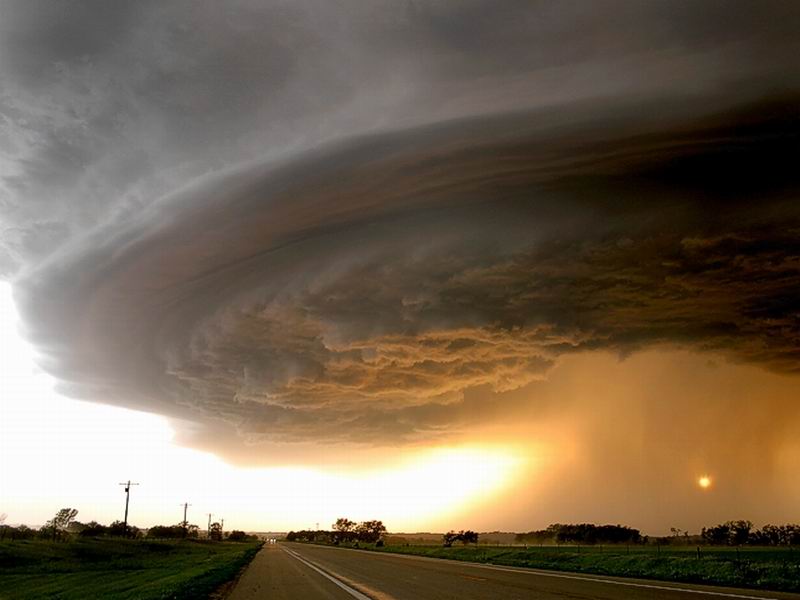
**Photo of Hurricane Katrina ( ? ) **
Return to Guide Return to Home Page
**Number of views of this page since September 21, 2005 ** :