The Law on the Digital Economy
The Law on the Digital Economy
May 25, 2004
This law, loudly proclaimed by Raffarin, was adopted by the National Assembly on May 8, despite a massive petition from internet users. It still needs to be approved by the Senate. It includes various provisions that pose a serious threat to the freedoms we currently enjoy on the internet. For example, it seeks to make website hosts jointly liable for offenses committed by website administrators (webmasters);
A website has been created: http://www.odebi.org to draw attention to this issue. A demonstration is even planned for Saturday, May 29 at 2 PM, at Colonel Fabien Square in Paris. I believe it would be important for as many people as possible to attend. But before raising this issue, I would like to recall that for French people, the internet remains relatively new and often obscure. Until fairly recently, few people had access to it. Today, even though many people "connect" and browse websites, few truly understand how it all works, or even what a web host is. I believe it is advisable, before moving on to a passage taken from the ODEBI website, to provide some clarifications regarding websites.
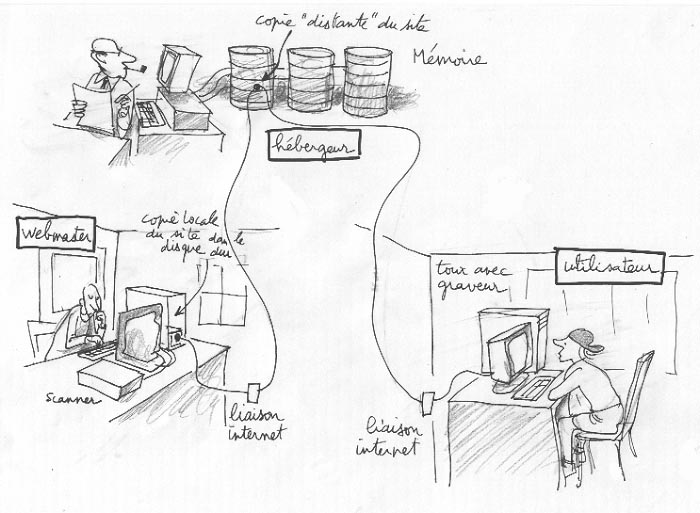
At the bottom left, you see a webmaster, simply a person who has learned how to use software enabling them to create HTML pages that can be arranged to form a website. To do this, they use an editor. A word processor like Word is an "editor." With Word, you can create documents containing text and images. With an internet page editor, such as Dreamweaver, you can also create pages containing text and illustrations, photos, or drawings. These "HTML pages" are not the same as Word text pages. They can, for example, be of arbitrary length—five, ten times the screen size. As I keep adding lines of text and inserting images, my page will grow longer, and a "scroll bar" will appear on the right, allowing me to scroll through the content on screen.
The second tool of these internet pages is the link. When you browse pages on a website, certain passages are colored and underlined. When you click on them, you are instantly taken elsewhere—anywhere: another part of the same page, another page on the same site, or even another website or a specific page on that site. This is truly astonishing. For instance, if I write: "If you want to know more, click here to read what Mr. Smith says in his thesis defended at the University of Ottawa in 1979," clicking will instantly transport you to the relevant page in that thesis. It’s as if, in a fraction of a second, you had crossed an ocean, entered a library, found the thesis, and landed on the correct page. In reality, this thesis has been "digitized." It no longer exists in the library mentioned but somewhere on a hard drive of a server that could be... anywhere, not necessarily in Canada!
Here, you can click as much as you like, nothing will happen. This is not a real link, but just a passage I've underlined and colored blue.
All this to say that you don’t need to be a computer genius to create a website. The only essential requirement is that this collection of pages must include one special page called "index." When a user wants to view your site, this page will be called first. But we’re not there yet. Right now, this site exists only on the hard drive of the person at the bottom left. He has composed his pages, added all the links he wanted, included countless images (he can also add animations or sound, but let’s not complicate things). Once everything is done, he can test the functionality of his site structure by clicking on the index page in the folder containing his site. This action launches a reading program called a browser (such as Internet Explorer or Netscape, etc.). On the screen, the site creator—the "webmaster"—will see the pages exactly as they will appear when viewed by a user. But at this stage, everything is local. He is the only one—client of the site he created.
This is where he must enlist the help of a host, a company possessing vast memory capacity. After signing an agreement—a kind of contract between the webmaster and the host—the host will allow him, from his computer, to send his pages to a designated memory space allocated by the host, either for a fee or for free. Indeed, there are free hosts. I must admit I’ve never fully understood how these people manage to sustain themselves, and perhaps a reader can enlighten me.
I personally have two hosts.
http://www.jp-petit.com is hosted by a company called Axinet, which is a paid service.
http://lanturluland.free.fr uses the services of a free host called Free, which generously allocates memory space of 100 megabytes.
Once this agreement is in place, the webmaster receives access codes that allow only him (and the host) to access the pages of his site. At this point, the site exists in two copies: one on the webmaster’s hard drive, and the other in the host’s memory space. In doing so, the host grants the webmaster a URL—a website address—like the two shown above. This allows a user (the person on the right) with an internet connection to type this URL into their browser window, instantly connecting them to the information stored in the memory space hosted by the provider. How can thousands of people simultaneously access this information? Rudyard Kipling provides the answer in his stories:
This is a great trick and sheer magic.
At this point, you might be tempted to ask: where’s the problem? I’ll answer.
A certain Filstrup rents a room somewhere. He has a phone installed, sets up a computer, subscribes to an internet connection, then connects to a free host service and requests a memory space to create a website. To do so, he goes to the host’s website. Everything is done via his keyboard. He is asked for his name and address (he could easily use a fake name—no identity verification is required). All that’s needed is an email address so the host can send the new client a message containing the access codes, allowing him to upload... absolutely anything to that memory space. There is no control. The webmaster can thus commit a staggering number of offenses: defame fifteen people, reproduce copyrighted photographs without authorization, or upload texts and music that also require copyright payments. Once this is done, he can simply disappear into...