On the manipulation of information
Where does truth begin, where does manipulation end?
February 18, 2006
Orson Welles became famous in the United States by broadcasting on American radio a program in which he claimed to describe the arrival of extraterrestrials on American soil. The impact was tremendous. Some people jumped into their cars and fled. There were a few suicides. A few years later, I believe it was the young Pauwels who repeated the stunt in France. If I'm not mistaken, the broadcast was called "Plateforme soixante-dix." At the time, I must have been twelve years old. But I remember perfectly that afternoon when the family listened gravely to the news. Television did not yet exist, neither in color nor in black and white. For us, the media, outside of newspapers, were radio. Occasionally, a "press release" would arrive. Pauwels had started his broadcast in the most ordinary way. Then he abruptly interrupted it, claiming to have just received very important news. He pretended to have a terrible phone connection with a journalist supposedly present at the scene of what strongly resembled the landing of a "craft from elsewhere," living through the events "live and on the front line." The dramatic intensity was carefully calibrated. Pauwels's voice shifted successively from amused curiosity and skepticism to an anxiety he wanted to be contagious. After an hour, the dialogue sounded like this:
— Do you see them?
— I see two smoking cylinders...
— And do you see anything else?
— We can't see because of the smoke. Ah... I see silhouettes. There are two of them.
— Can you describe them? ...
— I see... ah, one of the creatures is pointing a shiny object toward me. Ahhr... I'm burning... ahrrr....
End of the radio transmission.
People didn't know whether it was real or a hoax, especially since most French people had not heard about the prank that had made Orson Welles famous across the Atlantic.
There have been fake celebrities. The Russians were masters at photographic manipulation, erasing unwanted people from photos. Between each purge, scenes would empty out. It was Photoshop before Photoshop. Today, even the most amateur can truly do... anything, which means the distinction between a genuine photo and a fake has become a matter of personal estimation, of cross-referencing.
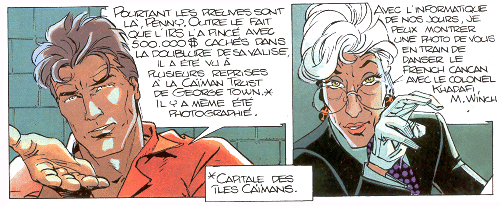
I really like the Largo Winch comic book series. In the one titled Shadow, Winch is imprisoned at the same time as his deputy. Fortunately, his loyal secretary Penny comes to visit him. Together, they laboriously unravel a new conspiracy in which the billionaire heir is involved. On page 5, we find the following dialogue:
The album was released in 2002. Since then, in four years, the technology has advanced even further. We can manipulate voices, still images, and even videos. Look at what you can see at the cinema. In Jurassic Park II, dreadfully boring, actors stroll around with baby dinosaurs in their arms. We see them move, cry.
Pierre Lo Cicero, one of my readers, amused himself by creating a "crop circle" in a field near my house—two quick clicks of the mouse. He used a small software program. It took him just twenty minutes. With more time, one could really do anything.
Twenty years ago, I knew in Aix one of the pioneers of computer-generated imagery (the term hadn't been invented yet, I think). But he arrived too early, I imagine. In France, you either arrive too early or too late. As an informatician, he was among the first to demonstrate that actors could be made to move—say, a stuntman on horseback—by outfitting them with sensors. Then, the actor and his horse were dressed in flashy accessories. He thought that one day we could film movies with Spencer Tracy or Marilyn Monroe, their appearances merely masks placed on the faces of extras, far less well paid than real stars, and that one day the public would no longer be able to tell the difference. It hasn't happened yet, but it will.
My generation witnessed the birth of computer-generated imagery. In the 1970s, it took hours of computation and a fortune to create a still life with a glass placed on a chessboard, through which you could see... I don't know what. We began adding textures. With a single click, an object could appear made of stone, marble, or veined wood. We were amazed.
Then came hair, wrinkles, reflections, even... sweat. I think of the film Final Fantasy, which is quite good. But where are we now? What are we capable of doing? Probably better. When I see what comes out of a game manipulated by a kid on a PC running at 4 gigahertz, and compare it to what an ordinary person could access in 1980, it's dizzying.
We place a constellation of sensors on an actor's face. He moves, smiles, speaks. Later, in the lab, we can add thickness or, conversely, make his cheeks thinner. We can make the hair of a virtual beard grow in fast motion. We can do... anything.
So, where is the truth?
Some people amuse themselves by altering newspaper pages and spreading false information. We'll have to get used to it, learn to pause before... anything. The most recent example: a forgery of the Républicain Lorrain.
http://img110.imageshack.us/img110/3135/articlegongelfang6qt.jpg

Read the text: this photo "is said to have been taken from a helicopter." Location: near the commune of Montmelian. The mark was supposedly made "by compacting the soil." According to the paper, local Muslim representatives had filed a complaint demanding apologies and exemplary sanctions against the perpetrators.
Reader calls to the newspaper. Response from the editorial team:
— No, we never published this.
But look at the image and read the intent, which was far from innocent: to reignite the controversy over the caricatures of Muhammad.
The key word is "manipulation." This was amateur work. But, in its own way, the mainstream press manipulates just as much. It gives prominence to certain current events while minimizing others, or even completely ignoring them. The history itself slips away from us. Decades later, we discover shocking aspects that had been carefully hidden from us. Go see this section of the page on my site, where we learn that Delouvrier, High Commissioner in Algeria under de Gaulle’s direct orders, admitted having paid the FLN for years to prevent them from sabotaging the gas pipeline bringing its precious cargo to the gate of Bougie. A bit higher on the same page, you'll see how an image of a glow was erased when one of the planes struck one of the twin towers on September 11, even though that same glow appears in the CNN broadcast footage. In a recent program devoted to Algeria and its history, the former director of the Institut du Monde Arabe in Aix (s...)