Brain Chip Parasitism Technology
How to implant a chip in your brain
Jean-Pierre Petit and François Lescure
October 24, 2005
It's child's play. But before explaining how, let me make a simple observation: technology has merely imitated the living world since the dawn of time. Clothing is artificial skin or fur. The first chipped stone mimicked a fang, tooth, or horn. Fire allows us to pre-digest food and extend our "range of food access." Glasses are artificial lenses. Books are "external memories," storing transmissible information. Keep going. Synthetic molecules from the pharmaceutical industry extend—more or less successfully—natural pharmacopeias. Bushmen's poisons mimic those of snakes. To list all such analogies would take forever.
We then arrive at parasitism. The first parasites are viruses. Numerous cases of parasitism exist where the invader takes residence in an animal's brain or nervous system, altering its behavior. For instance, certain insects will hurl themselves into water and "commit suicide" so they can be eaten by another creature, allowing the parasite to continue its "life cycle"—not destroyed or digested, but expelled elsewhere. Other insects climb to the tops of grass blades, a behavior they never exhibit naturally, so they can be eaten by birds, which carry the parasite over long distances and deposit it intact, alive, in their droppings. Many parasites rely on successive hosts.
"Chips," far more sophisticated extensions of RFID (Radio Frequency Identification Devices) or electronic "tags," represent the technological version of parasitism. The company alien technology produces them for various purposes. Visit their website. Military applications are presented without the slightest hesitation. We already know that nanotechnologies—far more advanced than any ordinary people might imagine—can produce chips as small as one hundred microns in diameter, that is, one-tenth of a millimeter: smaller than a grain of sand. About the size of the dot ending this line. The company Gillette once planned to implant such markers into its razors. But the outcry from American consumer associations killed the project. It's just postponed.
For the clothing industry, these chips can be embedded... right into the fabric's threads. The technique is already perfected and has been successfully tested. It will simply require people to grow accustomed to the idea.
There remains the major conceptual leap: accepting that chips could be integrated into human bodies. Everywhere, the benefits of such a solution are extolled: medical data, tracking of sex offenders, marking individuals deemed dangerous. Then, one day, marking people in general. As someone once said, "Why reject this technology if you have nothing to hide?"
I've already mentioned a system that could implant millions of microscopic chips into humans via a massive vaccination campaign. Thus, people would unknowingly equip themselves. Isn't that a wonderful solution—without violence or coercion?
But how to get these microchips to settle where they could be most useful: in the brain? Should we imagine a sophisticated system to deliver them into our brains?
Not at all. It happens automatically. All that's needed is for these microchips to have a density lower than that of blood. Let me explain. Of course, we won't place just one chip in the life-saving vaccine vial, but several. The blood will carry these tiny "bubbles." I didn't choose that word by accident. You've heard of diving accidents, decompression sickness. The pulmonary alveoli serve as the natural interface for oxygenation—and also for gas elimination—from the blood. Like any liquid, blood can absorb gas molecules in various ways. Oxygen binds to red blood cells to form oxyhemoglobin, enabling oxygen collected in the lungs to be transported to cells. Nitrogen also dissolves in the blood. For any given pressure, a certain number of nitrogen molecules per cubic centimeter of blood. When pressure increases, this number grows.
When a diver ascends, nitrogen comes out of the bloodstream. If the ascent is slow enough, no bubbles appear. Nitrogen is gradually released in the lungs, at the "interface"—in the delicate alveolar regions where blood flow contacts air within the lungs. To better understand, take a bottle of champagne. When you uncork it, the free surface of the champagne constitutes its de-gassing interface. Countless CO₂ molecules escape the liquid per second. By allowing the gas to escape gradually, you ensure the external pressure drops slowly, not too abruptly. Then, de-gassing occurs without bubbles forming. After some time, you can leave the champagne open to air. No problem remains. All the CO₂ has been evacuated through the two or three square centimeters of free surface near the bottle's neck.
But if pressure drops too quickly, bubbles appear rapidly. In a diver’s blood, the same thing happens. Decompression stops are used to prevent blood from decompressing too rapidly, allowing gas release to occur gradually, without bubble formation, in the pulmonary alveoli at the interface. In cases of "too rapid ascent" or overly abrupt decompression, bubbles appear throughout the bloodstream. Problems arise when these tiny bubbles travel along capillaries. They can then block blood flow. If these capillaries supply organs that poorly tolerate oxygen deprivation—organs that can't survive under "apnea"—those organs may become damaged.
We know the nervous system is a major consumer of oxygen and, consequently, suffers greatly when deprived of it. Our nerves are supplied with oxygen via a network of capillaries. If nitrogen bubbles obstruct this network, the nerves can be damaged or destroyed.
Capillary networks can be structured in two different ways: with or without anastomoses (a term found in the Larousse dictionary). In anastomosed capillary networks, the tiny blood vessels communicate with each other in multiple ways. This is a matter of the microvascular network's topological organization:
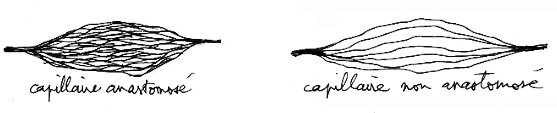
We can compare these capillaries to corridors. In an anastomosed network, if one corridor is blocked, the blood flow—carrying oxygen—can pass through a neighboring corridor. In an anastomosed network, if a bubble becomes lodged somewhere, compensatory circulation can kick in, continuing to supply oxygen to the tissue. In a non-anastomosed network, this becomes much more problematic, possibly impossible. If the blockage persists too long, necrosis will strike the organ (a few tens of...