Climate change and increasing intensity of tropical cyclones
Consequences of climate change
August 29, 2005
They are multiple, and one could discuss their causes at length, which may not stem exclusively from the greenhouse effect caused by CO2 emissions. Regarding this, there exist systems capable of capturing CO2 and transforming it into oxygen, while fixing carbon in the soil—systems that cost nothing and have been functioning since the dawn of time. These systems are called:
- Trees *
Instead of combating rampant deforestation by rapidly turning toward non-polluting energy sources, humans are considering expensive and potentially dangerous solutions, such as compressing CO2 and attempting to store it in underwater wells.
Anything but sensible...
It has been observed that increased CO2 dissolved in seawater has made it more acidic due to the reaction between CO2 and water, producing carbonic acid.
CO2 + H2O → CO3H2
As a result, planktonic organisms struggle to form their shells. The release of CO2 into the atmosphere and its inevitable absorption by seawater could have unpredictable and significant ecological and food chain consequences, disrupting the entire ecosystem.
A reader reminds us that the Siberian permafrost is melting at an unprecedented speed, something never seen in human memory. This melting releases methane, which is twenty times more effective than carbon dioxide as a greenhouse gas.
We should also recall that "solar meteorology" is poorly understood. As Souriau once reminded me, whenever solar activity increases even slightly, we feel its effects here on Earth within eight minutes—effects that are far from minor. If the Sun joins in, we're in trouble.
It appears that the United States is beginning to face tropical cyclones of increasing intensity, such as the recent Hurricane Katrina (August 29, 2005).
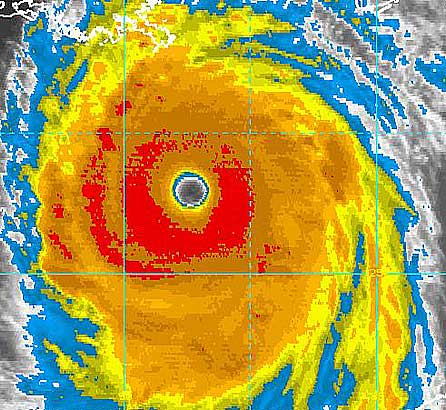
Hurricane Katrina (August 29, 2005). Maximum wind speed: 300 km/h
Intensity: five (maximum)
Projected path:
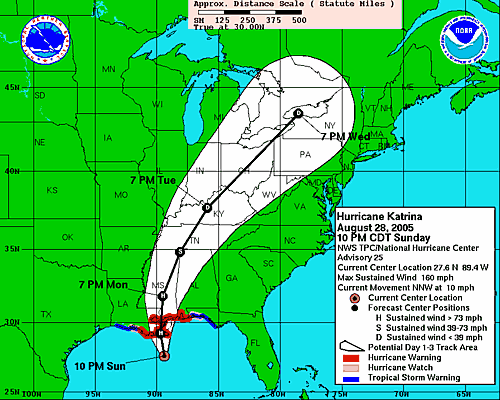
Path of Hurricane Katrina
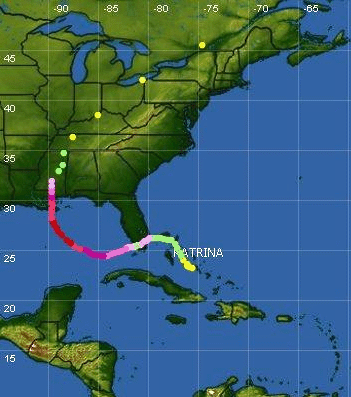
Path with wind intensity
An excellent Flash animation explaining cyclone formation:
http://tv5.org/TV5Site/info/afp/francais/animation/CyclonesFR2508/start.swf
August 29, 2005, 9 PM: Katrina "not only changed course over the weekend, but temporarily became a Category 5 hurricane," the worst possible scenario for the oil market, notes Bill O'Grady, analyst at AG Edwards. Katrina's arrival forced oil companies to shut down numerous installations in the Gulf of Mexico, where a quarter of U.S. oil infrastructure is located. At least 21 oil wells and platforms were evacuated in the region, and seven refineries in Louisiana were closed as of Saturday. One of the state's major ports, the Louisiana Offshore Oil Port, has also been closed since Saturday. Normally, this terminal handles 11% of the country's oil imports. "Refinery activity in the region has been suspended—something that adds fuel to the fire, given that the market is already highly volatile," commented Seth Kleinman, analyst at PFC Energy. Crude oil prices have been rising steadily for nearly three years, but the approach of such a powerful hurricane as Katrina, combined with an unexpected drop in U.S. gasoline inventories this week, caused prices to surge by $5 in just one week.
The price of a barrel has reached $70 today
In recent times, traders have also been deeply concerned about geopolitical tensions between Western countries and Iran. According to analysts, prices could now head toward the $80 per barrel threshold, especially given the extremely tight supply-demand ratio, partly due to insufficient investment in refining over recent years and sustained high demand. Economists no longer hesitate to label the rise since early 2002 as the "third oil shock," though they acknowledge it affects the global economy far less than the previous two (1973 and 1979/80), particularly because it avoids triggering an inflationary spiral. The Organization of Petroleum Exporting Countries (OPEC), which supplies about 40% of global crude oil, sought to reassure the market this weekend by reiterating that no shortage is expected. However, anxiety and frustration are rising among consumers, who are already suffering from soaring gasoline and heating oil prices. Meanwhile, businesses are seeing their profit margins shrink accordingly.
Some predict oil prices could approach $100 per barrel by the end of 2005 ( ? )
Tuesday, August 30, 2005. Hurricane Katrina proved to be one of the most devastating storms ever to hit the southern United States. At least 54 deaths in Mississippi, with widespread destruction in Louisiana and Alabama. The death toll could rise further in coastal cities hit by torrential rains and winds reaching 240 km/h. Mississippi Governor Haley Barbour stated that the damage along the coast was "unprecedented" and that destruction was expected to reach "catastrophic" proportions. Insurers estimate damages between $12 and $26 billion, making Katrina one of the costliest hurricanes the country has ever seen. Over one million people were left without electricity in Louisiana, Mississippi, and Alabama.
The storm forced oil companies to shut down 711 wells and platforms in the Gulf of Mexico—a region that normally supplies about a quarter of U.S. fuel and gasoline production.
Oil prices reached a new historical high of $70.80 per barrel on Monday before dropping sharply after U.S. government statements about a possible release from strategic reserves in case of shortage.
Katrina had already killed seven people during its first landfall over Florida earlier in the week. In Louisiana, three elderly people died Monday during evacuation to inland areas.
Check out Yahoo News: http://fr.news.yahoo.com/050831/202/4k7j0.html
In short: Katrina surpassed all expectations in terms of human casualties and destruction. Hundreds of deaths. 80% of New Orleans (1.5 million inhabitants) submerged under water. Area: half the size of France. Without electricity or water, the region is nearly cut off from the world. Looters, taking advantage of the darkness, are ransacking homes and stores. In the Mississippi coastal zone, damage is "simply enormous," said Governor Barbour. Homes and casinos are destroyed, highways are flooded, and several bridges connecting coastal towns have been swept away. "This is our tsunami," summarized Biloxi Mayor A.J. Holloway. With 95% of oil production halted, the barrel price rose to $70.85. In an American newspaper, a journalist wrote:
The true name of this hurricane...