We've Lost Half the Universe
What's the point of Petit struggling so hard?
...In 1997, I published a book titled "We've Lost Half the Universe," with Albin Michel publishers. There was total silence in the press—general or scientific—upon its release, yet it sold reasonably well over the past four years, solely through word of mouth.
or in paperback edition:
...This book presents a popularized account of my work in astrophysics and cosmology, which began (in cosmology) in 1987 with the publication of three papers in Modern Physics Letters A. Other publications followed in Nuovo Cimento, Astrophysics and Space Science, The Modern Journal of Physics B, etc.
...In this field, therefore, I am certainly not a fantasist or an amateur, despite what people like Jean-Pierre Luminet might claim. When Jean Staune (UIP) questioned Luminet about my work, Luminet responded: "Petit's papers? Full of errors..."
...Now, if Luminet decides to retract this remark, let him speak up. My source is, in principle, reliable.
...The theme of my research: It is pointless to search for dark matter in our universe. Phenomena such as galaxy and galaxy cluster confinement, and strong gravitational lensing effects, should be attributed to a "twin matter" located in what can truly be called a "parallel universe" to ours. I have been working along these lines since 1977 (with the publication of an initial note in the Comptes Rendus de l'Académie des Sciences de Paris), that is, for 23 years. And what do we see in the February issue of Science and Avenir?
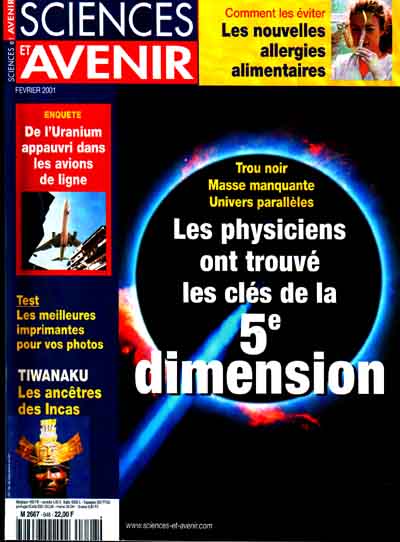
and within the article body:
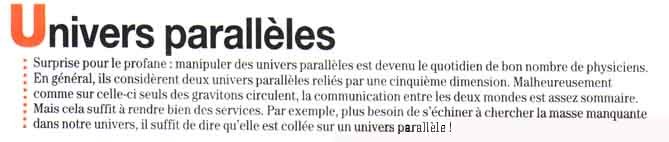
...You will search in vain for any mention of my work or reference to my cosmological model—despite its solid structure and potential for multiple observational confirmations—in the press ("general" or specialized in scientific popularization). Recently, La Recherche published a dossier discussing "various cosmological models"—not a single word about J.P. Petit's work. I therefore suggest readers of my website conduct an experiment. If they find it useful, they may send an email jointly to the editorial office of Science and Avenir (redaction@sciences-et-avenir.com) and to the article's author, David Larousserie, asking whether they are aware of my work and, if so, what they think of it. If experts consulted by them offer an unflattering critique, kindly inform them that I would like to know the substance of it (just as I would appreciate Luminet offering a more scientifically constructive comment on his criticism). If readers are kind enough to send me copies of their letters by email, I will reproduce them on this webpage, along with any responses they may receive.
...Here is the copy of the message I personally sent to the editorial office of the magazine:
January 31, 2001.
Jean-Pierre Petit, Research Director at CNRS, Marseille Astrophysics Laboratory (LAM).
To the editorial office of Sciences et Avenir and to David Larousserie, author of the article published in the February 2001 issue titled "Enter the Fifth Dimension."
Gentlemen,
...I have finally grown accustomed to the fact that popular science media completely ignore my work in astrophysics and theoretical cosmology. My latest book, "We've Lost Half the Universe," published in 1997 by Albin Michel (which would gladly send you a press copy upon request), was not mentioned. It still sold reasonably well, thanks solely to word of mouth and references on my website http://www.jp-petit.com.
...What is more troubling, however, is seeing that the same media dedicate extensive space to speculative claims based on publications that do not even attempt to confront observations. In contrast, my "twin universes" model is quite well-developed.
...The book provides a popularized presentation, but a specialist in general relativity will find in my website articles containing all the necessary technical details.
...I have published in peer-reviewed journals (Nuovo Cimento 1994, Astrophysics and Space Science 1995, The International Journal of Modern Physics D 1999). The articles are fully reproduced on the website, and if needed, I am available—either to a journalist or to an expert they may have consulted—to answer any questions. Drawing a parallel with a sentence from your article: "For example, no need to strain to find missing mass in our universe; it's enough to say it's stuck in a parallel universe," I would point out that I have been "attaching matter to a twin universe of ours" for ten years (the original idea actually dates back to Andrei Sakharov in 1967).
What are my claims?
The Twin Universes Model:
- Offers an interpretation for galaxy confinement—reproduces the characteristic shape of the gas rotation curve with high peripheral velocities—explains galaxy cluster confinement—provides an alternative explanation for strong gravitational lensing effects, attributing them to the twin universe. Indeed, if our universe is sensitive to the gravitational influence of its twin, the matter distribution within it produces lensing effects in our own universe.
- The model accounts for the acceleration of our cosmos's expansion while the twin universe's expansion slows down. To use a journalistic expression, our universe is "propelled forward by the repulsive power of the twin universe." There is no need for a cosmological constant; or if one insists, the cosmological constant is merely the so-called "repulsive power of the vacuum," which are actually effects of the twin universe's action on ours. These two universes are asymmetric (their joint expansion forms a dynamically unstable system).
- The model produces a large-scale, porous structure in our universe that remains stable over tens of billions of years (Astrophysics and Space Science, 1995). The universes experience "joint gravitational instabilities." The twin universe, being denser, forms spherical conglomerates more rapidly (via numerical simulations), pushing our matter into residual space, which then organizes into non-joined bubbles. At the center of each bubble: a conglomerate of twin matter "geometrically invisible" (photons cannot pass from one universe to the other; each has its own). These two universes interact only gravitationally, which I have fully modeled using two coupled field equations proposed in Nuovo Cimento in 1994.
- The model accounts for classical general relativity observables.
- The model provides a theory of galaxy formation, occurring precisely when matter cells form. Matter, pushed away by twin matter conglomerates and compressed along these "plates," could then efficiently cool via radiation...