Cosmology, dark matter, cosmic structure, astrophysics
I was bored at the Marseille astrophysics conference
(June 2001)
Dark matter research, desperately.
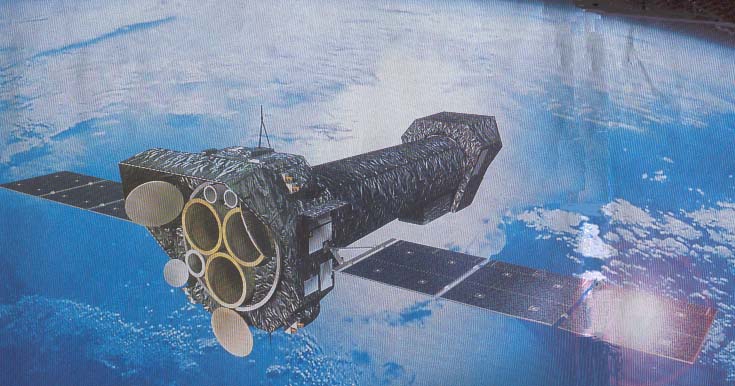
Scientists are very pleased with the observations that have been made in the X-ray range using the XMM and Chandra telescopes. Below is an artist's image of the XMM X-ray telescope:
I refer here to an old article, from January 2001, published in the magazine Ciel et Espace, written by Azar Khalatbari. Here are some excerpts:
Page 25: "Between galaxy clusters, matter concentrates to form long structures, filaments. All of this remains connected, each at its own scale, by the force of gravity. For a long time, cosmologists have wondered how the organization of matter evolved to result in these filaments and whether these currently visible structures existed in the past."
I wonder about it too, because this structure, at least in terms of observations, exists only in the imagination of Mr. Khalatbari. A few lines further, he writes:
"In the absence of observations on the early universe, cosmologists have used their grey matter (...) and their processors to develop numerical simulations. Result: if, in ancient times, matter formed tiny clumps (in astronomer's jargon, if the universe had density fluctuations), these primordial fluctuations could only have increased over time, under the effect of gravity. The result is the current picture."
What picture is he talking about, this fellow? The article remains silent on this subject. I went in June 2001 to an international astrophysics and astronomy conference held in Marseille. The general theme was "Where is the matter?" (Where is the matter?). In this kind of meeting, people are entrusted with making "surveys", "reviews of questions" on different topics. I remember that an Italian, whose name I have forgotten, was in charge of summarizing what was known about the VLS, the "very large structure", the large-scale structure of the universe. Well, now people have more and more powerful telescopes. Eight-meter diameter is practically a standard nowadays. Add the virtues of adaptive optics, space astronomy, and all that. In short, observations are becoming more and more precise. This Italian therefore showed us cuts of the cosmos, extending up to distances of hundreds of millions of light-years. My memory is not failing me. I saw lots of images showing that this large-scale, porous structure of the cosmos, discovered in the early 1970s, seemed to be definitely confirmed. No matter which way you look, from any angle, no matter how you slice the universe into sections, you always find the same "connected bubbles" structure. Then the chairman presented some arachnoid simulation results:
I remained, I admit, naively perplexed. When a man raised a microphone asking if anyone had a question for the speaker, I raised my hand. They gave me the microphone and, in front of an audience of about two hundred participants from different countries, I asked if the fact that these computer simulations and the beautiful images of the porous cosmos we had just seen fifteen minutes before did not seem to have an obvious connection, was a problem.
There was then twenty to thirty seconds of silence. A total, thick, knife-cut silence. I looked around, I listened: nothing. After this half-minute of complete silence, I had no choice but to sit down. Had I been off-topic? Probably. The era when "theoretical results" were supposed to match observations may be a thing of the past.
All of this reminds me of Galileo's misadventures. When he had his famous telescope in his hands, he discovered that some stars were actually double systems. As his contemporaries were skeptical, he invited them to look through the objective of his instrument, which they did. Do you believe that changed anything? No. These people told him that it was not because these stars appeared double in his instrument, directly from the forges of the devil, that they could be so in reality. It seems to be the same situation in astronomy today. You may know that for thirty years, no one has ever been able to explain this porous structure of the cosmos. The "pancake theory" of Zel'dovich has long been abandoned. In fact, as soon as one tried to make "matter plates", the heating dispersed these structures very quickly. Ah, by the way, I didn't tell you with what our simulation theorists had built their filamentary structure. With CDM (cold dark matter, or "cold dark matter"). In fact, just now, I didn't tell you the whole story. I don't know why I omitted this part of the matter. To tell you the truth, when the Italian was about to give his presentation, I had positioned myself in the second row, right next to the overhead projector. After asking about this pronounced gap that seemed to separate "theory" and "observations" and receiving twenty good seconds of silence, I added:
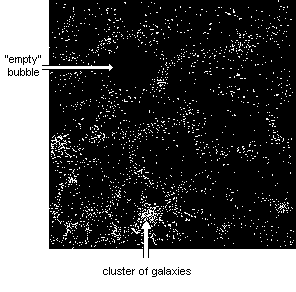
- In 93, this porous structure was obtained by simulation, starting from a twin model.
and I placed the following transparency on the device.
Everyone could then see this image, and also that it looked quite similar to the images previously shown, referring to observations. But no one said a word and I ended up looking like an idiot, standing next to the projector. Everyone was obviously waiting for me to remove this board, not scheduled in the program, and sit down. That's what I finally did. Total failure....
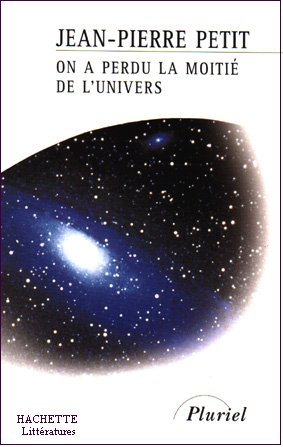
This image was published in 95 in Astrophysics and Space Science and was also part of my presentation at this conference (I was only allowed a "poster", which no one looked at). Incidentally, it was also reproduced in my book "We Lost Half the Universe" (Albin Michel 1997 and Hachette 2000, in paperback).** **
Coming to this conference (the first one I had the opportunity to attend in 17 years, since 1983 I have not received a penny from the CNRS as mission credits or any credits at all), I wondered if there would be a dialogue. My wife told me, "do make copies of your paper and place them on the tables, before the opening of the Tuesday session." That's what I did. I made 70 copies of the "long version" of my paper (64 pages) and, before the first session on Tuesday at 9 a.m., I placed all these copies on the tables. Everything was removed. I couldn't find any copies in the conference's waste bins or lying under a table. At the end of this document there were my contact details, my e-mail.
Six months later: nothing. Total silence. Not even a small question, the shadow of curiosity.....
It seems like a science fiction story: a scientist suddenly becomes transparent, without realizing it, and falls into a parallel universe. Yet during this conference I was very well...