Drugs in our prisons
Drugs in French Prisons
File opened on October 24, 2001. Last updated on May 14, 2004
Things are stirring in French prisons and within the police force. Inmates sentenced to long prison terms have chosen to speak out—hooded, voices disguised. Condemned for murders, they have drawn attention to the damage inflicted on their own families ("broken homes...").
Police officers would love to have bulletproof vests light enough to wear comfortably. It's true that even the most routine intervention, seemingly harmless, can quickly turn into a catastrophe, as criminals today no longer hesitate to shoot at law enforcement. As for magistrates, they recently made a serious mistake by releasing a repeat offender nicknamed "The Chinese," who promptly murdered someone immediately after his release, shielded by the "presumption of innocence."
All this reminds me of my first trip to the United States in 1961. One day I was in the heart of New York, near Washington Square. I watched a New York police officer, holster at his waist, carrying a six-shooter. At one point, he drew his weapon from its holster and spun the cylinder to check its contents. I was stunned. In Paris, police officers still regulated traffic at intersections with whistles and white batons, wearing peaked caps. At their waist, they carried a 7.5 mm Herstal pistol in a black holster. Drawing it would have taken them several seconds. I approached the New York officer and questioned him, finding his gear and behavior utterly strange for a young Parisian like me.
- "My friend, I don't know how things work where you come from, but here, this isn't about posing or style, if that's what you're imagining. Last week, my colleagues were patrolling Harlem at night. They came across three kids, aged between 14 and 17, trying to break into a store. They approached them and said, 'Hey, kids, come over here.' Then the oldest one pulled out a nine-millimeter and shot my colleague, who was closest to him, twice in the body. He's still between life and death."
In the days that followed, I wanted to take a romantic stroll with an American friend along the riverbanks. Back then, the Seine’s quays in Paris were still a favorite spot for lovers to wander at night. Suddenly, a police car stopped.
- "What are you doing in this area? A stroll? Are you crazy? We're taking you straight back home. Get in the car."
I learned then that walking through Central Park at night was already considered madness—this wooded area turning, as soon as darkness fell, into a workplace for city drug dealers. In 1961, we had little idea what drugs were. At most, they seemed to concern a small fraction of the French population, confined to certain neighborhoods and subcultures. They didn’t exist in any schools.
Looking back, it seems the United States has always represented a kind of future image for us Europeans. Forty years ago and more, violence was already everywhere there, especially in high schools. Like many, I had seen a black-and-white film from the 1950s called "Violence in the Making," starring Glenn Ford. He played a teacher confronted by a gang in his classroom. In the end, he uncovered the gang leader and, after a violent struggle right in the classroom—with no student intervening—he overpowered him and had the teenager arrested. Back then, all this seemed light-years away from our "National Education" system in the 1960s. That was forty-five years ago. Everything we see today might be a logical evolution, even if not inevitable. I won’t defend the now-defunct Soviet system, but I recall one thing: at that time, any citizen of the USSR could, on their territory, stop a child seen outside school hours and ask to see their school notebook with their timetable. If the child was skipping school, they would be swiftly taken to the police station and then to their parents. Today, very young people are prostituting themselves in Moscow train stations. Drugs are everywhere. They mostly come from Afghanistan, where opium poppies are still widely cultivated, and the Taliban simply collect a tax on this unusual trade. What do Russian customs officers do? What would you do if your salary arrived only with great difficulty?
The first thing a new inmate hears upon incarceration is:
- "Do you want drugs? Here, you know, as long as you pay, you can get anything."
Indeed, all kinds of drugs circulate freely in French prisons, with no problems at all—something most people are unaware of (I refer here to a direct testimony about the famous Marseille prison, the Baumettes). But how could drugs get into this prison? The answer is simple. There are different types of inmates. In high-security zones, physical contact with inmates is impossible. Visits are conducted behind glass, in booths equipped with phones, just like in the United States. But minor offenders receive visits in cell-visit rooms, with much greater freedom and minimal supervision. There are even famous prisoners who have become fathers during their incarceration—more than nine months after their imprisonment. I once saw a TV program where a prisoner’s wife demanded the right to sexual relations for inmates, "to maintain family unit cohesion."
If there is a search, it’s very superficial. Staffing issues. We’re not going to perform anal or vaginal examinations on visitors. And that’s where the problem lies. Drugs pass through these very convenient receptacles. Anything else, too. The visitor quickly extracts a small container from her vagina, which the prisoner then slips into his anus. At the time, I knew a prison employee. I proposed the following idea to him:
- "Why not equip prisons with uniforms that prevent drugs from entering via the body? All it would take is a changing room. At the entrance, visitors would undress completely, keeping only simple underwear—just enough clothing to make hiding an object difficult. Then they’d be given sturdy nylon uniforms, similar to sailors’ outfits: pants, suspenders, all secured with a padlock."
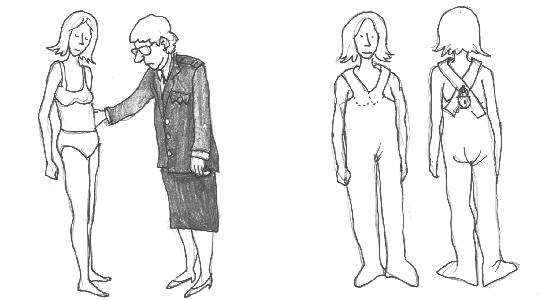
Reaching the anus or vagina: impossible. Such a system would drastically reduce drug smuggling into prisons. Do you know what the guy replied?
- "Impossible. If we took such a measure, prisons would become uncontrollable!"
Chance led me to a young fool named Alexandre, raised in a context of failing paternal authority. The mother, overstepping her bounds, had assumed a role as family head that she was, in fact, utterly incapable of fulfilling.