Twin universe model and negative energy particles
Seminar proposal in cosmology
November 2, 2006 ---
Geometrization of Andrei Sakharov's cosmological model
J.P.Petit & G.D'Agostini
** **November 2, 2006
--- ** **
Nobel Prize winner Andrei Sakharov is little known for his work in the field of cosmology ( [1], [2], {3] ). One of the authors ( [7], [8], [9], [10] , [11] ) worked from 1977 onward along the same lines, unaware of this work, which he was only to learn of in 1984 at the time of the publication in France of a book entitled "Andrei Sakharov, Scientific Works" [4], initially published in English in 1982 [5].
In schematically defining this model, involving a T-symmetry, Andrei Sakharov sets out his primary concern: to account for the absence of antimatter in our observable universe. After having considered a T-symmetry, Sakharov opts for CPT-symmetric universes [6].
We shall translate this idea geometrically using the following tools:
- Dynamical groups - Momentum space ( dual of the Lie algebra of the group )
( reference: Structure des Systèmes Dynamiques, J.M.Souriau, 1972 [12] )
Let us start from the Poincaré group, the isometry group of Minkowski space. The number of components of the moment is equal to the dimension of the group, that is to say ten. These components are then grouped as follows:
-
One component which is the energy E
-
Three components which make up the momentum vector.
-
Three components constitute what Souriau calls the "passage"
-
The other three form the "spin".
( this approach allows spin to appear as a purely geometric object, see reference [12], page 181 ).
The Lorentz group has four connected components.
-
The first, the neutral component of the group, reverses neither space nor time.
-
The second reverses space ( P-symmetry ) but not time.
-
The third reverses time but not space ( T-symmetry)
-
The fourth reverses space and time: ( PT-symmetry ).
Souriau groups the first two components of the Lorentz group to form what he calls *the orthochronous subgroup Lo *. The elements of this subgroup, acting on a given motion, preserve the orientation of time. The remaining components constitute the *antichronous subset L**A *, whose elements reverse time ( T-symmetry ).
Constructed from the Lorentz group by adjoining space-time translations to it, the Poincaré group also has four connected components.
The study of the action of the complete Poincaré group ( with its four components ) on its momentum space shows that T-symmetry entails the reversal of the sign of energy (reference [12], page 197, "space and time inversions", relations (14.67). )
Kaluza showed that endowing a relativistic material point with an electric charge was equivalent to inscribing its motion in a space endowed with an additional dimension, of the space type:
t , x , y , z , z
A point of this "Kaluza space" then corresponds to the vector:
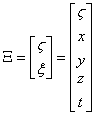
The dynamical group associated with this geometry is the central extension of the Poincaré group. The action of this group on Kaluza space can be represented in matrix form as:

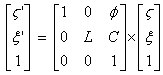
L, a (4,4) matrix, is the element of the Lorentz group, which is six-dimensional. C is the four-vector corresponding to a space-time translation:

*f *is a scalar. This central extension of the Poincaré group is 11-dimensional. This is also by definition the number of components of the moment. Thus, inscribing the motion of the relativistic material point in a space provided with an additional dimension, the Kaluza dimension, endows the moment with an additional, scalar component:
the electric charge q
The action of this group on its momentum space includes the contribution of an additional relation which expresses the conservation of electric charge:
q' = q
To make a C-symmetry appear, one must pass to a group comprising eight connected components, whose element will be written:
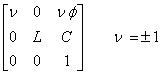
In studying the action of the group on its moment, the action on the electric charge becomes:
* *
We recover ( reference [13] Géométrie et Relativité p.413 ) the identity between charge conjugation and inversion of the Kaluza dimension. We therefore have before our eyes the clear geometric translation of C-symmetry.
As we have said, the Poincaré group:

contains elements realizing the symmetries P , T and PT. Let us consider the orthochronous subset Lo of the Lorentz group.

which is a convenient way of representing the element of the Lorentz group by separating out the elements of the orthochronous subgroup ( *m * = + 1 ) and the elements of the antichronous subset ( *m * = - 1 ) . One can rewrite the element of the Poincaré group as:
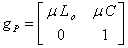
The antichronous components of the Poincaré group, or of its central extension, imply the existence of motions of particles endowed with negative energy. Their encounter with positive-energy particles would result in complete annihilation.
The universe as we conceive it is composed of particles with non-zero mass and particles with zero mass, the photons (without prejudging the nullity or non-nullity of the mass of neutrinos). All these particles are merely particular motions of the relativistic material point.
If one accepts letting the whole set of components of the group act, this suggests the existence:
-
Of particles with non-zero mass, of negative energy
-
Of photons of negative energy
From the point of view of physics it seems difficult to envisage a coexistence of objects with positive energy and their T-symmetrics, with negative energy. Hence the idea which was ours, consisting in envisaging a non-connected space of motions.
Like Sakharov we shall take as a basis a universe composed of two CPT-symmetric sheets with respect to a

We can translate this idea in terms of groups by introducing a sheet index
*f *= ± 1
Let us consider the following group and its action on a non-connected five-dimensional space.
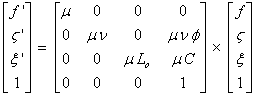
In this construction the CPT-symmetry ( inversion of z and of x ) goes with the inversion of the sheet index ( f → f ).
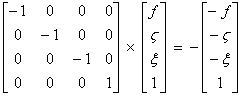
The calculation of the coadjoint action leads to:

P being the momentum-energy four-vector.

If the space of motions corresponding to *f * = 1 contains the positive-energy particles, the element of the group corresponding to *m *= - 1 reverses the coordinate f ( change of sheet ), the energy E, the momentum p , the electric charge q and entails a CPT-symmetry.
The matter-antimatter duality ( C-symmetry ) is present in each of the two sheets.
We therefore have a geometric description of the model initially proposed by Andrei Sakharov.
We can now try to provide some details on the boundary space joining the two sheets ( f = +1 and f = -1 ). One of the dimensions must disappear.
In our universe one finds motions deducing one from the other by P-symmetry. Example: two photons of the same energy but of opposite helicities ( phenomenon of polarization of light ).
C-symmetry is also at work in our universe ( proven presence of antimatter, whether in cosmic rays or in colliders ).
But no experiment or observation has made it possible to demonstrate the existence of negative-energy particles.
Energy is a scalar linked to invariance under time translation. In the boundary space, the link between the two sheets, it is therefore the time coordinate that disappears.
We have two five-dimensional sheets, two Kaluza spaces ( where the fifth dimension is of the space type ) endowed with the metric:
ds2 = c2 ct2 dx2 dy2 dz2 dz2
of signature:
( + - - - - )
The boundary space which joins them has the metric:
ds2 = -dx2 dy2 dz2 dz2
of signature:
( - - - - )
This boundary space is Euclidean.
This corresponds schematically to the drawing in the figure below:
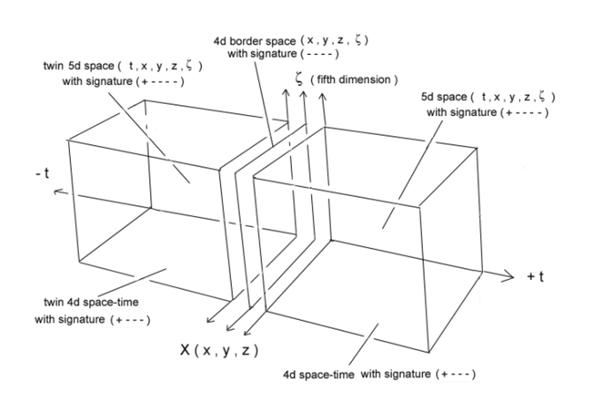
Sakharov's model ( two sheets of CPT-symmetric universes )
**The boundary universe between the two is Euclidean **
References :
[1] A.Sakharov : "CP violation and baryonic asymmetry of the Universe". ZhETF Pis'ma 5 : 32-35 (1967) : Translation JETP Lett. 5 : 24-27 (1967)
[2] A.Sakharov : "A multisheet Cosmological Model" Preprint Institute of Applied Mathematics, Moscow 1970
[3] A.Sakharov : "Cosmological Model of the Universe with a time-vector inversion". ZhETF 79 : 689-693 (1980) : Translation in Sov. Phys. JETP 52 : 349-351 (1980)
[4] Andrei Sakharov, scientific works, Editions Anthropos, France, 1984 ( out of print )
[5] Andrei Sakharov, scientific works, Marcel Dekker Inc Ed. 270 Madison Avenue, NYNY 10016
[6] Andrei Sakharov. The antiquarks in the universe. Commemorative communication for the 60th anniversary of N.N. Bogolyubov, Nauka, Moscow, pp. 35-44.
[7] J.P.Petit : "Univers énantiomorphes à flèches du temps opposés", CRAS du 8 mai 1977, t.285 pp. 1217-1221
[8] J.P.Petit : "Univers en interaction avec leur image dans le miroir du temps". CRAS du 6 juin 1977, t. 284, série A, pp. 1413-1416
[9] J.P.Petit : Twin Universe Cosmology: Astronomy and Space Science 226 : 273-307, 1995
[10] J.P.Petit : The missing mass problem. Il Nuovo Cimento B Vol. 109 July 1994, pp. 697-710
[11] J.P. Petit, P.Midy & F.Landsheat : Twin matter against dark matter. Intern. Meet. on Atrophys. and Cosm. "Where is the matter ? ", Marseille 2001 june 25-29.
[12] J.M.Souriau, Structure des Systèmes Dynamiques, Editions Dunod, 1970. English translation in : Structure of Dynamical Systems, Birkhauser Ed. 1999
[13] J.M.Souriau : Géométrie et relativité. Hermann Ed. 1964
** Here is the letter accompanying the transmission to the IAP of this document. I will keep my readers informed of the reply, or of the absence of a reply to this letter. ** **** ****
Jean-Pierre Petit
Former research director at the Cnrs
At the observatory of Marseille
Villa Jean-Christophe
206 Chemin de la Montagnère
84120 Pertuis
Pertuis, November 2, 2006
to the Director
of the Institut d'Astrophysique de Paris
98 bis Boulevard Arago 75 014 Paris
Copy:
Text constituting my seminar proposal entitled
Geometrization of Andrei Sakharov's model
Dear Director,
A retired astrophysicist, I had come to present my work in astrophysics and cosmology in a seminar, within your walls, at the time when Omont was its director, devoted to a model constituted by two sheets of CPT-symmetric universes, initially proposed by Andrei Sakharov.
That must be six or seven years ago.
Having advanced this work I would like to be able to present it in a seminar to the researchers of the Institut d'Astrophysique de Paris
Please accept, Dear Director, the expression of my respectful sentiments.
Jean-Pierre Petit
Former research director at the Cnrs
Jean-Pierre Petit
Former research director at the Cnrs
At the observatory of Marseille
Villa Jean-Christophe
206 Chemin de la Montagnère
84120 Pertuis
Pertuis, November 2, 2006
to the Director
of the Institut d'Astrophysique de Paris
98 bis Boulevard Arago 75 014 Paris
Copy:
Text constituting my seminar proposal entitled
Geometrization of Andrei Sakharov's model
Dear Director,
A retired astrophysicist, I had come to present my work in astrophysics and cosmology in a seminar, within your walls, at the time when Omont was its director, devoted to a model constituted by two sheets of CPT-symmetric universes, initially proposed by Andrei Sakharov.
That must be six or seven years ago.
Having advanced this work I would like to be able to present it in a seminar to the researchers of the Institut d'Astrophysique de Paris
Please accept, Dear Director, the expression of my respectful sentiments.
Jean-Pierre Petit
Former research director at the Cnrs
*This letter remained unanswered. * ---