Subcutaneous chips military technology surveillance
AFP March 11, 2005
In Australia, soldiers and bank employees with implanted subcutaneous chips
Posted online March 11, 2005 - updated March 14, 2004
Source: http://fr.news.yahoo.com/050311/202/4b9g2.html
We had started by presenting this document on March 11 with "the usual reservations." Even so, readers (scientists) had told me "you should remove this file. It's possible that it's a hoax." But I preferred to leave it online with a warning text. Then we launched verifications toward AFP, where the information was confirmed. The dispatch came through at:
11-03-2005 08:12:22
For those who still doubt, here is the image-copy of the Agence France Presse flash:
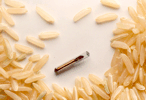
Here are these chips, the size of a grain of rice:

It's ... extremely serious and what is even more serious is that our French media don't talk about it. We have a mass communication device called television. And this media broadcasts totally secondary things, feeds us stupid game shows, stories of dogs run over. A car accident on the highway, Claire Chazal announces gravely, a fire in a retirement home, Pierre Pernot continues.
But it's "spaceship Earth" that is burning while the average Frenchman lets himself be stupefied by "La 1° Compagnie."
Should we worry people, tell them that things are going very badly? No, answers Rafarin who trots out his positive attitude slogan, while he watches his stock market shares rise. His personal shares, of course.
I think we should worry, and quickly, otherwise your children and grandchildren will never reach adulthood.
I've been struggling for five years and I have 3500 daily connections. More, from time to time. But that doesn't make 3500 readers and it doesn't make a ten-thousandth of the population.
I'm telling you, the "wave of subcutaneous chips" will sweep across the world within three years. And that will only be the beginning.
I need to put together a file:
&&& The true and the plausible
Nowadays the truth is no longer plausible, if it ever was, simply because humanity doesn't dare look at itself in the mirror. And enormous, shameless lies are made plausible, credible. The human herd lets itself be led into an abyss of stupidity, without reacting, like the Jews toward the gas chambers at Auschwitz. Do you remember that anecdote I mentioned in my Shoah file? (and I'm not Jewish, nor a "Zionist," nor ... anything at all. I'm simply trying to feel like a citizen of the world). A contingent of Jews gets off those death trains at Auschwitz. They are asked to undress, "to go to the shower." That is plausible. The kapos collect their clothes. Suddenly one of them recognizes among these people who will die in the next few minutes a woman from his neighborhood. They've known each other since childhood. He tells her "they're not going to make you take a shower. They're going to kill you with gas." Because of their shared childhood this woman believes this man. She then rushes toward the line of men and tries to warn them. No one believes her because it isn't plausible. Same failure with the line of women holding their children by the hand or carrying them in their arms. No, it's too horrible, it can't be. The Nazis then seize her, drag her aside and torture her savagely, until she admits which man has just told her the truth. Then, once this contingent of Jews has been "processed," they seize this man, tie him with wire and, in front of the other kapos, shove him alive into an oven telling them
- You see. If you talk, this is what awaits you!
Today science "has made progress." The groups to be eliminated won't be gassed. They will be made to die "natural" deaths. As early as the Vietnam War Nixon had created a "Jason commission" whose goal was to develop more sophisticated military techniques. We owe to this honorable commission, of which Gell-Mann, Nobel laureate, father of quark theory, was a member, fragmentation grenades with plastic debris that can't be detected by radio. We owe to it the strategy according to which a wounded man, an invalid, costs more than a dead man. Gell-Mann found "that war was an interesting problem on the mathematical level and of what is called operations research." As early as the Jason era, "ethnic biological weapons" were actively researched, capable of targeting only Asians, or other ethnic groups. AIDS is a blunder born of these experiments, carried out in Zaire on green monkeys (extremely common small monkeys). One day human groups will be made to disappear through "epidemics" that will strike only certain categories of population. The elements will be played with. We will know how to trigger "natural phenomena," direct them toward "targets." Chips will be implanted in you by hiding them in syringes, during vaccinations. "Non-lethal weapons" will put torture within reach of a mass of psychopaths, who will enjoy the most total impunity. Do you remember that anecdote, coming from a Central American country. A mother has been looking for news of her child for weeks. Suddenly a policeman hails her and says "your son sends you a gift." And he hands her an object in a handkerchief. They are ... his eyes.
Meanwhile our modern Panglosses of the scientific sphere, ten meters behind, will draw attention to the consequences, thirty years from now, of environmental degradation. You will be made to sign petitions to save the Amazon rainforest but
The tree hides the forest
and it's much more serious than that. If you don't understand that this story of subcutaneous chip implantation is extremely serious, it's because you have shit in your eyes and wax in your ears.
Policies are being put in place beside which those of the Nazis will look like amateur tinkering. These "chips" are one of the vectors, but there are many others. With receiver-chips you will be stupefied, substance will be given to the "Zorglonde" of the Spirou comic strip. At the DGA (General Delegation for Armaments) there is a "Carcinogenic Weapons" division. There are some in every country. People collapse under their fears and their immense naivety. They are duped with next to nothing, with smoke and mirrors, with images. They are conditioned. One need only remember the total vacuity of Schwarzenegger's electoral speech, elected hands down as senator of one of the most powerful and important American States.
In the Senate, a man of ... 82 years, Robert Byrd, must stand up alone, while the other senators keep silent, out of cowardice or because they are corrupt. Because many are.
Will we manage to reach the shores of wisdom without paying for this journey with billions of deaths?
There is the question of our time. One may doubt it, given the few lessons we have learned from the last two World Wars. But what to do so that humans come out of their torpor?
| Friday March 11, 2005, 12:59 PM | The
| revolution of micro and nanotechnologies already around the corner | PARIS (AFP) - Some may rejoice, others may be indignant: a world where keys, passwords, passports, cashiers and inspectors would no longer have any reason to exist, a world where after subcutaneous implantation of a chip smaller than a grain of rice, one can be tracked in all one's movements, is no longer entirely in the realm of fiction. | In Australia, the staff of all banks are implanted by default and soldiers are also "chipped." The generalization of microchips is inexorable, promising as many radical advances as potential risks for individual freedoms, according to specialists in micro and nanosystems gathered this week at the CNRS, in Paris. |
|---|
The rise of these miniaturized systems, integrating sensors capable of sensing the outside world and actuators able to act on that environment, thus a technology derived from integrated circuits, only goes back to the 1990s, recalls Christian Bergaud. He is co-director of one of the twenty specialized labs of the CNRS, the LIMMS (Laboratory for Integrated Micro Mechatronic Systems), a French-Japanese structure celebrating its tenth anniversary.
"Just the combination of mechanics and electronics gives very interesting possibilities, and today the majority of fields of science are involved," explains the researcher. "The majority of scientific disciplines is involved and we already live with micro-switches in our mobile phones, shock sensors for airbags, etc.," he adds.
In the aeronautics and space field, the interest of miniaturization goes without saying: for satellites, a first strategy consists in keeping the same architecture while replacing conventional components with microsystems. The 3 tonnes of SPOT-5 are thus reduced to one in its successor, the Pléiades satellites. "The second strategy goes through a new concept, that of nano-satellites on the order of a cubic centimeter, which can be combined into constellations to carry out complex tasks," explains Dominique Collard (CNRS - Valenciennes).
A specialist in applications for biology and health, Bruno Le Pioufle (ENS Cachan) affirms that "we are heading toward entire laboratories that will fit on a chip." According to him, "miniaturization and parallelization offer a phenomenal increase in analysis capacities. It costs as much to build one transistor as a million transistors, and if one fits a thousand test tubes on one square centimeter, one can detect a very large number of genes analyzable simultaneously, a large number of gene products (protein chips) and one can simultaneously test a very large number of drugs on living cells (cell chips)." Moreover, "the smaller it is, the shorter the reaction time, thus a far superior efficiency of analyses," he adds.
"We are heading toward a system increasingly suited for in vivo investigations (inside the body)," concludes Bruno Le Pioufle, who cites micro-catheters that traumatize surrounding tissues less and less.
At a more distant horizon, it is possible to envisage autonomous microsystems that would move within the human body, "like intestinal microcapsules equipped with electronics and apparatus to carry out analyses, deposit drugs or perform biopsies."
For general information on implantations in humans, go to http://www.implanter.org
Return to Guide Return to home page
Number of visits to this page since March 11, 2005: