Untitled Document
Resistance and Disinformation
July 5, 2010
In May 1968, rebellious journalists briefly took control of major newspapers (something that would be impossible today). As far as I recall, this happened with Paris-Match, in whose pages stunned French readers discovered a photograph taken from a ground-floor apartment on a fashionable street, showing CRS police officers overturning cars in the streets and setting them on fire themselves. &&& A reader might still be able to find these legendary photos.
It's as old as the world, and it's called provocation. It can also be classified under the label of false flag operations, since it involves carrying out acts designed to trigger repression, while making it appear that demonstrators—completely innocent in their massive protest—were responsible.
At the time, May '68, I lived in Aix-en-Provence. A Parisian journalist came down to give a lecture at a cinema, and explained that during worker demonstrations involving 20,000 people, participants were handed a piece of paper with the words:
Say five thousand
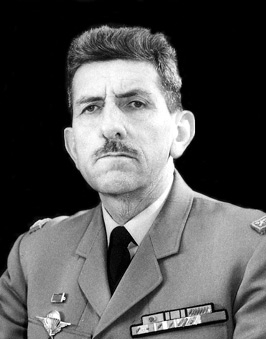
That was a strange time. De Gaulle was so overwhelmed by events that he temporarily abandoned his post as President of the Republic, fleeing by helicopter to Germany in Baden-Baden, the foreign country, to join General Massu, one of the key figures in the Battle of Algiers, who ordered and defended the use of torture by electric shock during the Algerian War.
 ****
****