Sphere inversion and permutation of cusp points
The Sphere Inversion
December 8, 2004
page 2
Permutation of the cusp points of a crosscap
This will be a small interlude, in the style of "what can the sphere inversion be used for?" Here: to swap the two cusp points of a crosscap, which seemed at first impossible. I came up with this little trick about a dozen years ago. It has never been published. But where to publish something like this? It's not really a major mathematical result, but it's still quite an attractive exercise. In what follows, we will use polyhedral representations. On the right, the "round" crosscap and on the left, one of its possible polyhedral representations.
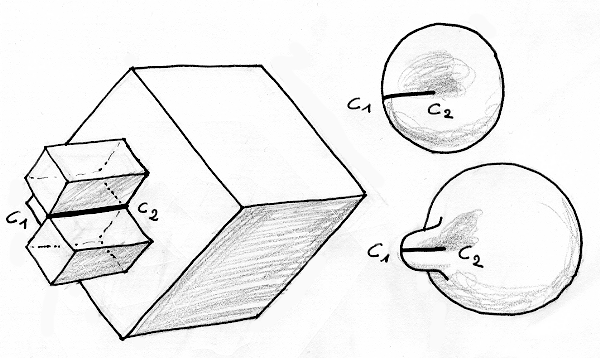
**The crosscap with one of its multiple polyhedral representations. **
In the figure at the bottom right, we have arranged for the two cusp points C1 and C2, located at the end of its self-intersection line, to be placed in what can be considered as a portion of a sphere. We know that we can invert a sphere. Therefore, we can apply the same treatment to this object, without worrying about the different steps of this transformation. In polyhedral terms, this will consist of inverting the cube.
All we know is that at the end of the operation, we will have two kinds of invaginations that appear as what an observer located "inside" the initial crosscap would see (which is an improper expression since this surface is one-sided).
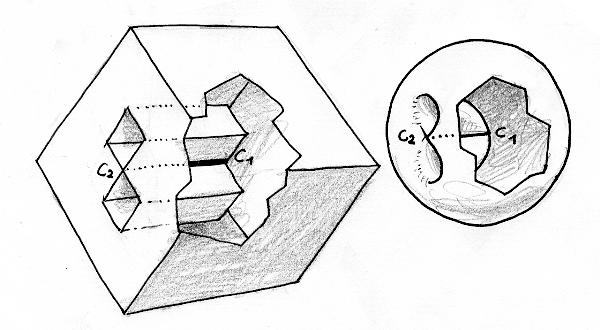
After inversion, from the cube on the left, from the sphere on the right
The polyhedral representation is quite convenient to not lose track of these operations. All that remains is to insert two fingers into these invaginations and pull everything outward:
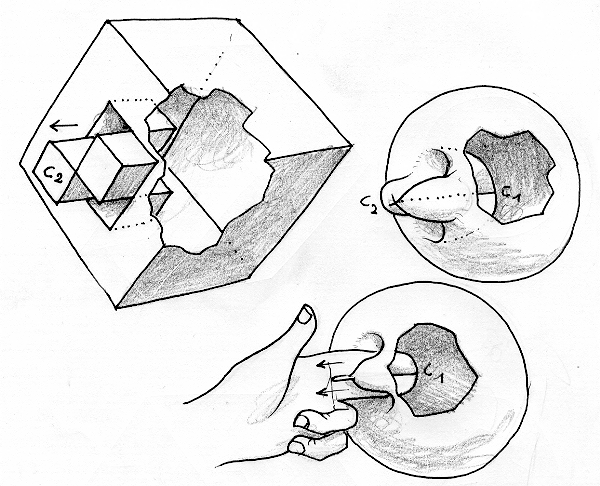
Pulling the cusp point C2 "outward"
If you're amused, you can build the polyhedral models with cardboard. Unless someone brave builds these models in VRML so that they can be manipulated.
All that remains is to complete the operation.
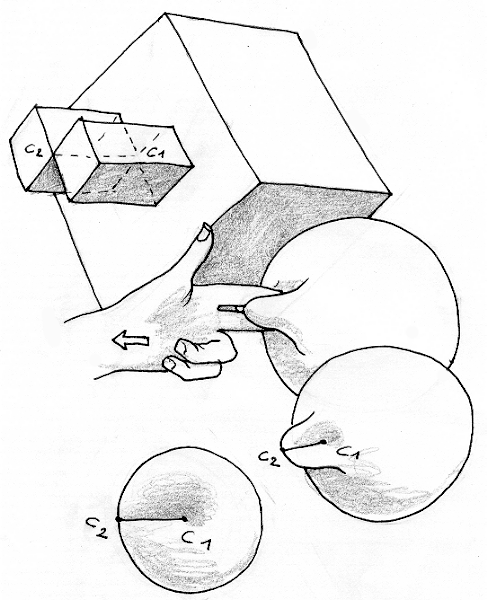
**Transition to an immersion identical to the original, with the cusp points swapped. **
I once promised to make a dossier about my encounters with the psychoanalyst Jacques Lacan. The crosscap had been used to model the "fundamental fantasy." He had focused on the "central cusp point" and simply neglected the second one. In this central area, Lacan had located the "linguistic phallus" or "object a." I will tell you the rest another time. The point is that Lacan had not foreseen that these points could be "father-mutated." In fact, when he had spoken to me about this linguistic-geometric-psychoanalytic modeling, I had furrowed my brow imagining that the two cusp points could play different roles in this crosscap, and in the next second, simply by asking the question, I had found a way to exchange them. Lacan was quite surprised, I remember. His fundamental fantasy had two linguistic phalluses instead of one. All his work had been articulated around this object. But I immediately proposed an alternative solution by placing the linguistic phallus at the (only) pole of a Boy surface. Thus, everything returned to order to his great satisfaction.
This episode took place not long before his death. From what I could see, this psychoanalytic-geometric redeployment apparently has not yet spread within the community of Lacanian psychoanalysts.
Back
to Guide Back
to Home page
Number of visits to this page since December 7, 2004 :