The Sphere Eversion
The Sphere Eversion
December 7, 2004
page 3
**Elementary catastrophes. **
We have already mentioned above that the immersions we considered were such that the tangent planes along their self-intersection sets, when they existed, remained distinct. It is then possible to pass from one immersion to another using four elementary catastrophes. Morin gave them names, which appear on the following drawings. The first leads to the creation of a closed curve (and its destruction, the inverse operation). This is what happens when you immerse your elbow in the water of a basin to assess its temperature (on the left). Figure a4: the surfaces are in contact at a point. In a5, the self-intersection curve has been created. In the following text, we will call this operation "the elbow catastrophe".
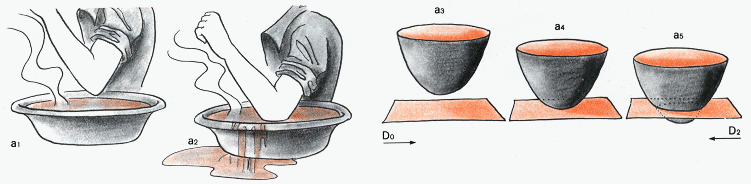
The "elbow catastrophe": creation - destruction of a closed curve
The second catastrophe is that of the "mandarin slice":
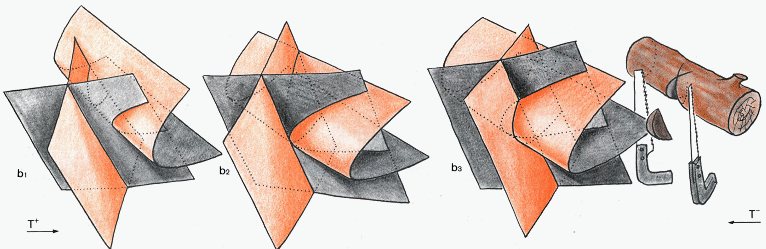
**The catastrophe consisting of the creation-destruction of a "mandarin slice". **
If you look closely at these images, from left to right, you will see a parabolic cylinder approaching a dihedral angle. The self-intersection set is composed of two parabolic-shaped curves, separate, and obviously the edge of the dihedral angle. In the central figure, the edge of the dihedral angle is in contact with one of the cylinder's generators. This edge is tangent to the cylinder at that point. The self-intersection set is composed of two parabolic-shaped curves, tangent at a point, and to the dihedral edge. Right figure: the parabolic cylinder has continued its movement. The self-intersection curve has changed. It is composed of the dihedral edge, plus the parabolic curves that intersect at two points, located on the dihedral edge. Conversely, one can consider that the parabolic cylinder is stationary and that the two "cutting planes" are moving. The right figure would then suggest two axe cuts, or two cuts made with a saw. The shaving is also represented. Morin compared it to a "mandarin slice", a very expressive image.
The third catastrophe is that of the "pants".
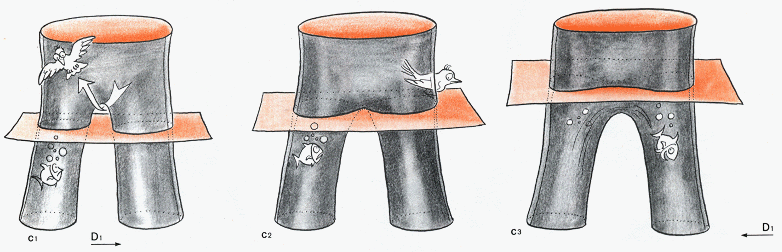
The "pants" catastrophe
The images are sufficiently expressive. You go from left to right down a pair of pants in water. On the left, the bird passes under the crotch but the fish remains confined in one leg. On the right, the fish passes, but the passage used by the bird has disappeared. In the center, the intermediate situation. What matters is the local modification of the intersection curve, which corresponds to what is called a "surgery", a change of connection of curve arcs. Try to properly integrate this transformation, which will prove to be the most difficult to implement and to see clearly in the homotopy of the sphere eversion. Remember well that this catastrophe closes a passage while opening another in the perpendicular direction.
The fourth and last catastrophe is that of the "inversion of a tetrahedron":
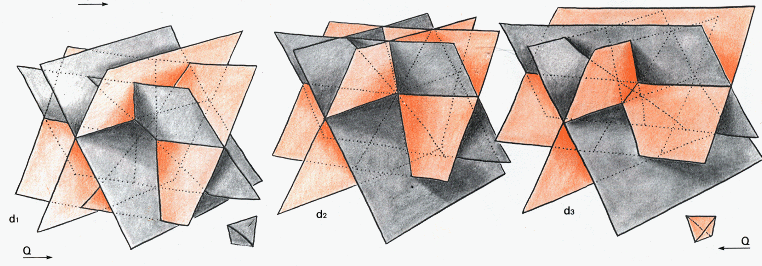
The catastrophe inverting a tetrahedron
The self-intersection curve is composed of four "lines" which are the extensions of the four sides of a tetrahedron. In the left figure, this tetrahedron is isolated, showing its gray faces outward. On the right, it's the opposite: the faces are pink. In the center, the intermediate situation: the tetrahedron is reduced to a point Q (quadruple, since it is at the intersection of four sheets).
With these four catastrophes, we will consider turning a sphere through a continuous sequence of transverse immersions. This variant is due to the mathematician (blind) Bernard Morin. Our meeting was worth telling. One day, a technician from the faculty of letters asked me to bring my drawing skills to a lecturer who was going to speak about geometry. I came to this meeting without any suspicion. I had always been quite skilled at visualizing objects in space and when our advanced mathematics professor gave us a descriptive geometry problem to solve, I would draw the intersection and provide a perspective view at the same time as he produced his statement. But this time, things would happen differently.
I had no difficulty drawing the figures above. But when it came to integrating them into a diagram involving the sphere eversion, I finally completely lost my way, confronted with an entire set of sheets located one behind the other. Piqued, I returned to see this strange person, who, although blind, seemed more at ease than me in this display of forms. I then followed his courses for several months. The dialogue was quite complicated. On his side, he had only the recourse to speech. On mine, I could either describe my drawings to him, or put models I had made at home, or later on site, into his hands. These dialogues would have needed to be recorded, absolutely surreal, of the kind:
*- Try to imagine two curves that would come together to form a sort of egg beater. *
Despite the difficult personality of the person, these meetings remained unforgettable for me. I finally got used to taking two aspirins before our work sessions, as a preventive measure. His character can be summarized by the nickname his wife gave him: "Blessed Thunder", a character from the Hergé comic strip "Tintin in Tibet". Morin's grudges were as legendary as irreversible. He sometimes mentioned some of his enemies, who had passed away, saying about them:
- I sometimes throw a little curse at them in the afterlife, saying that if it doesn't harm them, at least it can't do them any good.
Back
to Guide Back
to the Home Page
Number of views of this page since December 8, 2004 :