The Sphere Eversion Mathematical Catastrophes
The Sphere Eversion
December 8, 2004
page 4
Bernard Morin's version
To download the pdf version of the 1979 article by B. Morin and J.P. Petit, published in Pour la Science
The Sphere Eversion ( 2.8 Mo )
We start with a sphere showing its gray side outward and its pink side inward. In b and c, we bring its poles into contact. Then the layers interpenetrate according to a "elbow catastrophe". A closed self-intersection curve is created. At the bottom and to the right, three half-cuts help better understand the obtained configuration. At this stage, the sphere looks like a sort of "inflatable boat", with a "bulge" and a "double-walled floor".
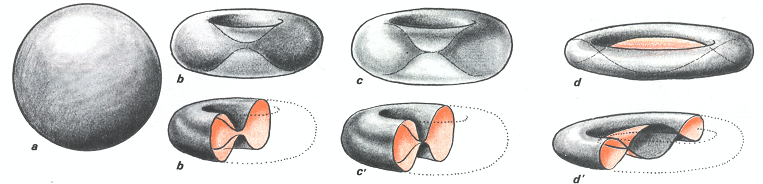
First step: an "elbow catastrophe". Creation of a closed self-intersection curve
Second operation: another elbow catastrophe, creation of a second closed curve.
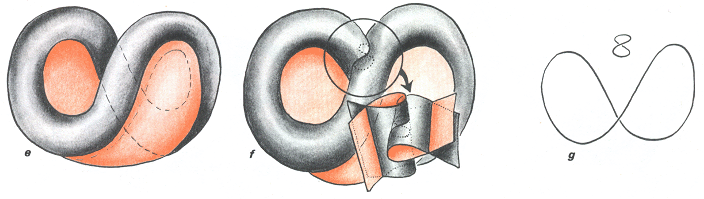
**Second creation of a closed self-intersection curve. **
To do this, the "inflatable boat" has bent, with a twisting movement, which allowed bringing two parts of the "bulge", diametrically opposite, into contact. The following image is the result of two catastrophes leading to the creation of "mandarin slices".
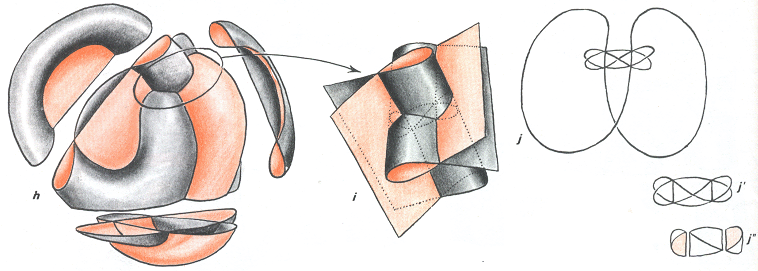
After creation of two "mandarin slices"
On the left, cuts have been made in the model. In the center, the way the two cylinders, locally, whose cross-section affects the shape of the Greek letter "gamma", have interpenetrated. We recall that the catastrophe of creating "mandarin slices" was done by cutting a "log" with two planes forming a dihedral angle. Each of the cylindrical structures whose cross-section is in "gamma" has both the rounded section and the dihedral. Look carefully at figure i. In j we have drawn the entire self-intersection. The largest portion of the closed curve comes from the first "elbow catastrophe" which had transformed the sphere into an "inflatable boat". After creating the two mandarin slices, we obtain a more complex set of which j is a subset. In j", we see that this structure can be compared to the assembly of two "mandarin slices" on two edges of a tetrahedron, not adjacent.
All of this will one day be much easier to understand when I can produce animations. It does not pose any technical problem in principle. It's simply a matter of time. Few people can not only see in space, that is to say read this coding using lines, dots, colors, shadows, and reflections, but also chain in their head transformations by imagining the suggested movement. I hope one day to have the time to do all these things. Note that we could use polyhedral models, as I did to show how to transform a Crosscap into a Boy's surface. That is the future. But these models must be invented. Further on, you will find the optimized polyhedral version of the central model of this transformation imagined by Bernard Morin (remember that he is blind!), along with the way to build it yourself from a cut-out.
Why haven't I pushed these things further? I would say: because of lack of "outlets". There are no mathematics journals that accept publishing such works. We could do it in 1975-78 through some notes in the Comptes Rendus of the Paris Academy of Sciences, which probably weren't read by many people. But it was because the academician André Lichnérowicz personally interested in these works. He is now deceased. Since these works were completely finished by 1975, it would have been desirable to produce an animation film from my drawings. Having worked in animation, I was fully capable of coordinating such an enterprise. But it was impossible to find funding at the CNRS and finally the American mathematician Nelson Max, inspired by models built by his colleague Charles Pugh (from this same version of the sphere eversion), and using a powerful computer, managed to produce the first film. But this is neither the first nor the last time that French people, receiving no echo to their efforts, are thus outdone by foreign colleagues who are better organized and better supported.
Let's move on to the third phase, the most difficult to grasp.
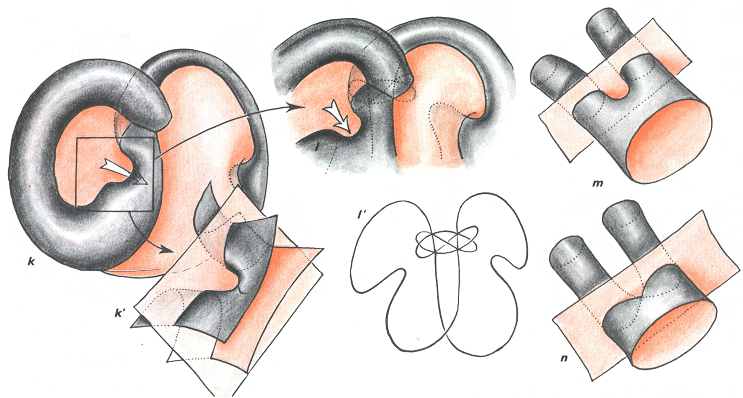
Preparation of two "pants" catastrophes
In figure k, we clearly distinguish the two ends of the "pants legs", whose details are shown in the foreground k'. The white arrow indicates the passage "between the legs". This transformation is really difficult to grasp. I have added drawing m to try to be better understood. In l, I have represented with dotted lines the self-intersection curve, which is entirely shown in l'. A passage (the one taken by the white arrow) will close. This closing movement will cause a part of the intersection curve to rise, in two places. These curve ends will come into contact, each one on one of the lines belonging to the "mandarin slices". When the contact occurs, the surgery will take place. The difficulty comes from the fact that once you have seen the four elementary catastrophes, on the previous page, you must be able to transpose them from all angles, twisting your neck if necessary. In n, the critical moment is represented where the surgery takes place (the "median situation" of the transformation) and where the way of connecting the curve ends will be modified. We know that this "pants" catastrophe closes one passage and opens another. The initial passage is represented by the white arrow. But there is another one that would be visible from the same angle by rotating the model 180° around a vertical axis. These arrows form only one. Before these catastrophes occur, it is still possible to move through this "folded inflatable boat". When these catastrophes have taken effect, this passage will no longer be possible. Instead, two other passages will have been created. But where, which parts of space are involved? These passages will connect the inside of the mandarin slices with the outside. In l', you can see these mandarin slices. Let's move on to the next step.
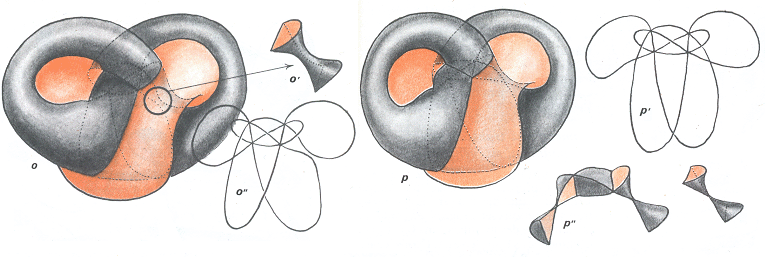
Closing the passage. Towards a double critical situation
In o we have represented the two "pants" catastrophes at two different stages. One of the passages is completely closed. We are in a critical situation, just before the arcs of the curve change their connection mode. On the right (detail of figure o' ), the passage is only beginning to close. Thus, the appearance of the self-intersection curve o" is different on the right and on the left. On figures p, p' and p", the criticality (the "median" situation of the transformation) is reached on both sides. On the following plate, the surgeries have taken effect. The tubes...