The Klein Torus Turnover
The Torus Turnover
December 9, 2004
page 6
The non-trivial torus turnover **
**J.P.Petit : ** **
Comptes Rendus Académie des Sciences.
volume 293, meeting of October 5, 1981, series 1 pp. 269-272
I will just present the following drawings without commenting on them.
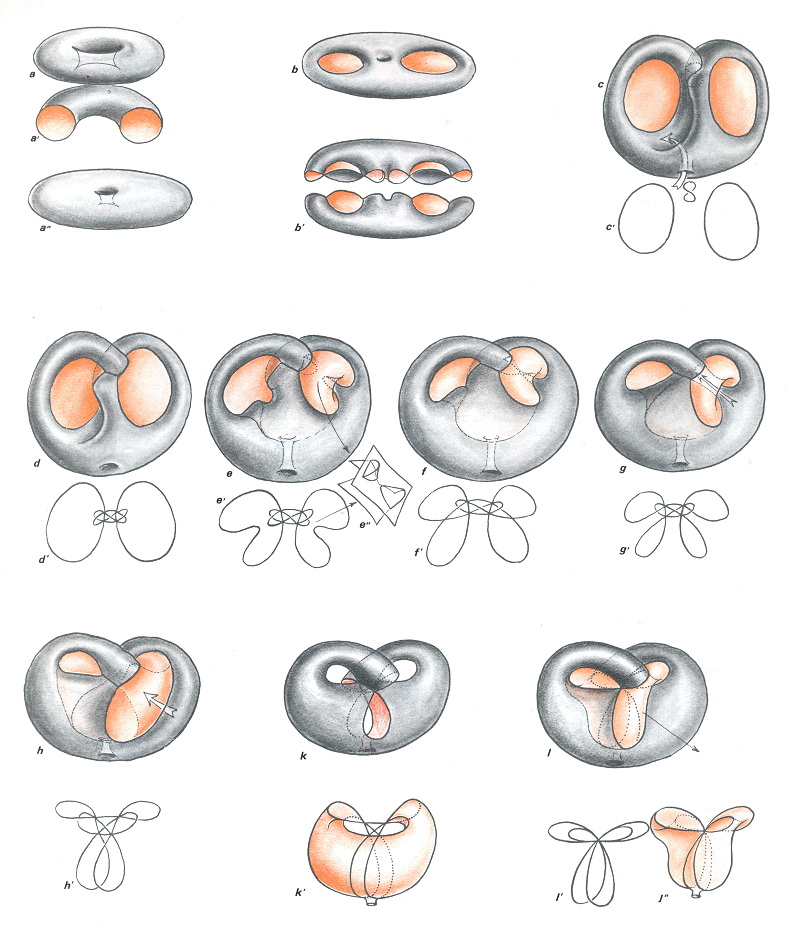
**Non-trivial torus turnover. First part of the transformation **
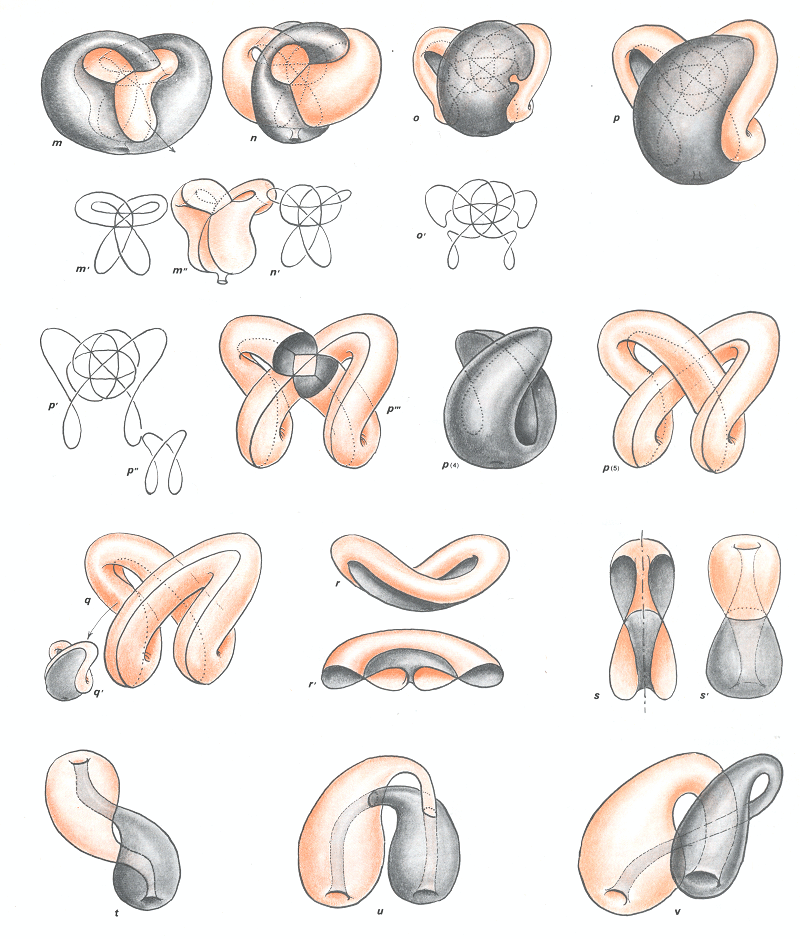
**Non-trivial torus turnover. Second part of the transformation **
When reaching figure v, it becomes clear that it is then easy to match the gray structure and the pink structure to transform this object into a two-ply cover of the Klein bottle.
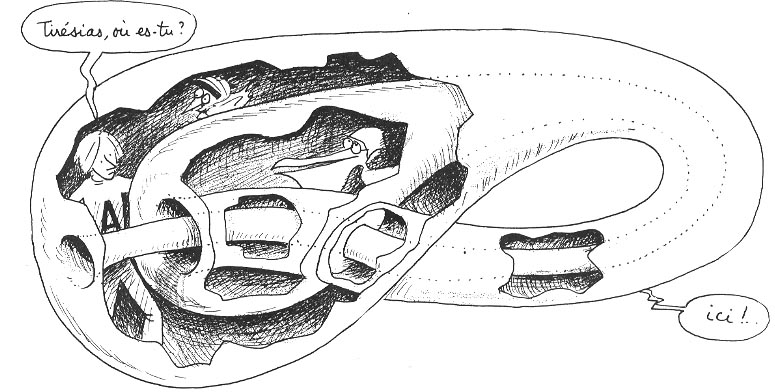
The turnover then occurs by swapping the layers. Below, the same drawing with a color code.
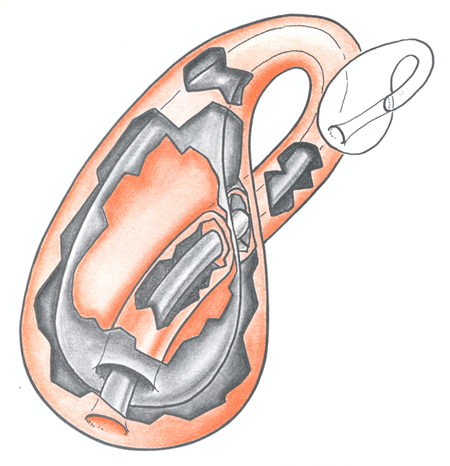
Two-ply cover of the Klein bottle, with color coding
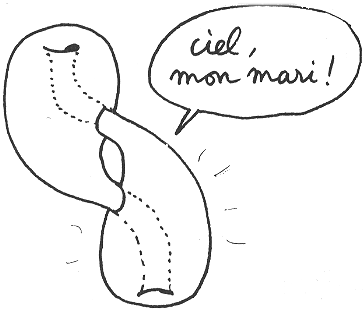
( this drawing is not part of my annual report to the CNRS. It can be found in the Topologicon )
Different families of tori.
What Stephen Smale demonstrated in 1957 was that there was only one family of sphere immersions and that all of them could be connected to each other by a homotopy. These formed a group whose neutral element consisted of leaving the object as it was. It was then wondered whether the same would be true for the torus. Mathematicians Ioan James and Emery Thomas showed that the immersions of the torus were distributed among four continents between which it was impossible to pass using a regular homotopy.
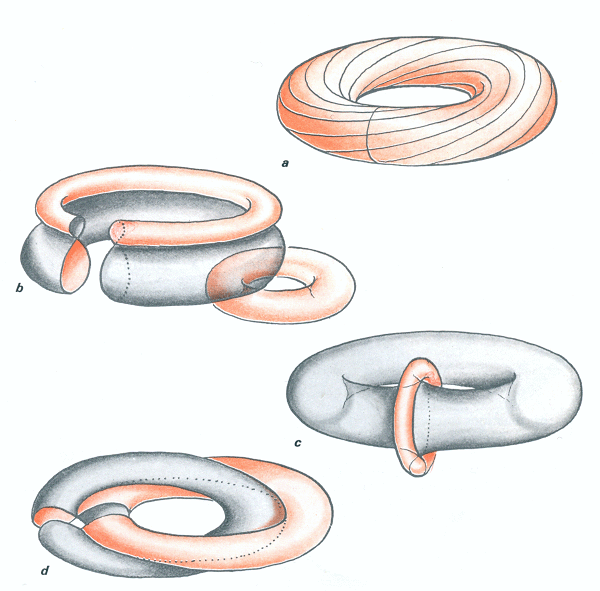
The four families of tori
The "standard torus", drawn in the center of the page, belongs to the same family as the object shown in b. This is what I showed in my version of the torus turnover that I invented in 1980. The family mentioned in a represents a torus that has undergone a 360° twist. It resembles the standard torus, but the two are defined from their mapping system, using two families of curves. In the standard torus, two sets of circles are used, analogous to meridians and parallels. On the torus a, one should complete the family of circles glued on it with a second family, twisting in the opposite direction. What can then be shown is that it is impossible, using a regular homotopy, to bring the mesh of this torus a into coincidence with the mesh of the standard torus (meridian circles plus parallel circles). It is in this sense that they are different objects. Obviously, all these objects can be configured as a two-ply cover of the Klein bottle.
The power of the geometer's tools is to be able to predict what is possible and what is not. Transforming the standard torus into the torus of figure b: yes. Going from c to d: no.
This avoids wasting time unnecessarily and especially encourages the search for things that are in no way obvious, like turning a sphere inside out. It is the same in all sciences. It happens that people overlook fruitful approaches for years or even centuries, simply because they believed them to be impossible to perform. I spent several years of my life developing a theory for the suppression of shock waves around an object moving at supersonic speed in a gas, using a Laplace force field, "MHD". An student even wrote a thesis on this topic under my direction and we published these works in various peer-reviewed journals and scientific conferences. This is a theme that is only beginning to emerge, thirty years later. It is suspected that the Americans have hypersonic aircraft capable of maneuvering at Mach 10 without creating shock waves (and in particular without suffering the formidable thermal constraints related to the air compression behind these "bangs". This is the famous Aurora myth, an aircraft flying at the altitude where the auroras occur, between 80 and 150 km altitude. Aurora is also the precursor of future space launchers, which, relying on the air, will be much more economical than the rockets of the CNES. In France, it was impossible to initiate such research (I had these ideas in 1975), because people, especially at the CNRS, found them completely unreasonable. The result is thirty years of delay compared to the United States, in my opinion totally irrecoverable.
The tobacco joke
To be complete, it is necessary to mention the versions of the sphere turnover that have a tobacco joke as their central object. This was an object that was common when I was young, but that one no longer encounters much today. The first one to have drawn these sequences was Georges Francis. For some years now, I have been working on a polyhedral version of these versions, which has already given a rather nice central model. But, to show it to you, I will have to find it again. Soon, I hope, because it is one of the most fascinating objects I have ever created.
Previous page Next page
Back to Guide Back to Home Page
Number of visits to this page since December 8, 2004 :