ITER:
a 15 million euro experience
The fusion reactor: dangerous
Lithium plus water = explosion!
On
May 16, 2011, a delegation from the European Parliament came to the Hotel du Roi René in Aix-en-Provence, where they listened to several presentations made by project officials from ITER. I was able to hand 40 copies of a document I had printed at home to the Member of Parliament Michele Rivasi. This document is a condensed version of what you will read below. The parliamentarian distributed them to the other delegates.
Approximately 200 anti-nuclear demonstrators had gathered in front of the hotel. There were few, considering what is at stake, and I was the only scientist, even the only engineer or technician present. The demonstrators were typical grassroots anti-nuclear activists.
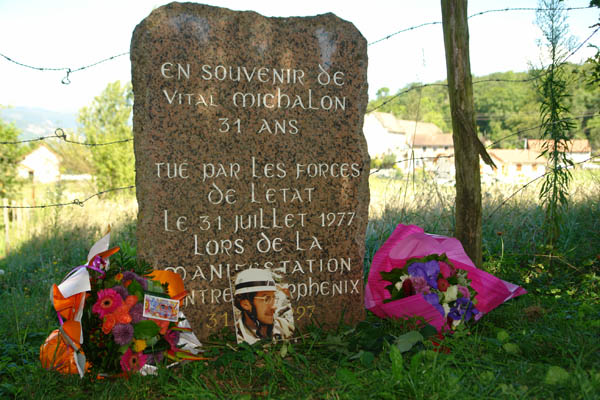
Indeed, people like me were awakened only after the reminder provided by the Fukushima events. But this awareness, in my case, of how deadly nuclear technology can be, is definitive. I had never really asked myself the question before. In the past, early activists suffered firsthand the blows of police batons, tear gas, and defensive grenades that killed Michalon, an anti-nuclear demonstrator opposing the construction of the Creys-Malville super-plant on July 31, 1977, when he was hit in the chest by one of these grenades.
Even today, people come to chain themselves to train tracks through which convoys carrying radioactive waste pass to the "reprocessing center at La Hague" (in fact, a plutonium extraction facility producing French-made MOX nuclear fuel, used in 20 reactors in France, including reactor number 3 at Fukushima, and sold abroad by France). The chained demonstrators are usually brutally removed, many are injured, and they fight so that we and our children can enjoy good health and escape the profit-driven schemes of nuclear oligarchs.
The deadly convoy must pass, at any cost.
I admit I feel ashamed for having reacted so late, and I feel like vomiting seeing not a single one of my scientific or engineering colleagues join this legitimate protest. The awareness of the madness of nuclear danger is only now emerging, spurred by the Fukushima disaster, despite the media blackout orchestrated by atomic barons.
But before this awareness arose, those who opposed nuclear power were dismissed as marginal, dreamers—when in fact they had a clearer and earlier vision of reality than we did.
As we will see below, things are far worse than anyone could have imagined.
Until now, arguments against the ITER project were mainly environmental or aesthetic. I have just seen a grotesque and shocking video taken from the ITER project website, where a guide claims they delicately relocated bats to encourage them to nest elsewhere. Protected flora has also been taken into account.
But what a ridiculous idea, when you consider what comes next.
We know about the radio-toxicity of tritium, a radioactive substance with a half-life of 12.3 years. Yes, the problem is real. Tritium is a hydrogen isotope whose nucleus contains one proton and two neutrons, unlike the nucleus of light hydrogen (a single proton) and the other isotope, deuterium (one proton and one neutron). All three are accompanied by a single electron. This electron constitutes the "electron cloud" of the atom, determining the chemical properties of the substance.
Thus, from a chemical standpoint, light hydrogen and its two isotopes, deuterium and tritium, have nearly identical properties.
When "heavy" hydrogen combines with oxygen, the resulting molecule is called "heavy water." All combinations of these three nuclei with oxygen are possible, including molecules containing one or two tritium atoms.
This water rich in tritium will be radioactive.
Opponents of the ITER program argue that since tritium behaves like hydrogen, it is extremely difficult to contain safely. The tiny molecules of light hydrogen can pass through valves and seals. Worse still, hydrogen can penetrate solid walls! Tritium is a champion of escape, passing through seals and most polymer materials.
From a biological standpoint, there is no danger from light hydrogen or deuterium. With tritium, it's a different story. The hydrogen atom has the property of combining with a wide variety of other atoms, producing a vast number of molecules in both the mineral and biochemical realms.
In doing so, this tritium could enter food chains and even DNA.
ITER supporters may counter that a release or leak of tritium, corresponding to the operation of the test machine or its descendants, would result only in insignificant pollution, "posing no risk from a public health standpoint."
We’ve been hearing this from nuclear authorities for decades.
Another argument advanced by ITER supporters is that the human body contains what are called "water cycles." If the body absorbs tritiated water, it would quickly release it into nature. Its "biological half-life" (one month to one year) is shorter than its "radiological half-life" (Wikipedia).
http://fr.wikipedia.org/wiki/tritio#Fixation_biologique_du_tritio
http://fr.wikipedia.org/wiki/tritio#Cin.C3.A9tique_dans_l.27organisme
Things would be different if tritium atoms were bound, for example, to DNA molecules. Here we touch on the long-term effects of low-dose contamination.
At this point, ITER supporters would shrug their shoulders and say the amounts of tritium are so tiny they would go unnoticed... etc...
In conclusion, it appears impossible to find effective criticisms in this area.
Of course, there is the project's cost, which has exploded, and the budget tripling is merely a pale beginning, as we will see later, along with the calendar risks. The crucial, painful question remains:
- And when will the electricity be produced?
The technical and scientific aspects we will discuss below make it impossible to predict future budgets, timelines, or even feasibility and profitability.
Let us begin by examining the origins of the ITER project.
http://www.iter.org/proj/iterhistory
We read that this project emerged from discussions between Gorbachev and Reagan during their meeting in Geneva in 1985, at the end of the Cold War.
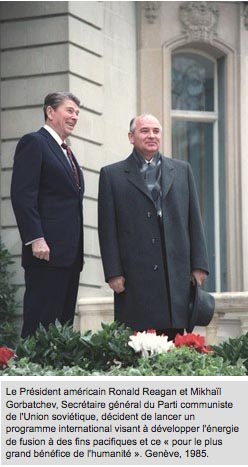
Reagan and Gorbachev in Geneva, 1985
The massive reduction of nuclear weapons and missiles has given the atom a completely negative image, only slightly softened by the positive connotation of civilian nuclear energy. Indeed, we know that a civilian reactor can be converted into a plutonium-producing reactor, capable of manufacturing the explosive material used in fission bombs: plutonium.
-
The Chernobyl disaster showed us that this peaceful atom, which we had dreamed could bring prosperity to humanity, could destroy its environment indefinitely, beyond the lifespan of our species, while simultaneously proving harmful to our health and the human genetic capital. These arguments cannot be ignored.
-
If we include the intractable problems related to waste storage and reactor decommissioning, about which we still have no idea how to proceed.
-
We must also consider the inevitable spread of nuclear weapons.
We should also note that a year after this meeting, Chernobyl occurred.
The need to find a "peaceful atom" that cannot be used to create new weapons, and whose waste consists of an innocuous gas—helium—that cannot lead to the spread of "sensitive materials"—is becoming increasingly urgent.
Immediately, one thinks of deuterium-tritium fusion reactors, which are credited with all kinds of virtues.
An endless energy source, we might say. And thinking of the phenomenal quantities of deuterium and tritium (or lithium, from which tritium can be produced) contained in ocean water.
The energy from fusion is first and foremost a very strong myth—the myth of the "beneficent atom," safe, peaceful, and providing "unlimited energy."
We include an image that speaks to the human imagination: a "sun in a test tube."
Humanity has always associated major natural phenomena with mythological constructs. Rain from the sky brings good harvests. Pre-Columbian civilizations prayed to the sky to give them this vital liquid: rain. But water is also the flood, the destroyer, the killer.
The same applies to the Sun. For the Ancient Egyptians, gods were merely manifestations of the central solar deity. Ra was the beneficent sun that promised good harvests, while his brother Seth, the terrible desert sun god, was the one who withered crops and caused travelers to die of thirst.
There is a myth of the atom. When Oppenheimer, who could read Sanskrit, first witnessed the nuclear fire before his eyes, he instinctively recited a verse from the Bhagavad Gita (verse 33, chapter 11), ending with the phrase:
"I am death, the destroyer of all worlds."
http://en.wikipedia.org/wiki/Bhagavad_Gita
The atom began to enter history, taking a place in human imagination as a terrible god comparable to Jupiter's thunderbolt or Thor's hammer, with biblical connotations of the Apocalypse, the end of the world.
Then came the era of the peaceful atom, dispensing comfort and improving quality of life. An atom that heats homes and powers the high-speed trains that transport us so comfortably and quickly.
But the tragedies of Chernobyl and Fukushima impose themselves as brutal, violent wake-up calls. Then the atom becomes something like a white plague—invisible, odorless, slowly deadly.
- Not everyone will die, but everyone has been touched...
Even when reactor operations appear to proceed without problems, health incidents among workers have been observed. A study conducted by INSERM (the French National Institute of Health and Medical Research) shows that cancer cases among these workers are twice as high, even though dosimeters indicate doses below the (arbitrarily set) limits established by the Nuclear Safety Authority.
Here we see the civilian atom, despite the powerful nuclear lobby, taking on an unsettling form.
So why not promote this "sun in a test tube," this atom that returns to being beneficial, safe, and risk-free? If an airplane crashes into a tokamak, or a terrorist sabotages it with explosives, there would be no problem!
What would the consequences be? A little deuterium, tritium, lithium, and helium would escape into the air—nothing more, we’d say—and by the next day, the incident would be forgotten.
With fusion, we see the myth of the "risk-free, waste-free atom" emerging.
As one can imagine, this is not entirely true. Deuterium-tritium fusion produces neutrons that in turn contaminate all reactor structures. These structures would become radioactive through "activation," due to transmutations occurring in all materials exposed to a significant neutron flux. Thus, decommissioning a fusion reactor would be equally complex, problematic, and costly as decommissioning a fission reactor.
ITER supporters might argue that fusion waste has half-lives measured in centuries, while fission produces deadly radionuclides for hundreds of thousands of years.
After this preamble, we must try to move beyond the myth, forget the pretty phrases like "sun in a test tube" and "unlimited energy," be realistic, and assess the proposal in terms of feasibility.
To do this, I will need to use a physicist’s discourse. Where possible, I will strive to make this discourse accessible.
Fusion is a ivory tower protected by the extreme complexity of the phenomena involved. This is one of the reasons nuclear authorities can avoid any questioning by responding, "It's very complicated." This sends their interlocutor—possibly a politician—into a cloud of complexity, allowing them to dodge tricky questions, like an octopus releasing its ink.
Let us therefore enter the heart of these scientific questions and go beyond the usual jargon for beginners.
The ITER project rests on two sets of results. On one hand, we have the British result from JET (Joint European Torus), obtained at the Culham laboratory in October 1997, where injecting different forms of energy allowed, for one second, the achievement of fusion reactions, with a coefficient Q = 0.7.
What does this Q coefficient mean? It is the ratio between the gross energy emitted during fusion and the energy injected in the form of microwaves, injection of neutral particles, etc.
A fusion reactor produces energy whose flux is proportional to the volume of the nuclear vessel, or equivalently, to the cube of its characteristic dimension (take, for example, the diameter of the plasma torus).
Energy losses occur at the walls and are proportional to the surface area of the vessel. These vary as the square of its characteristic dimension.
The conclusion is that the Q coefficient follows this evolution law:

If JET was limited to Q = 0.65, it means the machine was too small. ITER, twice as large, should allow a Q coefficient twice as high, or:
Q = 1.4
In ITER brochures, it is claimed they expect a factor greater than 5, with a runtime of between 400 and 1000 seconds.
Some details about the experiment at JET. This tokamak is not equipped with a superconducting coil. The magnetic field is created by a solenoid made of copper wire. The current intensity through the solenoid is several megaamperes, and the Joule heating dissipation prevents extending the experiment.
http://fr.wikipedia.org/wiki/Joint_European_Torus
http://claude.emt.inrs.ca/VQE/sources/fusion_futur.html
The heating systems for ITER (microwaves, neutral particle injection) are an extrapolation of those installed at JET.
So, ITER "will work."
No one doubts this. Deuterium-tritium fusion will be achieved, with a Q coefficient greater than one, and for a much longer time, thanks to the use of a superconducting coil.
But is that all?
The machine, as we will show, is not complete.
In its current state, it cannot even be considered a prototype undergoing validation. Simply because it lacks one, or even several essential elements, especially those whose operation has never been tested.
The reactor will be loaded with a 50/50 mixture of hydrogen isotopes, deuterium and tritium. The fusion reaction causes both elements to disappear, producing a helium nucleus with two positive charges, at the cost of 3.5 MeV of fusion energy, and producing a neutron with 14.1 MeV.
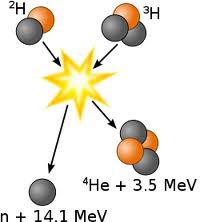
Deuterium-tritium fusion
The confining magnetic field prevents the helium nucleus from escaping. Through energy exchange with deuterium and tritium ions, the helium atom helps maintain the plasma temperature, otherwise it would cool down due to energy loss through radiation. But this field has no effect on the neutron, which lacks charge and will impact the confinement ring walls. Captured by the materials forming the wall, it will create radioactivity in these elements through activation and various transmutations.
The French Nobel laureate Pierre-Gilles de Gennes doubted whether the delicate superconducting coil material could be protected from the neutron bombardment resulting from fusion. Superconducting materials are fragile. Neutron damage can locally destroy superconductivity, render magnets useless, or even cause their destruction.
Faced with this major problem, ITER officials respond that behind the first wall ("the first wall") and the coil, there will be a second wall made of lithium compounds that absorb neutrons and produce tritium through an exothermic reaction:

http://www-fusion-magnetique.cea.fr/gb/cea/next/couvertures/blk.htm#ch1
http://www.energia-nuclear.net/es/como_funciona/fusion_nuclear.html
Also see:
It should be emphasized that this reaction is a fission reaction, triggered fission of lithium-7, which is unstable and splits into two atoms with 4 (helium) and 3 (tritium) nucleons.
This second wall (or tritium-breeding blanket) is made either of a liquid mixture of lithium and lead. The role of lead is to slow down neutrons. In this process, it can emit two others. This liquid mass at 500°C is cooled by pressurized water. It is impossible for this liquid metal mixture to come into direct contact with the water. Lithium melts at 180°C and vaporizes at 1342°C.
Lithium does not burn in air at room temperature, unlike its alkali cousin sodium. But at sufficient temperature, it burns like its other cousin, magnesium, and this combustion is exothermic and highly violent.
http://www.plexiglass.fr/materiaux/metaux/lithium.html
Excerpt
(translated):
Lithium
is the only alkali metal that can be handled in air without danger, while the others oxidize and frequently ignite. In air, lithium slowly forms a film of oxide and nitride.
With humid air, the attack, catalyzed by water vapor, is much faster.
The metal ignites in dry oxygen atmosphere above 200°C, forming Li₂O and not peroxide, distinguishing it from its heavier homologs (Na, K, etc.) and making it more similar to alkaline earth metals.
The combustion of lithium is highly exothermic and produces an intense white light, like magnesium.
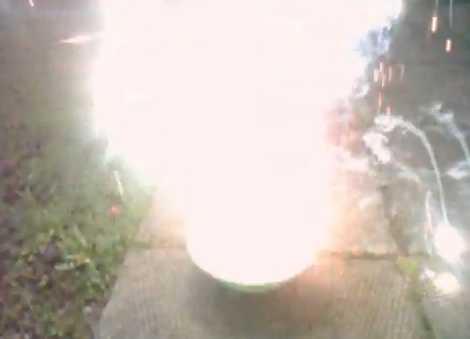
Lithium burning in air, in contact with water: immediate explosion
http://www.youtube.com/watch?v=ojGaAGDVsCc
Lithium fire in water:
http://www.youtube.com/watch?v=hSly84lRqj0&feature=related
Lithium plus water:
http://www.youtube.com/watch?v=oxhW7TtXIAM&feature=related
When exposed to water at 500°C, it decomposes the water, removing oxygen and releasing... hydrogen. This type of reaction is similar to that occurring in zirconium cladding around fuel pellets in Fukushima reactors, and generally in all water-cooled reactors when temperature rises and water turns to vapor.
The hydrogen released in the reaction between lithium and the cooling water could combine with air and cause an explosion like the one seen at Fukushima. Lithium is an extremely reactive substance that can combine with oxygen, with hydrogen (forming lithium hydride, the explosive component of hydrogen bombs), with nitrogen at room temperature forming lithium nitrides. All these reactions are exothermic and can get out of control, causing severe damage.
And from all this, no one tells us anything.
No one has discussed what could happen if, in a fusion reactor, the lithium catches fire or combines with the water meant to cool it. These tritium-breeding blankets (which regenerate tritium from lithium) have never been tested. As Michele Rivasi pointed out at this meeting, it would be better to test these tritium-breeding blankets on other machines, such as JET or German machines (ASDEX at the Max Planck Institute in Garching), or Japanese ones, before launching into a project that is:
- expensive
- dangerous
- problematic
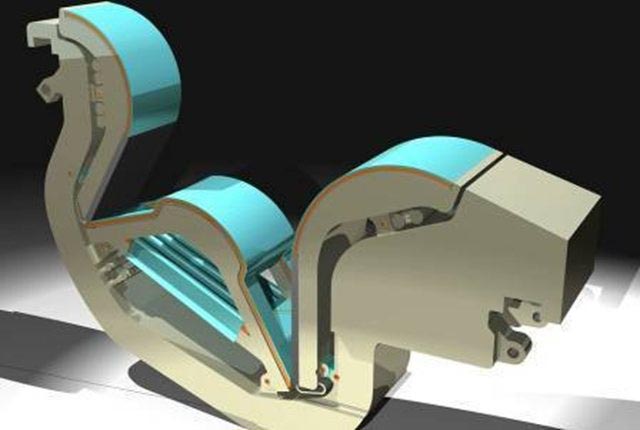
Around the tritium-breeding cells, which will be seen in the image below (source: CEA website), two things should be noted:
- Directly in contact, the first wall made of beryllium. Beryllium is a metal that melts at 1380°C. Its behavior inside a tokamak has not been tested. Beryllium is highly toxic, capable of causing an incurable lung disease called berylliosis. It is also carcinogenic.
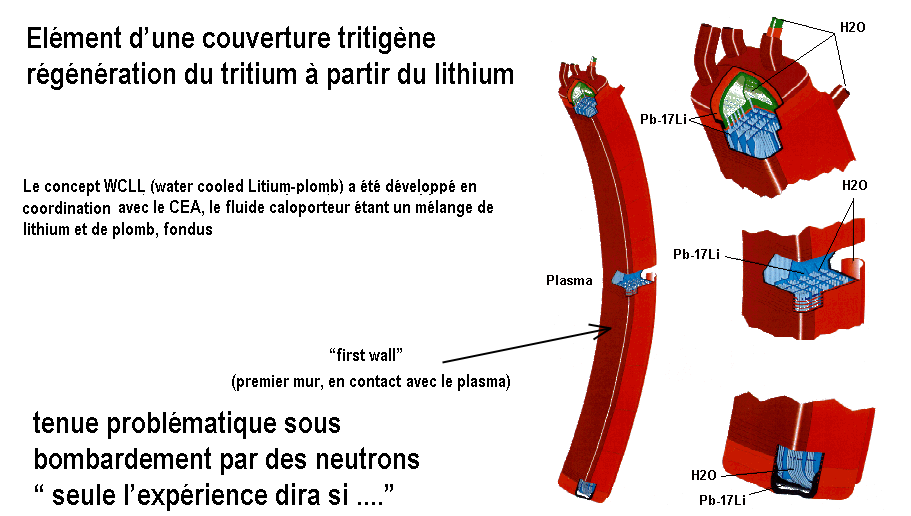
Element of a tritium-breeding protective blanket (another "untested experiment")
On the other side, you will find the superconducting coil, cooled by liquid helium at 3 K (or -270°C). At the slightest temperature rise above 20 K (depending on the superconducting material used), superconductivity disappears. The part of the coil losing superconductivity becomes resistive and dissipates all accumulated energy as heat (Joule effect), which can completely destroy the superconducting material. Liquid helium vaporizes violently, expanding its volume by more than 700 times. It is a potential bomb.
When these conductors are in the "superconducting" state, there is no heat dissipation. The cryogenic system is present to cool and maintain the superconducting element at low temperature.
A similar accident occurred at CERN in 2008. One of the coil welds broke, causing a loss of superconductivity. The current flowing through the coil is 9,000 amperes. An electric arc vaporized the liquid helium in the coil. The resulting explosion displaced the 40-ton coils several meters (…).
In a fusion reactor equipped with its essential tritium-breeding blanket, a catastrophe is possible with:
- Violent combustion of the lithium contained in the tritium-breeding blanket (it burns like magnesium—this would make a great TV demonstration).
- In the presence of water: explosion.
- The heat produced disrupts the nearby superconducting coil, causing it to vaporize.
- This lithium fire releases toxic lead vapors (lead poisoning) and radioactive tritium that was synthesized in the tritium-breeding blanket.
- The "first wall" (one to two millimeters of beryllium, also toxic) also vaporizes and mixes with the toxic contaminants.
- We include the dispersion of several kilograms of tritium, representing the reactor's charge.
Total disaster...
We should be reassured, since an explosion of this kind would immediately halt the fusion reaction. That's not bad. This is what we've been told for decades, emphasizing the safety of nuclear reactors of the next century.
But regarding chemistry, this would be...
Seveso.
At this ITER meeting, Michele Rivasi created evident discomfort when she asked, "Who will pay in case of accident or catastrophe? Who will be responsible?" The response was a deathly silence, significant:
- But really, what are you talking about? What catastrophe? All precautions will be taken, of course...!
This presence of lithium, essential for creating this tritium-breeding blanket, makes the reactor utterly dangerous.
This inevitable danger has been carefully hidden from the public, behind a true curtain of smoke from the "basic fusion reaction"—the deuterium-tritium mixture.
Let us be clear. A "fusion reactor" does not operate with just one reaction, but with two.
In detail:
2 Deuterium + 3 Tritium → 4 Helium + 1 Neutron + Energy
(the most publicized reaction in nuclear history)
Neutron + Lithium → Helium + Tritium (via regeneration) + Energy
Neutrons account for 80% of the emitted energy: 14 MeV (mega-electron-volts).
Helium accounts for 20% of this energy. This energy is transferred in the plasma through collisions and maintains the reactor temperature at 100–150 million degrees.
Neutrons, being electrically neutral, pass through the "magnetic barrier" and impact the "first wall," made of beryllium. Either they pass through without interaction or they interact with it and participate in the reaction:
9 Beryllium + 1 Neutron → 2 Helium-4 + 2 Neutrons
The second reaction, indispensable for a fusion reactor, is the one that regenerates tritium:
1 Neutron + 6 Lithium → 4 Helium + 3 Tritium + Energy
We can combine these two fundamental reactions into one:
2 Deuterium + 6 Lithium → 2 Helium-4 + Energy
Thus, a "fusion reactor," which has a familial relationship with breeder reactors, consumes not a mixture of deuterium and tritium, but deuterium and lithium—two substances abundant in seawater.
Hence the idea of "unlimited energy."
Fine. But we still need to know how to operate the tritium regeneration reaction, which is extremely dangerous and untested. It will be tested in ITER.
It has taken intense disinformation and media anesthesia over several decades for the local population, apart from a few "excited ecologists," to accept the installation of such a dangerous project with such passivity. The mayor of Aix-en-Provence, Maryse Joissains, has reaffirmed her unconditional support for ITER.
The tritium-breeding blanket should consist of N elements like the one shown above. In the ITER experiment, only a few such elements will be installed. Perhaps just one, with the others replaced by a casing serving as a neutron barrier—probably lead.
The deployment of this tritium-breeding blanket around the chamber will serve only as a demonstration, and undoubtedly will become the next toy for our nuclear oligarchs.
No matter which angle we look at the ITER project, we always end up with very complex problems, requiring untested solutions that are also complex. And whoever speaks of complexity speaks of extended installation time and cost explosion.
In terms of complexity, there is as much distance between ITER and a fission reactor as between a tube reactor and a kettle.
We might ask the inventors of ITER:
Will the behavior of the entire "first wall" system, along with its protective blanket (tritium-breeding) and associated heat evacuation system, be satisfactory? Or is it more of a novelty than a well-tested system?
Another problem related to ITER's operation is the ablation of the first wall due to impact from hydrogen ions. The guiding principles are based on results obtained in France at the Tore Supra machine, a French tokamak installed in Cadarache, equipped with a superconducting coil capable of providing up to 4 teslas. However, the temperatures achieved do not allow fusion. (Unless I am mistaken—any clarification will be welcome), these were in the range of several million degrees. Moreover, the operating duration was a record 6 minutes.
It is possible to study the behavior of walls very close to, or even in direct contact with, the hot plasma. The confinement chamber has been lined with carbon tiles (CFC), very similar to those used in the space shuttle. Carbon conducts heat well and exhibits good resistance to high temperatures. Scientists have studied heat absorption through conduction across a wall called the "limiter." This is the circular path we can see below the toroidal chamber.
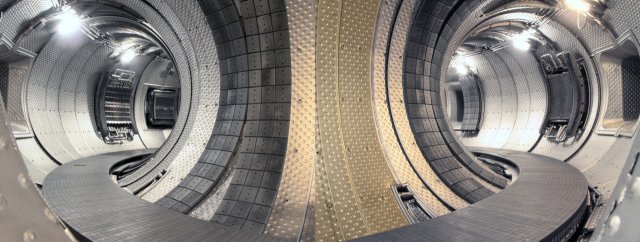
The Tore Supra chamber. Below, its limiter
The chamber walls have been tested with heat fluxes of 1 megawatt per square meter, increasing to 10 megawatts per square meter at the limiter, where the surface temperature reaches 1200–1500°C. The limiter is a heat exchanger, with water circulating behind it at 220°C and 40 bars pressure, thus allowing testing of heat recovery possibilities in a tokamak.
An aside and a clarification I recently confirmed: It has been announced with great fanfare that deuterium-tritium fusion—the "magic pair"—had been achieved at JET. In fact, it is not widely known that most fusion experiments have been conducted using deuterium alone, at temperatures slightly above 150 million degrees.
The reactions occurring in a reactor using deuterium as fusion fuel
Source:
http://fr.wikipedia.org/wiki/Fusion_nucl%C3%A9aire
http://www.energia-nuclear.net/es/como_funciona/fusion_nuclear.html
- Deuterium + Deuterium → (Helium-3 + 0.82 MeV) + (Neutron + 2.45 MeV)
- Deuterium + Deuterium → (Tritium + 1.01 MeV) + (Proton + 3.03 MeV)
- Deuterium + Tritium → (Helium-4 + 3.52 MeV) + (Neutron + 14.06 MeV)
- Deuterium + Helium-3 → (Helium-4 + 3.67 MeV) + (Proton + 14.67 MeV)
The British conducted some tests with deuterium-tritium to validate the concept. But according to my source, the essential part of the tests was carried out with deuterium, perhaps for cost reasons.
Radiation losses.
Plasma loses energy through two radiation processes of the "electron gas." First is "synchrotron radiation," which results from the energy loss of these electrically charged particles orbiting the machine's magnetic field. The second source of energy loss is "bremsstrahlung" radiation. When an electron passes near an ion, its trajectory is deflected. It decelerates and emits this type of radiation, whose intensity increases with the square of the ion's electric charge Z.
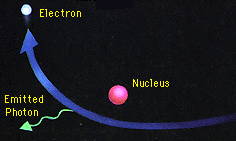
Bremsstrahlung Radiation
Carbon is interesting for several reasons:
- Its excellent resistance to high temperatures (the "tiles" are very similar to those used on the space shuttle)
- Its good thermal conductivity
- The low number of electric charges carried by carbon ions (six)
In the mechanism of energy loss through bremsstrahlung radiation, a carbon ion (stripped from the wall and contaminating the plasma) contributes 16 times more energy loss than an electron or a hydrogen ion, which carries only one charge.
However, carbon suffers from erosion and behaves like a true hydrogen drain, absorbing hydrogen and producing hydrocarbons. If mixed with tritium atoms, it becomes radioactive in turn (tritium has a half-life of 12 years).
Therefore, carbon cannot be used unless (as we will see below) as a waste absorber.
For ITER, where the internal wall covers 1,000 square meters, the choice has been made. 700 square meters will be lined with beryllium, the lightest of all metals, with a melting point of 1,280°C. This coating will undoubtedly withstand thermal shocks thanks to a sub-parallel circulation of pressurized water. Regarding plasma contamination from ion sputtering, beryllium has four electrons and contributes 16 times more energy loss than an electron and a hydrogen ion.
Fusion naturally produces helium. A reactor like ITER could not operate with 10% helium, which constitutes the "ash" of the fusion reaction. It must be continuously removed.
This was the function of the limiter, but engineers have considered another geometry, leading to the design of a divertor. This corresponds to the drains we see running at the base of the toroidal chamber:
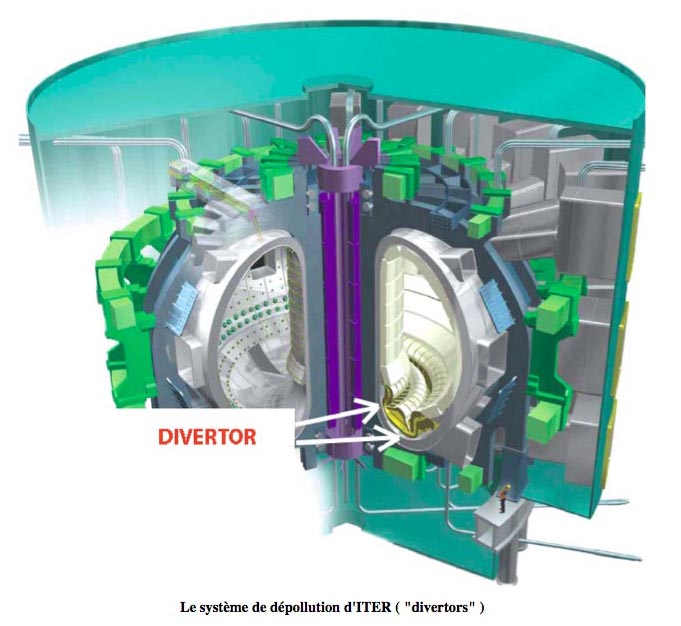
The divertor consists of modules, segments that can be manipulated and replaced. Here is the design of one of them.
Divertor Module
The green parts correspond to tungsten plates. This metal, which forms the filament in incandescent light bulbs, has the highest melting point of all metals at 3,000°C. The divertor's shape can be explained by considering not only its primary function but also a specific magnetic geometry that allows it to capture ions:
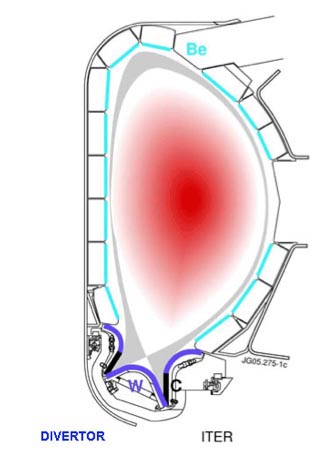
Light blue: beryllium. Dark blue: tungsten. Black: carbon.
A "fish-tail" magnetic geometry is clearly visible. The slots located at the base of these two drains are designed to serve as the opening through which plasma can be pumped out and then reinjected into the chamber after removing the ash (helium) and the ions contaminating the plasma that cause radiative cooling: carbon, beryllium, and tungsten.
Tungsten is the most damaging contaminant of all. Its electronic structure gives it 74 electrons, and specialists have told me that once mixed with fusion plasma, it can reach 50 or 60 electric charges. The encounter of an electron with one of these ions results in a bremsstrahlung radiation energy loss 3,600 times greater than when an electron meets a hydrogen ion.
We are discussing radiative losses in the form of bremsstrahlung radiation. However, there are other types of losses that are even more significant, associated with "free-bound" transitions.
When electrons encounter deuterium, tritium, helium, or beryllium ions, the nuclei have lost all their electrons. This is not the case with tungsten under operating conditions. Probably between fifteen and twenty-five electrons (out of its 74) remain bound to the nucleus. The encounter with a free electron triggers de-excitation of this residual electron shell, immediately followed by radiative de-excitation with photon emission. Another significant loss.
Plasma contamination by tungsten ions could lead to a drop in efficiency, potentially causing the fusion plasma to extinguish.
After consulting with a specialist, I learned that the pumping of heavy ions will occur at the base of the slots separating the two elements of the divertor, through centimeter-sized holes.
JET was initially equipped with a limiter similar to that of Tore Supra. The British have modified their setup to line the chamber with tungsten and install a divertor at its base. As Michèle Rivasi pointed out on May 16 in Aix-en-Provence, it would have been better to wait for the results of the British experiments before launching the ITER project.
The same conclusion applies to the beryllium wall.
Has the divertor system been tested?
Can it guarantee the purity of the fusion plasma?
Answer from specialists:
- Only experience will give us the answer.
Conclusion:
When one ventures into the intricacies of the ITER machine, one discovers a complexity that is dizzying. This "thing" is a hundred times more complex than a nuclear fission reactor. It involves dozens of problems, many of whose solutions have not yet been tested. The efficiency of the divertor remains pure speculation. And precisely this solution for continuous plasma decontamination is the essential condition for continuing its development.
From this perspective, ITER is an exciting experiment, a hub of thesis topics and sophisticated studies. But it is also
A 15-billion-euro experiment
(at least for now)
Even the smallest additional problem will trigger a new explosion in its budget. Our parliamentarians must be aware of the issue and not be misled by routine phrases designed to numb them, to fill their minds with smoke:
- The sun in a test tube
- An unlimited energy source...
When I asked a researcher involved in this project:
- When, and at what cost, can we expect this machine to become an electricity generator?
His answer was:
- We’ll need a budget that isn’t too tight… around several billion euros, to be achieved over several decades.
The menu is on the table. Too expensive, too slow, too many problems.
What are the solutions for energy needs?
Nuclear, via fission:
- Dangerous
- Harmful to the environment and health
- No solution for managing nuclear waste
Fusion, via ITER:
- Too expensive
- Too many unsolved problems
- Too slow
I will attend the DZP colloquium (dense Z-pinches) in Biarritz, from June 6 to 9.
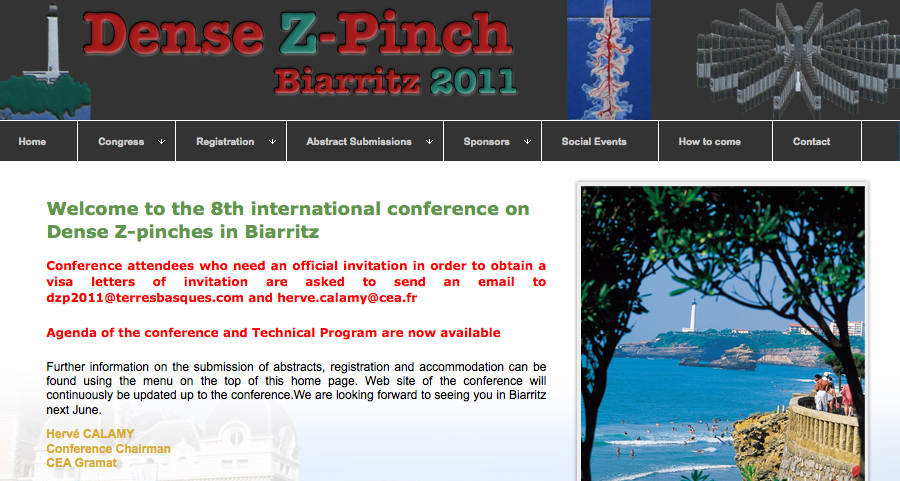
DZP2011 is the principal conference for specialists working in the field of dense Z-pinch research and closely related topics. Previous conferences held in Laguna Beach (1989), London (1993), Vancouver (1997), Albuquerque (2002), Oxford (2005), and Alexandria (2008) have attracted over 100 delegates from up to 20 countries.
The topics covered by DZP2011 include all aspects of dense Z-pinch research, including fundamental Z-pinch physics and the broad range of applications of Z-pinches to such areas as inertial confinement fusion, laboratory plasma astrophysics, soft x-ray lasers, and fundamental high energy density physics. Related dense plasma configurations such as X-pinches, plasma foci, and high current capillary discharges are among the topics of interest.
On Monday, June 6, 2011, at 8:30 a.m., my friend Malcolm Haines will deliver the keynote presentation, analyzing results obtained from Z-machines since 2005, and reaffirming his conclusion: "At Sandia, temperatures exceeding two billion degrees have been achieved since 2005." His intervention at this international colloquium dedicated to Z-machines is essential.
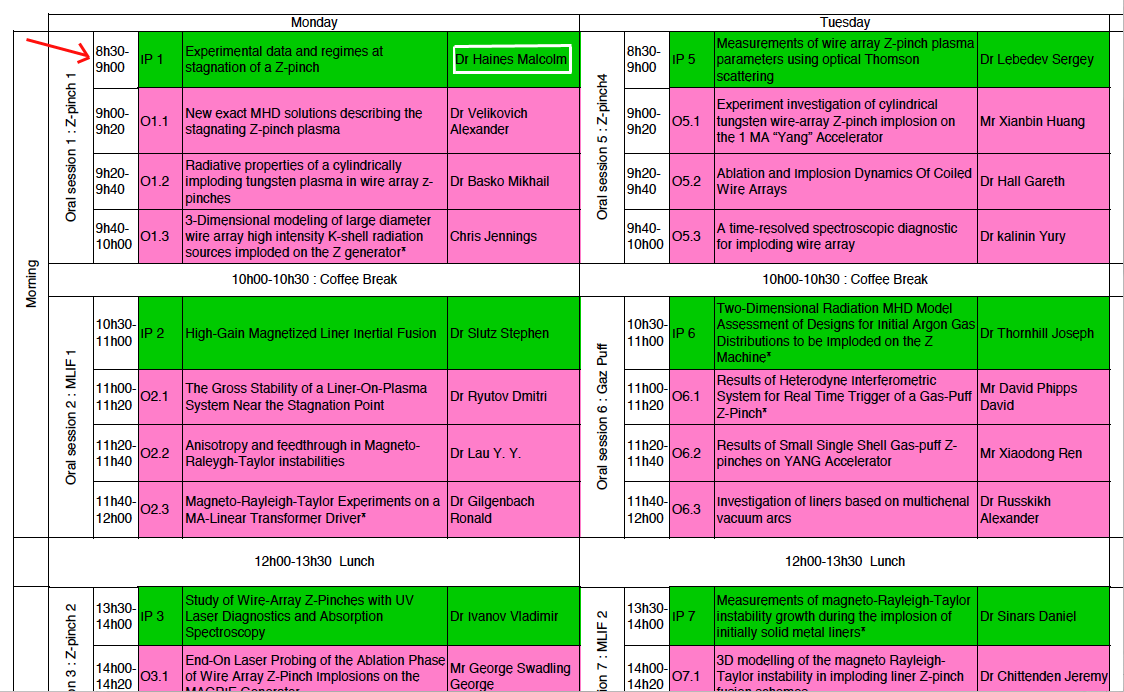
Biarritz Colloquium Program on Z-machines (June 6–9, 2011)
(Will any French journalist attend the event in person, or will they be satisfied with summaries dictated by the CEA and other institutions?)
The explanation of this phenomenon fits in two words: "turbulent resistance."
I will be supporting Malcolm in his presentation.
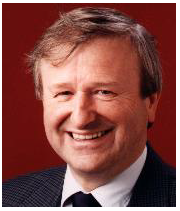
Malcolm Haines, pioneer of plasma physics and MHD
In previous years, I’ve heard Americans claim that such temperatures had never been achieved, and that the conclusions published in the prestigious journal Physical Review Letters in 2006—under the article title "Over two billion degrees"—were false. But in the five years since the article’s publication, they have never published a single line to support their refutations, nor even provided reasonable and logical explanations.
In my view, the Americans have launched a disinformation campaign, since this new process can be used to design and subsequently build pure fusion bombs (where the fusion process is initiated by magneto-hydrodynamic compression, or MHD, rather than by an atomic bomb). These are miniaturizable, "clean" bombs (without nuclear waste) based on boron-hydrogen fusion (this reaction starts at around one thousand degrees and is weakly neutronic).
As I mentioned earlier, Haines will be present at the colloquium, but we cannot be certain. He currently has health problems that might prevent him from attending.
If Haines does not come, no one else will be able to oppose, with the weight of his scientific credibility, the brazen and hateful lies of the Americans.
Eric Lerner, who works on a Focus experiment and strongly advocates for a non-contaminating boron-hydrogen fusion approach, will also be present.
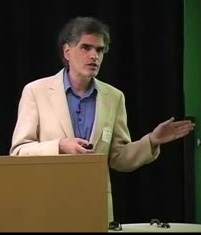
Eric Lerner, champion of aneutronic fusion
As I’ve been saying on my website for five years, one day we will see electricity generators based on this aneutronic fusion appear (a concept I previously mentioned in the comic "Energétiquement vos," available for free download at the Savoir sans Frontières website).
http://www.savoir-sans-frontieres.com/JPP/telechargeables/ESPANOL/energeticamente_vuestros.htm
Like internal combustion engines. Over a century ago, they replaced steam engines.
ITER is nothing more than... the steam engine of the third millennium, hyper-complex.
If nuclear energy is to regain momentum one day, it will undoubtedly come from fusion propulsion generators.
We will see the emergence of fusion with no waste of any kind, no fusion byproducts, and no structures rendered radioactive by neutron bombardment.
Persisting with an energy based on fission processes, accumulating highly radioactive waste (100,000 tons in France alone), storing waste with a half-life measured in hundreds of thousands of years, is absurd. Especially when science has advanced significantly and offers alternative solutions.
We deny the power of scientific progress.
Experiments conducted at Sandia show that another path is possible. But as always, it will be:
- Weapons first, energy later.
Nothing or no one tells us that research into this pure boron-hydrogen fusion pathway will produce electricity generators in the short term.
But these machines would cost 500 times less than ITER.
Let us examine the solutions:
Fission: dangerous, highly contaminating, health risks
ITER fusion: many problems, uncertain, too expensive
Aneutronic fusion: undefined horizon, but low cost. Fundamental research must begin now.
Shale gas: contaminates groundwater.
Returning to oil and gas: massive imports, limited resources, pollution (including oil spills), greenhouse gas emissions.
Renewable energies remain: vast, diverse, requiring low technological levels.
If all countries in the world accepted to massively invest in these solutions (beyond simple household installations) and redirect the portion of their budget currently allocated to nuclear (civil and military) and weapons development toward this effort, all problems would be quickly resolved!
However, this process would face fierce opposition for various reasons.
-
The enormous efforts and investments made in nuclear energy would become obsolete. The reason such investments were approved and continue today is primarily for military applications (plutonium production).
-
The low technological level required for developing renewable energies (deserts, geothermally active regions, oceans, etc.) would place technologically advanced countries on equal footing with those previously considered incapable of catching up with modern technology.
-
And this process is nothing less than a "anti-New World Order, anti-globalization, and even anti-capitalist" policy.
Opinion of President Nicolas Sarkozy during his visit to Tokyo on March 31, 2011
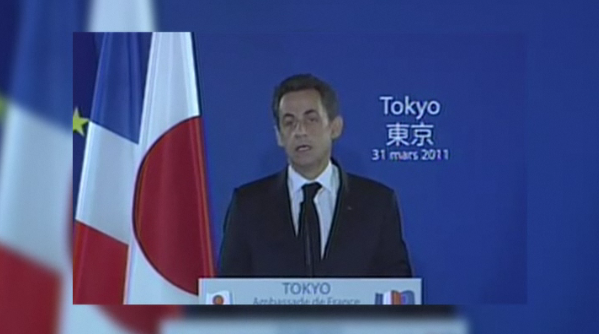
Two minutes of video
News
Guide (Index)
Home Page