20 )
What twin matter could be made of.
Theoretical physics is in a big crisis since more than 30 years. A lot of papers were published many years ago about magnetic monopole, but none have ever been observed. The existence of supersymmetric partners has not yet been proved. Nobody knows what a "graviton" could be. When scientists tried to detect the proton's decay, this last did not cooperate. Almost all that new telescopes bring is still a complete mystery. Nobody knows what are QSO, gamma flashes and how they work. Giant black holes are strangely silent, etc. Superstring is nothing but a new fashion, despite thousands of papers published in this "new field". Superstring world is a strange playground where physics seems desperately absent. In the following we present the first geometrical description of antimatter. As J.M. Souriau used to say, group theory is the most basic tool we have to deal with physical phenomena. A natural action of a Lie group is its coadjoint action on its Lie algebra, as introduced by J.M. Souriau in 1970 [53]. The dimension of a group G is the number of parameters it depends on. This is also the number of components of its moment J. The Lorentz group L is a six-dimensional group, which has four connected components. Introduce the four elements group ω, in its matrix representation (a). Then we can build the complete Lorentz group L from its neutral component Lₙ, through a direct group product (b), where (c) is the matrix representation. A new semi-direct product (d) gives the Poincaré group.
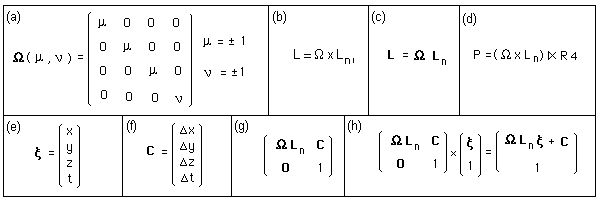
Introduce the event-quadrivector (e) and the space-time translation vector C: (f).
We can give a matrix representation (g) of the Poincaré element. In (h), its action on space-time is defined. But this one hides a more important action: the coadjoint action of the group on its ten components moment space J (the Poincaré group has ten dimensions).
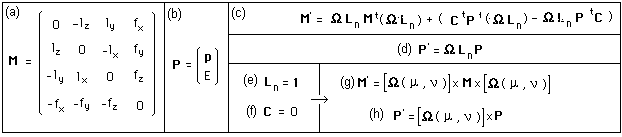
Souriau writes this moment as:
J = {E, p, f, l},
where E is the energy, p the momentum, f the "passage" and l the spin. It is convenient to introduce, following Souriau, an antisymmetric matrix M: (a) and the quadrivector momentum-energy P: (b). The calculation of the dual of the action of the group on its Lie algebra gives the action on the momentum { (c), (d) }.
Now, if we want to highlight the symmetries I, P, T and PT, we choose (e) and (f). The coadjoint action becomes then { (g), (h) }, which gives:
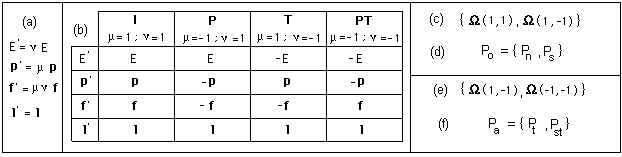
As pointed out by J.M. Souriau in 1970, from the matrices (c), we construct the orthochron subgroup P₀: (d), composed of two connected components: the neutral component Pₙ and the space-inversion component Pₛ. The elements of these two components do not change the sign of the energy E. On the contrary, the matrices (e) produce the antichron subset, whose elements invert the sign of the energy, so that time-inversion is accompanied by energy inversion, i.e. mass-inversion, if the particles possess one. In conclusion, we see that negative mass and negative energy emerge from the dynamic description of the Poincaré group, referring to relativistic movements of material points.
We are now going to extend the Poincaré group, considering:

We introduce the matrices (a) and (b). Then we give a matrix representation of the group, acting in (e) on a bundle Z₂ × U(1) × ℝ⁴. In (f), we obtain the geometric expression of the symmetry C. The fifth dimension (c) is compact. Thus, any element of the group corresponding to choices (f) implies a symmetry with respect to the indicated straight line.
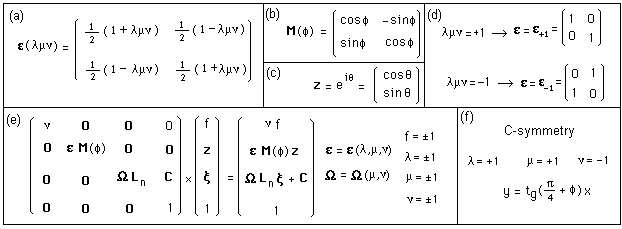
The calculation of the coadjoint action of the group on its moment presents no particular difficulty. As pointed out by Souriau in 1970, the addition of a compact dimension q is accompanied by an additional quantized scalar, identified to the electric charge q. The action on the part of the moment corresponding to the Poincaré group does not change. The action on the electric charge gives:

Particles are described in terms of orbits of the group. Some have a positive energy, others a negative one. f can be considered as a fold index.
f = +1 denotes the fold F,
f = –1 denotes the fold F̅.
We thus obtain a geometric twin structure. The action is simply:
f′ = n f.
This can be summarized in figure 21:
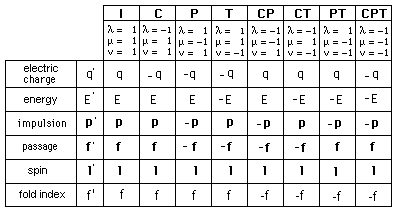
Fig. 27: Impact of symmetries on the components of the moment.
Note that (ν = –1) denotes the antichron terms of the group. A particle and its movement correspond to a particular element of the moment. The antichron terms transform orthochron movements into antichron ones and invert the mass and the energy. As space-time is composed of two separate folds F and F̅, encounters between particles of opposite energy can be avoided if we place the positive energy particles in a fold (for example F) and the negative energy particles in its twin fold F̅. This physical description is consistent with the properties of the group.
- PT symmetry and CPT symmetry.
As pointed out by Souriau in 1970, any symmetry including a T transformation inverts the energy and the mass. If we consider a normal particle, with mass m and electric charge q, its CPT symmetric has negative energy and mass. Feynman showed that the PT symmetric of a particle behaves as an antiparticle; however, according to Souriau's results, it has negative mass and energy. From the above, we have constructed a new description of the Universe as composed of two twin entities. The first is a fold F, supposed to be ours, filled with matter and Dirac antimatter, symmetric C with respect to the first. In the second fold F̅, the matter-antimatter duality also applies. Its matter is symmetric CPT with respect to ours, while its antimatter corresponds to that of Feynman. In total, the two folds are symmetric CPT. This is consistent with the initial ideas of Sakharov ([33] to [36]). The initial work of the author, devoted to the cosmology of the twin Universe, was published in 1977.
- Leaking neutron star model: an alternative to the black hole model.
Classically, the criticality of a neutron star is based on a geometrical criticality. A sphere of constant density, surrounded by vacuum, can be described by two linked Schwarzschild metrics (internal and external). These expressions were given in section 7. They become critical when the neutron star's radius tends to its associated Schwarzschild radius. Tolmann, Oppenheimer and Volkov derived (see [52], eq. 14.22) a famous "TOV equation", giving the pressure as a function of the radial distance in a neutron star.
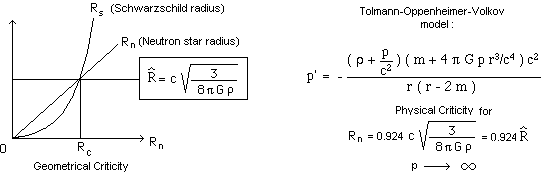
Fig. 28: On the left, geometrical criticality; on the right, physical criticality.
The calculation shows that, before the geometrical conditions are reached, a physical criticality occurs: the pressure tends to infinity at the center of the star (left).
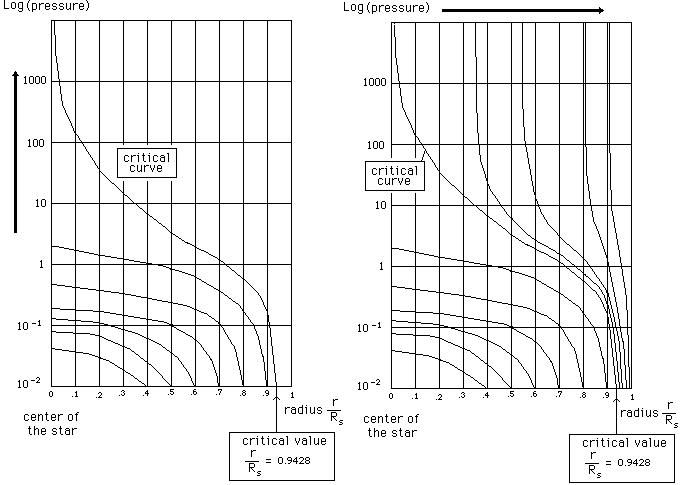
Fig. 29: Pressure as a function of the radial distance in a neutron star.
We are now going to make some assumptions. In section 15, we tried to describe the primitive state of the Universe by going back in its past. In order to explain its great homogeneity, we introduced a variation of the physical constants during the radiative era. However, this exploration remains very hazardous. We only tried to provide new insights into the question: "What happens when we look at the distant past of the Universe?" I think we do not have all the keys. I will, however, express an opinion: I think that when the pressure reaches a critical value (to be determined), our Universe becomes linked to its twin, which A. Sakharov suggested "resides in its past". Although it is still unclear, I admit that it is an hypothesis. I think our universe interacts with its past, which would extend along a sort of space-time bridge. Sakharov thought that our Universe and its twin were linked. I add that they would be interacting constantly, everywhere, at all times. That's why the arrow of time seems to be reversed in the twin, as shown in section 19. That's also why the twin's atoms seem to have a negative mass and repel ours. For us, they simply live backwards in time, and according to Souriau's works, their apparent mass is negative.
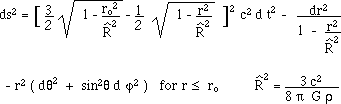
By analogy, I suppose that when physical criticality is reached at the center of a neutron star, the local values of the physical constants change drastically. Such a condition would "reproduce" locally the "Big Bang conditions". A space bridge would open, sucking matter at relativistic speed. This "soft scenario" would occur when the matter flux due to the stellar wind of a companion star reaches critical conditions at the center of the star. A steady state could then be geometrically described using the four Schwarzschild metrics. For the fold F:
For the adjacent, conjugated region of the twin fold F̅:
One can study the geodesic systems and link them via a space bridge whose only parameter is its area. Tiny space bridges could absorb the matter coming from the stellar wind of a companion star, because near it, the density is enormous and the velocity is relativistic. On figure 24, a 2D didactic image of the model.
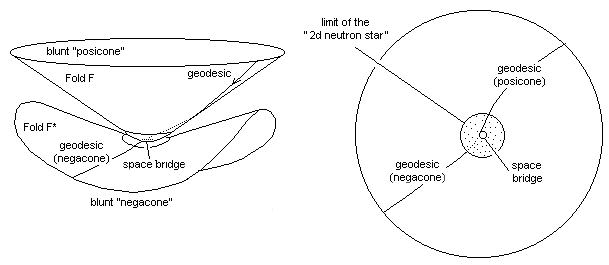
Fig. 30: 2D didactic image of a leaking neutron star (SNS).
A violent inflow of matter, due for example to more eruptive phenomena of a companion star or to the fusion of two neutron stars forming a binary system, could produce a rapid opening of a space bridge, as suggested on the right of figure 24. The explanation of gamma bursts could lie there. This model challenges the black hole model. We will see further how this last is questionable. Something is wrong with this black hole model. There are too few candidates, and everyone knows that a slight error in distance evaluation can transform such black hole candidates into simple neutron stars. There is no undeniable proof of their existence. People only believe in them, by habit. They always said: "What could you imagine else?" Look at the beginning of the article. We mentioned the issue of the journal Le Monde in which Fort and Méillier presented a colored 3D map of dark matter, and the journalist, enthusiastic, titled [1]: "Dark matter does exist: it bends the light rays". But what about the "dark clusters" [2], discovered by the same researchers, which "attract and bend the light rays, but apparently repel the ordinary matter"? If confirmed, they would be composed, as suggested by Fort, exclusively of "exotic matter". And if they are, what is that stuff? What about the acceleration of the space probes [49], which a dark matter distribution cannot explain? Today, people need to find giant black holes at the center of galaxies, in order to justify the dynamical parameters of these regions. But these giants seem very silent, like Sleeping Beauty, don't they? Some have suggested they could be "satiated black holes". How long will we continue trying to solve new problems by inventing new names?
Summary of the article ---