Black holes do not exist.
Where does the black hole model come from? From the field equation with a null second member. Paradoxically, such a very dense object arises from an equation initially designed to describe empty regions of the Universe. The Kerr metric does not add much: the object simply becomes more complex. Rotation causes an azimuthal frame-dragging phenomenon, which means that the speed of light is different depending on whether one looks forward or backward relative to the rotation. No matter what technique is chosen, things become frankly pathological once past the horizon and inside. At the center lies "the singularity." Let us start with an exercise. Consider the 2D metric (a). If we consider r as a radial distance and
j
as a polar angle, we encounter problems for r < R
s
. But if we introduce the change (b), the expression of the metric becomes (c). All pathologies disappear. Moreover, this surface can be embedded in R3: the equation of the meridian is (d). See figure 25 where we have represented a geodesic. This illustrates the fact that a pathology can depend on a wrong choice of coordinates and on a wrong choice of topology.
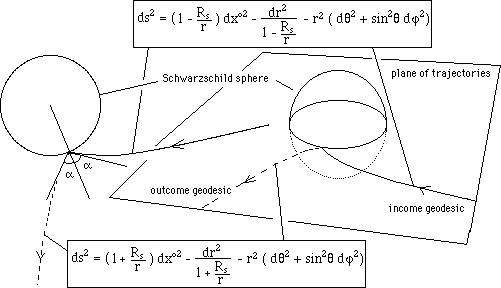
In the 3D example, we have calculated (plane) geodesics (see figure 26) which are projected in the initial (r,
q,j
) representation space.
We obtain a "throat sphere" connecting two 3D Euclidean spaces. There is nothing inside. The space for r < R
s
has no physical meaning. If we were to calculate geodesics in that place, we would obtain an imaginary solution.

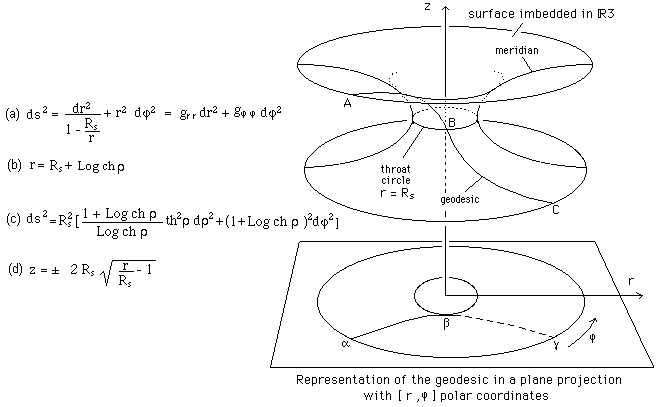
Fig
. 25 : 2D metric of a surface with a "bridge" linking two folds.
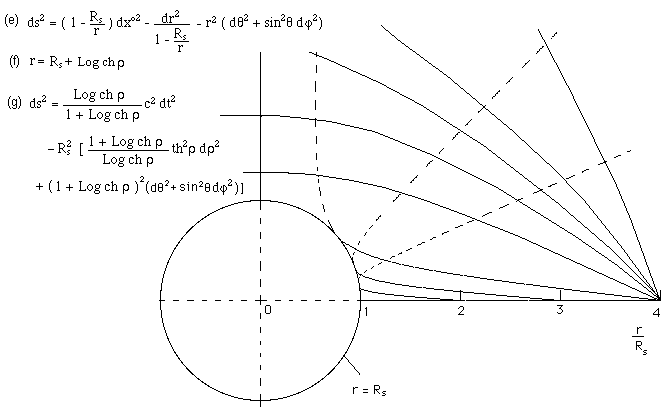
Fig
. 26 : 3D metric hypersurface with a "space bridge". Geodesics.
Classically, one introduces a proper time s (j) and a "time-coordinate t (i). The study of radial geodesics gives two differential equations (k) and (l), whose solutions correspond to curves (m), fig. 6.2, reference
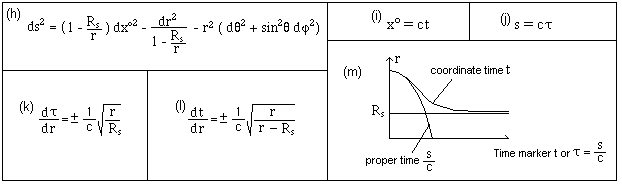
[ 52].
The curves shown on figure (m) are the basis of the black hole model. One identifies the coordinate t with the proper time of a "distant observer," so that the free fall time of a test particle towards the Schwarzschild sphere becomes infinite for him. Let us show that this is completely due to this particular choice of time coordinate. In
[
54] in 1925, Eddington
suggested a new time marker (p).

Then, the study of the corresponding radial geodesics.
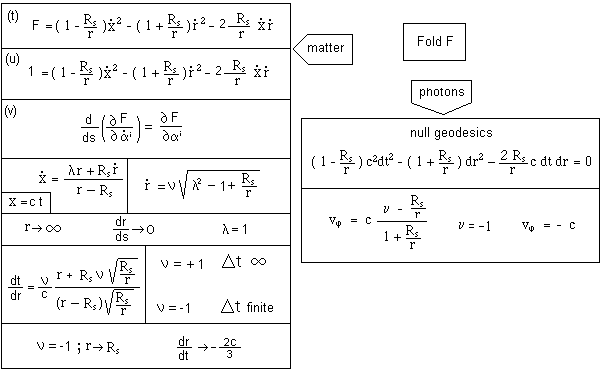
We use Lagrange equations.
On the right, we see that the speed of light, following radial paths, has two values.
( nu = - 1 )
corresponds to centripetal paths: the speed has a constant value - c. Similarly (on the left), the transit time from a distant point to the Schwarzschild sphere depends on the orientation of the paths. The centripetal ( nu = - 1
) free fall time is achieved in a finite time interval
Dt . On the contrary, a centrifugal path
( nu = + 1 )
, starting from the Schwarzschild sphere, gives an infinite time interval, so that the Schwarzschild sphere acts as a one-way membrane. This corresponds to a radial frame-dragging effect.
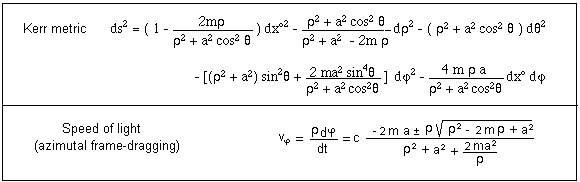
This is not a reason to reject this interpretation of the Schwarzschild geometry. Indeed, we find a similar phenomenon in the Kerr metric
( azimuthal frame-dragging
). Then, the classical expression of the Kerr metric. We see that we get two distinct values for the azimuthal speed of light. This depends on whether we consider light following the rotation or going backwards.
We can give a new interpretation of the Schwarzschild geometry, through a space bridge linking two folds F and
F. If the fold
F corresponds to the twin fold, the time coordinate
t
= - t (T-symmetry). From section 19, we know that this T-symmetry goes with a mass inversion, so that a positive mass passing through the Schwarzschild sphere, considered as a throat surface, changes sign. The conjugated geometry, as presented in section 13, corresponds to the change R
s
into - R
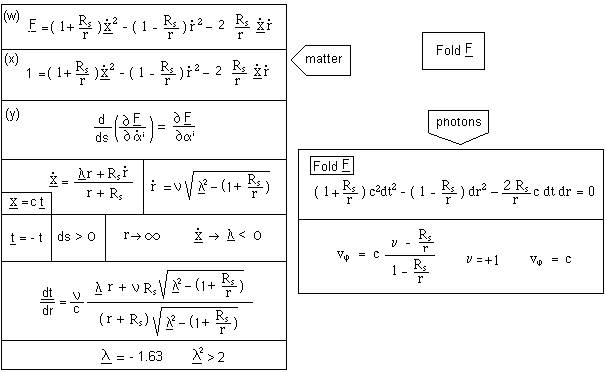
s . Then we introduce the following time marker change, analogous to Eddington's:

Still using Lagrange's equations, we study the radial geodesics system and establish a link between the two folds.

But the inverse paths require an infinite time, so that it is a one-way passage from one universe to the other. Here again, we find a frame-dragging effect, but in the opposite direction.
During the transit, the proper time flow remains unchanged: ds >
O. This makes the black hole model questionable. Indeed, according to this new interpretation of the Schwarzschild geometry, such a space bridge can swallow in a very short time (
»
10 -4
sec) unlimited amounts of matter. By the way, an analysis based on the Kerr metric, although a little more complex, gives similar results.
Then, the solution of the geodesic systems.
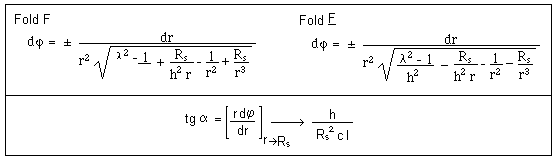
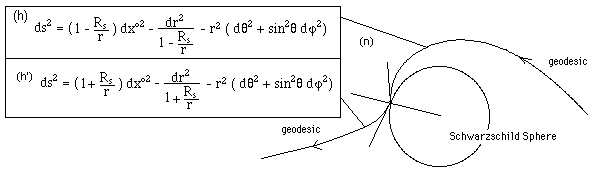
How to represent such paths? We can use the initial ( r ,
q , j
) representation space. We then obtain the above system of differential equations and the diagram of figure 27.
Fig
.27 :
Incoming and outgoing geodesics.
The geodesic seems to "bounce" on the Schwarzschild sphere, as shown in figure 28 as well.

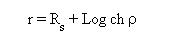
But all that comes from such a naive Euclidean representation of the path. Using the following change of space marker:
The expression of the joint metrics becomes:
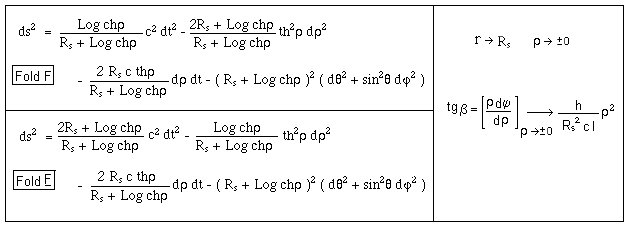
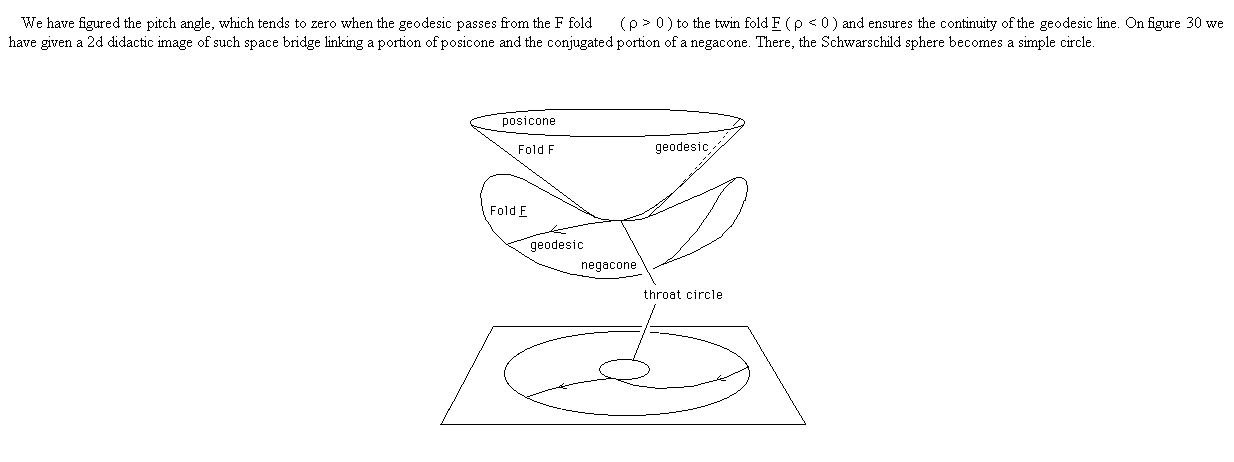
Fig
. 29 :
Didactic image of a fast flow space bridge
.
References.
[ 1 ]
J.F.Augereau : « If dark matter bends light rays it shows it does exist » (Si la matière sombre dévie les rayons lumineux, c'est donc qu'elle existe).
Le Monde, March 17 th 2000.
[ 2 ]
Interview of B.Fort in Ciel et Espace, June 2000.
[ 3 ]
J.P.Petit : The missing mass effect. Il Nuovo Cimento, B, vol. 109, July 1994, pp. 697-710
[ 4 ]
J.P.Petit, Cosmology of twin universes. Astrophysics and Space Science. Astr. And Sp. Sc.
226
: 273-307, 1995 [ 5 ]
Zel'dovich Ya.B., Astrophysica 6. 319 MNRAS
192
, 192 (1970)
[ 6 ]
Doroskhevich A.G. MNRAS
192
, 32 (1980)
[ 7 ]
Klypin A.A & Shandarin S.F. MNRAS
204
, 891 (1983)
[ 8 ]
Centrella J.M. & Mellot A.L. Nature
305
, 196 (1983)
[ 9 ]
Mellot J.M. & Shandarin S.F. Nature
346
, 633 (1990)
[ 10 ]
Shandarin S.F. In Large Structures of the Universe, ed. J.Audouze, M.C. Peleton and A.Szalay, 273. Dordrecht : Kulwer (1988).
[ 11 ]
Kofman.L.A., Pogosyan D. and Shandarin S. MNRAS
242
, 200 (1990)
[ 12 ]
Peebles P.J.E. Principles of Physical Cosmology, Princeton University Press (1993).
[13]
M.Myamoto and R.Nagai Publ. Astrom. Soc. Japan
27
, 583, 1975
[14] J.Binney and S.Tremaine, "Galactic Dynamics", Princeton University Press, Princeton, 1987. [16] Bahcall J.N & Soneira R.M. APJ. S
44
p. 73 1980
[17] Bahcall J.N. , Flynn A and Gould A. APJ 389
p.234 1992
[18] B.Lindblad, Handbuch der Physik
53
, (1959) 21
[19] C.C. Lin and F.H.Shu : Astrophysics and Gen. Relat. Vol.2 Gordon and Breach Sc. Publ. 1971, p. 235
[20] Toomree A. (1981) The structure and dynamics of normal galaxies. Cambridge University Press, p.111
[21] Toomree A. and Toomree J. (1972) Astrophys. J.
178
, 623
[22] A.Toomree, Ann.
Rev. Astronom. Astrophys.
15
(1977) 437
[23] E.Athanassoula : Companion driven spirals and bars. International Astronomic Union. Symposium n° 146 (1991)
[24] A.Toomree Astrophys. J.
158
(1969) 89
[25] R.H.Miller and B.F. Smith, Astrophys.
J.
277
(1979) 785
[26] F. Hohl, Astrophys. Sp. Sc.
14
(1971) 91
[27] Holmberg E. (1941) Astrophys. J.
94
, 385
[28] B. Sundelius and K.J. Donner : Interaction galaxies, Dynamics of Disk Galaxies (1991) Sundelius ed. p. 195
[29] S. Engström : Feature velocitys in numerical simulations., Dynamics of Disk Galaxies (1991) Sundelius ed.p. 332
[30] A.Toomree Ann.
Rev. Astron. Astrophys.
15
(1977) 437.
[ 31 ]
F.Bouchet and L.Hernquist : Cosmological simulations using theoretical tree methods.
Astr. Jr Suppl.
Series 68 , pp. 521, 538, 1988.
[ 32 ]
F.Bouchet, L.Hernquist and Y.Suto : Application of the Ewald method to cosmological N-body simulation. Apj. Suppl. Series 75
, pp. 231-240, 1991
[33] A.Sakharov : "CP violation and baryonic asymmetry of the Universe". ZhETF Pis'ma
5
: 32-35 (1967) : Translation JETP Lett.
5
: 24-27 (1967)
[34] A.Sakharov : "A multisheet Cosmological Model" Preprint Institute of Applied Mathematics, Moscow 1970
[35] A.Sakharov : "Cosmological Model of the Universe with a time-vector inversion". ZhETF
79
: 689-693 (1980) : Translation in Sov. Phys. JETP
52
: 349-351 (1980)
[36] A.Sakharov : "Topological structure of elementary particles and CPT asymmetry" in "problems in theoretical physics", dedicated to the memory of I.E.Tamm, Nauka, Moscow 1972 pp. 243-247
[37] Green M.B. & Schwarz J.H. Nucl. Phys.
B181
, 502-530 (1981) ;
B198
, 225-268 (1982) ; Phys. Lett. B , 444-448 (1982)
[38] Green M.B. Surv. High Energy Phys.
3
, 127 (1982)
[39] Gross D.J. , Harvey J.A. , Martinec E. & Rohm R. , Phys. Rev. Lett.
54
, pp 503-505 (1985)
[40] Kolb E.W. , Seckel D , Turner M.S. : The shadow world of superstring theories, Nature Vol. 314, April 1984 pp. 415-419
[41] P.C.W.Davies & J.B.Brown : Superstrings, Cambridge University Press 1988
[42] Abdus Salam, Nuovo Cimento
5
, 299 (1957)
[ 43 ]
Nima-Arkani Ahmed, Savas Dimopoulos and Georgi Dvali : "The hidden dimensions of the universe", PLS oct 2000 n° 276 pp. 56-64
[ 44 ]
J.P.Petit : An interpretation of cosmological model with variable light velocity.
Modern Physics Letters A, Vol. 3, n°16, November 1988, p.1527
[ 45 ]
J.P.Petit : Cosmological model with variable light velocity :
the interpretation of red shifts. Modern Physics Letters A, Vol.3 , n° 18, December 1988, p.1733
[ 46 ]
J.P.Petit & Maurice Viton : Gauge cosmological model with variable light velocity. Comparison with QSO observational data. Modern Physics Letters A Vol.4 , n°23 (1989) pp. 2201-2210
[ 47 ]
P.Midy & J.P.Petit : Scale Invariant Cosmology. The international Journal of Modern Physics D, Vol.8 June 1999 pp.271-280
[
48] E.A.Milne
: Kinematic Relativity Oxford 1948.
[
49] J.D.Anderson, P.A.Laing, E.L.Lau, A.S.Liu, M.M. Nieto and S. Turchev : Indication for Pioneer 10/11, Galileo and Ulysse Data, an an Apparent Anomalous, Weak, Long-Range Acceleration. Phys. Rev. Letters :
81
31 August 1998.
[
50] G.J.Stephenson Jr. , T.Goldman, Phys. Rep.
205
, 211 (1992) ;
216
, 343 (1992).
[
51] M.N. Nieto and T.Goldman, Phys. Re.
205
, 221, 1991;
216
, 343.
[
52] R.Adler, M.Bazin & M.Schiffer : Introduction to general relativity, Mac Graw Hill book, 1975, chapter 10, section 10.5 : Classical limit of gravitational equations, p. 345.
[ 53] J.M.Souriau, Structure des Systèmes Dynamiques, Ed.
Dunod 1970, France & Structure of Dynamical Systems.
Birkhauser Ed. Boston-Zurich 1997.
[ 53] J.P.Petit : Enantiomorphic universes with opposite time arrows (Univers énantiomorphes à flèches du temps opposées). Comptes rendus de l'Académie des Sciences de Paris, t. pp. 1977
[ 54] Eddington S.A : : A comparison of Withead's and Einstein's formulae.
Nature
113
: 192 (1924).
Paper's Summary ---