June 25 - 29, 2001
Conference
WHERE IS THE MATTER?
During the week of June 25 to June 29, 2001, an international conference was held in Marseille, bringing together two hundred participants, including one hundred and forty speakers, with the theme "Where is the Matter?" There was also a subtitle:
Tracing Bright and Dark Matter with the New Generation of Large Scale Surveys
Translation:
Mapping of optically visible matter and dark matter
using the new large-scale observation means.
These words have great importance. They immediately place this conference within a paradigm. It is thus assumed that the universe is one, and that it has two contents, one which is accessible to our means of observation (in the range of visible, ultraviolet, infrared, in short, where observations are made based on electromagnetic waves) and the other which, for the moment, escapes this type of investigation and is described under the generic term "dark matter", in English "Dark Matter". How to perform observations, how to map this dark matter? On the one hand, by relying on gravitational lensing effects, which, in general, have proven to be too important to be explained by the presence of only visible matter, whether it be galaxies or galaxy clusters, on the other hand, by starting from the kinetic parameters of the observed objects.
Even before the effects of "abnormally important" gravitational lensing were highlighted by people like Fritz Zwicky, based on the analysis of galaxy rotation curves or the measurement of the velocity dispersion of galaxies in clusters, it was deduced that the optically detected matter could not ensure the cohesion of these systems. By rotation curves, we mean measurements made on interstellar gas orbiting in the general gravitational field, carried out by the Doppler-Fizeau effect. This gas, obviously, was rotating too fast, especially at its periphery (presence of a characteristic "plateau"). Galaxy clusters are assimilated to "gas clumps" whose galaxies would be the "molecules". The "proper velocities" of galaxies, as astronomers call them, become the equivalent of the thermal velocity of molecules of a gas, velocities distributed randomly in all directions. Keeping this gas analogy, the combination of "thermal velocities" and density gives what is called pressure (which is the measure of the kinetic energy density of agitation, per unit volume). A cloud of interstellar gas does not disperse, because the force of gravity balances the forces of pressure that tend to disperse it. If we assimilate a cluster of a thousand galaxies to a sort of gas clump, we can also say that the forces of pressure tending to disperse it, calculated on the basis of the measurements of the velocity dispersion of galaxies and the detected mass, are too important to be counterbalanced by the force of gravity. Reasoning differently, knowing the mass of the cluster, we can calculate an escape velocity. As Zwicky pointed out, the individual velocities of galaxies exceed the escape velocity of the cluster to which they belong. If an additional force was not at work, these galaxies should have left the cluster a long time ago. The same is true for the stars in galaxies. Therefore, the problem is quite real. The question is in the interpretation given to this phenomenon.
The unanimous answer of the astronomers currently has a name: "dark matter", although no one has been able to indicate what the nature of this "dark matter" could be. But no one has ever doubted the fact that the effects observed could derive from something other than the presence of an unobserved component, with a positive mass, peacefully located in our (unique) universe. In this context, the work of "mapping the invisible" has already begun. Initially, it was simply stated "in such a galaxy cluster, a certain mass M must exist in order for this cluster not to explode or, equivalently, to explain the strong gravitational lensing effects it generates (multiple images, background galaxies distorted, this distortion going up to their stretching into arcs)". Later, astrophysicists, like Albert Bosma, from the Marseille Astrophysics Laboratory, to which I belong, empirically added "dark matter halos", of unspecified nature, in order to "fit the rotation curves", an anglicism denoting the action of finding by this empirical method the velocity laws corresponding to the values from observations. Therefore, a number of people are now fully devoted to calculating the distribution of matter in these dark matter halos, which are invisible. This is called "zero-order theories". This activity, which does not require any particular skill, is purely technical. The people engaged in it do not seek to provide any indication on the nature of this "dark matter" they empirically map, and certainly not on the processes that have generated its presence in galaxies. Not knowing the nature or origin of this component, it is all the more excluded to build a "galactic dynamics". At the conference in question, I heard an American present an overview of models where they try to describe the formation of galaxies (from cold dark matter, in English "cold dark matter" or "CDM"). All these models obviously rely only on Newton's law (plus a huge computer that crunches all that). They remain little convincing in the sense that, regardless of the initial data introduced, the "proto-galaxies" formed have much too weak angular momenta. Thus, one of the questions raised by these "new theorists" (Newton's law plus big computer) was "where does the angular momentum of galaxies come from?" We are clearly at the level of "zero-order theories", whether it be maps or simulation attempts.
Since 1999, astrophysicists like Yannick Mellier and Fort, followed by half a dozen teams in different parts of the world, have produced the results of six years of work, corresponding to a large program. If dark matter were present in the universe, especially in galaxy clusters, it would produce gravitational lensing effects. At the extreme, this produces almost kaleidoscopic images, as the Hubble telescope has shown us, where objects located behind a cluster explode into a set of multiple images, possibly producing one or several gravitational arcs.
It then becomes clear that when the supposed concentrations of dark matter are less important, they induce simple distortions in the images of galaxies, giving their image an additional ellipticity, simply by optical effect, which then superimposes on their real ellipticity. Mellier, Fort and those who followed them later developed an image processing method where the computer detects local anisotropies of the images (starting from the hypothesis that in the absence of gravitational lensing effects, the major axes of the elliptical galaxy images should be randomly distributed). Then the method allows to reconstruct the distribution (3d) of the supposed dark matter that could produce such images. In 1999, Mellier and Fort made a sensation by publishing a color image, in perspective, representing the distribution of dark matter in a portion of the universe, corresponding to a portion of the sky equivalent to a few square degrees.
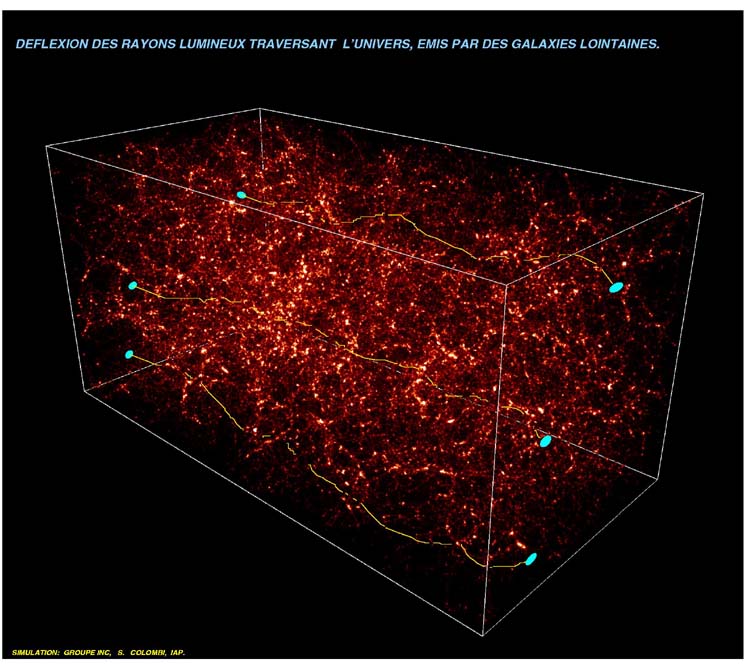
The image was published in the newspaper "Le Monde" and the author of the article, journalist Jean-François Augereau, titled "Dark matter exists, since it deflects light rays."
Link to this article
. All of this seemed very impressive at the time, marking the beginning "of a mapping of the invisible." But a year later, Fort (director of the Paris Institute of Astrophysics, to which Yannick Mellier also belongs) gave an interview to the magazine Ciel et Espace (June 2000), in which he mentioned some problems, previously passed over in silence. The method had led our two researchers to locate two particularly important concentrations of dark matter (5 10
14
solar masses, equivalent to a thousand galaxies, mass comparable to that of the largest known clusters: the Virgo cluster or the Coma cluster). But, a puzzling fact, these regions of the sky seemed remarkably empty:
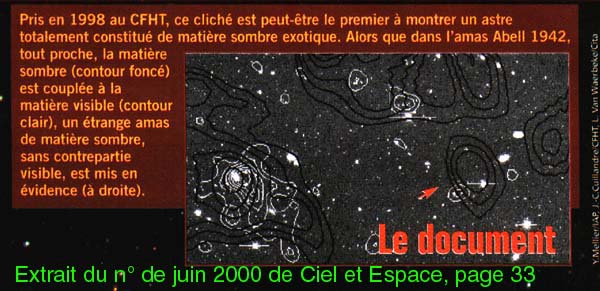
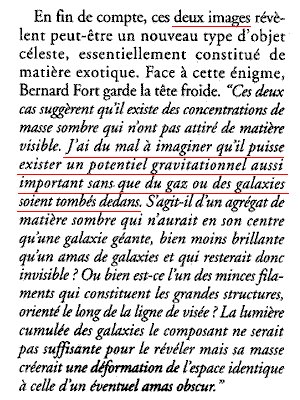
Such results were obviously very disturbing and at first the two authors simply passed them over in silence, hoping that they could either be an artifact, or a new type of cluster emitting in particular frequencies. Therefore, new observations were carried out, in the UV or infrared range, which did not yield anything significant. Finally, Fort and Mellier named these objects "dark clusters," specifying that they could be "composed exclusively of exotic matter," a very peculiar matter that, although subject to the phenomenon of gravitational instability, would have the power to attract only matter of the same type. Fort, in his 2000 interview, said that he had difficulty believing that such a potential well had not attracted some galaxies, gas or any objects emitting electromagnetic waves. Below is the reproduction of the excerpt from Fort's interview.
Participating in this June 2001 conference and presenting a communication ("Twin matter against dark matter"), I was therefore very curious to hear Mellier at this event. He began by declaring that he was perfectly confident in the validity of his data processing method. At this occasion, he showed on the screen the 3d map that had earned him a full page in Le Monde in 99, confirmed the identification of his two "dark clusters" and added that he had, since then, detected a third object of the same type, equally massive. When I questioned him about these objects, he gave me the following public answer:
- Personally, I don't believe in these dark clusters....
It was impossible to find out more and I confess that this answer bewildered me greatly. Either his method has flaws that have so far escaped analysis, is susceptible to generating artifacts (which would correspond to these extremely puzzling objects), or it is reliable and the existence of these three objects raises an extremely disturbing question, which cannot be answered by such a gimmick. Let us add that since the launch of a telescope performing observations in the X-ray range, it has turned out that clusters are very important sources with energies around 10 keV. By attributing this radiation to hot hydrogen, this places the temperature of the latter around 100 million degrees, which corresponds to a thermal agitation velocity of 1400 km/s.
Mellier said: his dark clusters also do not emit X-rays.
The explanation for such behavior can be simply found by rereading the subtitle of this conference, which leaves no room for any interpretation other than that of dark matter. This behavior is not an exception in the world of contemporary astronomy and astrophysics. Let us give an example. The famous Hubble law, according to which the redshift is proportional to the distance of the source, has long since become a sort of dogma. All sources must conform to this law and those that accidentally refuse to do so would be "excluded". It is known that Halton Arp, a real obstacle to circular thinking, claimed to have identified many "anomalous redshifts". As he clearly did not want to comply and admit that these "aberrant" images were only observation errors, he was finally banned from observation by his colleagues (those who distribute "observation time") and sent to New York. If a conference were to be held on the subject, it could only be about "surveys" aimed at a better definition of the "Hubble constant". Any work that would report an anisotropy of the redshift, or a significant variation of the famous law for different object populations or quasi-periodic fluctuations in a given direction would be considered a disturbing deviation, or simply as a "off-topic" work.
When I decided to present a communication at this conference, my colleague Evangelina Athanassoula, Researcher at CNRS, stationed at the Marseille Observatory like me, received this news with perplexity, considering that my work was "off-topic". It is indeed a way of looking at things, but I find it rather unscientific (like Yannick Mellier's comment about his own work!). It is therefore not surprising that the works I was admitted to present at this conference did not really attract interest or criticism: they were simply "off-topic". On Tuesday, June 26, 2001, having 40 copies of the "long version" of my communication (43 pages) and 30 copies of a shortened version (16 pages), I decided to try again, went to the amphitheater where the conference was held and placed these seventy documents on the tables, before the first sessions started, with the note, in red pencil, on the cover: "take me, read me". All of them disappeared into the bags of the participants. I found none lying on the floor or in a waste paper basket. Despite this new attempt to start a discussion, none of the 200 participants contacted me. In the following days, my interventions during the sessions completely fell flat. Let's just say that one speaker had just made a "survey" on the general problem of the gravitational lensing effect, before his colleagues (including Mellier) presented their most recent results. Dialogue:
-
We are talking more and more these days about the possible existence, in our universe, of a component with negative energy, repulsive from the point of view of gravity. Have you considered the effects of gravitational lensing that would result from the presence of concentrations of such particles? We would then be dealing with a "negative lensing". I personally described this kind of phenomenon in an article published in 1995 in Astrophysics and Space Science.
-
In that case, it would be a gap in a homogeneous distribution of positive energy matter.
-
No, that's not what I'm talking about. It would be to consider the effects created by objects possessing negative energy.
-
So, gaps in positive energy matter....
End of the discussion with, in the background, a completely indifferent audience. I finally said to the participants:
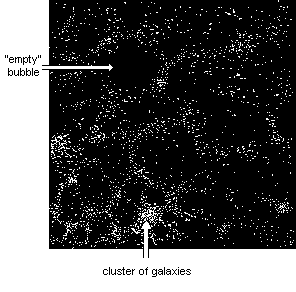
- We are in June 2001. The analysis of gravitational lensing effects and the resulting mapping lead to incomprehensible objects: the "dark clusters". The dynamics of galaxies "imposes the fact that the majority of their mass is in the form of a dark matter halo", which no one detects and no one is able to indicate either the composition or the origin. All attempts to identify this dark matter have resulted in failure for ten years. A similar phenomenon for galaxy clusters where the ratio of non-observed matter to visible matter reaches a hundred. Astronomers predict the existence of black holes with a million solar masses at the center of each galaxy, and no one observes them. We have seen, during this conference, colleagues presenting us with ever-refined images, describing the Very Large Structure (VLS), the large-scale structure of the universe. Obviously, the image "of joint soap bubbles" is confirmed year by year. However, as we have seen, the most advanced numerical simulations, based on CDM (Cold Dark Matter or cold dark matter), produce a filamentary universe, which seems to have nothing in common with the observations. Below is a recent image, presented at the conference.

Yet you have seen the images we have produced for already eight years:

and which, in fact, match the observations:
How is it that it is absolutely impossible to establish a dialogue between these two currents of ideas?
Total silence.
At the same time (June 2001), a conference was held in Blois where theoretical physicists were questioning the nature of a new cosmic component, called by one of them "dark energy". According to some, this mysterious substance, having the property of repelling matter, through a force qualified "antigravitational" would represent some 65% of the cosmic content. Why "antigravitational"? Because an accumulation of observations carried out on supernovae with very high redshift seems to confirm a late acceleration of the cosmic expansion.
This object has received several names. It should be noted that today, in the absence of being able to highlight the existence of their object of study, whether experimentally or observationally, scientists produce ... a large number of labels. One of the names proposed is:
Quintessence
This word is significant. Indeed, "quintessence" is the "fifth essence", the "fifth element". The word is borrowed from alchemy, which was based on a description of matter according to four elements: water, fire, air, earth. There it is, the fifth. Our theoretical physics seems to have regressed to the Middle Ages. But this is not exceptional. In this era where obscurantism is spreading, where one no longer really knows what is what, scientists are rallying behind different banners. The banner of astrophysicists is "dark matter", while theoretical physicists swear only by the
superstrings. It is therefore not surprising that contemporary scientific conferences resemble assemblies of theologians, gathered around organized systems of beliefs.

The text of our communication at the international conference "Where is the Matter?".
A little humor on the way