Monohedron

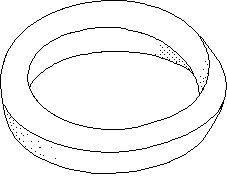
... This is a monohedron that I invented, one rainy day. If you look closely, it is a polyhedron that has only one face and only one side. If you take a normal vector at a point on the single face and make it go all the way around, it reappears, having undergone a rotation of 90°. It is only after the fourth turn that it returns to its initial position i
...I had made the above drawing "off the cuff", imagining it in my head. But there are now programs that are capable of handling this kind of object. Those who have already downloaded (for free) Cosmo Player or would be willing to do so will be able to admire the work of my friend Christophe Tardy, on this monohedron. In the meantime I have reworked, with a draughtsman's coding, the single edge of the object, as he had extracted it from one of his images. To my knowledge there is no software that puts dotted lines to represent the hidden parts, and interrupts the strokes. But one could just as well use a paler cloud.
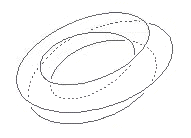
...The fact remains that we have here this single edge, without the slightest vertex.
...A mathematical curiosity? Perhaps. You may know, if you have cast an eye over my scientific work, or over their popularized introduction, that I am developing a "two-sheet" cosmological model, the initial idea being André Sakharov's (1967). Incidentally, these two "slopes of a universe" have opposite time-coordinates. This question of time or "of" times remains thorny. There is nothing more slippery than that word. What is the "arrow of time"? Can one speak of "two antiparallel arrows of time"? (that was Sakharov's initial vision).
...In the work that I published in the journal Nuovo Cimento, in 1994, I had considered, an idea that had initially been suggested in 1988 by Linde, that these "twin" regions might in fact be "antipodal regions". Thus these two twin universes (unlike Linde, the two universes that I consider interact, through the gravitational field, whereas his are totally unaware of each other). They are therefore "at once two and one". A mathematician would say that this structure is that of a two-sheet covering (the sphere S2 is the two-sheet covering of a Boy surface). In Nuovo Cimento I considered the two-sheet covering of a projective P3 (equivalent to a 3d Boy surface), bringing into coincidence antipodal regions of a hypersphere S3. But I have always thought that it could in fact be the covering of a projective P4, bringing into coincidence antipodal regions of a hypersphere S4. Under these conditions the interaction of two "adjacent" regions of this cosmos that is at once unique and double brings "into coincidence" antipodal regions (on this hypersphere S4) which would not only be enantiomorphic (mirror, P-symmetric) but also T-symmetric, that is to say "with opposite arrows of time". Here we find again Andréi Sakharov's idea.
...The monohedron is a (didactic) image of a cosmos with four sheets, of a "cosmohedron". A cosmos that would be "at once one in four". Four regions thus "adjacent" would interact. But these regions, what would they be? Where would one have to "read" them on such a figure? The cross-section of the monohedron (simple didactic image) is a simple square (since it is generated by the rotation of this square, see the virtual reality imagery created by C.Tardy). These four sides of the square-section represent four regions of the cosmos that would be in conjugation. One can then speak, locally at least, of a "four-sheet covering". If one assimilates the normal to the surface of the monohedron to the arrow of time, this one turns, at the same time as this generator-square. Thus the four portions of universe would have arrows of time "in a cross", antiparallel two by two:
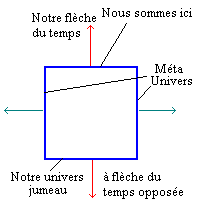
...One can also describe this by saying that there are two pairs of twin universes, whose arrows of time are antiparallel two by two. It is in a way:
( Sakharov )2
...Why such a complication? Would it be a new geometric recreation? Hmmmm... I am going to tell you what I have in mind. When I built the model with two twin universes I showed that the second cosmos could host a matter entirely analogous to ours, with its twin-protons, its twin-electrons, its twin-photons, etc (whether one uses the word "twin", proposed by Sakharov, or "ghost", phantom-like, more in vogue in the world of superstrings). I also showed that reversing time in fact amounted to reversing mass, hence energy.
...Linde was a student of Sakharov. Incidentally, I had discussed at length with him in '83, in Moscow, in a room at the National hotel where he had come to join me. In '88 he mentioned a double cosmos where the two matters would have opposite energies. Then, realizing the problems that could arise from making these two matters coexist in the same region of space-time, he sent "the other matter", with negative energy, to the antipodes. But, in doing so, he did not see that he was thereby rediscovering the idea of his master, Sakharov (who advocated opposite times), since (J.M.Souriau 1972) inverting time or inverting mass and energy is pretty much the same thing. ...If you have the courage, or the competence, to read the papers of Geometrical Physics B, you will see that the matter duality also exists in the twin cosmos. Not only is there a twin matter, but there also exists, in this second slope of the universe, a twin antimatter.
...All this can be extended to a four-sheet context. One would then obtain an imaginary matter and a twin imaginary matter (with purely imaginary time arrows, relative to us, antiparallel to one another).
...Problem: how would this imaginary manner interact with ours? I admit that for the moment I don't have the slightest idea, but I will surely find something. Geometry is a world rich in strings of all kinds. ... Let us pause for a moment on this idea. What is this imaginary world, relative to ours? It is a meta-world, etymologically speaking. ...The paraphernalia of the theoretical physicist and the cosmologist, which is none other than that of a good geometer, makes it possible to envisage (as Linde had remarked in '88) "parallel worlds" populated by particles that could either be identical to ours, or because they constitute their mirror images (P-symmetry), or their negative-energy doubles (T-symmetry), or both at once. At this point, why not cheerfully take the plunge by envisaging particles whose parameters are purely imaginary (mass, charge, time arrow, etc...). This leads to the idea of a meta-world that could itself also be made up of particles, obeying a purely imaginary physics, quite close to ours, perhaps, which one could then describe as meta-physics.
...I no longer know which philosopher had written "metaphysics is a great ocean, and to cross it we have neither boat nor sail". Is this sentence a final condemnation? Let us reflect. Not so long ago it was considered, until someone managed to synthesize urea (Wöhler in 1828), that "the living" was "the domain of God or of Dame Nature", depending on the options. Let us admit that things have changed quite a bit since then. ...To paraphrase, could "God" or "Dame Nature" be put into equations, trapped thanks to geometry, group theory and field theory (or tied up in a net woven with superstrings, depending on the options)?
...I believe that nothing should be forbidden a priori, but by combining audacity and modesty. Regarding biology, the considerable successes of recent decades give us the illusion that we know how to do an enormous number of things, that "considerable progress has been accomplished" and that, ultimately, shortly, we will know everything about this phenomenon called "Life" (which is the outlook of that eternal optimist Joël de Rosnais). It is true: we know how to map a DNA molecule, to grasp genes between thumb and forefinger, to take them here, go put them there, etc.
Impressive.
...But, dixit Testard, "it doesn't work". The genes thus grafted would lose their original functionality, or would simply no longer be functional at all. Obviously this is something that gene grafters do not shout from the rooftops. But Testard says it, which bothers them a great deal. Genetic engineering makes it possible to whip up an enormous lather, to secure subsidies in order to take out patents. Not being a biologist, I am not really up to speed on these things. Read Testard (des hommes probables, at Seuil). The conclusion would be that by thus doing the work of cartographers, we would not have progressed as much as we hoped. "DNA" says Testard, is only a data bank. According to him, this complex molecule would not contain "all the intelligence of the cell". This "intelligence" would have to be sought in the cell itself, which would be "the true elementary living entity". Gene grafters would be like people who, in a house, move certain elements, put for example handles and locks on walls and not on doors fitted with hinges, wondering why they don't work, plug light bulbs into water outlets, surprised not to see them light up.
Open question.
...With this four-sheet cosmos, there is metaphysics in the air. At worst, it will only be an attempt by a geometer, a matter for amusing oneself among friends. At best... I don't know.
...In any case, the twin universes, as a two-sheet covering, deserve the qualifier "of parallel universes". If one assimilates their time arrows to the normal to a space surface and if these arrows are antiparallel, then the two spaces are like two layers of paint placed on either side of a 2d surface.
...In the same vein, the two other universes, with their purely imaginary time arrows, could be considered as "orthogonal to ours". Hence the idea of a theorem, which could one of these days see the light of day:
Two universes perpendicular to the same third are parallel to each other.
To be continued.