7
An element
g
p of the Poincaré group
Gp is defined by a sequence of parameters {
p
i},
whose number, as we have already said, represents the
dimension of the group
. The matrix
d g
(g = e)
is composed of the quantities
{
dp
i} . The application
above is therefore of the type:
(81)
In other words, to a set of scalars
dp
i
corresponds a number of scalars
dp
i
'.
The duality consists in postulating the invariance of a scalar, according to:
(82)
n being the dimension of the group (ten, for the Poincaré group). The scalars Ji represent the components of the momentum, of the same number.

We will decide to decompose this momentum
Jinto two objects. The first will be an anti-symmetric matrix
Mof format (4,4), therefore having six components, and the second a "four-vector"
P, matrix of format (4,1):
(83)
(84) J = {
M,
p
, E} = {
M,
P }
We will write the scalar product in the form:
(85)
Tr meaning "trace of", and we will also have:

(86)
linear form whose invariance ensures the duality.

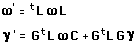
with:
(87)
(87b)
(87c)
but
GG
= 1
so this is equal to:
(88)
Identify the terms in

y (89)
That is to say:
(90)
----> Again, there follow some matrix calculation details. If you wish,

click here
you can go directly to the result
In the trace, a cyclic permutation of the terms can be performed.
(90a)
(90b)
(90c)
the second term on the right-hand side is equal to the product of a row matrix by a column matrix.
This is equal to the trace of the reversed product
(below, schematically, the product of a row matrix by a column matrix):
(90d)
In this trace, I can perform a cyclic permutation:
(90e)
Hence:
(90f)
(90g)
Here we will apply again the theorem
on the traces of matrices which are the product of another matrix by a
symmetric matrix.
Any matrix can be symmetrized
or antisymmetrized. Moreover the trace of the product of a matrix
by a symmetric matrix is zero.
(90h)
I can apply this to the matrix (90i)
since the trace is taken
(90j)
(90k) = sym ( ) + antisym ( )
but:
(90l)
so
(90m)
(90n)
(90o)
(90p)
and:
(90q)
finally:
(90r)
By grouping and changing the primes to the other side
I obtain my group action: