10
All I can say is:
- that by moving away from the "target" by a distance
c
.
- by observing it while moving myself at a velocity
v
.
- by being, relative to this target, offset by a time interval
D t
Relative to me:
--- I have not changed its mass m.
--- I have given it an impulse m
v
(momentum).
--- I have given it a passage m [c - v D t]
--- and a rotation:
Let us clarify this rotation:
(118a)
(118b)
(118c)
or:
(118d)
We can consider the three independent components of the rotation matrix
l
as those of a vector. This vector is then written as:
(119)
Although we have not defined the vector product in our space, that is, we have not assigned it a right-handed or left-handed orientation, we can still treat it as a vector product:
(120)
the
v
reversed denoting the vector product. We see that the last line of the formulas giving the coadjoint action on the momentum corresponds to:
(121)
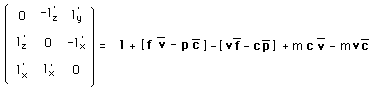
l
being a matrix and not a vector (but, in our notation, bold letters denote either matrices or vectors indistinctly, while italic letters refer to scalars).
This vector product begins to resemble, for the physicist, something familiar: the
angular momentum
.
We take a particle, move away from it by
c
, and observe it while circling at velocity
v
. It all behaves as if the reverse were true: that the particle is separated from a fixed observer and moves at velocity
v
.
(122)
There remains the "passage"
f
= m [c - v D t]
It vanishes simply by setting
c = v D t
, that is, by relating the velocity
v
to the spatiotemporal translation:
(123)
Let us return to the expression of the momentum derived from the Poincaré group, expressed in a coordinate system where the passage
f
is zero:
(124)
A particle is a particular choice made within the momentum. Nevertheless, coordinate transformations allow us to eliminate the passage
f
and reduce the components of the rotation
l
and the momentum
Pto a single component (motion along z):
(125)
Thus, the object described by the Poincaré group inherently possesses:
-
An energy E
-
A momentum P
-
An intrinsic rotation l
The rotation is a mass multiplied by a length, all multiplied by a velocity. It therefore has the dimensions M L² T⁻¹ of Planck's constant h.
The method of
geometric quantization
, developed by Souriau (see Structure des Systèmes Dynamiques, Dunod 1973), shows that this rotation must be proportional to:
(125b)
in half-integer values. That is, either the unit (photon), or 1/2 for other particles such as the electron, proton, neutron, neutrinos, and their antiparticles.
Back to the subsection "Groups and Physics"