Geometrization of matter and antimatter through the coadjoint action of a group on its momentum space. 4:
The Twin group. Geometrical description of Dirac's antimatter.
Geometrical interpretations of antimatter after Feynman and the so-called CPT-theorem.
.
Jean-Pierre Petit and Pierre Midy
Observatory of Marseille
France.
Abstract
.
Starting from the work of reference [3], we modify the model, in order to avoid encounters between positive and negative mass particles. The solution is to build a two-fold (F,F*) eighteen-dimensional space as the quotient of the group by its orthochronous subgroup.
We then obtain two spaces with opposite arrows of time.
We study the impact of the different components of the group on the momentum and movement spaces. It is shown that the matter-antimatter duality appears in both folds, in both universes. This work brings a new understanding of antimatter, through geometric tools. For example, Dirac's antimatter is the antimatter of our own fold. The matter of the second fold is CPT-symmetric with respect to ours. The PT-symmetric of a matter particle belonging to our fold is the antimatter of the other fold. Matter and antimatter particles of our universe have positive mass and energy. Matter and antimatter particles of the second fold have negative mass and energy.

- Introduction.
In a previous paper [1], we introduced a geometrical definition of antimatter, through a z-symmetry. Charged mass-points are supposed to move in a ten-dimensional space, divided into two sectors:
{ z i > 0 } and { z i < 0 }.
The first corresponds to the movement of matter, the second to the movement of antimatter.
By the way, photons follow the { z i = 0 } surface.
It resembles Plato's cave. The play is supposed to take place in a ten-dimensional theater, and, inside a four-dimensional cave called space-time, we observe four-dimensional shadows, four-dimensional movements.
In [1], we introduce a group which is an extension of the orthochronous part of the Poincaré group. It makes it possible to describe the charges of the particles in terms of additional components of their momentum. In the paper [2], the group is doubled, through a z-symmetry, which gives a geometric description of Dirac's antimatter. This last one has positive mass and energy.
Next step, paper [3], we decide to include antichronous elements in the group. Then we get symmetries including T-symmetry, i.e. PT-symmetry and CPT-symmetry. We find that the PT-symmetric of a particle of matter is an antiparticle, as suggested by Feynman. We find that the CPT-symmetric of a particle of matter is a particle of matter too, as asserted by the so-called "CPT-theorem". But, from the coadjoint action of the group on the momentum components we find that these two have negative masses and energies. Then it is no longer possible, as suggested by Feynman, to identify the PT-symmetry and the C-symmetry. Similarly the CPT-symmetry is different from identity, for it reverses the mass. As pointed out in [3], a solution, suggested by the mathematician J.M. Souriau [4], is to give up the antichronous part of the Lorentz and Poincaré dynamical groups. But PT and CPT symmetries disappear.
In the following we suggest another solution.
- Construction of a group acting on a two-fold space.
From [3], the action of our 16-dimensional group on a ten-dimensional space corresponds to:
(1)
(4501)
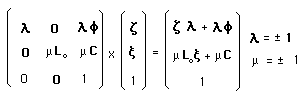
and the corresponding coadjoint action is:
(2)
(4502)
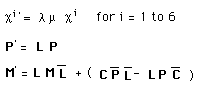
See computational details in the annex.
We build the two-fold space as the quotient of the group by its orthochronous subgroup. From (1), a point of space is defined by:
(3)
{ z 1, z 2, z 3, z 4, z 5, x, y, z, t }
Introduce a fold index f = ± 1
A point M of the first fold, called F, is defined by:
(4)
{ z 1, z 2, z 3, z 4, z 5, z 5, x, y, z, t, f = +1 }
and the conjugated point M*, which belongs to the second fold F*, by:
(5)
{ z 1, z 2, z 3, z 4, z 5, z 5, x, y, z, t, f = -1 }
We can write the new action:
(6)
(4506)
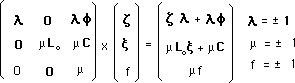
The coadjoint action on the momentum space remains unchanged. But the interpretation of the results is different. Negative energy movements occur in another fold. Positive and negative energy particles cannot meet, because they evolve in distinct ten-dimensional twin spaces.
Fig.1
(45f1)
: Two sectors of momentum space.
Fig.2
: Associated symmetries ---