Geometrization of matter and antimatter through coadjoint action of a group on its momentum space. 4 :
The Twin group. Geometrical description of Dirac's antimatter.
Geometrical interpretations of antimatter after Feynman and so-called CPT-theorem. (p5)
Equation (16) is the action on the Lie algebra element, corresponding to the group
. The coadjoint action is the dual of this action and is based on the invariance of a scalar. Call S this scalar from which one computes the coadjoint action of the group
on its momentum. We compute the coadjoint action of the group
g 3
from the scalar :
(17)
c dJ + S
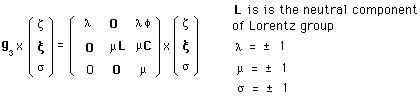
Then the coadjoint action of the group
g 3
on its momentum is :
(18)
(4529)
The momentum of the group
g 3
is :
(19) J = {
c
, momentum of the group
G }
The extension of the group adds a component
c
to the momentum, which obeys (20). In particular, if
, i.e. :
(20)
(4531)
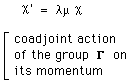
its coadjoint action is :
(21)
c
'
= l m c
(22)
(4532)

(23)
(4533)

Equations (22) + (23) coincide with the coadjoint action of the Poincaré group when
L is the neutral component of the Lorentz group.
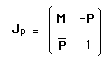
We know that we can put the momentum
J p
of the Poincaré group
g p
into an antisymmetric matrix :
(24)
(4534)
Its action on this momentum is :
(25)
(4535)

We can then write :
(26) J = {
c
,
J p }
and :
(27) (4536)
c
'
= l m c
The dimension of the Poincaré group is ten. The dimension of this extended group is eleven, due to adding the new variable
f
. (
l
= ± 1 ) and (
m
= ± 1 ) are not new dimensions of the group.
This method can be extended as many times as one wants. Consider the following matrix :
(28)
(4537)
The Poincaré group has ten dimensions. The set
( f 1
,
f 2
,
f 3
,
f 4
,
f 5
,
f 5 )
adds six more dimensions. The scalars (
l 1
,
l 2
,
l 3
,
l 4
,
l 5
,
l 5
) are fixed and do not correspond to new dimensions.
The coadjoint action of the group on its momentum
(29) J = {
c 1
,
c 2
,
c 3
,
c 4
,
c 5
,
c 6
,
J p }
is :
(30)
(4538)
c
'
i = l i m c i
with
i = { 1 , 2 , 3 , 4 , 5 , 6 }
References .
[1] J.P.Petit & P.Midy : Geometrization of matter and antimatter through coadjoint action of a group on its momentum space. 1 : Charges as additional scalar components of the momentum of a group acting on a 10d-space. Geometrical definition of antimatter. Geometrical Physics B ,
1
, March 1998.
[2] J.P.Petit & P.Midy : Geometrization of matter and antimatter through coadjoint action of a group on its momentum space. 2 : Geometrical description of Dirac's antimatter. Geometrical Physics B,
2
, March 1998.
[3] J.P.Petit and P.Midy : Geometrization of matter and antimatter through coadjoint action of a group on its momentum space. 3 : Geometrical description of Dirac's antimatter. A first geometrical interpretation of antimatter after Feynman and so-called CPT-theorem. Geometrical Physics B ,
3
, March 1998.
[4] J.M.Souriau : Structure des Systèmes Dynamiques, Dunod-France Ed. 1972 and Birkhauser Ed. 1997.
[5] J.M.Souriau : Géométrie et relativité. Ed. Hermann-France, 1964.
[6] P.M.Dirac : "A theory of protons and electrons", December 6th 1929, published in proceedings of Royal Society (London), 1930 : A
126
, pp. 360-365
[7] R.Feynman : "The reason for antiparticles" in "Elementary particles and the laws of physics". Cambridge University Press 1987.
Acknowledgements .
This work was supported by French CNRS and Brevets et Développements Dreyer company, France.
Deposited in sealed envelope at the Academy of Sciences of Paris, 1998.
Copyright French Academy of Science, Paris, 1998.