Patrick Baudry
was an astronaut.
It is known that during every space mission, each astronaut had a "double,"
ready to replace him at the last moment in case of failure. During Jean-Loup Chrétien's flight to the Mir space station, Baudry served as his double. Subsequently, the French were able to benefit from a second seat aboard a space station, and as is the rule in such matters, Baudry was then on board.
He thus boarded the American space shuttle and made a memorable entrance by arriving with a baguette under his arm and a skullcap on his head.
During this flight, the Americans tested the accuracy of their ground-based laser targeting stations. To this end, a mirror had been mounted on the left side of the shuttle, facing downward. The shot was supposed to be fired from the island of Hawaii, but missed its target by 400 km, due to a mix-up between feet and meters in the calculations (a similar error would later cause the crash of an American space probe on the surface of Mars). One might wonder: "Why on earth don't the Anglo-Saxons finally decide to measure distances in meters instead of feet, speeds in kilometers per hour instead of knots, and volumes in liters instead of gallons?" A pilot friend once told me: "If we did, the number of aviation accidents would be considerable, because pilots around the world—civilian and military alike—still think in feet, knots, and gallons." If we suddenly told pilots, "descend to three thousand meters," many would likely crash, thinking in feet. Perhaps the Americans therefore consider the loss of a lunar module a lesser evil.
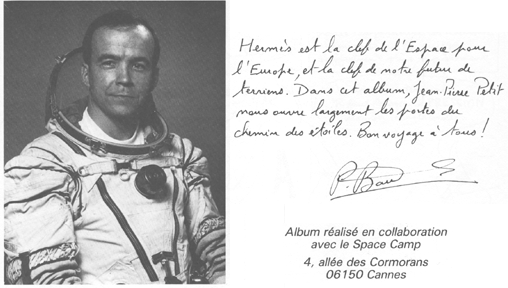
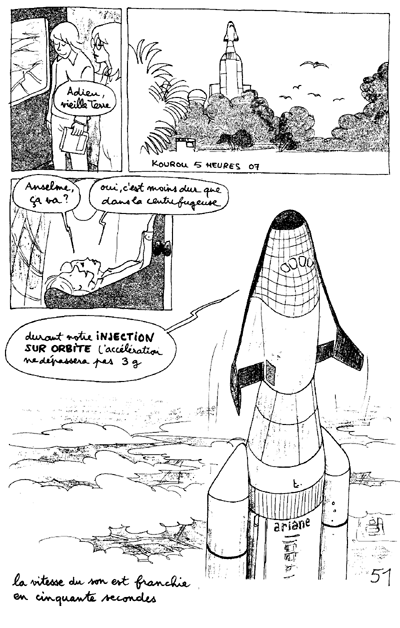
After his flight aboard the American shuttle, Baudry devoted several years to the "Hermès project." This was a French space shuttle project, which the Ariane V rocket could have placed into orbit, but which was ultimately abandoned. Jean-Loup Chrétien served as France's official astronaut in the media, both at home and abroad. Baudry, perhaps less flexible and more independent, launched, with private funding, a "Space Camp" project near the Cannes airport in the 1980s, as far as I recall. In the USA, "Space Camps" have enjoyed considerable popularity among young Americans. Baudry adopted the concept and attempted to develop it in France. If you read "Around the World in Eighty Minutes" (originally titled "Operation Hermès"), which was prefaced by Baudry (see photo), you'll find, in the form of drawings, many installations that equipped the Cannes Space Camp while it remained operational.
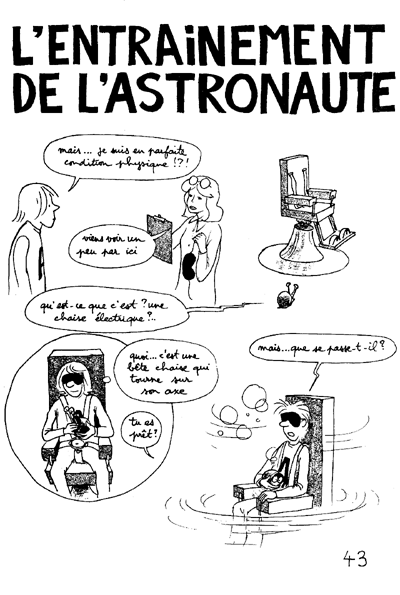
Young trainees were grouped into "crews" and prepared for a simulated space mission. Everything was included, from theoretical classes to a wide variety of training exercises: centrifuge, rotating stool, simulation of walking in reduced gravity, piloting a rocket-equipped seat to dock with what resembled the service module of Hermès, etc. The center housed two installations that concluded the training sessions. One, equipped with computers, was meant to represent the ground control room (a small-scale replica of the "Jupiter Room" in Kourou, French Guiana). The other represented the interior of the Hermès cabin and could accommodate four or five trainees. Instead of windows, aspiring astronauts could view a simulated landscape created using computer-generated imagery.

Such a facility can obviously only survive with subsidies. The project eventually collapsed financially, and the bankers pulled the plug. It is clear that the only place where a "Space Camp," if it were to rise again from the ashes, could be established would be near the CNES center in Toulouse, under its auspices. Thus, the former collaborators of Baudry, such as Philippe Droneau, can now be found in a "City of Space."
As for Baudry himself, in his recent book "The Unfulfilled Space Dream" (Taillandier edition), he describes himself as "a test pilot at Airbus."
A word about this book. It details, with considerable precision, the journey of Gagarin leading up to his historic flight. Baudry reveals many vivid details, such as the fact that Gagarin supposedly urinated along the side of the rocket just before launch. The Russians are not religious (at least not when they called themselves "Soviet"), but they are superstitious. Just before this historic flight, Korolev, father of Russian astronautics, placed a one-kopeck coin on the rail along which the wagon carrying the massive "Semyorka" was moved into position for launch, so that it would be crushed under the rocket (the coin, not the rocket). Then he went off to urinate into the enormous pit where the gases from the numerous engines would be vented. According to Baudry, these rituals have since become part of every Russian space station launch. Thanks to Baudry, we also gain credible information about the death of the first Russian cosmonaut, during a test flight in a MiG-17. After having generously contributed as a charismatic communicator and later as a deputy, Yuri Gagarin wished once again to sit at the controls of a fighter jet. He was just a few hours into this reactivation flight, guided by a highly experienced instructor, when their aircraft crashed. According to information gathered by Baudry, Gagarin's MiG-17 was caught in the turbulence of a commercial airliner passing through a zone where it had no business being at that time. The turbulence immediately put the MiG-17 into a spin as it approached, and the two pilots had no time to activate their ejection seats—or, counting on their skill, may have hoped until the very last moment to save the aircraft.
Baudry then offers fairly convincing criticisms of the International Space Station (ISS). As many space specialists have already pointed out, people up there are merely repeating, at great cost, everything the Russians accomplished over twenty years in their Mir station (as one American senator opposed to the project put it: "We're going to put people in there and make them go round and round"). Since long-duration stays have already been achieved aboard the now-defunct Russian Mir station, this is not truly new. Baudry says that in fact, no one really knows what to do with this expensive station (costing a hundred billion dollars). We talk about "microgravity experiments." But Baudry immediately points out that simply having an astronaut move through the station by grabbing onto the walls, or adjusting an antenna, or even a small motor transmitting vibrations, or someone slamming a door a bit too hard...