Stephen Hawking
. In an article dated October 19, 2001, published in the magazine Le Point, journalist Ugo Rankl made a first: attacking a celebrity. The scientist’s situation is indeed pitiful. For many years, he has suffered from Lou Gehrig’s disease, which destroys the neurons that control voluntary movement and "traps a perfectly intact mind within a rag doll body." This is truly a tragic fate. About fifteen years ago, the publication of a book titled A Brief History of Time became a global event. If my memory serves me right, sales skyrocketed after one or more television documentaries about Hawking were aired, showing him in all his physical misery while journalists endlessly repeated, "At Cambridge, he holds Newton’s chair." The next day, crowds of people rushed into bookstores saying, "Do you have the book about the man in the little wheelchair?" The success was global. In total, twenty-five million copies were sold in an incalculable number of languages, making Hawking a very wealthy man. May he enjoy his fortune.
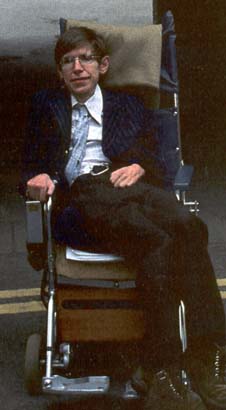
We poorly understand the sociological phenomenon of the bestseller. Some, like this 200-page book, are not even read to the point that certain British critics could write, "Stephen Hawking, the most sold, least read, and least understood author in the history of books." Some members of the scientific elite even speak of a "freak show factor," literally, "the backlash effect of exhibiting a monster."

In June 2000, the science columnist of the Sunday Telegraph dared to write: "It's as if we wanted to make Christopher Reeves, the actor who played Superman, the greatest tragedian simply because he is disabled." Reeves (Christopher, not the other one) is severely disabled. After a horseback fall, his spinal cord was almost completely severed at the neck, turning him into a tetraplegic, capable only of moving his head muscles, breathing, and weakly twitching his fingers. Almost exactly the same situation as Hawking, except that Hawking has even less control ("His wife rushes to wipe a trickle of saliva running from his mouth," reports Ugo Rankl). Criticism of Hawking’s theories and persona has since taken shape. Since a Nobel laureate in physics, Gerardus Hooft, pointed out: "Nothing allows us to elevate Hawking to Einstein’s level, even though the two men are constantly associated with the pinnacle of scientific genius. Unlike Einstein, none of Hawking’s theories have ever been verified. But what is worse is that he proclaims himself the champion of a single, ultimate physical theory that would unify all knowledge about time, space, forces, and energy. This theory (called the 'M-theory,' as in 'Mystery') aims to coherently unite general relativity and quantum physics. For religious minds, M-theory would allow understanding God’s designs. Yet nothing in Hawking’s published work suggests he is sufficiently brilliant or visionary to claim the existence of such an ultimate theory, which he might have approached more closely than anyone else."
This statement goes far beyond mere criticism of Hawking’s persona, which had already become notorious since the book’s publication due to his ridiculous outbursts. In A Brief History of Time, he wrote: "If the universe contains itself and has neither beginning nor end, then what purpose does God serve?" A phrase that, spoken in a lecture, would prompt an audience member to shout, "Is there a philosopher in the room?" There is an entire cinema-Hawking phenomenon, not new at all. His Cambridge office is thus filled with photos of Marilyn Monroe, in color and black and white, and his wife Elaine, as the Point journalist reports, who, during visits, never tires of repeating: "Stephen is completely obsessed with her. If she were still alive, she’d be a terrible threat to our relationship." It is likely she performs this hysterical and inappropriate exhibitionism for every visitor and journalist.
...
Rankl’s article mentions a scientific meeting held in 1981 at the Vatican. Hawking likes to recall that the Pope told him on that occasion: "You are free to study the evolution of the universe after the Big Bang, but you must not investigate the Big Bang itself, as it was the moment of Creation, hence God’s work." Since then, Hawking says he "strives to transgress the pontifical prohibition and thus faces the same hostility that Galileo encountered three centuries earlier."
We understand that a man enduring such a pitiful existence would gladly accept the role offered by the media. Commenting further on the man seems rather pointless to us. We know his work and have read his book. We therefore share the opinion of scientific critics, as reported by Ugo Rankl: "a poor popularizer and a very average scientist." Propelled onto the world stage, becoming immensely wealthy thanks to the success of his writings, Hawking—supreme irony—occupies "the chair of applied physics" at Cambridge, and has become the scapegoat for a growing critique. But let us not misdirect our target. This critique does not aim at individuals, but at a disease that seems to have spread over the decades throughout theoretical physics and cosmology, transforming theoretical scaffolding into theological discourse: "a story of the universe we are asked to believe without being shown proof," laments Professor Hooft. I like to quote a recent statement by mathematician Jean-Marie Souriau: "Theoretical physics has become, today, a vast psychiatric hospital. But alas, it is the madmen who have seized power."
In our gallery of portraits, you will find, for example, a dossier on French Academician Thibaud-Damour, who "works on a pre-Big Bang theory that is not quite mature." See also the presentation of Brian Greene’s book, also centered on the "string" approach and the "M-theory." What is new today is that even Nobel laureates like Gerardus Hooft dare to say that... the king is naked. Reflection is now necessary on the various approaches proposed. Where are we at this dawn of the third millennium? Who should we believe?
At any rate, the literary machinery is quite sophisticated for those who produce books. Greene’s book is a prime example of the genre, but Hawking’s earlier work was built on the same pattern, and we will show in a forthcoming dossier, to the dismay of his fans, that Nottale’s book, La relativité dans tous ses États, is no exception. The first part, dedicated to popularizing classical ideas (poorly done by Hawking, skillfully handled by Greene), serves to create illusion. This reader conditioning is intended to make the audience believe that what follows will be of the same quality. In A Brief History of Time, Hawking explains that he demonstrated that black holes have no hair—“black holes have no hair.” This is a “famous theorem of Hawking”: the surface of a black hole should be smooth. As Ugo Rankl reminds us, Hawking refutes accusations of lack of scientific output by stating: "In the mid-1970s, through mathematical proofs, Roger Penrose and I demonstrated that black holes were capable of returning part of the energy they absorbed." The only problem is that black holes, like the sea serpent, have not yet achieved undeniable status as actual objects in the menagerie of astrophysics, real observables.
Books like those by Greene and Nottale are designed differently. In the first part of these works, phrases abound such as: "as we will show in the second part." You can even practice counting them. The catch is that this so-called second part never delivers the promised proof, except conditionally: "if... then...". In practice, 99% of readers never reach the halfway point of these books (Greene’s is quite thick). They will never verify whether the promises of the first part were ever fulfilled. These are not scientific works—they are campaign speeches. It is painful, tedious, exhausting to dismantle one by one these illusions of science.