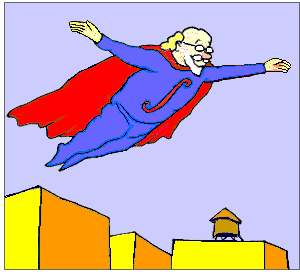
"Grandpa"
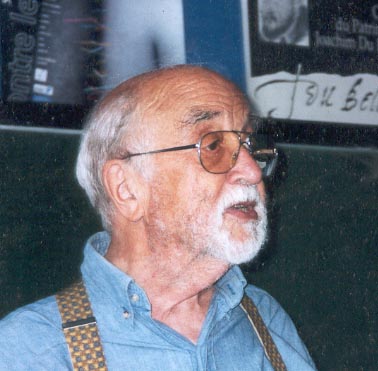
Souriau
(Also known as the mathematician-geometer Jean-Marie Souriau)
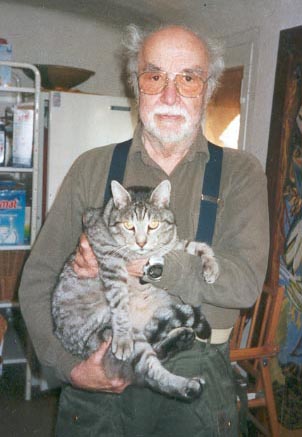
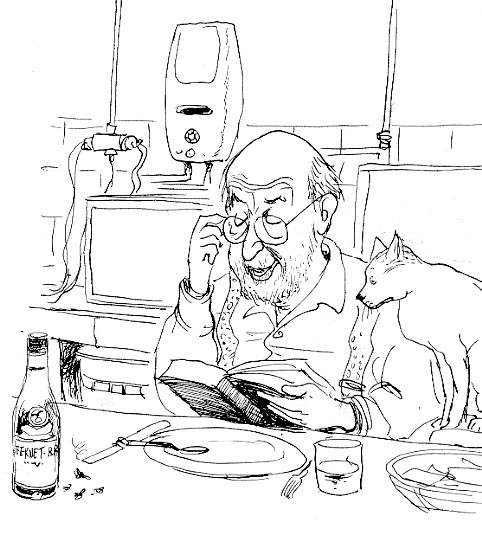
is a pivotal figure in my scientific life. Thanks to him, I undertook a very difficult supplementary training in mathematics, a process in which he displayed great patience. At eighty-three, he remains endlessly creative, thanks to a magical elixir—Fernet-Branca—that his mother gave him even in his baby bottle. A powerful neuronal stimulant and a remedy for numerous ailments, this artichoke-based liqueur is widely appreciated, though not universally. According to Souriau: "When you taste this drink for the first time, you think it must be a silver cleaner. Then you regret it isn't one."
Grandpa is one of the pioneers of Symplectic Geometry (I suspect he might be the reincarnation of Lagrange, though, of course, I have no proof). He is also the father of the concept known as
the coadjoint action
of a group on its momentum space,
which allows the geometric nature of physical objects (mass, energy, momentum, etc.) to emerge.
See on the website.
Souriau used this framework to produce, for example, the first geometric interpretation of spin.
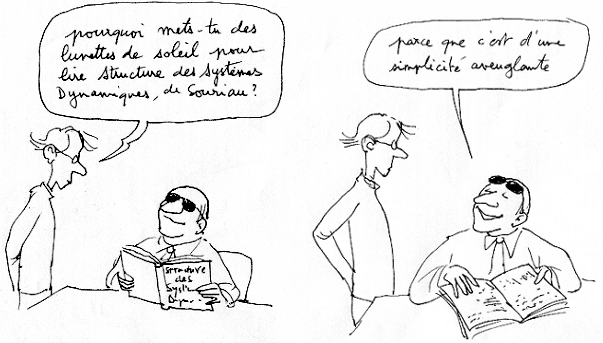
Important detail: the man speaks neither English nor understands it. Consequently, he published a significant portion of his work in French, in two highly dense books: Geometry and Relativity (Hermann, 1964) and Structure of Dynamical Systems (Dunod, 1974), texts of unyielding obscurity that represent major contributions to mathematical physics—but are, of course, out of print and often difficult to find. Mathematical physics must not be confused with theoretical physics, which Souriau defines personally as "physics minus experience, and mathematics minus rigor." In Geometry and Relativity, Souriau revisits work originally developed by Kaluza, introducing an additional dimension—a fifth dimension. When one states that the second member of Einstein's field equation has zero divergence, one classically obtains the equations of fluid mechanics in their simplified form (Euler's equations). However, in a geometric context with an extra dimension, Maxwell's equations emerge—something that does not happen in four dimensions. Moreover, this approach yields an additional scalar and a surplus equation, lacking immediate interpretation. Thus, it is "an equation in search of a phenomenon" (a situation that generally characterizes superstring theory). Any suggestions regarding the physical interpretation of this "scalar plus equation" would be most welcome. Please contact us.
Souriau's work is extremely diverse. In contrast to many so-called "pure" mathematicians, he believes mathematics and physics must be inseparably linked. He is one of the rare mathematicians I know who can instantly locate the carburetor or battery under a car's hood. In the section of this site titled
presentation of other researchers' work
, I have discussed his work on the
dynamics of the solar system.
It is well known that the relative positions of the planets and the distribution of their orbits remain a mystery. The famous Titus-Bode law is merely an empirical description. Based on resonance mechanisms, Souriau showed that planets tend to align on orbits corresponding to a "golden law" (based on the golden ratio). Why does this mythical number appear here? We know numbers are distributed across different sets: integers, rationals (numbers expressible as a ratio of two integers), irrationals (those that cannot be described this way), etc. We can "measure the degree of irrationality" of a number, a concept introduced by Émile Borel. In this sense, the golden ratio—solution of the equation:
x² - x - 1 = 0
—is the most irrational of all numbers. What connection then with resonance? Imagine plucking a vibrating string, which oscillates with period T₁. The sound emitted may cause a neighboring string, with nominal period T₂, to resonate. Resonance is maximal if T₂ = T₁. It is noticeable if the ratio of periods is a rational fraction (a harmonic ratio), much weaker if the ratio is close to an irrational number like √2, and minimal if the ratio equals the golden ratio.
Souriau, by his own admission (as apparently all mathematicians do), finds his ideas while sleeping.
He believes (as many others do, though few dare say so aloud) that our planetary physics has been stuck in a rut for half a century, the last notable contribution being, in his view, Richard Feynman's Nobel-winning work on quantum electrodynamics. Souriau even considered writing a book titled "Fifty Years of Non-Physics." Indeed, despite declarations such as those by Thibaud-Damour (see below), superstring theory appears to have yielded little, not even a single button. Thirty years after the "pioneers" supposedly "opened the path," it remains essentially a pastime for friends, since this "theory" has never managed to interpret a single observation, phenomenon, or propose a single experiment. However (see Structure of Dynamical Systems), Souriau made significant contributions to quantum theory by successfully reconstructing various equations (Schrödinger, Klein-Gordon, Dirac, Pauli, Maxwell) starting from group theory—this being known as "geometric quantization." Thus, the quantum view of reality would stem from an extension of the geometric context, from four to five dimensions, with the fifth dimension, or "fiber," being closed.
Recently (end of 1999), Jean-Marie conceived a variation on the
axiomatization of groups
(presented in Grenoble, early 2000, at a conference on epistemology). In early 2000, he became interested in quasicrystals (discovered in 1984). As soon as I have time, I will present this new work—also presented at that conference—on my website.
At the dawn of the third millennium, he finally invented a riddle that kept our readers enthralled for over two weeks, and whose solution was ultimately found on the same day, independently, by
Xavier JANC
and
Dominique GIGON.
Here is the riddle:
elementary particle
Click on it to see the solution, after confirming you are over eighteen.
November 9, 2004:
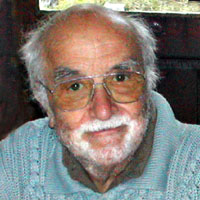
A photo of Souriau
:
Common sense, which others call utopia
J.M. Souriau
May 2006
.
Pioum, Souriau's cat, is...