Scientific Ufologists
August 8, 2009
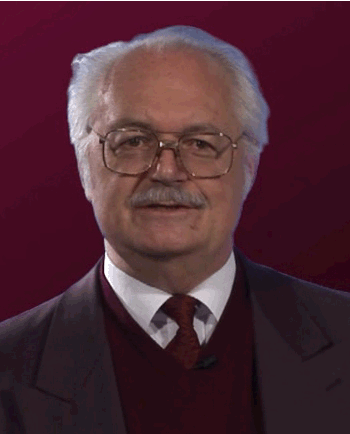
Illbrand Von Ludwiger
Born in 1937 (we are thus the same age), this individual has long shown interest in the UFO dossier and may therefore be classified among the "scientific ufologists," or so-called such. Recently, an amateur ufologist drew my attention to a book recently published by this gentleman, in which he argues that current science will never unravel the secrets of UFOs, which he claims to have studied for 40 years.
I personally met him at the Brighton conference (2001) on "advanced propulsion," an encounter that prompted me to write "UFOs and American Secret Weapons" (Albin Michel, out of print, available on the secondhand market. Its current market value is 80 euros). At that time, he delivered an endless lecture on the work of
Burkhard Heim
, who had passed away, whom he regarded as a genius.
Von Ludwiger probably has no idea of the weakness of his scientific knowledge. Discussing science with him is utterly pointless. Let's say he belongs to those men who "look like scientists" but are in fact merely very mediocre scientists.
He participated in the
Pocantico conference
, a masterpiece of disinformation.
He managed the truly remarkable feat, during this one-hour presentation, of physically putting the majority of the audience to sleep, some even snoring loudly. Below is a sketch I made on the spot at the Brighton conference, which perfectly summarizes the situation:

Below is the impressive biography accompanying this individual:
This is a translation, sent to me by a reader, of an article dedicated to him on German Wikipedia:
http://de.wikipedia.org/wiki/Illobrand_von_Ludwiger
Life
[Edit]
V. Ludwiger studied physics, chemistry, mathematics, and astronomy in Hamburg, Erlangen, and Göttingen. In addition to these studies, he spent two years at the University of Bamberg Observatory and received his degree as an astrophysicist from the University of Erlangen in 1964. Since then, he has worked as a physicist and systems engineer in the aerospace industry, for example at EADS. Between 1966 and 1970, he worked on the European rocket launch program ELDO in Woomera (Australia), and also participated in military projects in the United States, France, and England. [1]
In 1974, he founded the European Central Section of the American UFO organization, the Mutual UFO Network (MUFON), known as MUFON-CES in Feldkirchen-Westerham.
It is a private association of scientists investigating unidentifiable flying objects. V. Ludwiger is the author of numerous books and magazine articles on the UFO phenomenon. He maintains here that certain UFO phenomena, which are known to have Earth-bound causes, can be scientifically proven to originate from such sources. In recognition of his long-term investigation of UFO phenomena, he received the 1990 Dr. Hedri Prize from the private Hedri Foundation in Switzerland. Since 1999, V. Ludwiger has lived in early retirement.
Publications [Edit]
-
Heim’s Unified Quantum Field Theory. Resch Verlag, 1981, ISBN 3853820158
-
Research on the State of UFOs. Zweitausendeins Verlag, 1992, ASIN B0011P4LVC
-
UFOs, Witnesses, and Characteristics. Q Edition Verlag, 1995, ISBN 978-3861241737
-
Unidentified Flying Objects over Europe. Herbig Verlag, 1999, ISBN 978-3776621105
-
UFO – The Proof of a Phenomenon (book). Terminer die Medien Verlag, 2004, ISBN 978-3831260782
-
The New Vision of the World of Physicist Burkhard Heim. Terminer die Medien Verlag, 2006, ISBN 978-3831203451
-
Anomalies in Science. Discipline: Philosophy of Science (book). Terminer die Medien Verlag, 2007, ISBN 978-3831261444
-
UFO – The Undesirable Truth. Kopp Verlag, Rottenburg, 2009, ISBN 978-3938516843
-
Guided Tour of the Most Important English and German Literature as a UFO Research Guide. Pp. 116–221, in: UFO Research in History, Biology, and Physics, MUFON-CES-related report no. 12, 2009
Participation in TV Documentaries
[Edit]
-
UFOs – and They Still Exist! ARD / NDR, 1994
-
UFOs, Lies, and the Cold War. Arte TV, 2005
-
Worldwide Wonder: UFO Emergency in Germany. Pro7, 2007
-
UFOs – They Are Here! 2009 DVD film, VEMP
-
(R) Evolution 2012. DVD, Scorpio, 2009
External Links
[Edit]
-
Works by and about Illobrand V. Ludwiger in the German National Library catalog (For Illobrand V. Ludwiger • recordings • Wikiquote)
-
Biography on the MUFON-CES website
-
Video interview with Illobrand V. Ludwiger
-
"On the Death of Physicist Burkhard Heim," obituary by I. V. Ludwiger on Burkhard Heim (pdf, 16 pages, 2001; 436 kB)
-
"The Theory of the House of Elementary Particle Structures," article by T. Auerbach and I. V. Ludwiger in the Journal of Scientific Exploration, 1992, vol. 6, no. 3, pp. 217–231 (February 24, 2009; retrieve pdf, 216 kB).
-
"Sociology of Science, UFO Psychological Research, and Theoretical Science Perspective," video lecture by I. V. Ludwiger, Erfurt 2009
-
Interview with Illobrand V. Ludwiger, UFOs: A Multidimensional Reality, German Initiative for Exopolitics, 2009
External Links
[Edit]
- ↑ Biography: Illobrand V. Ludwiger. MUFON-CES, 2000, retrieved June 30, 2009
August 18, 2010:
Following the publication of this page on my website, an "ufologist," utterly devoid of scientific competence, communicated to me the indignant protests of Von Ludwiger, who claimed he didn't know I held such a poor opinion of him. And indeed, I do. I was one of those who were utterly bored during his long presentation in Brighton in 2001, though, unlike many others, I managed with great effort to stay awake. The German, in his comment, also defended his idol Heim (deceased), citing articles published in journals such as "New Scientist," with flashy titles like "A Leap Forward into Hyperspace." He couldn't defend his own ideas, because he never had any. But a scientist, a researcher,
has the duty to produce new ideas,
that is their function.
They must, at some point in their career, be
innovators.
They must be fertile. Otherwise, they are merely research bureaucrats, and at best, good teachers or science historians, popularizers (tasks that are eminently useful and respectable).
I stand by what I said. The UFO subject requires the intervention of scientists not only at the highest level of contemporary knowledge but also endowed with genuine scientific creativity, which is exceedingly rare in this field. For 33 years, France has officially entrusted the management of this "UFO problem" to people of unblemished mediocrity, including former technicians who would mistake Piraeus for a man, having "found their engineering position and their doctoral thesis in a surprise gift package."
I once exploded during a TV show when hearing one of these mediocrities, a poor fellow randomly appointed to head this service, an ex-optics technician, say to us, "We are here among scientists..." The fault lies not with this person, but with those who, like the Polytechnician Yves Sillard, mentioned later, appointed people who did not "fit the job profile."
I don't care if I'm accused of arrogance. In 35 years, I have produced concrete results, including experimental ones. I introduced entirely new and unprecedented concepts, such as supersonic aerial evolution without shock waves. The work to be presented at the Korean conference in October 2010 is brilliant. I claim this qualification, and others will follow.
It is a duty to aim for excellence when seeking to contribute to understanding one of the major phenomena of our era. Conversely, as I state on this page, this dossier has attracted for five decades every kind of oddball, opportunist, mythomaniac, and even... shopkeepers, like the ridiculous Denocla. "Bandar-log," to borrow Kipling’s image from The Jungle Book. It is on this point that I wished to draw attention. People like Ludwiger, Meessen, Vallée, Poher, and others will leave no significant scientific contribution to posterity. At best, if they are lucky, they are obscure university professors happy to appear in the media, emerging from the academic obscurity. They have nothing meaningful to say, nothing concrete to offer, and merely display their mediocrity or refer to works they consider genius, far ahead of their time, but which remain fundamentally highly speculative, like Heim’s.
At our time, physics is experiencing an unprecedented crisis, and more than ever, experience remains the cornerstone of scientific inquiry—our only lifelines, like buoys, until a new conceptual, paradigm-shifting, decisive, revolutionary breakthrough emerges, comparable to what we experienced at the beginning of the century, which I conjecture is imminent. The only things to cling to remain experience and observation. The famous theory of superstrings, which describes nothing, explains nothing, predicts nothing, a mountain giving birth to a mouse, is symptomatic of this crisis of thought. Numerous other brilliant but inconsistent theories exist, such as those of the... multiverses.
In this ocean of mediocrity, silence and diplomacy are frankly inappropriate.
The "Scientific Ufologists"
This discussion of Von Ludwiger leads us to consider the phenomenon of the "scientific ufologists"—scientists, PhDs, who have long displayed interest in the UFO dossier but have never contributed anything concrete to the field, nor published a single article related to it, directly or indirectly, in genuine scientific journals (that is, by confronting the scientific world). In the scientific world, even if it can be very long and painful, one must score goals on the field, not just roll machinery in the locker room.
What is serious is that this cohort of mediocrities, some of whom don't even deserve the title of scientist despite their parade of credentials (there are fools even among PhDs and university professors), form a contingent that has integrated into "scientific ufology," or so-called such. One can cite figures such as the Frenchman
Jacques Vallée
, who lives in the United States, author of numerous books on UFOs, who once claimed to be an "astrophysicist" but had only ever worked as an information systems specialist and database expert in the 1970s. He merely held an old master's degree in astrophysics.
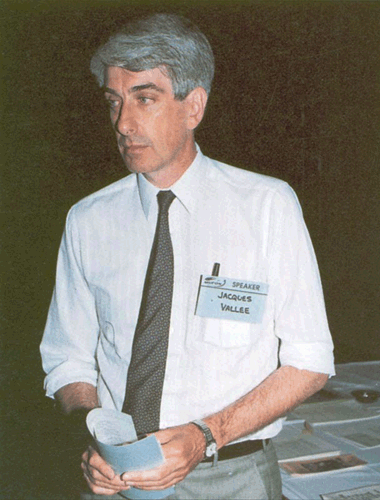
The "ufologist," Jacques Vallée, in my view: pseudo-scientist
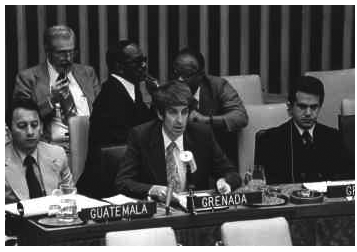
In 1978, shortly after the creation of GEPAN (1977), a representative from Grenada, a country that had witnessed UFOs, requested that the subject be discussed at the UN, whose secretary at the time was the German Kurt Waldheim. He received scientists, including Jacques Vallée and Claude Poher. In short,
pseudo-science... at the UN
.
July 1978: Jacques Vallée at the UN (behind him, Hynek)
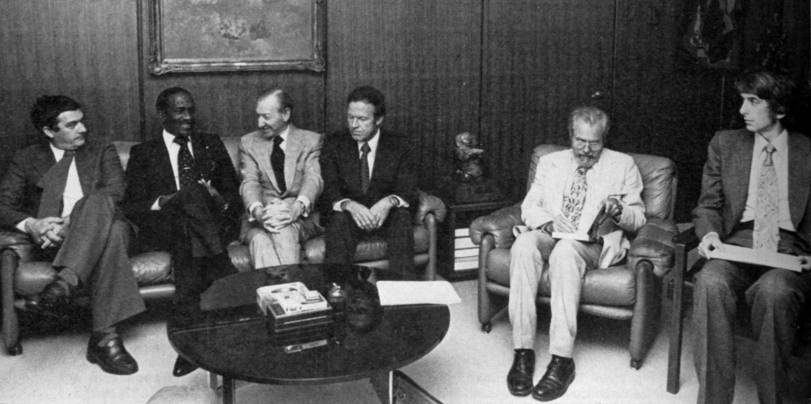
At the UN:
C. Poher, E. Gairy (Grenada), K. Waldheim, Gordon Cooper (astronaut), Allen Hynek, and
Jacques Vallée
Laurel and Hardy at the UN
Incidentally,
Kurt Waldheim
had a past as a Nazi officer.
He belonged to a unit responsible for atrocities in Yugoslavia during the war,
a fact only revealed in... 1986, when he ran for and was elected President of Austria!
http://www.agoravox.fr/actualites/international/article/kurt-waldheim-le-president-de-l-25832
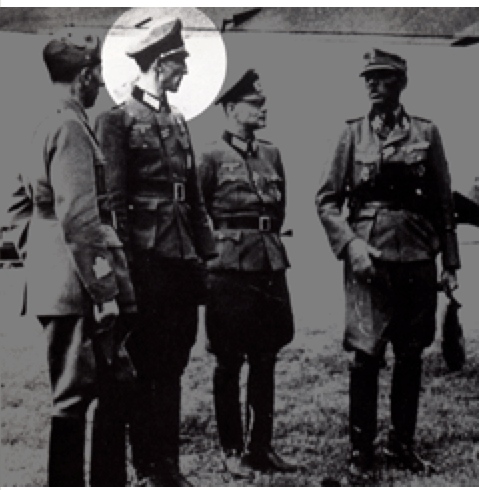
Kurt Waldheim as a Nazi officer
Although deceased, I will mention
Allen Hynek
, whom I met in 1976 at a UFO congress he had organized in Chicago (more precisely in Evanston, Illinois). There, I realized that Hynek, world-renowned for his role as scientific advisor to Project Blue Book in the 1950s, was merely a minor astronomer of average scientific ability, with no significant accomplishments. His CUFOS (Center for UFO Studies) in Evanston was just a two-room apartment where a secretary managed "the master's lectures." At that time, Hynek, like Vallée, followed the hypothesis of the "entirely paranormal" regarding the UFO phenomenon. He edited a small magazine whose central article seemed to be "UFO of the Month." In short, attending this conference was a complete waste of time.
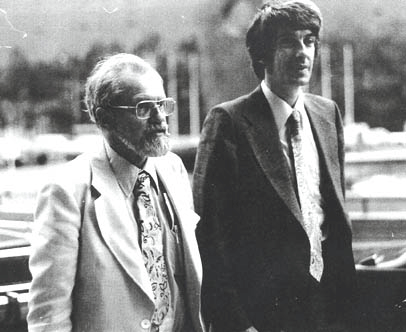
Allen Hynek and young Jacques Vallée
In Evanston in 1961, I was joined by the CNES engineer
Claude Poher
, another "scientific ufologist" who had been seduced by the interpretation of the phenomenon as a paranormal manifestation. With a knowing air (I remember it as if it were yesterday), he told me:
- When confronted with a UFO manifestation, the first thing to do is check whether there aren't any prepubescent teenagers nearby. They generate the most paranormal manifestations.
Among this motley crew, I arrived with experimental results from MHD, photos, and even a film. At the end of my one-hour presentation, a Texan was to take over. But when it was his turn, he declared:
- What this Frenchman says is too interesting. I wish to give him my speaking time.
So I continued, noticing that Hynek did not appreciate my disrupting the schedule of his parody of a scientific conference, with its chairmen, session presidents, badges, and coffee breaks. I had hoped that coming there would allow Hynek to connect me with Peter Sturrock, whose plasma physics lab I knew was operational. Vox clamatus in deserto.
Claude Poher is a "self-made man," a simple technician who became an engineer at Arts et Métiers through evening courses (a path that can produce very bright individuals, some of whom went very far later on). Poher, however, owed his rise at CNES solely to his family connection with Alain Poher, President of the Senate. As the first head of GEPAN at its creation in 1977, he never published anything serious on a scientific level, nor made any tangible contribution. Before handling GEPAN, he was "Director of the Rocket Probes Department" at CNES. Appointed head of GEPAN by the polytechnician military engineer Yves Sillard, then President of CNES, he resigned less than a year later, allegedly to sail on a boat he had built. Regarding the boat, I confirm it. I saw it in Toulouse, in his garden. As for the "touristic reasons," that doesn't hold water.
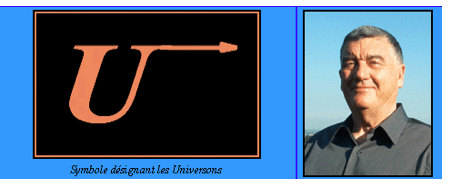
Claude Poher, author of a pseudoscientific theory: the "Universons"
When he was in charge of GEPAN in 1977, I was already hospitalized due to my October 1976 workplace accident (a 250 kg electromagnet fell on my lower back in the basement of the Marseille Observatory, where I had set up a clandestine lab, with the complicity of my director and friend—something I only revealed after his retirement).
Poher is responsible for a claim he made during a conversation with journalist Bernard Thouanel, which Thouanel confirmed: according to him, I had passed off a hang glider accident as a workplace accident to collect disability pension.
This rumor, launched by Claude Poher, has recently been picked up by one Denis Roger Denocla
,
on a UFO forum.
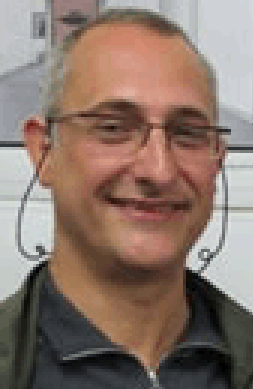
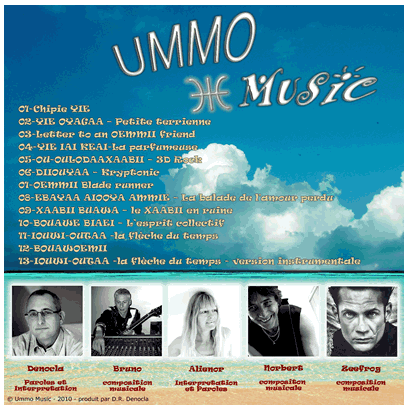
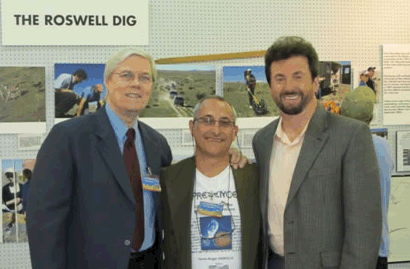
Denis Roger Denocla, the UFO shopkeeper
Photographed here by journalist Bernard Thouanel at the Roswell Museum
Denocla does not belong among the "scientific ufologists." He is another species: the
UFO shopkeepers
. In this field, he holds all records. But before addressing this aspect of the individual, I wish to put a final end to this infamous rumor, which disgraces those who launched it and/or propagate it.
If, as Claude Poher claimed, I had passed off a hang glider accident as a workplace accident to collect a disability pension, logic would have dictated that I would have accepted the pension payment with satisfaction, having thus deceived the medical experts at CNRS.
This accident occurred in October 1976 during the unloading of a 250 kg electromagnet at the Marseille Observatory, where I had installed a lab. Paraphrasing characters from the Muppet Show, we had written on the door:
The future already belonged to the past
I was immediately taken to the hospital. I endured a long and painful hospital stay, completely lying down for three months (I couldn't even sit up). It took years to regain part of my mobility, and I have suffered from the consequences of this accident for 34 years, which forced me to abandon cherished activities like driving safaris in Kenya and similar pursuits.
After several months, my condition was deemed "consolidated" by CNRS, and an expert doctor awarded me an 8% disability rate, corresponding to a non-revisable pension of 540 F
per quarter
(81 euros). However, as the CNRS social worker, Madame Eldin, had informed me, if my condition rendered me totally disabled, I could receive social assistance, particularly to raise my son Jean-Christophe, who was then 7 years old, and whom I had custody of.
I remember calling her from my bed (I was still bedridden). We had the following dialogue:
-
Madame Eldin, there's something I'd like you to do for me.
-
Oh, Mr. Petit, you know I can't do much...
-
Yes, you can do this one thing.
-
What?
-
Get out of here!
When I began walking again, painfully with crutches, kind neighbors did my shopping, and thanks to that, I could continue raising my son alone. We continued our travels. But since I had difficulty walking, we abandoned trips to Kenya and focused instead on scuba diving holidays in Cuba and the Red Sea. I remember a stay we had in Cuba, in Jibacoba, where, outside the "weightless" moments when Jean-Christophe and I went hunting, I had to remain lying down for the rest of the time.
An earlier anecdote, from 1977, when I was still dragging myself around my apartment in Aix with two crutches. I had a visit from a certain Couturier (whom I later encountered years later on a show hosted by Bernard Tapie. He had, by then, become Director of the Paris Observatory). But in 1977, Couturier came as an emissary of the CNRS Astrophysics Commission, to which I belonged. He spoke to me thus:
- I came to tell you what the commission wants. I might shock you, but "we want you to peel potatoes." I mean: take a small photo of a galaxy, do a simple calculation, nothing extraordinary, and publish it. Then we'll leave you in peace and everything will return to normal. But forget about twin universes and other nonsense like that (I had just published my note in 1977, presented to the Paris Academy of Sciences by mathematician André Lichnérowicz).
I stood before him, leaning on my crutches. Suddenly, tears I couldn't hold back streamed down my cheeks.
-
What? What did I say?
-
Nothing, you can't understand. It would be better if you let me go now.
A third anecdote. At the time of my workplace accident, I was still seeking a right of reply regarding statements made by the astrophysicist-academician Evry Schatzman (deceased in 2010), who, during a lecture in Grenoble, had repeated for the hundredth time that UFOs were merely hallucinations and old wives' tales. Regarding the operating principles of this "MHD aircraft," which I had described in a note presented to the Paris Academy of Sciences by Lichnérowicz, he declared the machine absurd, incapable of sustaining itself "because it generates its own electric and magnetic fields." He added that "theorems oppose this," and mockingly compared my approach to that of Baron Munchausen, who, seated on his horse stuck in a swamp, pulled himself out by his own hair.
Yet Schatzman had been the president of my State Thesis jury, defended in 1972. He had personally traveled to Marseille for the occasion and was well aware that I was not some random fool. But whenever UFOs were involved, he reacted like a priest defending a scientific institution, which he perceived like a religious institution.
I obtained this right of reply while still completely bedridden. It was in Annecy, at the sessions of the Rationalist Union, of which he was then president. So I went there at the end of 1976, in an ambulance arranged by friends, and entered the hall on a stretcher. After the local section president had outlined the issue, Schatzman awaited me at the blackboard, chalk in hand. But what he encountered left him speechless. Viton had constructed a small experiment where Baron Munchausen, seated on his horse, was submerged in acidic water contained in a small aquarium. Inside the horse: a cylindrical permanent magnet. Instead of spurs, electrodes. When Viton connected the wires, the horse emerged. Schatzman turned pale, and I said to him:
- If what you claim is correct, then this experiment cannot work.
He admitted it.
- I confess I was too hasty in my statements in Grenoble...
I had just made a mortal enemy.
The atmosphere in the hall became turbulent. Lying on my stretcher, I could see little. I asked Viton, who had accompanied me:
-
What's happening? I hear people shouting...
-
I can tell you one thing. If we lived in the 13th century, you and I would already be on stakes, roasting in the courtyard.
It was at that very moment that we first realized we were touching a complete taboo, and that we should not expect any rational response from many people in the future.
I return to this story of the disability pension to clarify the UFO-lantern of Mr. Denocla.
In my difficult situation, I suddenly realized I had no family, that I was living like a tightrope walker. I had neither brother nor sister. All others were dead or distant relatives. When I had this workplace accident, I imagined I would be seen as a victim, a kind of hero. I had grand illusions.
It turns out that CNRS is its own insurer for workplace accidents. When I investigated, what I discovered shocked me. Social security had its own list of toxic substances. The CNRS workplace accident service had adopted this list. It turned out that researchers had been severely poisoned, with permanent neurological damage, by substances not listed on it.
So CNRS contested their claims... because the substance wasn't on the list.
Some suffered consequences from irradiation, having worked on particle accelerators, for example. Etc...
In such a shop, gathering about 30,000 researchers, injured and pensioned workers were not numerous. But many, parents of numerous children, crushed by debts, "discarded," were treated scandalously.
When I became aware of this, I lost all respect for my employer.
A long administrative court trial would have been needed for these people to claim their rights (a situation similar to that of military personnel irradiated during nuclear tests). I didn't know how my health would evolve. I somehow pulled through by some miracle, and it took me
years
, doing gymnastics in a pool, to the point of developing scales (as I did here for six months in spring 2010, thanks to the aquagym pool I had built at home).
In fact, at CNRS, a researcher severely injured in the course of their profession can be compared to a car wrecked on a road, which is simply pushed into a ditch to clear traffic, to rust and rot in the corner.
Look into it and see what a 100% disabled workplace accident pensioner receives at CNRS. For him, if he has no family to help, hardship, even poverty, will be the result.
When I received notice that I would now receive a pension of 81 euros per quarter, non-revisable, I first decided to create additional income, capable of turning into a safety net if things went badly. Thus was born, in 1978, the collection of scientific comic books "The Adventures of Anselme Lanturlu." Then I wrote to the workplace accident service saying to them:
- Among the CNRS workplace accident victims, there are people less fortunate than me, lacking talents like mine. I refuse this pension and ask you to transfer it to researchers, engineers, or technicians injured in accidents, who live in hardship due to what happened to them.
The CNRS workplace accident department then replied that "this pension was non-transferable." For a year, I systematically returned this money to CNRS, which paid it into my CCP account. CNRS had its own account. All I needed to do was transfer it.
This unanticipated reversal, not provided for in the rules, caused a very costly financial management malfunction. I received numerous calls from the service, begging me to stop returning this money, given "all the trouble I was causing by doing so." CNRS even offered me a "fixed settlement of my compensation," which I also refused.
After a year, I grew tired of these transfers. Those 81 euros then landed in my CCP account every two months. Then I retired in 2005. And then I received a letter that made me exclaim, "Finally, I've got these fools!" This letter informed me that continued pension payments were conditional upon signing a... death certificate. I felt I was living a new story by Marcel Aymé.
Of course, I ignored this request.
The pension office then repeated its request a second time. Then a third time, by registered mail with acknowledgment of receipt (document below)

I mechanically signed the acknowledgment of receipt handed to me by the mail carrier, but I did not return the requested certificate, which CNRS had once again enclosed with its mailing. Finally, after 29 years, CNRS stopped paying me this damned pension of 81 euros per quarter in 2005. And that was it. That day, I felt I had regained a bit of my human dignity.
Based on this document, you still learn one thing worth noting. It is not because an individual runs a website with 100,000 readers, appears on television screens, has books signed by him, and has his signature—or alleged signature—on a postal receipt, that it proves he is still alive. To prove that, he would need to send, bearing his signature:
A sworn declaration of non-death
When I heard, during an interview he gave to a Canadian journalist named Bourbeau, Thouanel mention that he claimed to have heard from Claude Poher that I had passed off a hang glider accident as a workplace accident, I wrote to Poher explaining the truth. This must have been around 2007, two years after my retirement. He replied to my email mockingly. If I expected apologies, it was a failure.
So it's simple. If fate ever brings Claude Poher across my path, I will punch him in the face immediately. It will be uncontrollable and instantaneous. Even at 73, I still have a decent punch, which has served me before. The same warning applies to Messieurs Thouanel and Denocla, now fully aware, if these two dare to continue spreading this slanderous lie.
Returning to Denis Roger Denocla, the "UFO shopkeeper." With him, things have reached heights we could never have imagined possible. Look: he offers 172 items for sale. Compose this link:
http://www.denocla.com/?p=717%E2%8C%A9=fr
You'll hear the song he composed "in Ummite language." Here is the album:
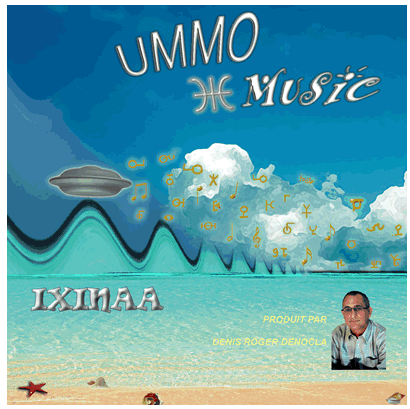
Denis Roger Denocla, the UFO shopkeeper
You can also find T-shirts, bags, mugs, and even... underwear:

Visiting the Roswell Museum, with a T-shirt sales stand
The starting point of such delusions is the website you inevitably land on if you type "Ummo" into Google. There, you'll find a link pointing to the "scientific studies" this opportunistic figure has even deposited, adding his copyright, and writing on his site "warning to plagiarists!"
Will the Ummo dossier be discussed at the Strasbourg conference?
No.
We have compiled the topics. We won't discuss crop circles or abductions, otherwise we'd never finish. But I can tell you one thing: at UFO-science, we've created a new website dedicated to this fantastic Ummo dossier, focusing on the genuinely scientific applications it has generated. This will be something entirely different from the tons of nonsense offered by those managing the main website associated with this dossier.
We'll launch the site the day after the conference. On the internet, things move very quickly. As for the Ummo documents, internet users will also find them on our site, free of copyrights and other nonsense—texts that belong to no one, since nobody knows their authors. These texts will be accompanied by comments of a different caliber than the nonsense others have spun for ten years. It will be like shaking rotten apples off a tree. Denocla's little business will take a hit. The "main site" will quickly fall from the top of the rankings. The person who created it, seizing control of these texts and attaching a ridiculous copyright to them (and the original Spanish texts with the tattoo ADUMMO, or "Ummo Defense Association"), realizing he'd failed, has been gone from the scene for years and is now infiltrating the alter-globalist movement.
The Augias operation continues. I've realized Bernard Zappoli continues to enjoy a fairly comfortable career at CNES. You can find echoes of this by typing his name into Google. But I don't have a good photo of him. I haven't found one. If anyone can send me one, I'd be grateful. I do have photos of Alain Esterle, though.
I'll dedicate a dossier to bringing to light facts from the years 1978–1979. At CNES, Zappoli's colleagues might be surprised to discover just how dishonest he was, thirty-three years ago, by becoming an accomplice to Esterle's ambitious and cynical schemes, advised by another polytechnician, Gilbert Payan, who told astronomer Pierre Guérin in 1977:
- Eventually, Petit will have to be removed from the research, due to the context.
What became of the former military engineer, the brilliant Henri Bondar, murdered for revealing this entire sordid mess, with proof in hand (the report drafted by Zappoli, which I still possess)?
I'd also be grateful for a photo of the shadowy figure, the polytechnician Gilbert Payan. There's no statute of limitations on "scientific crimes." The current state of decay of French MHD research is due entirely to these three individuals. My site has considerable audience. I'd just like to see ordinary citizens, simple taxpayers, stop these people on the street and say:
- We pay taxes so that research can progress in France. Are you one of those who, at the end of the 1970s (until the early 1980s for Payan), caused MHD research in our country—once leading in 1975—to sink into such misery that the only qualified individual in this field was reduced to conducting experiments in a 9-square-meter garage?
The history of UFOs is paved with unflattering episodes. A few days ago, I had on the phone a well-known "ufologist," a Frenchman living abroad. At one point he said:
- I could tell you some things about Padrines
(the organizer
of the Strasbourg conference in October 2010
)
-
Well, since we're on the phone, go ahead and tell me!
-
No, it's not my style to talk about people behind their backs (...)
-
You know he has cancer, already with metastases, a brain tumor, and others in his bones.
-
I know. I myself have insomnia, rheumatism, and high cholesterol (...)
In the end, this creature sent me, at the advice of his lawyer, a registered letter with acknowledgment of receipt, ordering me to remove his name, photo, and email address from my site. I complied immediately. But I simply installed screenshots showing the pages where all this was displayed in full detail.
Poor ufologists
who are clearly terrified that this Strasbourg conference will undermine their little businesses.
Poher, a perfect "pseudo-scientist," made a fool of himself a few years ago by publishing a book, the result of years of solitary contemplation, titled "The Universons, Energy of the Future." "Theoretical work," supported by strawberry branches, was followed by experimental work conducted in the laboratory Poher built in his home. There, he rediscovered properties of piezoelectric substances known for nearly a century. Indeed, when a body with piezoelectric properties is struck, it generates a strong voltage capable of producing a spark in the air. This is how these crystals replaced the flints in our fathers' or grandfathers' lighters (depending on the reader's age). Conversely, when a strong voltage is applied to these same crystals, they produce an impulse capable of imparting motion to a mass. Poher attributed this property to his "universons." Naturally, he was utterly incapable of publishing these "studies" in a peer-reviewed journal, to his great dismay.
After his resignation from GEPAN (followed by that of his successor, the polytechnician Alain Esterle), I always perceived his new assignment as a kind of golden closet. He spent the twenty years preceding his retirement on "long-term foresight," among other things... studying antimatter (...), and publishing "internal CNES notes." He is listed among the high-profile speakers at French ufology dinners, where "one might take Piraeus for a man."
Another "scientist-ufologist": Professor Auguste Meessen, retired from the University of Louvain-la-Neuve, Belgium.
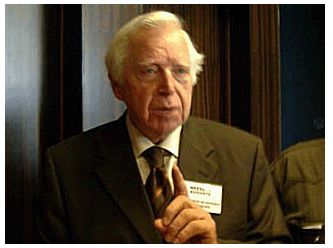
Auguste Meessen, former shadowy figure of the Belgian SOBEPS
At least he authored a few authentic scientific publications of relatively interesting content, particularly an essay on the quantification of space-time (though unfortunately it fizzled out). He gained prominence during the 1990 Belgian UFO wave, and must be credited with the idea that infrared emissions from UFOs could inhibit image capture on photographic film. A very interesting idea. Indeed, a professional photographer, Ferryn, who witnessed a UFO during that wave, took several photos of a craft flying overhead, emitting light similar to that from a truck's headlights. When developed, these "headlights" were reduced to barely visible reddish dots. This occurred even though Ferryn, a professional photographer, had tested his equipment and film by finishing his roll with images of aircraft landing at night at a nearby airport. Meessen suggested that this image recording weakness might be due to infrared emission, and he delivered a brilliant demonstration of this at SOBEPS.
This is where Auguste Meessen's major contribution to UFO research lies. During the F-16 affair, the Belgian military, through its representative, Colonel Schweicher, professor of microwaves at the Royal Military School in Brussels, entrusted Meessen with the recordings from the black boxes of the aircraft. But he proved incapable of analyzing them, and the study was handed over to a military engineer from the Military School, who produced an interesting thesis on the subject, successfully reconstructing the UFO's 3D trajectory. In contrast, Meessen tangled himself in a pseudo-explanation based on a meteorological phenomenon.
I met Vallée and Meessen in 1976 at a conference on the UFO phenomenon, which at the time had been organized by the University of Poitiers (a thing now unthinkable, and even more so today). Vallée was immediately destabilized by finding himself confronted with a scientific level he could never claim. We met again many years later on the set of Polac's "Right of Reply" show. I still remember the sentence with which he began his intervention:
- Well, I'd be extremely disappointed if the UFO phenomenon were nothing more than visits from extraterrestrials!
This single sentence sums up the man. In this field, everyone works to keep the subject within their own area of knowledge. Vallée's knowledge in physics was strictly nonexistent, so he could only immediately reject a position like mine, which the Anglo-Saxons call "nuts and bolts." The same attitude prevailed with Allen Hynek, who in 1976, "in jest," told me:
- You're the kind of scientist I hate most....
For nearly ten years, between 1970 and 1985, I vainly tried to establish contact with Auguste Meessen, hoping his position as a university professor at Louvain could allow us to implant theoretical and experimental research related to the UFO dossier within a university-research framework. In this matter, I've always been very "generous"—no one can claim otherwise. Unfortunately, my numerous letters remained unanswered.
Meesen, like all other "scientist-ufologists," never published an article in a peer-reviewed scientific journal on the UFO phenomenon, limiting the dissemination of his writings to the pages of Inforespace, a publication with very limited circulation, produced by the SOBEPS association (Belgian Society for the Study of Space Phenomena).
Meesen's position became highly uncomfortable when, as a professor of theoretical physics, he found himself placed on the terrain of MHD. One year, he published (again in the Belgian association's journal Inforespace) an article reiterating the basic ideas of the "induction MHD aerodyne," which Jean-Christophe Doré and I had begun working on, and which has recently been the subject of three presentations at international conferences in Vilnius (2008), Bremen (2009), and soon Korea (2010), as well as a publication in the peer-reviewed Polish journal Acta Physica Polonica (2009). I could only modestly inform him of my own work, of a different caliber than his vague statements, having published everything in the Comptes Rendus de l'Académie des Sciences de Paris in... 1977, a note presented by the late mathematician and academician André Lichnérowicz. One can easily imagine his frustration.
For years, I've been a thorn in Auguste Meessen's side, as a... competitor, in terms of... leadership in the scientific approach to the UFO dossier. This absurd climate of rivalry is not my doing. It arose when we should have instead collaborated closely. But, in fact, Meessen's mathematical level was insufficient to grasp the concepts I had developed in cosmology as early as 1977 ("Enantiomorphic Universes with Opposite Proper Times," another note presented to the Academy of Sciences, again by Lichnérowicz). Instead of asking questions to clarify things, he rashly launched a frontal attack, publishing in Inforespace an article claiming to completely demolish my model (which was, moreover, directly inspired by... Ummites texts, to which Meessen had declared himself immediately allergic!). Naturally, he lost that battle too.
When Claude Poher was placed in charge of GEPAN, he immediately perceived me as a dangerous competitor and did his best to "dilute" me within a large group of "external GEPAN collaborators," gathering the entire UFO crowd. This fear was unjustified, because even if I had wanted to, which I didn't, I would never have been in a position to cause him any professional concern (especially from the bed of a hospital, where I could hardly be "maneuvering").
I remember that when I had desperately called for help in that pitiful situation at the end of 1976, finding myself facing the merciless attacks of academician Evry Schatzman, then president of the Rationalist Union (who had, ironically, been the jury president for my thesis in 1972), who was doing his best to burn me at the CNRS, Poher replied:
- I can't do anything. I'm too busy. I'm meeting with ministers....
They say truth never triumphs, but fools always eventually die. Death is a very ordinary thing, and we'll all find it on our path one day (born in 1937, I'm currently 73). Dying doesn't cleanse an individual of all the nonsense they've done in life. Schatzman is dead, irony of fate for a man so proud of his brain's capabilities, after two years of Alzheimer's (another unfortunate twist, against which no one is immune! Will I still have the intellectual agility I currently possess in ten years? Nothing is certain). While alive,
displaying the utmost intellectual dishonesty,
Schatzman was the fiercest opponent to any scientific approach to the UFO phenomenon. He considered this stance a true "sacred duty," a position he shared with theoretical physicist Lévy-Leblond, and many other well-known scientists, such as René Pellat (plasma physicist, who died in an accident while serving as High Commissioner for Nuclear Energy and vigorously pushing the ITER project).
I'll quote a sentence from Schatzman, when he was president of the French Physical Society:
- I don't know how an airplane flies, and it doesn't interest me.
A remarkable openness of mind.
Schatzman had been the jury president for my thesis, defended in Marseille in 1972. My approach to galactic dynamics using tensor calculus had intrigued him (as had Lichnérowicz, who literally saved my life, at the last moment in 1969, when I became the target of murderous attacks by the director of the Institute of Fluid Mechanics in Marseille, Professor Jacques Valensi, a god-like figure in that lab where I had worked for seven years, and where I had committed the imprudence in 1967 of producing MHD work potentially applicable to large-scale industrial uses).
Schatzman had personally witnessed, in 1979, during a demonstration of hydraulic MHD simulation at CNES's center in Evry, the suppression of the bow wave (analogous to a shock wave) by electromagnetic forces. Seeing this, he acknowledged that an MHD machine could potentially eliminate the frontal shock wave formed when an object enters a gas at supersonic speed. But he quickly added, "nothing allows us to assert that this shock wave doesn't reform a bit further down" (...)
Statements from a man who understood nothing about fluid mechanics.
This isn't just about settling scores decades late. I simply want to point out that scientifically and humanly, we haven't been blessed for over three decades, and unfortunately the landscape remains extremely problematic in this regard. I believe that if anything were to move, it could only come from the USA, where there are patrons capable of funding operations like mass-producing adhesive network caps for mobile phones.

Adhesive network caps, turning a mobile phone into a spectroscope (J.C. Doré)
August 30, 2010
Jean-Christophe Doré has just received the first sample of adhesive network caps we want to sell at the Strasbourg conference on October 16 and 17, 2010. Here are the photos:
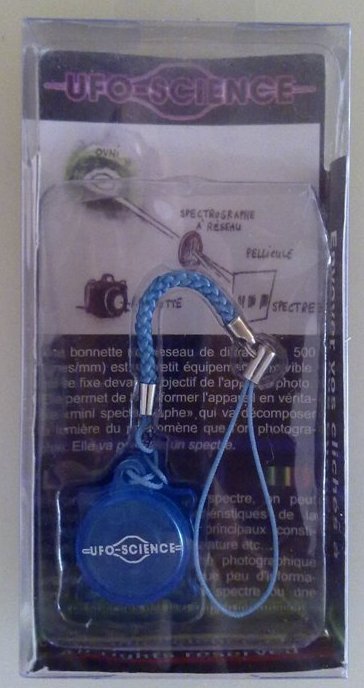
The cap, manufactured in China, in its packaging
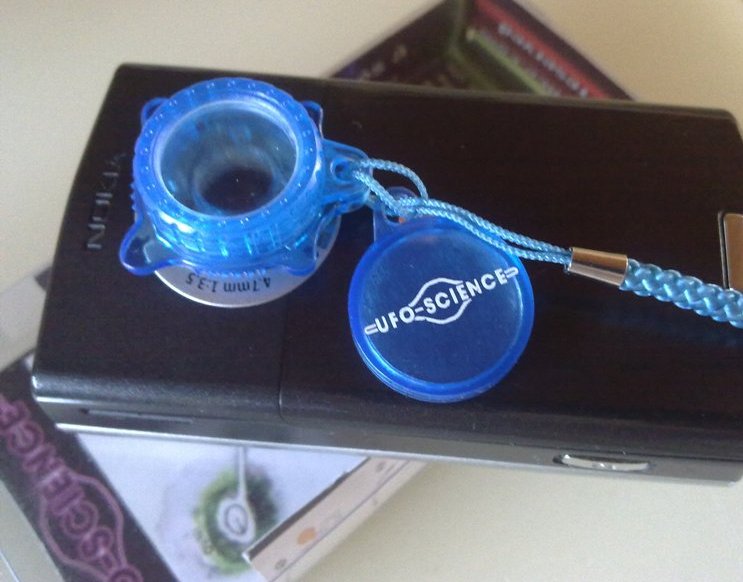
The same, attached using its adhesive device, on the lens of a mobile phone
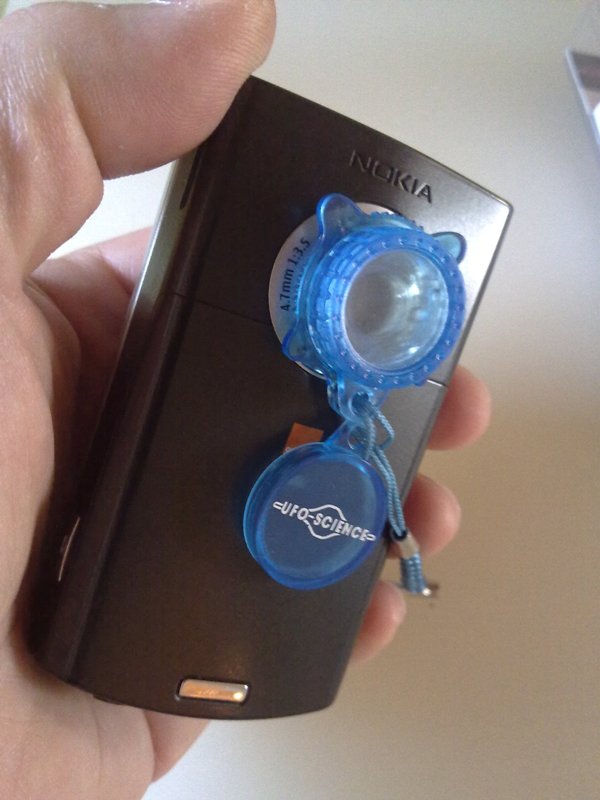
Ready to use
,
or ... almost
Alas ... not quite. The Chinese manufacturer equipped this cap with a grating of 50 lines per mm. We need at least 500. But the thousand-unit batch hasn't been produced yet, fortunately. Jean-Christophe is checking. It's possible the manufacturer put "a grating" just to give an idea of what it might look like. These gratings aren't sold as plates, which are then cut out. All this should be fixable. At this stage, the work is 99% complete and is entirely credited to Jean-Christophe Doré, who had the idea, and to my wife Jie, a Chinese national, who managed the contacts there.
The CNES service could have had this idea and had a hundred times the material means to manage it. They've known about this project for two years, but were unable to seize it for their own benefit. We'd need 100,000 of these caps like this, circulating, if possible. Then we'd have one of those precious UFO spectra.
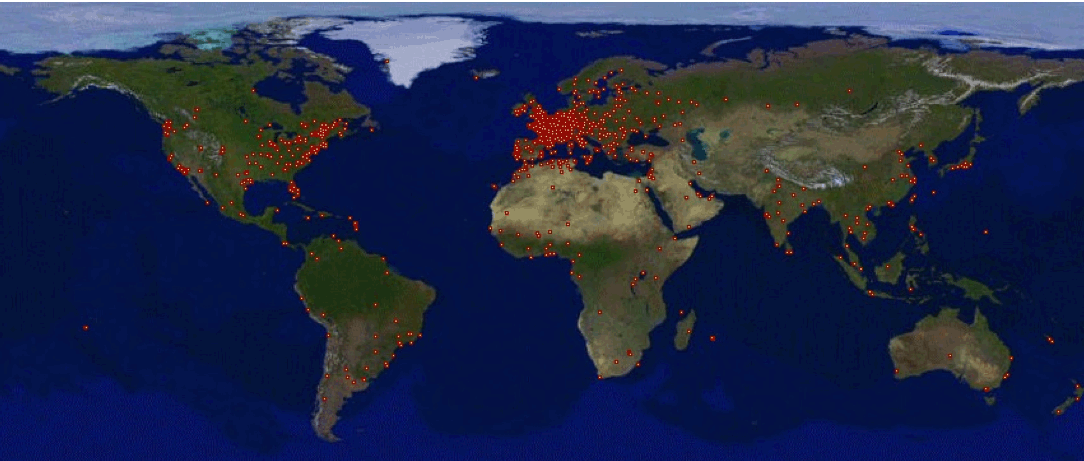
We've already circulated (by giving them away) 3,000 diffraction network caps, in the form of slides:

The map of "slide caps" distributed by UFO-science over three years
Here's what a spectrum looks like, taken with such a device. Based on what a spectrum taken with daylight would look like. The gradation of this "natural light" is continuous:

Now here's the spectrum obtained with a "neon tube." A clarification: these fluorescent tubes haven't contained the rare gas neon for a long time, but rather "mercury vapor" (hence the harmful and polluting nature of these new energy-saving lamps, which contain mercury and emit X-rays at short distances).
The gas inside the tube is at tens of thousands of degrees (I'm referring to electron temperature, the "temperature of the free electron gas"). Fast-moving electrons strike the fluorescent coating lining the inside of the tube and its various components, which re-emit light at various frequencies through the phenomenon of
fluorescence
. The mixture was carefully chosen to best approximate daylight. But you can see there are lines corresponding to missing frequencies. In the blue and green, there are frequencies we can't produce via fluorescence. Hence these gaps in the spectrum. Your eye is perfectly capable of noticing the difference. That's why this "neon" light (the name has stuck) seems somewhat strange, different from daylight. In fact, it fails to perfectly recreate sunlight.

Thus, if you were shown these two photos, you could immediately tell:
- There, it's sunlight, but there it's a "neon tube."
You now see the importance of researching a UFO spectrum:
to identify the chemical nature of the emitter.
If the identified lines correspond to those that could be emitted by components of Earth's atmosphere, we might consider the possibility of a natural phenomenon, misunderstood and unidentified. But if not—if, for example, we find lines from cesium or lithium, which don't exist in Earth's atmosphere—then a natural phenomenon would be ruled out, and the analysis would provide material for scientific reflection, whereas the photo or video taken with a simple camera or camcorder would contribute... nothing but a small white spot, from which nothing could be extracted.
A project like this network cap is not new. At the time of GEPAN's creation in 1977, Claude Poher had the caps made, inspired by an earlier American project from 1952. It was a dual-lens device using 35 mm film. One lens captured a visible image, the other, equipped with a grating, captured a spectrum.
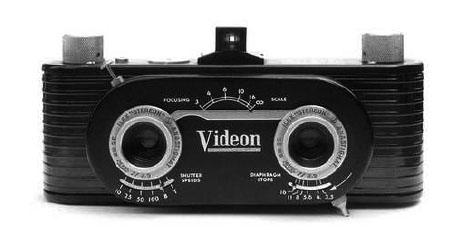
The videon, distributed to U.S. military crews
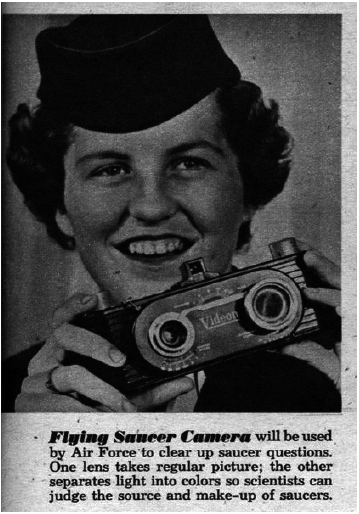
The same, presented in the magazine Mechanics Illustrated, in the 1950s
We've recovered one and entrusted it to a specialist in vintage cameras in Paris, who is trying to restore it. With luck, we'll be able to show it at Strasbourg. Poher had this technique studied by engineer Louange from the company Fleximage (visible in the photo of the Pocantico conference, center, recognizable by his tall stature and dyed hair—see further down), a consultant for CNES and GEPAN since its inception. He asked the optics company Jobin and Yvon to build network caps intended exclusively for adaptation onto police officers' cameras. Meanwhile, the polytechnician Gilbert Payan, "Mr. UFO" in France, had become CEO of Instruments S.A., a company of which Jobin and Yvon was a subsidiary.
But instead of distributing one cap per policeman (there are over 100,000 in France), they distributed... one cap per police station. These remained in drawers, and no spectra were obtained over three decades. No one knows what became of these devices, which quickly became incompatible with the new cameras issued to the brigades. It's impossible to recover an instruction manual, if one ever existed.
Doré met Yves Sillard, the creator of GEPAN (see his photo below), in 1977 at his home, and discussed with him the idea of reviving this project.
- Yes, said Sillard. Then we'd need to equip those specialized in observation, the astronomers...
But there's no one more allergic to the UFO phenomenon than an astronomer, professional or amateur. The mainstream thinking, propagated for example by the magazine Ciel et Espace, is there to keep them in this position of rejection. Once again, we were confronted with a suggestion that could politely be called "non-functional."
Quantity is essential. In the early 1970s, limiting this equipment to police officers was a matter of maintaining control by any means. Thus, the operation was a complete failure. The only solution is therefore to distribute these devices to as many people as possible,
to the general public
. The more there are in circulation,
around the world
, the greater the chances of capturing these damned spectra. Ideally, a mobile phone manufacturer could add this gadget to the device at minimal cost, which the user could simply slide over the tiny lens with a single finger press.
After this visit to Sillard, we realized we'd have to manage this ourselves. No one would claim ownership of such a simple idea. If people volunteer to help promote widespread distribution—say, by including the caps with a magazine issue—we'll put them directly in contact with the Chinese manufacturer, without pretending to act as intermediaries.
Below is another creation by Jean-Christophe Doré: UFOcatch:
For more details:
http://www.ufo-science.com/wpf/?p=485#more-485
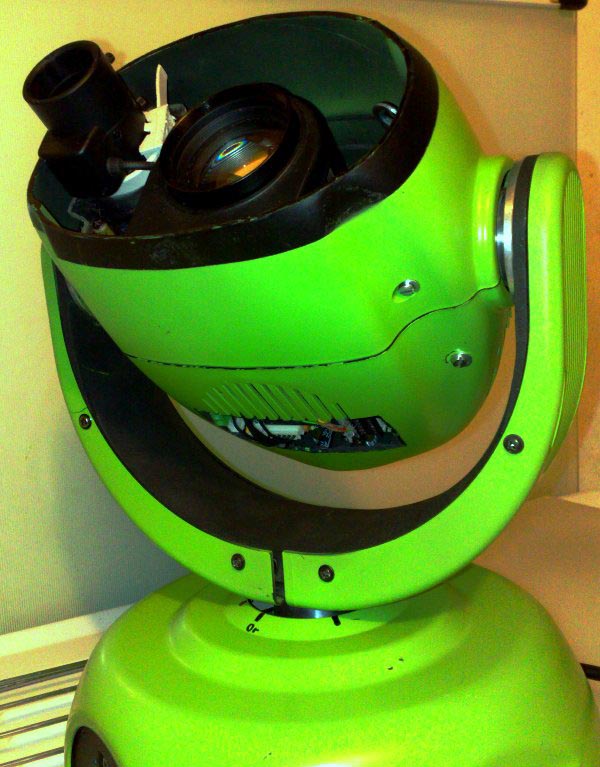
UFOcatch, dressed in the colors of the amphibian it mimics in behavior
A quick note:
a network of UFOcatch units can record 3D trajectories with speed measurement. Furthermore, such stations could locate points of satellite or meteorite fragment impact within tens of meters. Finally, equipping them with infrared cameras would allow these systems to detect the early stages of fires and report their location. It would only require mounting these stations at height. A UFOcatch equipped with a small infrared camera, using its automatic zoom system, could enable wildlife photography.
In Brighton, it was clear that another "epistemic ufology luminary," in this case Von Ludwiger, had understood not a single word of what I presented. But that doesn't matter—among the base ufology community, figures like these represent... safe values, who could only be the main actors at an international conference on the UFO phenomenon, which the "ufology dinner" actors would attempt to organize in 2012.
We will present our work on October 16 and 17, 2010 at
an Astronomy - Space - UFO Phenomenon Congress in Strasbourg
. This presentation will immediately follow a presentation of our MHD research at an authentic international MHD congress taking place in Korea from October 10 to 13, just a few days earlier, where Jean-Christophe Doré and I will be attending. This conference is organized by Michel Padrines, who has advanced, widespread cancer (metastases in the brain and spine). He has just been readmitted to the hospital. If he's unable to present the conference in October, we will do so on his behalf. Such a situation doesn't prevent the ufology rabble from saying worse things, preferably under pseudonyms, in forums. I didn't know humans could display such inhumanity, such human mediocrity, such baseness. Also cowardice. Because courage in facing opponents face-to-face isn't a dominant virtue in this milieu, about which a friend said thirty years ago:
- I now know the depths of thought.
At this conference, we will attempt to contact one of the world's largest UFO organizations, the American MUFON (Mutual UFO Network). This organization is in contact with American patrons who could easily fund the development of simple, concrete projects like the network caps and especially UFOcatch. But will we succeed in establishing any contact, in provoking a positive action, even though MUFON's scientific advisors include people like those we mention on this page, particularly Von Ludwiger? We'll know after the conference. I'm initially quite skeptical.
Until its dissolution, SOBEPS was supported by Auguste Meessen and a pleasant lecturer at the Belgian university, a maître de conférences.
Leon Brenig
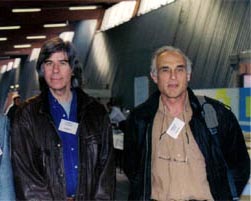
Leon Brenig
Ferryn on the left, Brenig on the right, at a "ufology" meeting
Brenig has not produced any notable scientific contribution related to the UFO topic. He gained attention in previous years by delivering a speech at the time of the dissolution of the Belgian SOBEPS association, leaving behind dozens of kilograms of investigation results poor in information, scientifically exploitable (no spectra, no measurements—only testimonial recordings, sketches, and a few photos). At that occasion, Léon Brenig declared:
- SOBEPS no longer had a reason to exist, since it could now pass the torch to CNES's Geipan (...)
Peter Sturrock
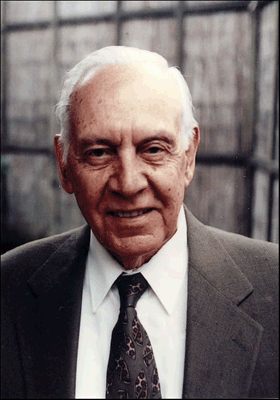
Peter Sturrock, master of disinformation, closely tied to the Rockefellers
His Wikipedia page
Born in 1924. At the time I'm writing these lines, he's 86 years old, and was 52 when I went to the United States for the conference organized by Hynek, hoping to meet him. But he wasn't present at that meeting.
Sturrock's case is different. A glance at his profile shows he was a significant scientist, particularly a good specialist in plasmas, fully capable of understanding my MHD work. He visited me in Aix at the beginning of the 1980s to see if I had the means to create some disruption in the epistemological sphere. Finding that I had no means, he returned to reassure his master, the CIA.
Sturrock co-organized with Rockefeller the
Pocantico meeting
of September 29, 1997 (a meeting dedicated to the UFO topic, organized by Rockefeller at one of his properties near New York, attended also by Auguste Meessen, Jean-Jacques Vélasco, Von Ludwiger, French engineer Louange—none of whom realized this meeting was nothing but a complete farce).
Sturrock particularly declared there, saluting the work done in France, that what the United States lacked was a... SEPRA.
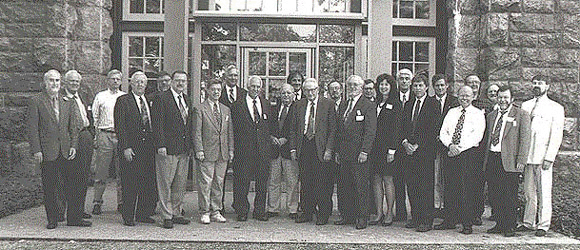
The Pocantico meeting, organized by Sturrock and Rockefeller (at one of Rockefeller's properties)
From left to right: T. Holzer, V. Eshleman, Rodeghier, Schuessler, H. Melosh,
J. Jokipii,
H. Puthoff,
D. Pritchard,
Sturrock
, C. Tolbert,
Louange
, Laurance Rockefeller,
Vélasco, I. von Ludwiger,
H. Diamond, M. Sims,
Vallée
, B. Haisch, Veyret, Haines, Swords, J. Papike, G. Reitz, E. Strand
In red, those I personally met
You can find the complete list of participants and their titles on
this web page
.
Sturrock co-founded with Jacques Vallée the journal "The Journal for Scientific Exploration," which rejected an article I sent them on MHD propulsion in the early 1980s, convincing the late astronomer Pierre Guérin that Sturrock and Vallée were engaged in a coordinated operation of blackout and disinformation, Vallée's role being to folklorize the subject as best as possible, which he did by selling millions of books.
Michel Bounias
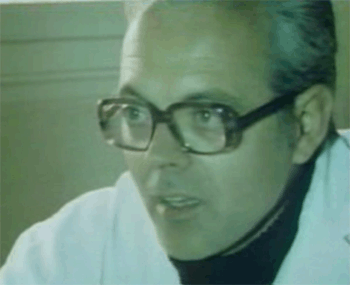
Michel Bounias, research director at INRA in Avignon (National Institute of Agronomy), was a scientist of great talent. He completed his thesis at the CEA, studying the alterations caused in plants by nuclear irradiation. Later, he early on, in vain like so many others, campaigned against the harmful actions of pesticides, especially on bees.
In 1981, he was requested by GEPAN to perform analyses on plant samples collected from a field in the locality of
Trans-en-Provence
or an Italian eyewitness, Renato Nicolaï, claimed to have observed a disc-shaped object landing, with a diameter of slightly over two meters. Intrigued by the noticeable difference he had detected in the pigment content of the plants (measurements performed via thin-layer chromatography), he returned to the site and collected samples every meter along the "restanque" where Mr. Nicolaï said he had seen the object land.
Repeating his measurements, he found an extremely strong correlation between the phenomenon and distance, the correlation coefficient reaching, if my memory serves me well, 0.95.
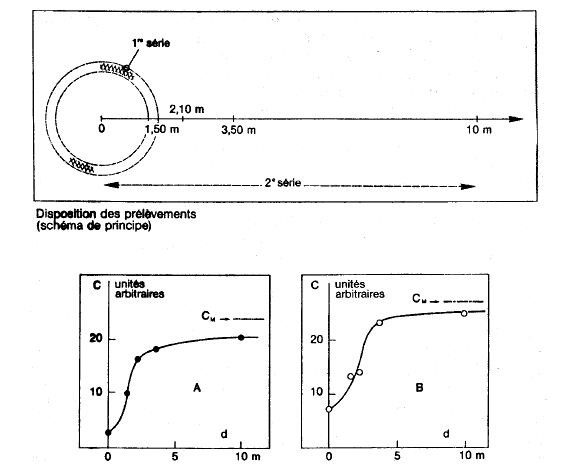
Trans in Provence: Pigment depletion as a function of distance
What was interesting was that no known agent capable of producing such a phenomenon was known at the time. This remains true today, despite the claims of a mere schoolteacher, Eric Maillot, utterly unqualified (cited in the Wikipedia page dedicated to this case), who calls himself an "UFO specialist" within the "Laboratory of Zététique," created and led by Professor Henri Broch in Nice. It should be noted that this self-proclaimed discipline, zététique (which shares little with ufology), remains completely unknown to the epistemologists in the philosophy department of this university, to which it should in principle belong.
One thing is certain, however. Having recklessly spoken out in the media, Bounias was methodically stripped by the INRA leadership (as the INSERM, medical research, had previously done with Jacques Benveniste) of his equipment, his facilities, his staff, and was relocated to a mere office at the University of Avignon. This witch-hunt had a significant impact on his health, and he died of cancer in 2004, well before retirement.
As the late Aimé Michel had also said:
- This work is the first example of a genuinely scientific analysis of a real UFO case.
Yes, Michel Bounias was one of the very few scientists of real value who ventured into the UFO dossier, and he left behind not only his career but also his life.
As a reader pointed out, "ufology" also has its "academicians":
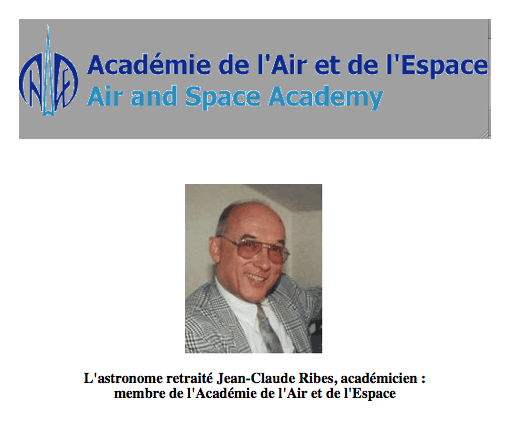
Jean-Claude Ribes contributed to the "Cometa" brochure and, together with Guy Monnet, is the author of the theory that interstellar travel occurs in giant vessels carrying tens of thousands of bipeds on one-way journeys.
If you look closely, you'll find other individuals who have gathered in an organization called the "Société Savante."
Yves Sillard
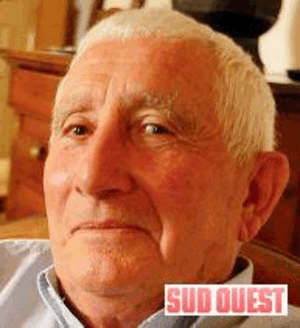
Former head of the DGA (Délégation Générale à l'Armement, or military research)
Yves Sillard
He is the true responsible for the French UFO mess for the past 33 years, due to his laxity and lack of follow-up.
By clicking the link, you'll discover the prestigious career of this Polytechnician, who founded the Gepan (Group for the Study of Unidentified Aerospace Phenomena) in 1977. Following a long conversation I had with him in 2005, at the time of the creation of the Geipan (Group for the Study and Information on Unidentified Aerospace Phenomena).
Those who have read my books—now out of print, but still available on the second-hand market, such as Enquête sur les OVNI (Albin Michel, 1988)—know that the CNES interventions from 1977 to 1981 were nothing but a succession of increasingly disastrous maneuvers, with Claude Poher and then his successor Alain Esterle as the main actors, backed by engineer and PhD Bernard Zappoli. For journalists wishing to question him about this unimpressive period of his career, see his CNES profile (and also the note he published on MHD at CNES-Gepan shortly after joining the service). Alain Esterle was sidelined by another Polytechnician, René Pellat (deceased). Behind these actions, yet another Polytechnician (clearly...), Gilbert Payan, "knowing how to dine," was retired early at age 55, his military mentors finally realizing the extent of his errors. Rather than recounting these failures, this incredible mess that condemned any restart of MHD in France, I prefer to send you to this link. The text was written at a time when its author (like me) still believed in some military trickery, particularly when mentioning that plant samples, properly collected this time during the Amarante incident, had been sent to a clone of the Bounias laboratory that the army had supposedly created at the ETCA (Central Technical Establishment of the Armed Forces).
We know that the Amarante samples were collected despite common sense, then sent to a lab in Toulouse instead of being sent to Bounias's lab in Avignon, as would have been logical. Hidden by the gendarmes "in the vegetable bin of the brigade," sealed in "airtight bags," these amaranth samples arrived completely ruined in Toulouse. You'll find the details of this grotesque affair in the archives posted on the Geipan website.
It's hard to imagine this was due solely to incompetence. Hence this hypothesis of decoy studies, which failed, while properly conducted studies would have been carried out secretly by the army.
The truth is much simpler and more mundane, emerging from Yves Sillard's words in 2005 during our over-hour-long phone conversation. If the samples were sent to a biology lab in Toulouse, it was simply because the head of what had become the Sepra, Jean-Jacques Vélasco, thought it was "closer to CNES." If Michel Bounias had been informed, he would have immediately returned to the site, collected new samples, frozen them in liquid nitrogen for transport and storage, and then analyzed them. He had demonstrated in 1981 that the phenomenon persisted for months and explicitly documented this in the report he submitted to CNES.
In the collective work Yves Sillard co-authored in 2007, this incident is mentioned. In a chapter, if I recall correctly, by Jacques Patenet, then head of Geipan, it is stated that after the gendarmes had collected their samples, the witness thoroughly cleaned his garden, especially mowing his lawn. For the CNES investigators (and even worse, for their successors and for Yves Sillard), "there was nothing left to analyze." Yet one does not mow a lawn with a plow. A few centimeter-long strands would have been more than sufficient for the required analyses, as Bounias had clearly specified in his report. But he was not consulted.
Why? Because the Toulouse biology lab was simply closer. Don't look for any Machiavellianism or taste for secrecy here. It's simply... incompetence.
The man responsible for this unbroken chain of incompetence over more than three decades is pictured above. After creating the Gepan with a stroke of the pen, he left Hubert Curien (then head of CNES, later Minister of Research, now deceased) to handle "the details." Learning in 2005 about the treatment Bounias had endured, Sillard expressed regret, "not having been informed."
Now retired, having thus lost much of his influence, Yves Sillard attempted to pull the Sepra out of its rut by creating the Geipan, endowed with a "steering committee" composed of a new group of multi-incompetents. During our phone call, I heard Sillard say (five years ago):
- It would be good if you were heard by the steering committee.
It feels like a bad boulevard play. There's no malice in this Sillard. For him, MHD is just a three-letter acronym. Administrative from A to Z, throughout a "stratospheric" career, he probably thought, like de Gaulle, "the logistics will follow." Unfortunately, the logistics did not follow. Now it's too late.
A young technician from Rochefort, Jean-Christophe Doré, is holding French MHD together single-handedly in his 9-square-meter garage.
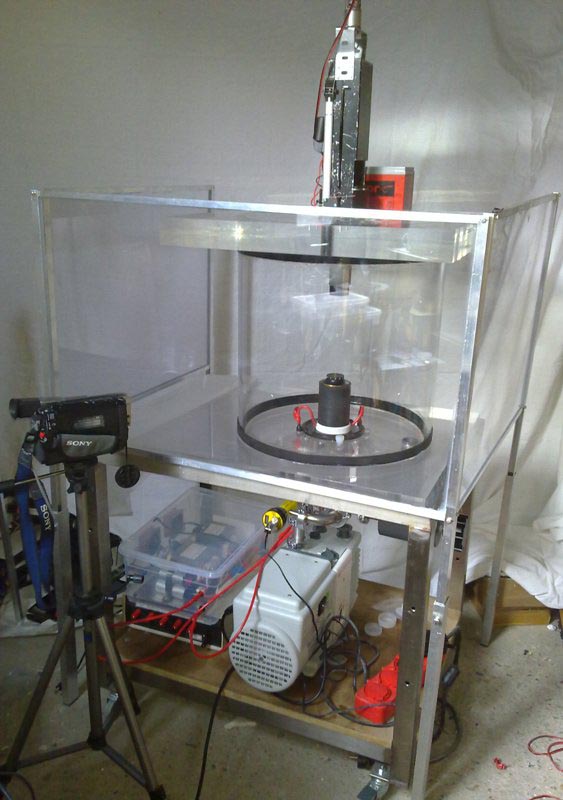
The low-density MHD test bench built by Jean-Christophe Doré in his 9-square-meter garage in Rochefort. The white background is a sheet provided by his wife, which barely conceals the rest of the contents of this room, including the children's bicycles.
This is... French MHD in 2010.
In October, we will both present the results of these experimental works at a major international MHD conference in Korea.
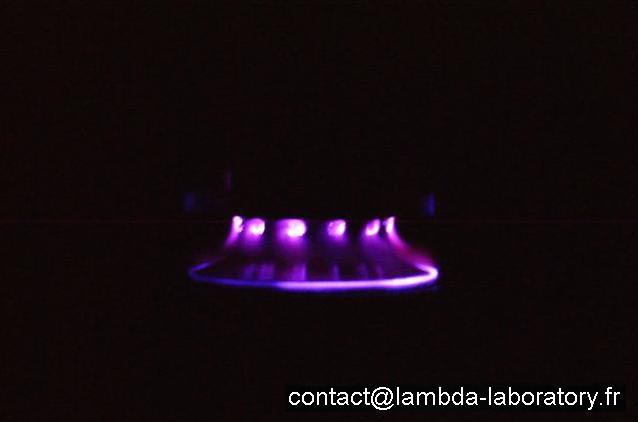
An unprecedented and brilliant experimental result: wall confinement via reversal of the magnetic field gradient
(You'll see it with your own eyes if you come to the Strasbourg conference)
International MHD Conference in Korea, October 10–13, 2010
For three decades in France, we have hit a wall that no one ever thinks about.
The wall of incompetence, allied with unyielding human mediocrity.
Doré is the keystone of UFO-science. If he disappeared, everything would collapse immediately, and I would dissolve the association, returning the funds to donors, as I was nearly ready to do after returning from the Bremen conference in October 2009, where I was in a wheelchair after Julien Geffray failed to record anything due to total lack of preparation (our devices were completely drained).
If Doré can continue this technical effort alone in his 9-square-meter garage, where he machines parts himself on a modest hobbyist lathe-mill (worth a thousand euros), the next steps will be the annihilation of Velikhov instability, followed by a pulsed wall ionization system. We will test the disc-shaped MHD aircraft in a low-pressure chamber, then in a cold-surge hypersonic wind tunnel, thus bypassing the "shockwave annihilation in hot burst, in shock tube" phase.
If we succeed in completing this research program—marked by publications and presentations at international congresses, where we can travel if my readers continue funding us—we will proceed to non-polluting fusion, opting for an "unconventional pathway."
August 10, 2010:
Christian Nazet, former general engineer of the armed forces, writes me (see below) that "Sillard is a decent fellow and it's pointless to attack him." That's possible. He also thinks the Geipan, with which he once loosely collaborated, is a complete failure.
Will Sillard realize that the "steering committee" he requested to create, to "guide the activities of this service," is merely a gathering of new incompetents? Will he realize that Yvan Blanc, like his predecessor Jacques Patenet, are simply not, and cannot be, up to this monumental challenge, as they are merely mid-career CNES engineers without talent?
What can he do in his current situation?
Nothing... except resign from his position as head of this sham steering committee, acknowledge this failure that has persisted since 1977, for thirty-three years, at the taxpayer's expense, as I write these lines. Over these years, the CNES service has contributed nothing, but instead acted as a fixed abscess, giving the public the illusion that "something was being done." I remember Jean-Jacques Vélasco repeating, episode after episode:
- Analyses are underway. When we have results, you'll be informed.
There was no analysis, no study. The Sepra head was merely repeating what he had been told to say. Why such a policy of misinformation? To hide vertiginous secrets? Not even. To have peace, translating a psycho-socio-immunological mechanism (called by others cognitive dissonance). For those who reject these facts with every fiber of their being, the discourse could resume the famous phrase from surrealist Picabia:
- Even if it's true, it's false.
Within the CNES General Directorate, there exists an extremely powerful, dominant faction, utterly allergic to anything related to the UFO dossier (rationality has nothing to do with it), powerful enough to block any progress. The mechanism at work in these people: FEAR, the old "Cosmotrouille" I discussed in my books, irrational, capable of invading an entire individual, determining all their actions, taking possession of their thoughts.
Five years ago, on the phone, Yves Sillard told me:
- You understand, I must proceed very cautiously. In the first place...
"In the first place" — a phrase spoken twenty-eight years after the creation of GEPAN! Lying on the floor of my office, I felt myself sinking slowly into the carpet.
Sillard knows about the UFOcatch project. Doré presented it to him at his home. But do you know his reaction? He thought that if we removed the word UFO, ... it would sound better.
- Hide this UFO, so I won't see it.
Former head of the DGA (General Delegation for Armament, or French military research), he probably thought such a project would be better received and supported within a military framework. Of course, UFOcatch is also a full-spectrum surveillance camera, thanks to its fish-eye lens, an automatic sentinel capable of shooting with certainty at anything that moves. Equipped with an infrared camera, it can detect the slightest human presence. With two cameras, one can estimate the distance to a human target, adjust the aim, and execute an infallible long-range shot. Such systems have been operational for a long time in the United States, where they protect sensitive areas—like Area 51—without visible barriers, where signs read:
Trespassers will be shot on sight
(Those who trespass will be shot on sight)
The MHD aircraft is also an unstoppable hypersonic cruise missile, impossible for any conventional missile to intercept, capable of flying at Mach 10 just above the ground. The MHD hydrodynamic is a hypervelocity torpedo, able to reach speeds of 3,000 km/h. It's also a submarine whose speed defies imagination, whose film The Hunt for Red October was only a pale preview.
The Z-pinch MHD compressor, of which the Z-machine is merely a prototype, and which will be discussed extensively in Korea from October 10 to 13, 2010, concerns "pure fusion bombs," whose general principles I've outlined on my website, with primary energy derived from a chemical explosive, generating millions of amperes via a magnetostrictive system, a derivative of Andrei Sakharov's invention from the 1950s.
This could be the energy of the future, with fusion of Boreon 11 + Hydrogen H1, producing three helium He4 atoms and few neutrons (in secondary reactions). Nazet and I spent months trying to get this idea across. It was he who obtained the famous letter from Smirnov, director of the Moscow fusion department, inventor of the "wire liners" (key to the success of the Z-machine).
Years ago, I met two men from the DGSE in Paris, regarding the Kursk incident. We exchanged information. One of them said:
-
Don't worry. Your website won't be shut down, because it's a valuable source of information for us.
-
Is it Alliot Marie who sent you?
-
Yes, she often spends hours glued to your site, saying, "What a pity this guy didn't want to work with us!"
It was in vain that I tried to meet the young man from Pirey, scientific advisor to Valérie Pécresse. I sent him a short memo on the Z-machine. When I met him at the ministry, he said:
- I didn't have time to read it...
I handed him a copy of Smirnov's letter, recommending the opening of a "Z-pinch" front alongside ITER, saying:
- If your boss agrees to receive it, we can ask Smirnov to send it officially.
He took the letter and probably didn't understand it. His boss didn't either. Research has long ceased to be science and become politics. ITER is a social plan, nothing more. Everyone knows it. Today I saw our Nobel laureate Charpak also demanding the halt of construction of what Nazet called "a cathedral for engineers."
I sent him an open letter.
Yesterday, in Vinon, I discussed the project with a man involved. The hierarchy is already in place. There are a plethora of bosses, sub-bosses, secretaries, and mission officers, generously paid.
- These people dig holes. Then they write reports about the holes they dug, and others about new holes they suggest digging. One must give the impression of doing something...
Go see for yourself. It looks like an ant colony on unemployment.
When I still lived in Brussels, I received a phone call from Jean-François Léon, a young military engineer who had designed the Sphinx machine in Gramat, Lot—a Z-pinch MHD compressor installed at this military center, whose primary purpose, like the Z-machine, was to produce intense X-ray fluxes to test "the hardening of nuclear warheads," their resistance to anti-missile weapons.
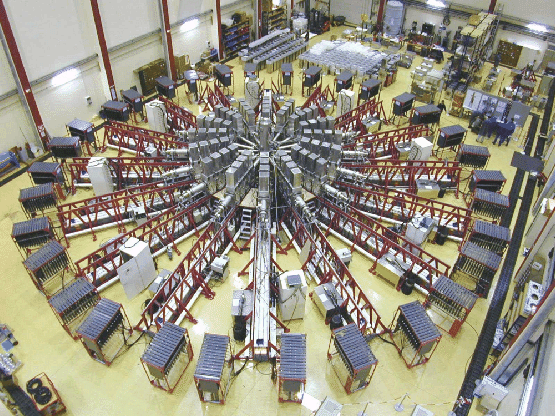
The French "Z-machine" in Gramat (Lot). 2.5 million amperes in 800 nanoseconds. Too slow.
It must have been summer 2007, I think. Léon spoke of a recent meeting in Gramat with the DGA, CNRS, and CNES to "hold council." He chose to call me. I had just mentioned my upcoming meeting with Pirey's advisor. He was interested:
- We could go together. I know many people...
In an email, I wrote:
- When facing such a possibility, one must have a request to make. I think the first step should be a survey of different countries, if possible. We should go to Sandia, where the Z-machine is located. I'd like to talk to Yonas or Deeney. In England, there's the Magpie device. The same wish regarding my colleague Malcolm Haines. And naturally, we should meet the Russians, absolute masters in this field. I'd envision a mission with Pirey. Given his title, he'd get the doors opened, and I'd loosen tongues.
Immediate reply from young Jean-François Léon, by email:
- I don't think it's a good idea for a non-specialist to make such a request initially.
I remained silent for three months. He eventually called me back:
-
I wanted to know: about the meeting with Pirey, is it still on?
-
Listen, Mr. Léon. When you called me, I listened for an hour. I asked you numerous scientific questions, enough to realize you didn't grasp the theoretical aspects. Enough to realize you were merely an engineer, not a plasma physicist capable of handling this problem. That's my opinion. When I reread your email, where you called me a "non-specialist," I think two things. Either you're right, and I have nothing to do with this. Or you're wrong, and it's you who has nothing to do here. In either case, we have nothing more to say to each other.
I met Pirey at the Ministry of Research a few months later. I don't think he understood much of what I told him. He's young, a former student of École Normale Supérieure, who wrote a thesis in differential geometry, and doesn't even know what a plasma is. Valérie Pécresse probably doesn't either. I told him what I thought:
- The French military have made it clear that nothing would happen without their approval, saying "this technology is potentially proliferative." But they're incompetent. The Gramat machine is useless. Operating dry, it's too slow, and this can't be improved. There's no one in France capable of taking on the problem of pure fusion. What's needed is a European project, with less than one-hundredth of ITER's budget, located in some "neutral" country, so it doesn't overshadow this luxury dancer. And research should focus on civilian applications, entrusting the leadership to the Russians. Keeping all this under defense secrecy would be a mistake.
Pirey took Smirnov's letter. The meeting lasted less than thirty minutes. We parted ways, and there was no follow-up. In Vilnius, September 2008, we saw that the Americans were beginning to de-inform (see my book). Since summer 2009, we know that their pure fusion bombs are just beginning to stumble. As usual, it's:
Bombs first, energy later.
Back to Geipan. Where has this strategy of cautious advancement, with a fresh egg taped under each foot, led us five years after Geipan's reaction? Nowhere. Yvan Blanc, who arrived knowing nothing about the UFO dossier, unsure what to do, haunts these high places where the spirit blows: "Ufology dinners." He constantly brings up the explanation that the lights observed were from small hot air balloons launched by pranksters.
He tries, to satisfy his hierarchy, to make us believe UFOs are lanterns.
There's this English case, these new "information leaks," this story that Churchill imposed a blackout on a reported encounter between a bomber crew and a UFO during World War II. Logically, the French press should give it some echo. At TF1, we heard a fool of a journalist say:
- We didn't know Churchill was interested in science fiction.
Will the TV networks interview Yvan Blanc, while ignoring the Strasbourg conference on October 16–17, 2010?
In passing, bad news from the organizer, Michel Padrines, still fiercely attacked by the howling mob of "ufologists" who fear this congress will ruin their little business. I didn't know one could reach such levels of baseness and cowardice. Suffering from widespread cancer (prostate, then brain and spinal metastases), Padrines, who has difficulty walking, has been hospitalized again. If he can't manage the conference in October, we will do it in his name.
Will Yves Sillard respond to media invitations to talk about Geipan and his "steering committee" (without pilot or aircraft), as he has done many times since 2005?
Nazet no longer believes in the future of the CNES service. Too many blockages and incompetence. Vélasco, a few months from retirement, was immediately dismissed for publishing a book prioritizing the hypothesis of extraterrestrial incursions. Blanc, sitting on the same ejector seat, won't take that risk.
None of this makes sense, has no future. And if Sillard wanted to do something with a bit of echo, he would resign and explain everything: that the UFO-carrots are cooked at CNES. We're the same age. Will he have the courage?
I think it's better to have no service at all than this sham service, which in fact is nothing but misinformation.
Do people at the top want to mislead? I'd say, not even.
Everyone just doesn't care, plain and simple.
Sarkozy is thinking about re-election. That's all. The youth from the suburbs, desperate, burn cars while our journalists lull us to sleep with the latest episode of the French football team's failure, or something equally trivial.
Normal, it's summer.
August 10, 2010:
I have a message to pass on.
Doré and I are struggling to find old ticonal magnets from thirty years ago, which gave 900 gauss on the surface. We don't need more for certain experiments. The advantage: they are electrically insulating and can be machined on a diamond wheel. Today's permanent magnets are at least twice as strong, but encased in metal.
There must be countless labs with these in drawers or basements. The standard size was around 4.5 cm by 2.5 cm by 1 cm thick. But larger ones existed. Still, by gluing them, we can make plates.
We're also interested in any magnets, like those from speakers. Of all shapes and sizes.
We're also building a solenoid powered by low voltage. I gave mine to Benveniste when I foolishly believed in the "Rouen project" in the 1980s. I gave him all my equipment, thinking I wouldn't need it anymore. But perhaps those who took over his work still have that large coil, which was supposed to produce 2,000 gauss in a 15 cm diameter. I also gave Jacques the power supply. Twenty amperes, if I recall correctly.
September 2, 2010:
We continue counting the nonsense, the expression of incompetence allied with the most mundane ambitions, often combined with the heaviest greed, all chained together without interruption for over three decades.
An old bomb expert wrote me yesterday: "It's fantastic what you're doing in that garage in Rochefort!" It's fantastic, but it's heartbreaking.
The only difference, as I could write to Yves Sillard, creator of Gepan in 1977 and responsible for this three-decade-long mess due to his mere laxity, is that thirty years ago, leaning on two crutches, I was conducting MHD research alone in a garret in Aix-en-Provence with equipment scavenged from lab trash bins. These researches (or rather discoveries) allowed me to present communications at international MHD conferences (1983, VIIIth International MHD Conference in Moscow), where I had to travel at my own expense, surviving all day on "Viennoiseries" I had packed in my bag for breakfast (I didn't have enough money for conference meal tickets, and back then there were no snack bars on site. So when colleagues asked, "Will you join us for lunch?", I'd excuse myself with a phone call and go eat alone, hiding behind a tree in the park).
But in Tsukuba (Japan) in 1987 and Beijing in 1991, where my communications were also accepted, I couldn't go. With what money? The great pride of CNRS in denying me funding, facilities, staff, and travel expenses for thirty years. The DGA even tried to evict me from the Marseille Observatory where I lived, like a bunker dweller, repelling their assaults with "paper and pencil," while they had already destroyed Bounias (who died of cancer in ) and Benveniste (who died on an operating table in &&&). For ten years, after my 1976 workplace accident, I was protected, "covered," by two intelligent and humane directors: Yvon Georgelin and Georges Comte.
The next one, James Lequeux, agreed to play along when the army, transmitting its wishes to the CNRS General Directorate, demanded I be handed over "hands and feet bound." The next one, James Lequeux, agreed to play along when the army, transmitting its wishes to the CNRS General Directorate, demanded I be handed over "hands and feet bound."
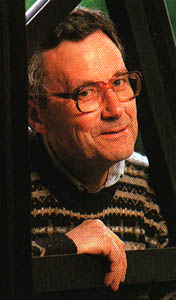
The astrophysicist James Lequeux, who failed to exclude me from the Marseille Observatory

The operation narrowly failed, thanks to the publication of two cosmology papers in the journal Modern Physics Letters A, a project that the imprudent Lequeux hadn't taken seriously ("How could someone possibly reinvent himself in a year in General Relativity and immediately become productive in such a notoriously difficult field? It must be bluffing").
Read the ensuing confrontation with Lequeux, who now served as editor of Astronomy and Astrophysics, which ended, to the astonishment of my colleagues, with a... letter of apology.
Today, things have changed. Thanks to reader support, we can now buy new equipment (the low-density test bench alone cost 10,000 euros), and it is again they who will pay the 5,000 euros for our participation in the Korea conference (even with the cheapest hotel, it's not just travel—it's high registration fees for this large conference with over a thousand participants and nearly 300 presentations, including ours, oral, not in poster form, placed in the Z-machine session, since people know I'll be speaking on this topic too.
UFO-science: three men:
Mathieu Ader, 25, Toulouse,
Xavier Lafont, 36, Carpentras, and
Jean-Christophe Doré, 40, Rochefort. If it weren't for the latter, a remarkable technician whom I'm taking to Korea (he deserves it!), nothing would happen. The association would have been dissolved and the remaining funds returned to donors, or, if they refused, sent according to our statutes to some charitable organization, like the Restos du Cœur.
In 2009, I attended the Bremen conference in a wheelchair (gifted by a reader!). This year, let's hope it goes well, despite the 11-hour journey, exhausting. I have a folding hunting stool I can carry on my shoulder, allowing me to stand for no more than a minute. Hoping I won't have it confiscated at the airport as a "potential weapon for aerial terrorism."
On return, Doré will tackle the following experiments, focusing on Vélikhov's instability, which will earn us participation in other international conferences. Ader, who has relocated to a house with a garage (a second garage!) will begin constructing a hydraulic test bench. We have magnets capable of 5,000 gauss. We will operate a "hypervelocity hydrodyne" in a circular tank. The military would call it an "MHD torpedo."
Doré's research shows we are not the only ones conducting studies in low-density supersonic wind tunnels. We will discuss all this on the UFO-science website. The installation we will set up in Jean-Christophe's garage will be similar, except that instead of operating in continuous mode with a high-flow vacuum pump downstream, we will operate in pulses, using a large vacuum capacity of several cubic meters. We will connect this large chamber to the divergent section of a supersonic and even hypersonic nozzle via a fast-acting valve. We will thus achieve one second of operation, which will be more than sufficient for measurements and taking photographs.
We must remember one thing: at the altitudes where vehicles like the hypersonic Aurora operate, atmospheric pressure is extremely low. Beyond that, the air's natural electrical conductivity is high. Aside from testing disc-shaped MHD aerodynamic vehicles (supposedly equipped with their own electrical power source), we will study a demonstrator of a hypersonic MHD vehicle featuring an "MHD-controlled" air intake and a "bypass" system. To go the extra mile, we could even, during this brief one-second operational phase, burn methane in a combustion chamber and measure thrust and lift (of this "wave rider") using simple piezoelectric probes.
This garage in Rochefort will soon become a site that should be immediately classified under defense secrecy. The French military will look ridiculous, and you can imagine that in any scenario, collaboration with these fools—whose sole preoccupation over 35 years has been to confuse Jean-Pierre Petit's ideas, without Jean-Pierre Petit—will be out of the question.
As I stated in my 2003 book, "UFOs and American Secret Weapons," which is now only available at exorbitant prices on the secondhand market, the American hypersonic Aurora, flying at Mach 12, has existed and been operational since 1991, and I will demonstrate this experimentally (right here in this garage!). The Americans amuse the public with old archival footage over 30 years old (X-43, X-51, etc., hanging under a B-52's wing).
This reminds me of a visit my friend Elio Flesia and I made, at the beginning of the 1980s, to a submarine testing center in Toulon (today, I would never set foot in such a place again). Flesia dragged me there. A military engineer was interested in our 1976 hydraulic experiment on turbulent wake annihilation behind a cylinder, which we had successfully achieved with Viton. He wanted to know if the same could be done with a deployed, noisy submarine periscope. Certainly, it was possible.
Interested, the officer asked:
-
In submarines, there's another source of noise: the propellers. Do you have a solution?
-
No problem: just remove them and replace them with electrodes.
The man slumped in his chair.
- The thing is... we already have projects running for ten to twenty years. It's difficult to change things like that...
And we left empty-handed, both of us as big as ever. At that time, Alan Holt, in charge of the MHD torpedo project at Carlyle Industries, had already achieved 2,000 km/h underwater in the first tests of American MHD torpedoes.
After the conference, I will write a new book, sold at cost and profit to UFO-science to "refill the tanks."
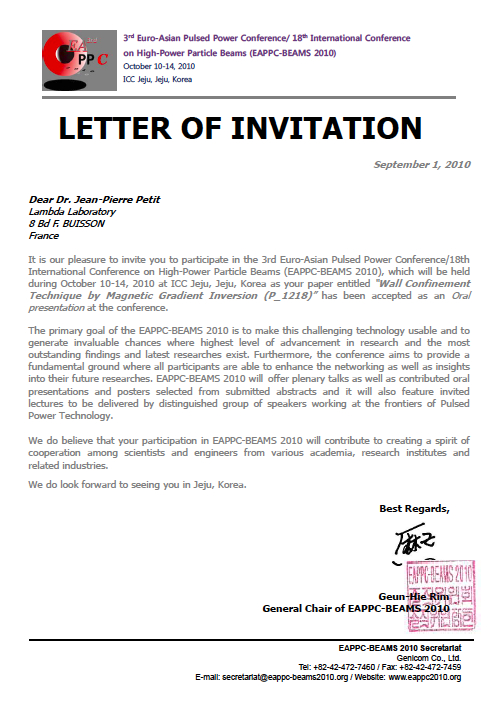
Regarding the Strasbourg conference (Astronomy - Mystery - UFOs), October 16 and 17, 2010, for the UFO-science presentation on Saturday, October 16, from 6 p.m. to midnight, the hall is already full: 200 people. Padrines will have to try, between radiotherapy and chemotherapy sessions, to find a larger venue.
New Features
Guide (Index)
Home Page
.