An analytic representation of the Boy surface
J.P. Petit and J. Souriau
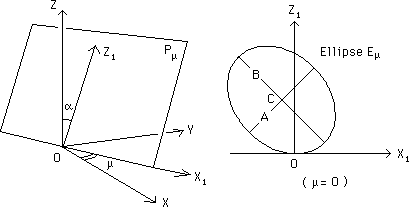
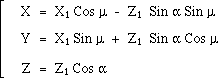
Below, the reproduction of a note in the Comptes Rendus of the Paris Academy of Sciences, signed J.P. Petit and J. Souriau, from 1981.

This work has a story. Until my album The Topologicon was published by Belin, in the series of Anselme Lanturlu's Adventures, in 1985, the representations of the Boy surface in specialized books were rare. One could find here and there photographs of models made either in plaster or in chicken wire. Charles Pugh, from the mathematics department of the University of Berkeley, is the undisputed world expert on chicken wire. It was with this material that he won an important financial prize, by making models describing the sphere eversion according to Bernard Morin, models that were later digitized by Nelson Max to be transformed into a film that circulates in all mathematics departments around the world.

But I find that chicken wire remains a rather lowly material, especially for such high-end scientific subjects. Having met a sculptor named Max Sauze, I learned the technique of copper wire, which is both flexible and rigid, which Max soldered skillfully, managing not to heat it too much, so that it would not create unwanted stresses in the material.

My friend Jacques Boulier, known as Vasselin, was then a professor at the Beaux Arts in Aix-en-Provence. One year he asked me to replace one of his teachers who had gone abroad, which I did, providing a part-time service with Sauze. While I was inventing the objects, Max was soldering them. Our students, intrigued, tried to imitate us as best they could. That year, this wing of the Aix-en-Provence Beaux Arts school had become a sort of mass production factory for mathematical surfaces.

If you want to try, it's not complicated. You need a roll of this copper wire, say one and a half millimeters in diameter, at most two, and a pair of cutting pliers. With that, you can represent the two families of curves that compose any surface.

The problem is to properly shape these objects. For this, it is useful to be able to slide the junction points, where the "meridians" and the "parallels" intersect. A good solution is simply to tie the two metal wires with sewing thread. It is tight enough to give the object stability, but loose enough to allow deformations and adjustments.
It is only when you think the object is mathematically conforming to your wishes that you can entrust it to someone who handles silver solder with dexterity and who will know how to solder without heating the rods, something Max did with consummate skill.
One day I brought a prototype of a Boy surface, having discovered how the meridians and parallels should be arranged. Apparently, one could manage to make the meridians look almost exactly like a family of ellipses.
Max carefully copied the object. I then went to Souriau. His son (who would never have had the patience to finish his physics degree) was playing with his father's Apple II. I said to him:
-
Jérôme, would you like to have a pure mathematics publication under your name?
-
Well, why not? Who do I have to kill for that?
-
No one. You see this object. Take a protractor, measure these ellipses and try to build a semi-empirical representation of this surface.
-
We can always try, give me...
Two days later, it was done. The article was quickly accepted by the Comptes Rendus of the Paris Academy of Sciences and published under our two names: J.P. Petit and J. Souriau.
But since the father is named Jean-Marie and the son Jérôme, all mathematicians are convinced that it is a work that we did together, Souriau the father and me.
The drawing of the surface on a computer, using a small BASIC program of a few lines, greatly surprised many mathematicians, who had expected something more complicated. The affair had an unpleasant fallout. The mathematician Bernard Morin had a doctoral student, Apéry, son of Apéry the elder, author of the ineffable theorem according to which the sum of the cubes of integers is an irrational number. Among other things...
I was unaware of it. Our advancement greatly worried Morin, especially since I naively told him at the time that this method should allow describing the four-leaf surface that had made him famous, the one that had been built with his chicken wire by Pugh, then digitized by Max, etc.
Morin frowned:
- No, that's impossible!
We'll see about that later. I remain convinced of the opposite. But this sentence was the counterpart of the famous remark that Archimedes made to the Roman soldier who came to disturb him in his thoughts - Noli tangere circulos meos!
In French "do not touch my circles!"
There, it was rather "do not touch my ellipses!"
Later, Apéry exploited my discovery, according to which one could endow the Boy surface with an elliptic meridian system, to build the first implicit equation of the object:
f (x, y, z) = 0
Morin, angry at seeing me appear as a troublemaker in his own mathematical work, forced Apéry to specify, in his thesis, that it was Sauze who had come up with the idea of the ellipses. Max did not deny it, but it is incorrect. The proof is in my cellar: the model I brought to Max to have it properly made.
Finally, all this is quite ridiculous, after all. This anecdote is there to show that mathematicians are no brighter than physicists.
The polytechnician Colonna, a pioneer in computer graphics, used our equations without mentioning their origin. But there is an amusing detail: if you happen to see on a screen images of the Boy surface. If it's "ours," it will inevitably have three slight "folds" near its pole. A defect in the equations' adjustment. Jérôme, the son of Souriau, had done it hastily and a final small touch of the iron near the pole would not have been amiss. This is still possible, by the way, for anyone who wants to.
This saga of the Boy surface is not over. To be complete, let's mention a character: Carlo Bonomi, an Italian billionaire. I met him during an expedition to the Bermuda Triangle (but this is another story entirely). We were then speeding along on his yacht, a luxury vessel that took your breath away, in search of a sunken pyramid, mentioned by a certain Charles Berlitz in one of his books. We did not find the pyramid, and we almost got eaten by the numerous sharks that haunted those places. If you have an atlas, the place...