How to transform a cross-cap into a Boy surface (right or left, as desired), passing through the Roman surface of Steiner.
September 27 - October 25, 2003
page 2
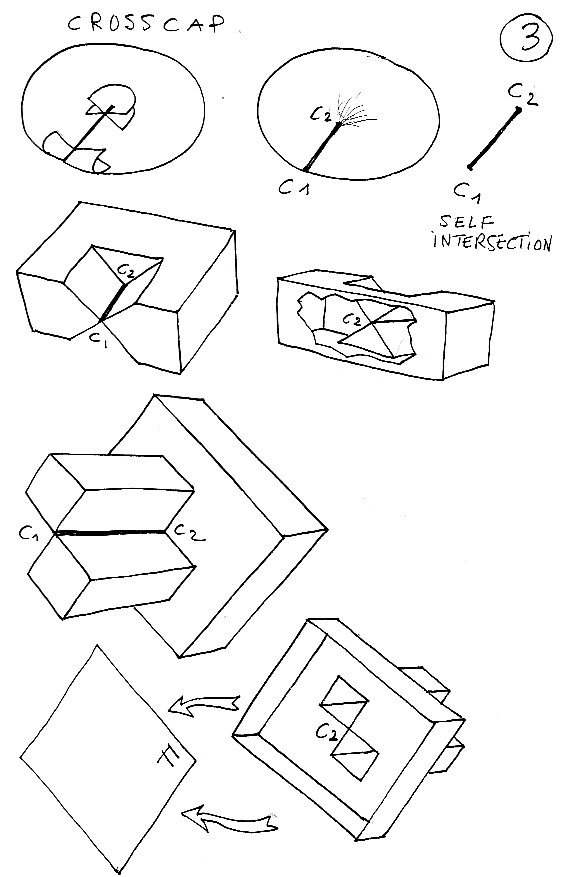
Here is a cross-cap (as you may have discovered in the virtual reality images). It has two cusp points bordering a line of self-intersection. You can make it by pinching a balloon with a curling iron. But you can also construct polyhedral representations of it. The one at the bottom will particularly interest us.
In this plate 4 lies the most difficult moment to grasp. It seems nearly impossible that an ordinary person would understand these figures just by looking at the drawings. Build these models. Clearly, we pull the cusp point
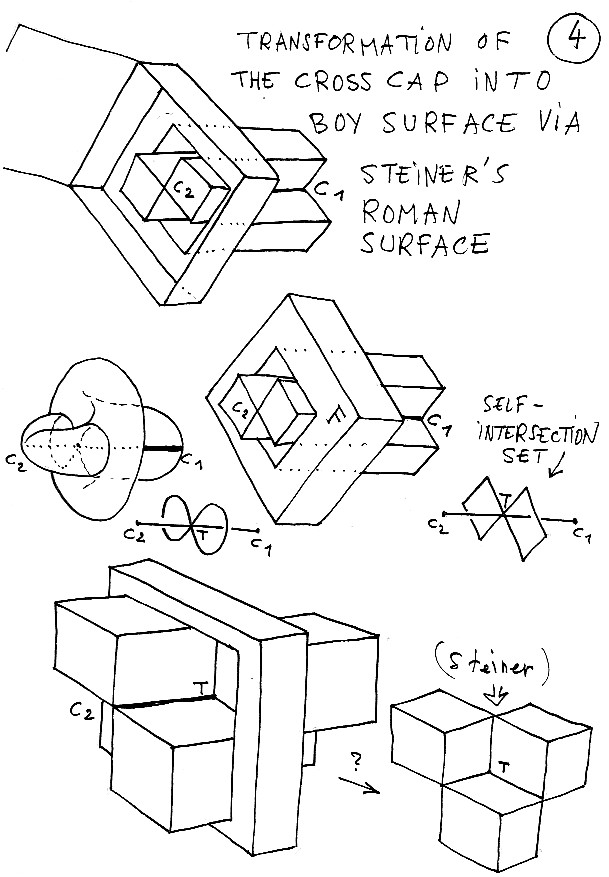
C 2
toward the "inside of the surface" (which, incidentally, makes no sense since, as you will have noticed immediately, the cross-cap is one-sided. By persisting, the surface self-intersects and the entire self-intersection completes, in a "rounded" form, into a figure-eight curve. A triple point
Tis created in the process.
The surface becomes more understandable in its polyhedral form, and at the bottom we have enlarged certain elements to show what leads us to transform this object into the Roman surface of Steiner (see virtual reality), whose simplest polyhedral form consists of assembling four cubes (here we see only three).
Plate 5: The polyhedron on the left, the rounded form on the right. The arrow takes a passage that we will "pinch." At the bottom, the beginning of the pinch.
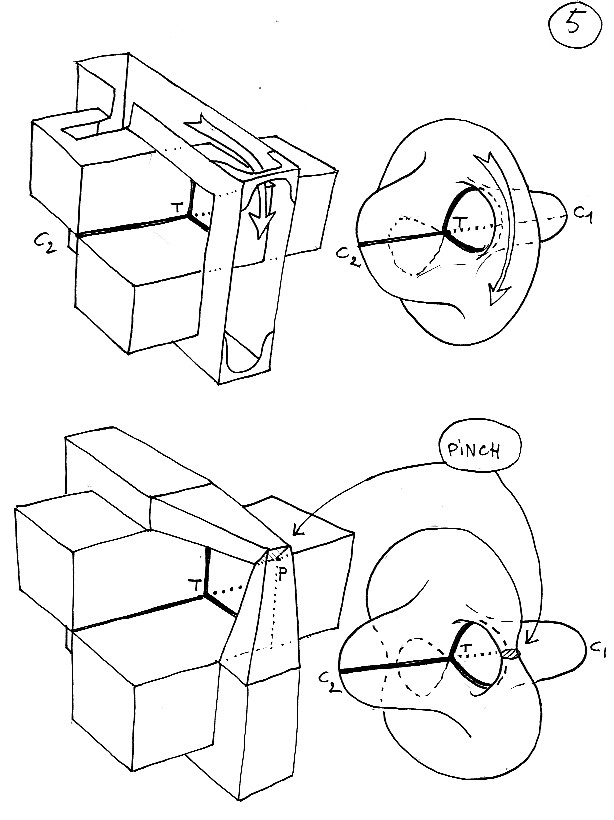
Plate 6: The pinch is carried out by creating a singular point
B. Actually, since we pinch from both sides to save time, two singular points
S1 and
S1 are formed, followed by two pairs of cusp points. At this point, without cardboard, scissors, and adhesive tape, you're in trouble.
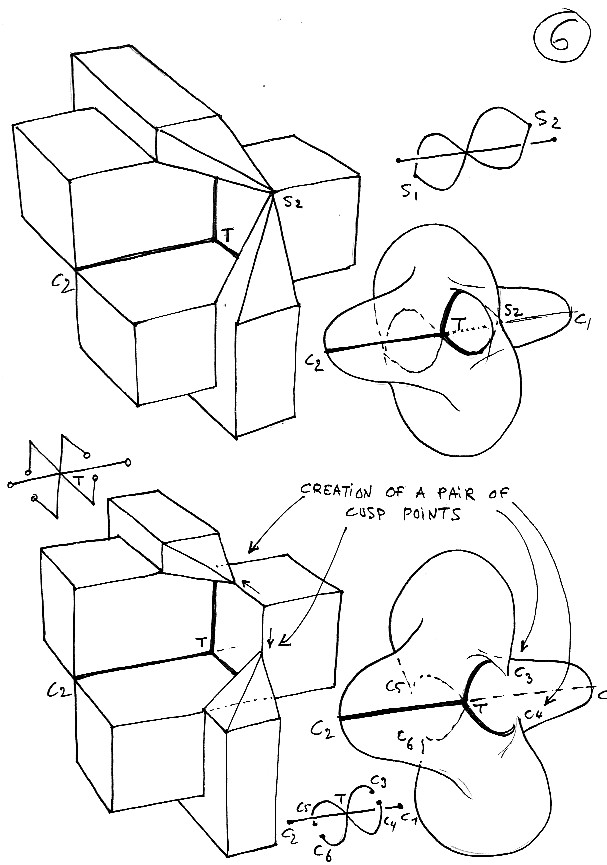
Plate 7: We have simply moved the various cusp points. If point
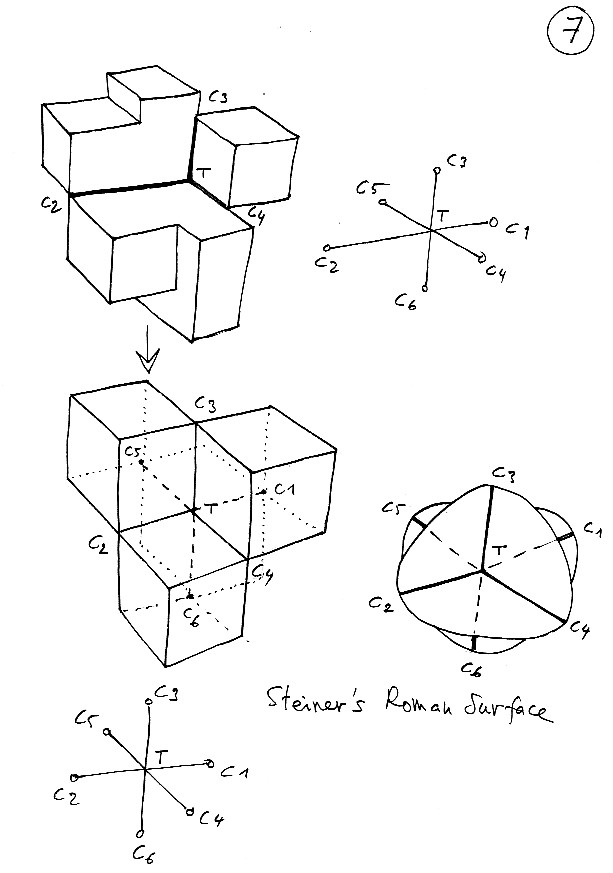
C2 is "obvious," you'll have a bit more difficulty identifying points
C3 and
C 4
as cusp points. Yet they are present at the end of a self-intersection line. Above point
C3 is simply what I've called a "posicoin," a point of concentration of positive curvature (a point of concentration of negative curvature is a "negacoin"). By slightly deforming this object, we arrive at a polyhedral form of the Roman surface of Steiner (a fourth-degree surface invented by Steiner in Rome).
See its presentation in virtual reality.
Thus, the trick is done. There are different types of surfaces, depending on the rules we impose. Surfaces that do not intersect themselves are called embeddings (of the sphere, the torus in
R3). When they intersect themselves but the tangent plane varies continuously, they are called immersions. Example: the Klein bottle in its classical representation. There is no embedding representation of the Klein bottle in
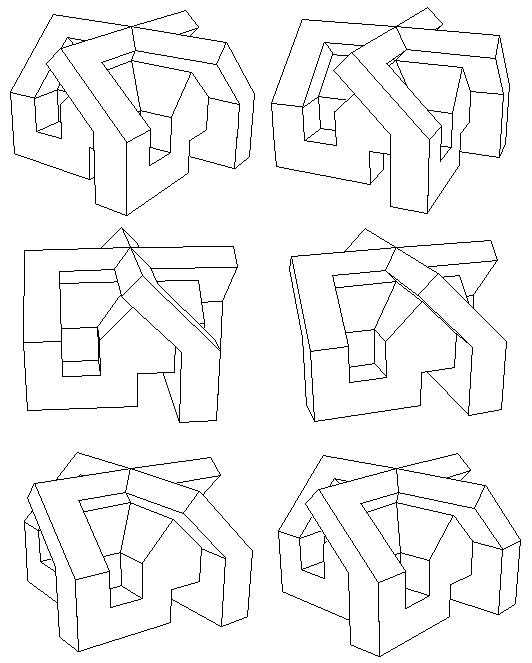
R3. It necessarily intersects itself. Immersions have self-intersection sets that are free of cusp points. These curves are continuous but may cross each other, forming double or triple points. Note: the sphere can be presented as an immersion by simply making it intersect itself. Indeed, this is how one manages to turn it inside out (A. Phillips, 1967, with the central step being the two-sheeted covering of a Boy surface; B. Morin and J.P. Petit, 1979, with the central model being Morin's four-ear model, whose polyhedral representation I invented about ten years ago, shown below.
Plan for assembling this object using a cutting-out method.
If we extend the rules of the game by assuming these objects possess cusp points, we obtain submersions (the cross-cap, the Roman surface of Steiner). I don't know if this is the exact term, but since I couldn't find any mathematician able to enlighten me, I found it amusing to invent one provisionally, until an expert geometer appears. Thus, the cross-cap and the Roman surface of Steiner would be submersions of the "projective plane."
To tell you the truth, after my difficulties in MHD over twenty-five years, I had begun these studies because they seemed as distant as possible from any military application. But, as my old friend Mihn pointed out, the term "submersion" might be misleading and suggest to the French Navy that I was attempting to conceal some breakthrough in underwater propulsion through these researches.
The rule of "creation-destruction" of pairs of cusp points allows us to pass from one submersion of an object to another, and that is exactly what we've just done by showing that the cross-cap and the Roman surface of Steiner are two submersions of the same object called the projective plane.
Don't try to imagine what a "projective plane" looks like. This object can only be grasped through its various representations. As for the term "projective plane," it's just one among a thousand invented by mathematicians to mislead those who wish to enter their closed circle. Larousse will be of no help to you in mathematics.
We now move on to the Boy surface, which is an immersion of the projective plane.
Previous page
Next page
Return to table of contents "Transforming a Cross-Cap into a Boy"