My conference PowerPoint from the international conference in Korea
(oral presentation on October 13, 2010)
Access the Korea presentation PowerPoint
After Korea, we will go directly to Strasbourg to participate in the conference "Astronomy-Space-UFO Case Files."
HESSDALEN, last minute:
We have contacted the Hessdalen team (Dr. Ervind Strand, Bjorn Hauge). It would have been appropriate to invite these people earlier. We did so, albeit belatedly. They are obviously interested in our UFO tracking and spectral capture instrument, UFOcatch. Their team has already carried out an analysis on a spectrum recorded there, but unfortunately their equipment captured not only the light from the phenomenon itself, but also stray light from various sources (street lamps), which significantly degrades the signal-to-noise ratio.
Just received (October 7) a message from Bjorn Hauge, author of the article. If Strand cannot come, he will be there.
UFOcatch is designed, like a frog, to focus on any mobile or time-variable intensity source (for example, one suddenly appearing in the landscape). A 360° surveillance is ensured by a fish-eye lens. When a source appears, a computer automatically calculates its coordinates—site, azimuth, and elevation—faster than a human observer could, using optical systems mounted on a motorized lyre. Then, designed and built by Jean-Christophe Doré, UFOcatch automatically zooms in on the phenomenon, eliminating background noise from surrounding lights, records the source's spectrum, and analyzes it in real time.
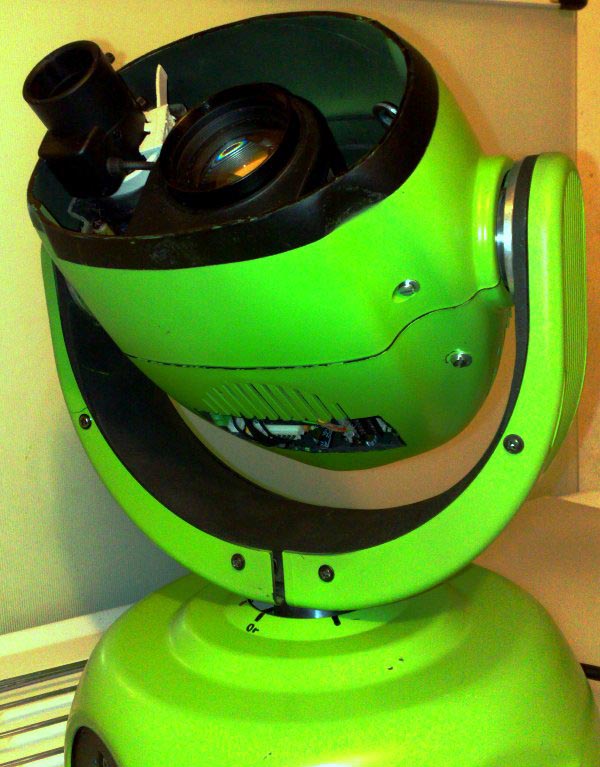
The motorized lyre of UFOcatch, built with help from French citizens
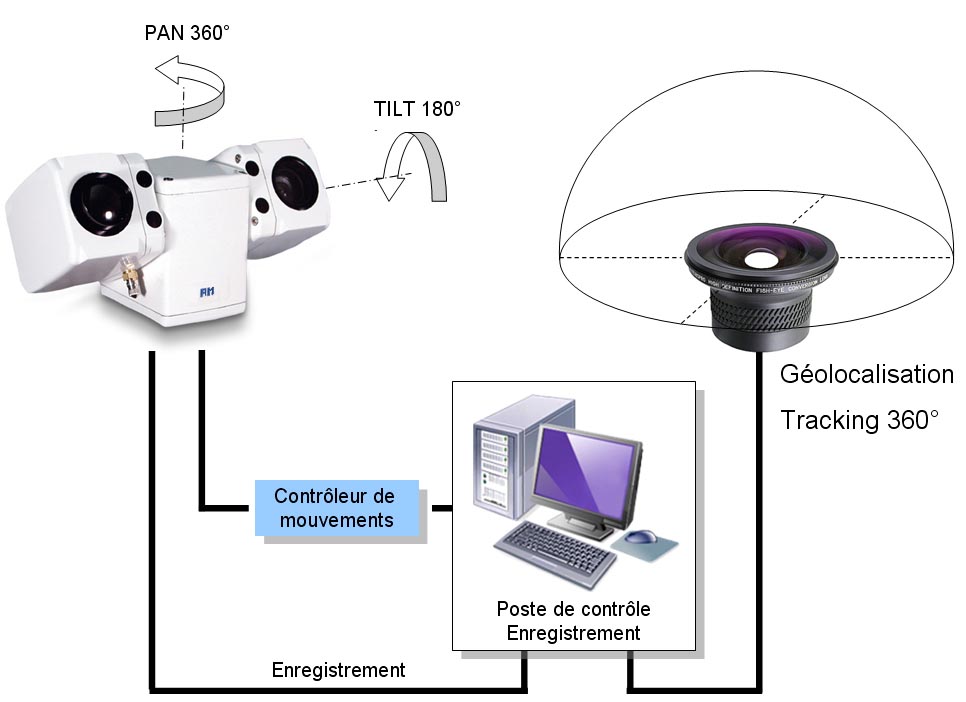
UFOcatch: schematic diagram
In an article, a researcher from Ervind Strand’s team claims to have identified the presence of
scandium
in a spectrum. We know that scandium comes from "Scandinavia," this rare earth element having been discovered precisely in minerals extracted from Norway.
After the conference, we will consider how to implement UFOcatch in Hessdalen—particularly well-suited for this type of research—in an attempt to clarify this matter.
UFOcatch will be presented in Strasbourg.
I observe that this conference receives no media support, which is not surprising. Mr. Padrines invited Mr. Yvan Blanc, head of GEIPAN, three times, asking him to participate, but received no response.
As president of the UFO-science association, a participant in the conference and although not its organizer, I took it upon myself to follow up with Mr. Yvan Blanc via
this letter,
which remains unanswered to date.
If this situation persists without any media announcement, GEIPAN will be in a poor position.
What will happen? Will the major French media (mainly Yves Calvi’s show "C dans l'air") come to the rescue of this sham institution, completely sterile for 33 years? Will we hear about a "leap forward" with the creation of a French-style "Condon Commission," composed of "scientists chosen among the most eminent"? Or will a report mention a Franco-Norwegian collaboration in Hessdalen, which has simply resulted in the arrival of personnel from the CEA, led by retired military engineer Christian Nazet, and the installation of acoustic sensors—GEIPAN being in no way involved in this matter?
In the PowerPoint accessible via this page, you will see our research program described. How to build a low-density hypersonic wind tunnel in a... garage? By digging a pit and housing a 10-cubic-meter vacuum chamber, with a basic vacuum created by a simple vane pump. Then, this vessel will be connected to the divergent of a nozzle via a fast-acting solenoid valve, producing a burst lasting a few seconds. Funding: sales of a book I will write after the Strasbourg conference, printed and sold by the association for its benefit. It’s high time: the Korea mission (5,000 euros for Doré and me, including the cheapest hotel, but expensive travel and 1,300 euros in registration fees each). And our latest equipment expenses will bring the association’s account to zero. To build this wind tunnel, we’ll need to raise... 30,000 euros.
Everything we do—our research, our conference missions—is directly funded by... French citizens. We thank them and believe we have not betrayed their trust.
In France, there is a CNRS laboratory called ICARE, with multiple facets, located in Orléans. You can view these facilities on the website:
http://www.cnrs-orleans.fr/icare/Fr/installations.htm
It’s Goliath compared to David. Here is the hypersonic wind tunnel at this center:
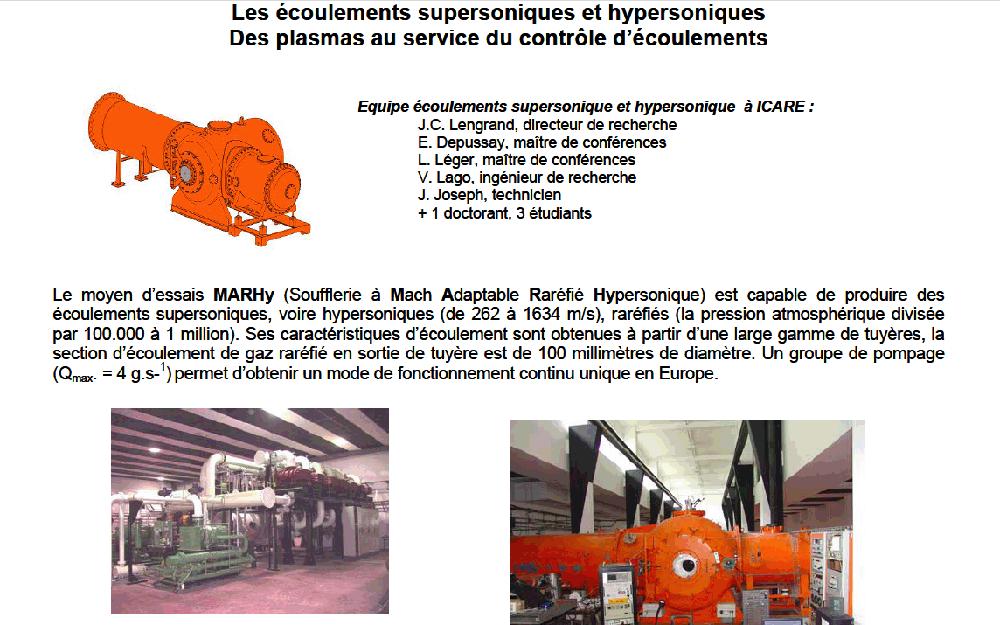
The CNRS Orléans laboratory's hypersonic wind tunnel
It operates
continuously
(above, its pumping group). If you look at
the associated PDF,
the research program appears quite embryonic for now. Elsewhere on the site, you’ll discover the French vision of the future hypersonic air-breathing vehicle:
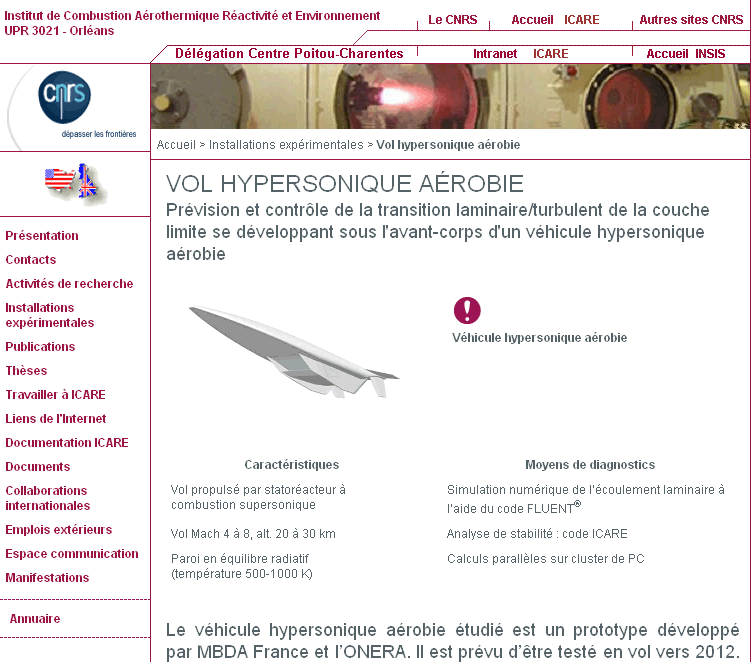
"French Aurora"
Once again, an approach that is extremely... embryonic. All of this is funded directly or indirectly by the military, who initiated this wide range of research after the publication of my book "UFOs and American Secret Weapons," which revealed to them the scale of research being conducted in the U.S. (and Russia) in the fields of MHD and "cold plasma physics" (i.e., non-thermonuclear).
In our garage, we will test a scale model of a hypersonic vehicle whose air intake will be controlled by MHD (a concept journalist Bernard Thouanel had, at the time of my book "UFOs and American Secret Weapons," dismissed as "technological delirium"). The book, published by Albin Michel, is out of print and can only be found on the secondhand market (fun fact: its value is rising!). It’s even possible we’ll burn a gaseous hydrocarbon. In just seconds, one can achieve remarkable things. In the late 1960s, I had already surpassed researchers worldwide (Warsaw conference, 1967), successfully operating the first non-equilibrium, bitemperature MHD generator in experiments lasting 50 microseconds—fully convincing demonstrations—using the principle:
It is not necessary to prolong an experiment beyond what is required
While a gas at 6,000°C streamed through, my MHD nozzle was made of Plexiglas and my electrodes were red copper.
We will now conduct MHD experiments in a hypersonic wind tunnel operating for a relatively brief period (a few seconds), but more than sufficient to reveal the phenomena we seek.
All of this is completely surreal and fantastically absurd. It’s especially deeply sad. Indeed, if we look back, what has happened in France in the field of MHD since the early 1970s, when this field had been entirely abandoned in France by the end of the 1960s?
In 1975–1976, Viton and I conducted the first MHD experiments in a basement at the Marseille Space Astronomy Laboratory. The consequence was the creation, by military engineer General Yves Sillard, of the GEPAN (Group for the Study of Unidentified Aerospace Phenomena), whose direction was entrusted to engineer Claude Poher, whose scientific competence was questionable (see his ridiculous "universes" theory).
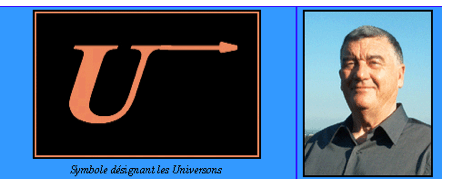
Claude Poher, "father of the universes"
In 1977–1978, after Poher left CNES to go sailing, and following contact with his successor, polytechnician Alain Esterle, a research project was drafted.
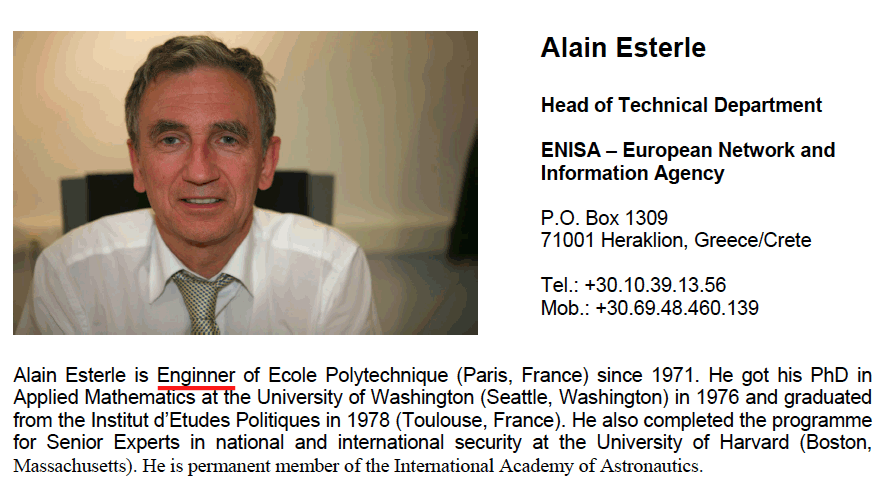
Alain Esterle today. Notice the spelling error in his professional profile: "Enginner" instead of "Engineer."
Esterle was assisted by engineer Bernard Zappoli (still currently at CNES), entirely incompetent in plasma physics.
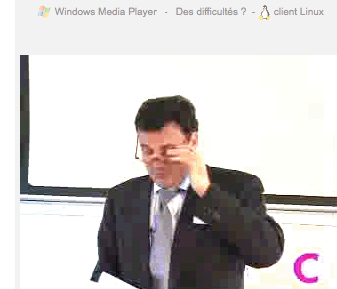
Engineer Bernard Zappoli, thirty years later, still at CNES, trying to sell microgravity studies to give some relevance to the International Space Station (ISS), where astronauts now only focus on their health.
He transmitted the following message:
- The Army does not wish for you to be involved in these researches, which will be conducted in Toulouse without you
(precisely at the CERT of Toulouse: Centre d'Etudes et de Recherches Techniques, under its direction).
Understood. Zappoli set up an expensive MHD experiment inspired by a report I had submitted to Esterle: "Perspectives in Magneto-Hydrodynamics." It was an unmistakable act of scientific plunder, gross and blatant. He accumulated errors and failed spectacularly. Informed, polytechnician René Pellat, dispatched to the site by CNES director Hubert Curien, recognized the mismanagement and caused the disappearance of GEPAN. Esterle and Zappoli were reassigned to other departments. Their successor was a mere technician, collaborator of Esterle: Jean-Jacques Vélasco, who became head of the "SEPRA" (Service d'Expertise des Phénomènes Aérospatiaux). Informed, Yves Sillard, who would become CNES president from 1976 to 1982,
did nothing.
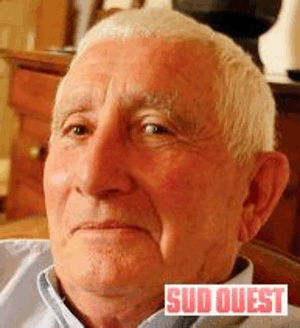
General engineer Yves Sillard:
As the highest-ranking figure in this entire story, he bears primary responsibility for this entire mismanagement
A new attempt at the beginning of the 1980s, this time at CNRS, with its general director Pierre Papon, assisted by his deputy Michel Combarnous, having decided to proceed after receiving excellent feedback about me from Russia, the homeland of MHD par excellence (leader: Andrei Sakharov). A contract proposal was drafted; the hosting laboratory was now CORIA in Rouen. Claude Thénard, associate professor (who had nothing to do with this), relayed the same message as before:
- The Army does not want you involved in this research.
I gave up, abandoned the effort, and turned to cosmology
(see the continuation of this path, twenty-two years later).
Without my scientific and technical support, poor Thénard quickly failed. His nozzles exploded one after another, and soon the project was abandoned.
Years passed. In 2007, I founded UFO-science. After difficult beginnings, our tiny team has participated in:
- The international MHD conference in Vilnius, Lithuania, September 2008
- The international conference in Bremen on hypersonic aerodynamics, October 2009 (where I will attend in a wheelchair)
- And this year’s international MHD conference in Korea, with original and clever experimental results obtained with minimal resources (see the PowerPoint)
Are there comparable MHD research projects in France?
- No. This is a field where we are the only ones present—starting from this... garage!
Compared to the research projects envisioned by French teams, including Orléans laboratory, our lead in all aspects—theoretical understanding of phenomena and experimental work—is considerable. But what will be the consequences? To find the answer, simply follow the logic developed over the past 35 years.
1977: Given the results Viton and I achieved, the Army initiated the creation of GEPAN within CNES. It was Yves Sillard, military engineer and then president, who signed the founding act of this service. Its scientific council had seven members. I was absent.
1980: Based on a report I submitted to CNES, the Army—once again through CNES—funded research at the CERT in Toulouse. From the outset, I was excluded from any responsibility or oversight of this research.
Let’s not forget that Sillard, behind all these actions, is a military engineer holding the rank of general.
Mid-2000s: Based on information I brought back from the Brighton conference (my book "UFOs and American Secret Weapons"), which showed that far from abandoning MHD, Americans had continued full speed ahead, developing hypervelocity torpedoes (which we will reconstruct in our towing tank at UFO-science, again in a... garage, another one) and hypersonic vehicles (Aurora), the Army decided to create a "cold plasmas" group and funded... forty laboratories.
The Army and the forty laboratories...
Concrete results: nothing.
The only notable experimental result in MHD is the one we will present in Korea (the oral presentation was accepted immediately, just days after obtaining the experimental result on the test bench).
What will happen if we achieve the expected results in our pulsed hypersonic wind tunnel?
The Army will pour money into laboratories supposedly equipped with adequate testing facilities. It’s not impossible that, failing to truly understand our work, these people will fail. See above: this wouldn’t be the first time.
We must continue, in this and soon these two garages, thanks to French citizens’ support, without being deterred by such unpleasant details. Our goals are different. All our efforts focus on demonstrating that UFOs can be flying machines, and that eyewitness observations are
not absurd,
even if the actual technologies used in these machines turn out to be entirely different from MHD. It doesn’t matter. If the French support us, we continue. In MHD, everything depends on the technical expertise of a single individual: Jean-Christophe Doré.
Mathieu Ader is preparing a towing tank for hydraulic MHD.
Military forces, in France and elsewhere, have other objectives. If they fully understand the phenomenon, their sole aim is to extract fragments of science and technology to turn into... weapons. It’s a logic we don’t grasp, but it’s
theirs.
They aren’t wired to think otherwise. And remember: it’s no coincidence that the creator of GEPAN (who now strives to keep his poor successor, GEIPAN, barely alive) is a... military engineer: Yves Sillard.
News
Guide
Home Page