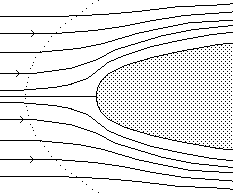
The dashed line is intended to represent the region where the fluid begins to move away, creating space for the object.
In supersonic flow, these sound waves can no longer "inform" the fluid before the object arrives. The gas is thus "taken by surprise," and its response is to form shock waves. The idea was therefore to find a way to act remotely, upstream of the object, to manipulate the gas by encouraging it to yield space.
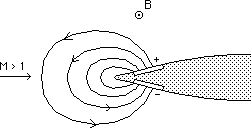
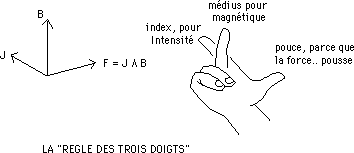
A first solution involves the penetration of an airfoil profile into air at supersonic speed. It is known that the impact of this object on the air causes abrupt deceleration. It therefore seemed logical to facilitate the gas flow along the profile near the leading edge, while initiating gas deceleration upstream. This is possible by applying a magnetic field perpendicular to the plane of the figure, with two wall-mounted electrodes positioned as indicated. The lines of electric current flowing through the gas are shown. This results in a Laplace force (Lorentz force, for Anglo-Saxons), which follows the "three-finger rule."
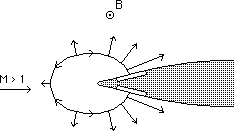
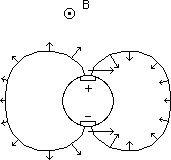
Below is the general pattern of the electromagnetic force field, perpendicular to the lines of electric current.

Thus, three advantages are achieved:
- Upstream of the vehicle, fluid deceleration begins before the object arrives.
- A fluid separation motion is initiated.
- Flow along the wall is facilitated.
The electromagnetic force per unit volume is J × B, where B is the magnetic field intensity, expressed in teslas (one tesla equals ten thousand gauss), and J is the electric current density, in amperes per square meter. The force is then expressed in newtons per cubic meter.
An electric current density of just one ampere per square centimeter (ten thousand amperes per square meter), combined with a 10-tesla magnetic field, would produce a force of ten tons per cubic meter of gas—sufficient to impose the desired flow effects.
The force is strongest near the electrodes, where the current concentrates and current density is highest.
The problem, of course, is passing such a current through a medium that is initially an excellent insulator at normal temperature: air. We will address this issue later.
In the first phase, in 1976, we opted for simulations based on hydraulic experiments. The fluid was acidified water (to increase its electrical conductivity). The next step was to size the experiment. We had a magnetic field installation capable of producing one tesla within a few cubic centimeters. The flow velocity was 8 cm per second. Given the water density of 1000 kg/m³, it was possible to calculate the minimum value of J such that the interaction parameter:
where L is a characteristic dimension of the model.
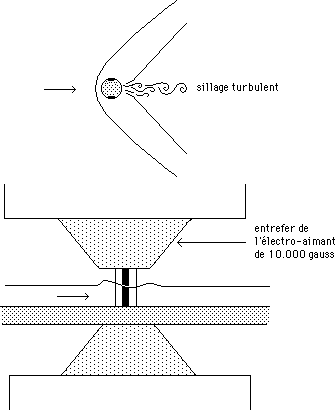
The elimination of the bow wave was achieved on the first attempt (1976). We tested on lens-shaped models, but initial tests were conducted on a cylindrical model, which produced a bow wave simulating a detached shock wave forming at a distance from a cylindrical obstacle:
With a magnetic field perpendicular to the plane of the figure, the bow wave was eliminated using two electrodes arranged as shown in the figure. The positioning of the pole pieces of the electromagnet is also illustrated. Model diameter: 7 mm. Electrode width embedded in the wall: 2 mm.
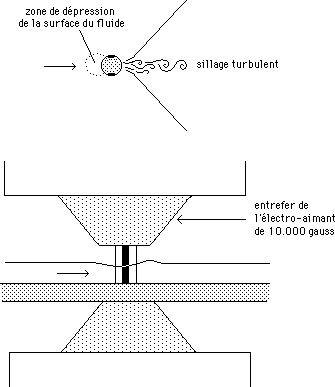
The figure above shows the waves in the absence of electromagnetic forces, and the following figure shows the result after elimination of the front wave.
The Laplace forces, resulting from the current passing through the acidified water, combined with the transverse magnetic field, correspond to the figure below:
These forces are particularly intense near the electrodes, where the current concentrates (maximum current density J). Upstream, they produce fluid deceleration. However, this force field is not sufficient to fully eliminate the wave system. In experiments using a cylindrical obstacle equipped with only one pair of electrodes, the waves were simply concentrated downstream of the model. Nevertheless, as shown in the figure, this was sufficient to create a depression at the "stagnation point," demonstrating that such a system could also be used for MHD propulsion.
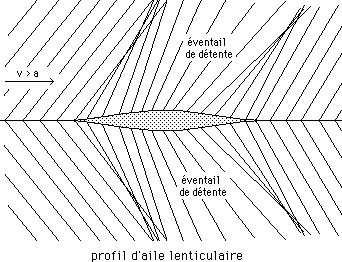
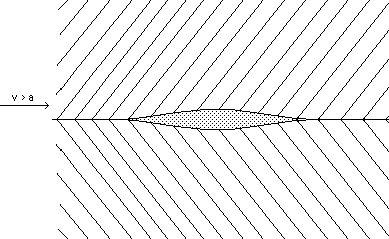
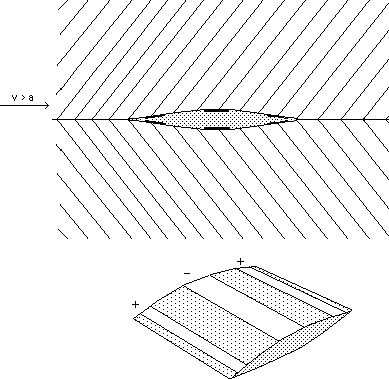
Complete suppression of the entire wave system could be achieved, as verified through these hydraulic simulations, around a lens-shaped model, using three pairs of electrodes this time. Indeed, referring to a previous figure, one sees that Mach waves arise from the overlapping of Mach waves in two regions—upstream and downstream.
We were the first (Bertrand Lebrun's doctoral thesis) to introduce the key concept of regularizing a supersonic flow using Laplace forces by imposing a system of parallel Mach waves around a model:
The second family of characteristics, Mach waves, is not shown.
Three actions are therefore required:
-
Prevent Mach waves from re-forming near the model's leading edge by accelerating the fluid in that region.
-
Prevent them from lying down (in the "expansion fan") along its side.
-
Finally, re-accelerate the fluid near the trailing edge.
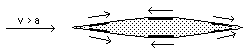
Hence, a system of three wall-mounted electrodes:
The magnetic field was perpendicular to the plane of the figure, but to create the appropriate force field, it was necessary (in the computer simulations) to "shape" it—something that could be achieved using several coupled solenoids. Near the electrodes, the Laplace forces were schematically arranged as follows:
Lebrun's thesis (published at the 7th International MHD Conference in Tsukuba, Japan, and the 8th International MHD Conference in Beijing, 1990, as well as in The European Journal of Physics) demonstrated the theoretical feasibility of the operation. This result is interesting on multiple counts. Indeed, when we accelerate the fluid, we supply it with energy, whereas when we decelerate it, it supplies energy. Why? Because the fluid's motion along the model at velocity V induces an electromotive force V × B. This force tends to generate a current density J = σ(V × B), where σ is the electrical conductivity.