About the size of a kitchen bucket, it is a chamber containing an anode and a cathode, the latter taking the form of a pool of mercury. Between the anode and cathode: a vacuum. That is, a space filled with saturated mercury vapor corresponding to ambient temperature, having an electrical conductivity too low to allow current passage, the electrodes being under high voltage (5 kV). A "trigger" is a small electrode located near the surface of the mercury. When a discharge is initiated between this electrode and the mercury-cathode, the mercury is vaporized, and this vapor then fills the chamber, enabling an electric arc to pass. In effect, a closed-loop lightning bolt. Once the discharge is initiated, it sustains itself until the energy stored in the capacitors has been dissipated by Joule heating in the copper conductors. Then the mercury vapor condenses, and the ignitron is ready for another attempt. A second ignitron, the size of a beer can, is sufficient to trigger current passage at the right moment in the electrodes of the test model.
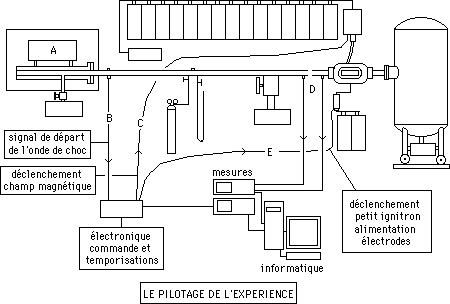
Below is the diagram of the operational control system:
In 1965, the main cost of such experiments was electronic equipment and data recording. Of course, at that time, microcomputers did not exist. The bandwidth of the most advanced oscilloscopes of the era (American Tektronix models, vacuum tube-based) would seem laughable today: 1 megahertz. But in those 1960s, their unit price reached 40,000 francs. Today, this cost could be reduced by a factor of ten at equivalent performance.
The traces appearing on oscilloscope screens were photographed on Polaroid film. Today, the entire acquisition of these experimental parameters could be managed by a low-end microcomputer equipped with a suitable interface card.
Recording the parameters of the wind tunnel was extremely simple. It was sufficient to place small needle pairs on the wall, under low voltage. The distance between the needles was one millimeter, and the voltage was low enough that current could not pass through the rarefied argon atmosphere. But when the shock wave passed, the mere fact that these electrodes were immediately downstream of the wave, immersed in argon at 10,000°C, was enough to generate a signal. By recording, using a dual-trace oscilloscope, the signals emitted by two such ionization probes spaced ten or twenty centimeters apart and located upstream of the nozzle, one could measure the shock wave velocity, and thus calculate all the gasdynamic parameters: temperature, pressure, degree of ionization, electrical conductivity. Additional oscilloscopes were required for supplementary measurements. To protect these oscilloscopes from strong electromagnetic interference generated by the spark gaps in the high-pressure chamber and, generally, by all electrical switching components, they were connected to the probes via shielded coaxial cables and enclosed within a Faraday cage, where the experimenters themselves also worked.
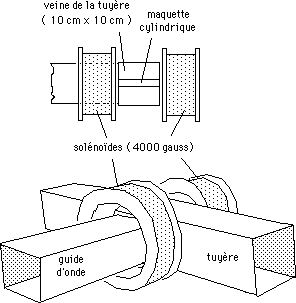
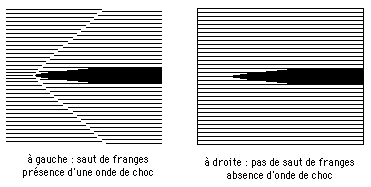
Here follows the description of the experimental setup that would have allowed us to verify the validity of the theory we developed between 1975 and 1980 regarding the feasibility of an object traveling at supersonic speed through a gas without generating a shock wave. We now need to discuss how to demonstrate the annihilation of these waves. One can then use a classic and proven method: creating a system of horizontal fringes by making two light beams interfere—one passing through the test jet, the other passing outside. A shock wave represents a sudden jump in gas density, which manifests as a change in refractive index. Thus, shock waves are traditionally visualized using this technique. Below, on the left, is the typical appearance of a "fringe jump" due to the presence of an oblique shock wave attached to the leading edge of an airfoil. On the right, the same image with annihilated shock waves.
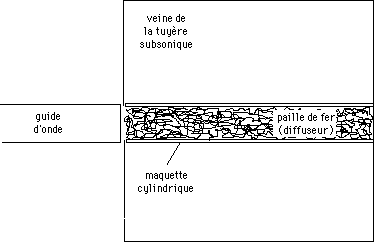
The argon plasma at 10,000°C is sufficiently luminous, so the light source used would be a small helium-neon laser, delivering a brighter light than the plasma itself.
At the end of the 1980s, Lebrun and I calculated all the parameters for such an experiment as part of his doctoral thesis, funded by the CNRS. I am convinced this experiment would have worked on the first try, just as all the MHD experiments I had previously attempted in the laboratory using shock tubes. I particularly recall an experiment from 1966 (which I will discuss in a future document), where the goal was to operate an MHD generator in "bitemperature" mode, meaning with an electron temperature (10,000°C) significantly higher than that of the test gas (6,000°C). The obstacle was then "Vélikhov instability" (which nullified all MHD efforts in many countries). A clever trick allowed us to bypass this obstacle, and the experiment worked on the first try. I presented this work at the international conference in Warsaw in 1967. But the dreadful atmosphere prevailing in that laboratory forced me to leave and switch disciplines, becoming an astrophysicist. My student, Jean-Paul Caressa, took over the entire research theme, which he made the subject of his thesis (although he clearly did not grasp the subtleties of Vélikhov's ionization instability, whose annihilation was the key to the experiment). This earned him the Worthington Prize and later enabled him to become director of the Meudon Aero-thermodynamics Laboratory, and subsequently regional director of the CNRS for the Provence-Alpes-Côte d'Azur region.
What became of such a project.
In the mid-1980s, I managed to interest the CNRS General Director, Pierre Papon, in this research theme. He supported us, relayed by his deputy Michel Combarnous, director of the Department of Physical Engineering Sciences. At the time, I was already based at the Marseille Observatory, a location ill-suited for such experiments. Combarnous then found us a host laboratory, that of Professor Valentin in Rouen. The CNRS was to finance part of the operation, with the army expected to provide additional funding. But soon, the military demanded that I be completely excluded from these activities, for reasons having nothing to do with science. With a change in CNRS leadership, I lost the support of Papon and Combarnous. Since Lebrun’s grant had been exhausted, nothing was done to allow him to continue his work.
The Rouen team, completely inexperienced in MHD (though possessing an old shock tube), accumulated errors. The funds...