MHD propulsion.
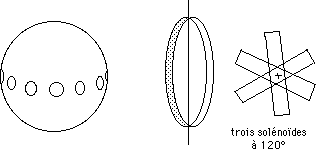
A previous drawing, showing the flow induced by the action of Laplace forces around a cylinder, demonstrates that these forces can be used for the propulsion of flying or navigational machines. Nevertheless, the cylindrical shape does not appear to be the most suitable. It is then easy to move to a spherical shape by equipping such an object with a ring of electrodes.
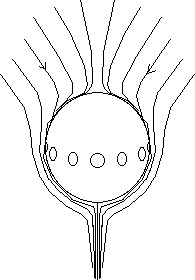
A rotating switch system allows sequential powering of two diametrically opposed electrodes, one serving as an anode and the other as a cathode. The key is then to couple this device with a rotating magnetic field system. In this case, there is no need to place a magnet mounted on an axis inside the model (although that is what we did during hydraulic experiments in 1976, by placing a rotating magnet inside a ping-pong ball). All physics students know that arranging three solenoids at 120° and powering them with appropriately phased currents produces the equivalent of a rotating magnetic dipole. The resulting field is:
If the shock wave annihilation experiment had worked around the lens-shaped profile, we had planned to repeat the operation using a model of this kind—multi-electrode and with a rotating field—powered by properly synchronized capacitor discharges.
The experiment in cold gas would also have been interesting. It would have sufficed to use the model as an HF antenna. We had conducted very interesting experiments on this topic as early as 1978. Once again, ionization would have remained neatly localized near the object.
Lens-shaped aerodynes.
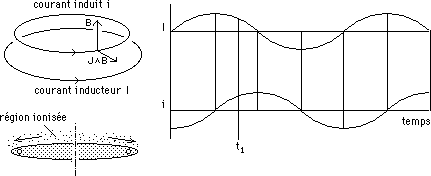
But the most interesting experiment would have focused on the topic of the MHD lens-shaped aerodyne (publication in the Comptes Rendus de l'Académie des Sciences, Paris, 1975, under the title "A New Type of MHD Converter"). This would be a machine devoid of electrodes.
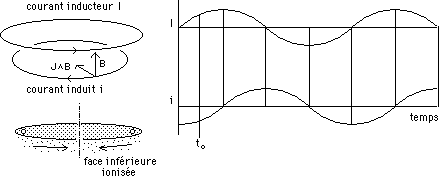
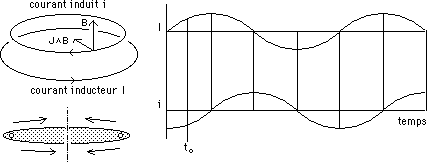
Consider a solenoid carrying an alternating current. It generates an induced field in the surrounding air, which may be accompanied by circulating currents, associated with a secondary field opposing (Lenz's law) the variation of the inducing field.
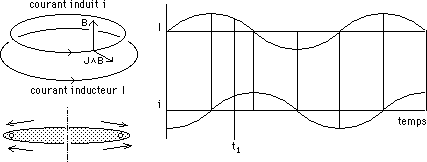
The induced current (i), forming closed loops, interacts with the inducing field B(t), producing radial Laplace forces that alternately act centrifugally and centripetally. For example, in the figure above, at time t₀, the directions of the B field (exciter) and the current density J (induced field, circulating in the gaseous mass) would produce a centripetal radial force.
At time t₁, this force would be centrifugal.
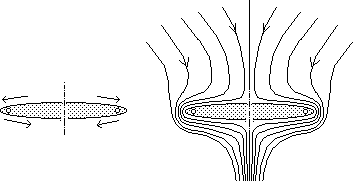
If the gas adjacent to the disk equipped with an internal solenoid is not ionized, nothing notable will happen. But if this gas is ionized, it will be shaken by a system of forces alternately centrifugal and centripetal, like a shaker.

One can conceive a propulsion system based on this principle by arranging for time-modulated ionization on the upper and lower faces, such that the gas located above the vehicle becomes electrically conductive when the forces are centrifugal:
and conversely, the gas below becomes conductive when the forces are centripetal:
This would result in a combined force system tending to strongly circulate air around the vehicle:
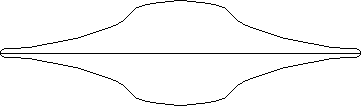
The formula (Comptes Rendus de l'Académie des Sciences, Paris, 1975) is appealing. However, one must find a way to create this pulsed ionization near the wall. The problem is delicate, as the time during which the air is made conductive must be on the order of magnitude smaller than the transit time of the gaseous mass around the object. Considering an object moving at 3000 meters per second, and a characteristic length of ten meters (the diameter of the vehicle), this leads to times on the order of a millisecond—feasible with pulsed microwave emission at 3 gigahertz. The upper and lower walls of the machine should therefore be lined with miniature klystrons, alternately emitting and extracting free electrons from air molecules.
Another solution, however, appears more promising. It is known that when molecules are bombarded with electrons having a precisely tuned energy, electron attachment occurs. Some molecules then acquire an extra electron and become negative ions, with a very short lifetime—interesting in our case.
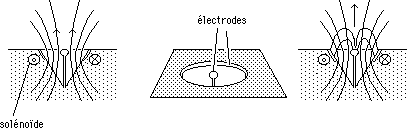
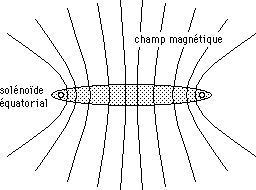
The peripheral electron cannons would take the form of miniature mousetraps. The principle is simple. A solenoid generates a magnetic field with the configuration shown below:
This field, perpendicular to the wall, decreases in intensity with distance from the wall. It is associated with a magnetic pressure:
On the right-hand figure, an electric discharge occurring between a central electrode and an annular electrode will expel electrons toward regions where the magnetic pressure is weaker—thus away from the wall—with an energy depending on the value of B. If B is properly adjusted, these electron jets will trigger the formation of negative ions in the air, efficient carriers of the induced current linked to the variation of the inductor field B created by the annular solenoid (see above). Maximum aerodynamic efficiency requires action in the gaseous layer immediately adjacent to the wall (the so-called "boundary layer"). But this raises a plasma confinement problem, which was quickly resolved in experiments conducted at low pressure.
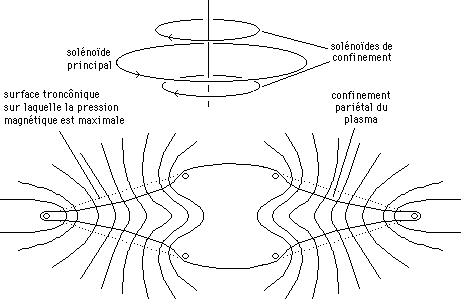
The magnetic field B created by an equatorial solenoid is itself associated with a magnetic pressure. This pressure decreases as one moves away from the plane of symmetry. Any electric discharge would tend to push it significantly away from the wall, making it uncontrollable.
The solution was to use not just one solenoid, but three—two smaller-diameter secondary solenoids—acting as confinement solenoids.
At any given instant, the currents passing through:
-
the equatorial solenoid
-
the two confinement solenoids
are in opposite directions. The geometry thus allows creating, near a concave wall, a magnetic pressure gradient capable of pressing the electric discharge against the wall and maintaining it within the boundary layer (in practice, for a machine of about ten meters in...)