A Project by MHD
November 3, 2004
Students and young people constantly approach me asking for help with TIPE projects—or even expressing a desire to set up an MHD experiment. Recently, an electronics engineer asked me for advice on building a flux-compression generator, along the lines of Sakharov’s (1952). I said no, because such a device is, in MHD terms, equivalent to a firearm—and military matters and I have been strangers for a very long time.
For the same reason, I refused to provide instruction in the field of two-temperature plasmas and their numerous, formidable instabilities. My knowledge (and practical expertise) in this area is substantial and unique in Europe. Only Americans and Russians know what I know—and they know far more, having had thirty years of research opportunities. I declined to publish these insights on my website, turn them into a book, or even teach at a Grande École. This is a definitive "no" across the board. The information provided in "UFOs and American Secret Weapons" should not mislead. While the basic principles are present, I deliberately omitted the key details that would make any project feasible.
French military authorities have eventually understood that "cold plasmas" with two temperatures—where the electron gas temperature significantly exceeds that of the atomic or molecular gas—represent an unavoidable step in developing many weapons, particularly for overcoming the Heat Barrier and positioning space-based weapon platforms at intermediate altitudes (30–150 km). There are numerous applications, and much more besides. Yet the French have been absent from this field for thirty years. These plasmas differ from fusion plasmas or stellar plasmas as much as liquids do from gases. For years now, people—civilian individuals—have been sent to me, eager to fund MHD research "purely out of scientific curiosity." I can no longer count how many such men have come knocking since 1975. I'll only speak of the two most recent. The first was of Italian origin: inventive, having founded and run a consulting office, he claimed to have recently retired and possessed fresh funds. But people always reveal too much. He had worked on developing a helicopter pilot’s helmet where aiming at a target required only turning one’s head. Mercury circuits integrated into the helmet acted as semicircular canals, informing the fire-control computer of the helmet’s position and the point being targeted.
Once someone has had "small military contracts," it's rare they lose contact entirely. The industrialist who, in the mid-1980s, paid Bertrand Lebrun for a year while he completed his thesis—before we shut down our operations—was actually manufacturing tank turrets in his vast workshops, using vertical lathes. I noticed this during my first visit. Those turret machines should have been hidden.
Every time someone shows up, I run an investigation on them. Two or three years ago, it was a young director of an agro-food company contacting me. Another "passionate about MHD," he said. I agreed to provide a project and was paid for six months as a consulting engineer. In their agro-food operations, they fully exploited the potential of microwaves. The man immediately told me: "You know, if you have any idea at all, here we can realize it. We have space and solid technical support."
He didn’t expect the prank I was about to play on him—and that’s exactly what the project I’m about to describe is. It concerns an MHD application I truly don’t see how one could use militarily (though, as Raymond Devos might say… maybe with molten metals or dissolved oxides for isotope enrichment? Who knows?).
The machine I’m describing is a very simple MHD pump powered by solar energy. Its efficiency is incredibly poor—absolutely abysmal—especially since it would be designed to operate with fresh water, even pure water, whose electrical conductivity, as everyone knows, is utterly miserable.
But then, why build it?
To slowly, over hours and days, pump water from marshes, wells, and water sources, while simultaneously purifying it by burning bacteria, parasites, etc., using oxygen produced via electrolysis. No moving parts, no maintenance—nothing. You set it up, point the sensors toward the sun, install the intake and return pipes, and let it run. Eventually, even the least drinkable water would become biologically pure. It was a beautiful, low-cost project. It could have attracted UNESCO or similar organizations. Clearly, it wouldn’t compete with existing pool or hospital water purification systems—effective, simple, UV-based. The remarkable quality of this MHD system was its fantastic simplicity.
Six months passed. I delivered all the data. It turned out that permanent magnets had made significant progress over the past thirty years—even in civilian sectors. Now capable of 1 to 2 teslas instead of less than one-tenth. Here is the design for the pollution-destruction cell:
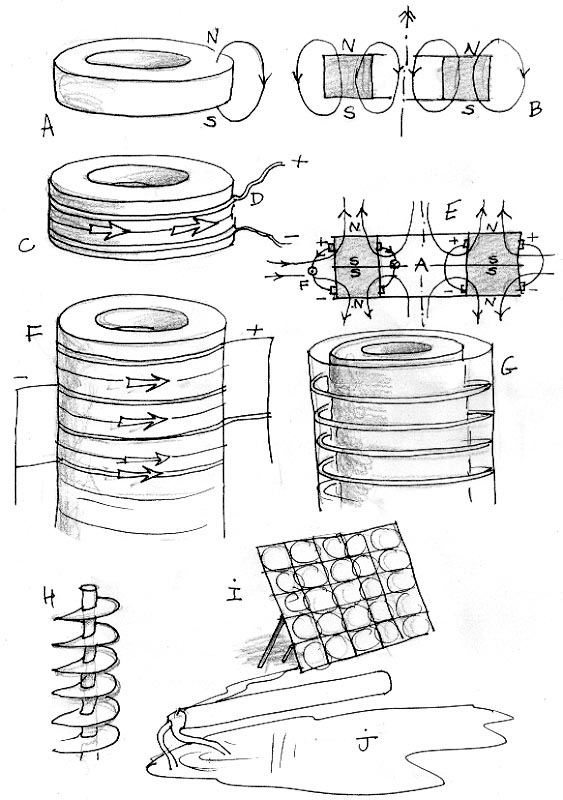
MHD Pollution-Removal Unit
This is just one setup—you could easily imagine ten different versions within the next hour. I chose this one because we actually tested it (Figure C) back in 1976, in the basements of the Marseille Observatory, where Viton and I had set up a lab "where the future already belonged to the past," paraphrasing the famous English Muppets. At the time, we used toroidal magnets with square cross-sections generating 900 Gauss (0.09 tesla). The field direction is indicated. We added the principle of the wall-accelerator, whose advantage is the ability to reduce electrode spacing as much as desired—very useful when working with fluids of extremely low electrical conductivity (like fresh water). But before considering this setup, you could simply use two solid magnets (ours were 8 cm in diameter with a 15 mm × 15 mm square cross-section). Glue them "nose to nose" with superglue, aligning two north or two south poles facing each other. For electrodes, we simply fixed two red copper wires, 2 mm in diameter, onto clamps. Place the whole assembly in a basin filled with saltwater and connect the wires to a battery. You’ll get a very nice centrifuge.
In practice, you’d ideally want thin disk-shaped magnets—perhaps 2 mm thick, or a few millimeters. Electrodes would be fixed around their circumference. Material: resistant to oxidation and corrosion. Effect: induce water rotation. Opposite this, angled vanes transform rotational motion into axial flow. The primary goal is electrolysis. This setup should be tested, as well as its effect on water contaminated with bacteria. A pleasant, low-cost project accessible to any engineering school or technical institute. Beyond that, of course, one must aim for magnets capable of at least one tesla. These magnets are sensitive to heat (which, like shocks, causes demagnetization). But this geometry allows heat to easily dissipate into the rest of the liquid flow, carried along the walls by the MHD accelerator. If any school or group wants to try this adventure, I’m available—but only for that purpose. That’s crystal clear.
My young and brilliant entrepreneur didn’t go far with this project. Everything was within reach. Clearly, he expected something else from me:
“Finally, Mr. Petit, all these high-power klystrons—don’t they inspire you? You who’ve always dreamed of controlled ionization via microwaves? Everything’s right here, within reach…”
No, they didn’t inspire me. I was only interested in purifying water sources in the Sahel. One of my closest friends had even been hired as an engineer. We may have thought: “If we can’t figure things out through Petit himself, maybe—through his engineer friend?…” But once I decided to remain silent, a carp became more talkative than I.
Strange projects passed through that agro-food company. There was the idea of a high-capacity capacitor, which I suspect was intended to power missile flux-compression systems, where superconducting techniques were already mastered—aimed at deploying electromagnetic weapons. Strange preoccupations for an agro-food business, wouldn’t you agree? Seeing how uncooperative I was, the man stopped paying me. Then one day my friend showed up with a letter from his beloved boss.
“And what about this? Doesn’t it inspire you?”
The letter came from the Gramat center—the site where French military forces experiment with numerous weapons, including cannons. It asked whether “someone might have ideas for accelerating projectiles using MHD.” Since I didn’t display the desired inspiration, my friend—remarkably imaginative though he was—was fired.
In the months prior, a certain Jean-Marc Roeder had gone to great lengths to establish contact with me. Presenting himself as a Buddhist among other things, he strongly wanted me to write a book on MHD. He appeared multiple times on the radio station Ici et Maintenant, run by another Buddhist, Didier de Plaige. In these broadcasts, he extensively discussed American secret weapons and UFOs, while publishing several articles in the magazine Top Secret. I urge readers to discover here
the path of an atypical Buddhist
(the link pointed to rro but is no longer valid), who had previously led a company called Est Video and designed the tactical visualization system for the underground PC of the First Army (which launches tactical nuclear missiles, the Pluton system). At that time, Roeder obtained a high-level defense clearance—Vulcan level—after a three-month security investigation by the Gendarmerie and DST. With INSA Strasbourg, he designs stealth reconnaissance drones for the French Army.