Wikipedia encyclopedia cosmology science
Wikipedia is not a forum! My response to the attacks by Alain Riazuelo of the Paris Institute of Astrophysics
September 7, 2006 - updated September 13, 2006
Wikipedia is a living encyclopedia. The dictionary defines this as "the sum of universal knowledge."
As it stands, this living encyclopedia is a fascinating concept that has enjoyed meteoric success, which will only continue to grow. It is a shame that images and music are burdened by rights that do not apply to text; otherwise, this structure could host the entire culture of the world. Do not the contents of all museums and the music of all times belong to the heritage of humanity?
All this will evolve positively over time. Performers may perhaps donate their works to this fantastic tool for dissemination.
Wikipedia manages itself. The process is quite clever. The bet was bold, but apparently, overall, everything has worked well enough that the UN is considering putting a "controlled" Wikipedia on the "string-powered" computers that will soon be installed in Thailand, if I am not mistaken.
There was a whole mass of classic knowledge to put online, and many "ants" contributed to building this edifice, anonymously and selflessly. It is a beautiful human achievement.
Contributions give way to dispute. A fantastic lesson in... democracy. But there are derailments.
A few months ago, readers drew my attention to a biography concerning me, presented in both French and English. There, things become a bit... nonsense. And it gets worse when "opinions of scientists" are grafted onto the comments. This text was subsequently removed from the Wikipedia pages. It originated from
Alain Riazuelo
33 years old, Polytechnique graduate class of 1993, cosmology thesis at Paris XI in 2000, working at the Paris Institute of Astrophysics
It was not the researcher himself who put this page on the Wikipedia site, but an anonymous person (another one), "Mr. 84kg," who spends much of his time on forums, describes himself very vaguely as a "teacher," and is very keen to maintain the cover of his anonymity.

84kg
This insertion of criticism gave rise to successive exchanges that are in the purest style of classic science forums. Now, I say it and I repeat it, Wikipedia is not a forum, it is an encyclopedia.
Such exchanges, such ad hominem judgments have no place in Wikipedia!
If people rant about me on science forums, I hardly care, especially when these criticisms are formulated under the cover of a pseudonym. But in Wikipedia, it is different. Furthermore, the author of the attack felt confident enough to sign with his name, providing his titles, work, and professional contact details. I therefore had to respond. Later, I will also respond to other criticisms, other attacks, often virulent, that linger on the web about me (I am thinking of a guy who had installed in Wikipedia a 12-point critique of my variable speed of light model, very acerbic, always covered by a pseudonym who, upon the announcement of my arrival, hurriedly removed the page).
From a deontological standpoint, this response to Mr. Alain Riazuelo should take place in the seminar room of the Paris Institute of Astrophysics, before this researcher's colleagues and also before representatives "of the public," since this criticism was formulated on a site widely open to the public. But I bet my best shirt that he will not take this risk.
Here is the response I had to place in the columns of Wikipedia, dated September 12, 2006, hoping that the record of this altercation, likely to discredit the scientific community in the eyes of readers, will quickly disappear from the Wikipedia site where such exchanges have no place.
Il Nuovo Cimento B Vol. 109 July 1994, pp. 697-710
Message from Jean-Pierre Petit dated September 12, 2006.
A totally "far-fetched" critique
reusing the qualifier mentioned by one of the participants
likely to discredit the seriousness of Wikipedia
Let us recall the facts
A biography concerning me was posted on Wikipedia. I contested its content and provided some clarifications about myself. Discussions are ongoing.
Here is the critique produced by Mr. Alain Riazuelo, a graduate of the École Polytechnique (class of 1993), who completed a doctoral thesis at Paris XI University in three years, defended in 2000.
The entirety of his critique is indicated in red. Points containing incongruities are in bold. My comments are in black and italics.
I obtained one of the "founding" articles of Jean-Pierre Petit's (JPP) twin universe model, published in 1995 in Astrophysics and Space Science. There is another article published by him at the same time in Il Nuovo Cimento, which I have not yet seen. It is probable that JPP has published other things on the subject,
however, the article I have before me seems to me largely sufficient to be able to make general comments, the conclusions of which are summarized at the end of this message.
This constitutes a first error. One does not judge a work without having read the entire dossier (Mr. Alain Riazuelo could also have easily downloaded not only the two mentioned articles, but also the more recent text of the communication I gave in 2001 at an international congress of astrophysics and cosmology, which is on my internet site). But this young Polytechnicien who defended his thesis in 2000 thinks that the simple reading of this article appeared sufficient to him to be able to draw final conclusions. We will see that the rest is simply deplorable.
JPP's model is based on the idea (probably justified in the other mentioned article) that we live in a universe with positive curvature,
It is always problematic to base an analysis on an assertion that was never said or written by the person whose work one intends to criticize. I have never advanced anywhere that I was hypothesizing that we live in a universe with positive curvature. This hypothesis exists only in Alain Riazuelo's imagination. This is very annoying because his entire reasoning relies on these imaginary premises.
that is to say, it is
a sort of equivalent
of the sphere we know, but with one more dimension (therefore difficult to represent).
"a sort of equivalent...": Naive vision that betrays Mr. Alain Riazuelo's lack of knowledge in geometry.
As on an ordinary sphere, one returns to one's starting point if one goes in a "straight line" (one should rather say if one follows a geodesic, but it matters little), and to any point one can associate an antipodal point, that is to say, the point furthest from where one is. JPP's idea seems to be to suppose that there exist two forms of matter in the universe, ordinary matter and "twin" matter, which possesses the exotic property of exerting a repulsive gravitation on ordinary matter (a bit like two electric charges of the same sign that repel each other). These two forms of matter can coexist, and only undergo the gravitational influence of one another.
In fact, and this is probably the reason for supposing that the curvature is positive,
He is the one formulating the hypothesis and drawing this conclusion. This sentence makes no sense. I would qualify it as a schoolboy's remark.
one does not feel the influence of the twin matter located at the point where we are, but that of the matter located at the antipodal point.
Once again, I do not know what justification can be provided for this kind of assertion.
In science, one judges the tree by its fruits. And the twin theory is very fruitful.
JPP then supposes that the universe is homogeneous and isotropic, and that there is as much twin matter as ordinary matter
(or that the twin matter is identified with the portion of ordinary matter at the antipodal point; it is not 100% clear, but this changes nothing about the problem).
When criticizing a work, it is good to add "I quote" and to show the passages where the person being criticized says such things. Obviously, Alain Riazuelo skimmed my work. And unfortunately, this is not the first time this has happened.
The result of all this,
the effective density of the medium being equal (according to JPP) to the density of ordinary matter minus that of twin matter,
it is zero (therefore). The motivation for all this seems to lie in JPP's wish to easily produce the distribution of matter in the universe, which has a somewhat "spongy" structure, with relatively empty bubbles, at the intersections of which there are overdensities (the surface of the bubbles), at the intersections of which there are much more marked filaments of matter, the large structures (superclusters) being (schematically!) at the intersections of the filaments.
Misunderstanding spreads like wildfire, because if this gentleman had read my work, he would have understood that for the interplay of joint gravitational instabilities to produce a lacunar structure, it is on the contrary absolutely necessary that these densities be different; otherwise, these two subsets separate by percolation, without any particular structure appearing (illustration). Below are the first results obtained in 1990 with my colleague and friend Pierre Midy on a Cray-one showing the result of the interaction of two populations having equal densities.
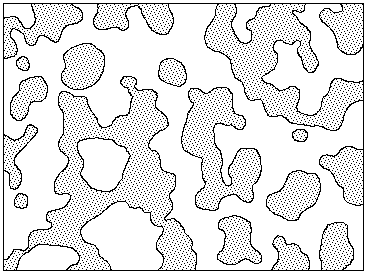
Separation of matter and twin matter when densities are equal: no lacunar structure
Work by J.P. Petit and P. Midy
Nuovo Cimento article, 1994, figure 8.
The spongy structure does not appear. But this was explained in the mentioned articles. Mr. Alain Riazuelo merely skimmed the whole thing.
There is a first problem here, which one will forgive JPP for: numerical simulations, considerably more advanced than ten years ago (the date of the article in question), allow reproducing the observations of this spongy distribution of matter in the universe. I do not know what the state of the art was at the time, but I am willing to believe that at the time it was not possible, and that JPP wished to propose something radically new to see if this could more simply explain this distribution which, according to him, remained an open problem at the time. Because the fact is that JPP asserts that his model (which does not necessarily correspond to what I have just described, but never mind, see below) allows explaining this spongy distribution.
I admit I do not follow his reasoning.
That is the only thing that is obvious. From the beginning, this boy visibly follows... nothing at all.
Apparently, he asserts that depending on whether ordinary matter or twin matter dominates locally, one must form clumps, the other bubbles. In practice, these two configurations are quite far from what is observed, even qualitatively (the clumps form a network that seems quite regular, the bubbles do not really form clusters at the intersection points).
Where things get seriously complicated is when, for example, JPP asserts that his mechanism cited above (
which I do not claim to have understood in detail, but never mind
On the contrary. When one intends to criticize a work, it is indispensable to have scrutinized it "and understood it in detail." This sentence reveals once again that he understood nothing from the start
, I am looking mainly at the calculations that follow) allows dispensing with cosmic inflation since it allows homogenizing the universe. The problem is that this assertion is based on very strong hypotheses about the "initial" distribution of matter (which he supposes Poissonian, that is to say, explicitly homogeneous on a large scale). If one supposes that there are significant density contrasts on scales larger than the current Hubble radius, his trick does not work at all, for example, because homogenization cannot take place in a time equal to the age of the universe (almost by definition
These sentences have strictly no meaning.
I therefore find JPP either quite
a crook
(...) for not mentioning this, or extraordinarily naive for believing that his initial conditions are sufficiently generic to be relevant to solving the problem he claims to solve (the homogenization of the universe).
My work presents itself, among other things (and through this very limiting filter that Mr. Riazuelo used to browse it), as an alternative interpretation to Linde's theory, the most speculative possible, to justify the current homogeneity of the universe. At this stage, it is clear that Riazuelo has not understood a single word of what I proposed. Furthermore, the formulation of the alternative is insulting.
Let us recall that one of the great strengths of inflation is to homogenize vast regions of the universe regardless of the initial conditions (or nearly so) on the distribution of matter at the end of the Planck epoch.
Inflation is a totally speculative theory, as is any theory in its beginnings. We are living in an era of great scientific crisis where a paradigm shift is awaited that will finally clarify the panorama. Competing, alternative theories of the same level of speculation should be able to be confronted. Alas, whether it concerns access to publication journals or opinions issued by one and the other, the position can often be summed up as "my speculations are less speculative than yours."
After various rather uninteresting digressions, JPP tackles quantitative things: he solves the Friedmann equations for his model. He notes (quite rightly) that the effective density of matter being zero, the only solution other than Minkowski space corresponds to a scale factor that grows linearly with time.
In such a model, JPP (rightly) notes that the spatial curvature is negative (it is written in black and white in the text).
That, at least, is exact.
Did JPP even notice that this contradicted his starting hypothesis (where it is positive)?
How can I contradict a hypothesis that I did not make???
If yes, he is dishonest (...), if no, he does not realize that his model excludes itself quite irrevocably,
since a space with negative spatial curvature is infinite, and there is no longer any relationship between a point and its antipodal image to which he clings so much. In a way, it is enough to notice this not to have to read the rest, while still wondering about the extreme weakness of the proposed reasoning (
the fact that the spatial curvature is positive
implies a strictly positive total density, we have known this since 1917, whereas de facto it is hypothesized here that it is zero...).
and it continues even more, in a manner that is also quite pretentious and discourteous. Riazuelo clings to a hypothesis that exists only... in his imagination. It is... pathetic.
The second problem that JPP then tackles (who therefore did not notice the futility of the thing, see previous paragraph), is to save appearances, because the expansion law found does not correspond to what is expected (in , see here).
There, he performs a set of bizarre and horribly poorly described manipulations
and above all totally misunderstood.
to explain that in fact, the time thus measured is not the true time indicated by a clock due to a hypothetical "variation of fundamental constants," whose sole reason for being is to save a model that is in any case completely shaky. This passage brings to mind basic dimensional analysis, although, curiously for someone who has worked in fluid mechanics, the term dimensional analysis does not seem to be mentioned in this article.
JPP therefore rewrites some equations of physics (Schrödinger equation, Boltzmann equation), and tries to see how to change the units of length, time, and mass to retrieve them after these changes of scale. We note in passing that the Schrödinger equation is poorly written (an s has slipped in place of a , it looks messy!), and that in redefining his length standard , JPP forgets that he subsequently supposes that his duration standard, which he notes T, varies over time, and that therefore we do not have as he says , but , which invalidates most of his calculations.
After the blow of the (basic) error on the curvature
error... imaginary
, it is clear that there is not much left to hope for from the model. Let us add that JPP is obliged to manually add the correct variation of his unit standards to retrieve the expected results, and that the proven presence of dark energy today requires a temporal variation of these that is extraordinarily more ad hoc still for it to work.
That is complete gibberish. Where is the demonstration of the "proven presence of dark energy"?
Let us add the absence of testable quantitative results, a non-discussion on the behavior of these standards in a regime (the epoch of primordial nucleosynthesis) where they should still change in an ad hoc (but different!) manner in his model to fit the observations, and the list is far from complete. For example, he finds that the entropy of a comoving volume is not conserved, which is quite curious because usually the Bianchi identity and homogeneity impose that it is conserved. It appears in any case that there is an error when JPP writes the Einstein equations because he forgets a c2 factor somewhere, and that forgetting such a factor when one builds a theory where c (the speed of light) varies, is assurance that one forgets an additional term in the Einstein equations (the same error as João Magueijo in his variable speed of light theory, which is wrong from A to Z because of this)...
A reasoning that shines... by its obscurity.
There is no one more blind than he who does not want to read. In the articles I have published, one finds, for example, the reconstruction of the large-scale structure of the universe, that of the rotation curve of galaxies (without appealing to an ad hoc distribution of matter, point by point, since in the dark matter model one precisely deduces its distribution from... the rotation curve). One finds a justification for the structure of barred spiral galaxies, which has never been produced (numerical galaxies regularly lose their arms very quickly through dissipative processes, for 30 years). The negative gravitational lensing effect allowed predicting that one should observe, at high redshifts, "dwarf" galaxies. According to my model, this nanism would be a "gravitational optics" effect, due to the presence of conglomerates of twin matter at the center of the cells of the lacunar structure of the universe. There are still many other things that constitute quantitative outcomes of this model. Conversely, if I may make a remark, I found that the contribution of Mr. Riazuelo's thesis as well as that of his numerous publications does not appear to me in a bright manner. It would be appreciated if he described with more clarity the brick he claims to have added to the scientific edifice.
To conclude:
Several basic errors (inconsistency on the sign of the spatial curvature, poor definition of the energy-momentum tensor) which irrevocably disqualify the model (
and its author, I would be tempted to add
).
I think this can be qualified as scientific defamation.
Ignorance or misunderstanding of cosmological concepts (the horizon problem, notably).
I return this critique to its author.
Numerous typographical and calculation errors (Schrödinger equation, failure to take into account the temporal variation of the duration standard). Ad hoc hypotheses (form of the variation of duration standards) to save a model
which does not seem
in any case to be well justified theoretically.
"which does not seem to me....".
Many points poorly detailed which leave two possibilities: either the author trivializes everything, or the author saw nothing; given the previous points,
I have a rather marked preference for the second option.
Is this a supported critical analysis or a judgment based on an impression? On a deontological level, all this is absolutely lamentable.
No quantitative prediction, and consequently no comparison with current data. This was forgivable in 1995, but certainly not now. In cosmology as elsewhere, one cannot claim to have the slightest seriousness if one does not make quantitative predictions.
Totally false, mendacious.
General Conclusion:
The case of Alain Riazuelo is not an isolated case. The interest I have shown in subjects that are nothing other than taboos in the field of science has generated an allergic reaction of the most violent kind, which generates reactions devoid of all rationality. Six or seven years ago, I had asked Omont, who was then directing the Paris Institute of Astrophysics, the laboratory to which Alain Riazuelo belongs, to be able to give a seminar within its walls, on my twin model.
Omont
Dialogue:
-
Negative. You have published books on extraterrestrials.
-
But that is not what I want to talk to you about.
-
I am sorry. For us, the two things are inseparable.
Shocked, the mathematician Jean-Marie Souriau then wrote to Omont: "You are looking for new ideas. Petit has them. Listen to him."
The seminar then took place before dozens of hostile, completely closed faces. At the end of my presentation, the person in charge of the seminar asked if people had questions to ask. As the only response, the members of the IAP, who had obviously not listened to a word of my presentation, left the room.
I mentioned in a previous message an incident that also dates back a few years. But since we are at the stage of naming names (starting with mine, in a very insulting manner). I will recall the following fact, which my colleagues at the Marseille Observatory could confirm. Alain Blanchard, the reporter for Riazuelo's thesis, had come to give a conference at the Marseille Observatory. He had been the author of very negative criticisms in reports, within the framework of the CNRS commission to which I belonged. At the end of his presentation, I said to him:
- Mr. Blanchard, I wrote to you three times asking you to grant me the possibility of coming to present my work in a seminar at your laboratory in Toulouse, and you did not have the courtesy to answer me. I reformulate this question before my colleagues present here, specifying of course that I would take on the travel and hotel costs in these conditions.
As the only response, he hastily gathered his transparencies and fled through the back door. One of my colleagues, astonished, then stood up saying -
- Did you see, Jean-Pierre, he is deflating!
After providing these clarifications, I think this lamentable controversy should leave the columns of Wikipedia, as well as the links that refer directly to it, the editors having to limit themselves to the facts alone. Regarding the number of citations, it has no relevance. The history of science can produce masses of examples of theories that were rejected or ignored when they were formulated. Example: Wegener's theory, on continental drift, considered totally "far-fetched" by all the geologists of the time (Wegener was a meteorologist).
I will conclude by paraphrasing one of the participants in this debate, who wrote "that we were not going to organize a seminar every time someone presents a far-fetched theory."
I will say:
When the representative of an institution like the Paris Institute of Astrophysics presents a critique as far-fetched (with the excuse of his status as a beginner researcher, therefore impulsive and imprudent), then it is urgent that I be able to give (again) a seminar on the subject, in these places. Obviously, I would need to be able to explain to Alain Riazuelo everything he did not understand, or misunderstood, by starting off like a hare on an assertion, a hypothesis absent from the texts I have published. And, as the formulated critique was made publicly, before a large audience, the readers of Wikipedia, it is then required that this same audience be able to be present, or at least represented during the debates that would accompany this seminar, and that it be recorded, that the arguments and responses be documented. The scientific game must resume a normal course, less superficial, less thoughtless.
Message from Jean-Pierre Petit dated September 12, 2006.
A totally "far-fetched" critique
reusing the qualifier mentioned by one of the participants
likely to discredit the seriousness of Wikipedia
Let us recall the facts
.
A biography concerning me was posted on Wikipedia. I contested its content and provided some clarifications about myself. Discussions are ongoing.
Here is the critique produced by Mr. Alain Riazuelo, a graduate of the École Polytechnique (class of 1993), who completed a doctoral thesis at Paris XI University in three years, defended in 2000.
The entirety of his critique is indicated in red. Points containing incongruities are in bold. My comments are in black and italics.
I obtained one of the "founding" articles of Jean-Pierre Petit's (JPP) twin universe model, published in 1995 in Astrophysics and Space Science. There is another article published by him at the same time in Il Nuovo Cimento, which I have not yet seen. It is probable that JPP has published other things on the subject,
however, the article I have before me seems to me largely sufficient to be able to make general comments, the conclusions of which are summarized at the end of this message.
This constitutes a first error. One does not judge a work without having read the entire dossier (Mr. Alain Riazuelo could also have easily downloaded not only the two mentioned articles, but also the more recent text of the communication I gave in 2001 at an international congress of astrophysics and cosmology, which is on my internet site). But this young Polytechnicien who defended his thesis in 2000 thinks that the simple reading of this article appeared sufficient to him to be able to draw final conclusions. We will see that the rest is simply deplorable.
JPP's model is based on the idea (probably justified in the other mentioned article) that we live in a universe with positive curvature,
It is always problematic to base an analysis on an assertion that was never said or written by the person whose work one intends to criticize. I have never advanced anywhere that I was hypothesizing that we live in a universe with positive curvature. This hypothesis exists only in Alain Riazuelo's imagination. This is very annoying because his entire reasoning relies on these imaginary premises.
that is to say, it is
a sort of equivalent
of the sphere we know, but with one more dimension (therefore difficult to represent).
"a sort of equivalent...": Naive vision that betrays Mr. Alain Riazuelo's lack of knowledge in geometry.
As on an ordinary sphere, one returns to one's starting point if one goes in a "straight line" (one should rather say if one follows a geodesic, but it matters little), and to any point one can associate an antipodal point, that is to say, the point furthest from where one is. JPP's idea seems to be to suppose that there exist two forms of matter in the universe, ordinary matter and "twin" matter, which possesses the exotic property of exerting a repulsive gravitation on ordinary matter (a bit like two electric charges of the same sign that repel each other). These two forms of matter can coexist, and only undergo the gravitational influence of one another.
In fact, and this is probably the reason for supposing that the curvature is positive,
He is the one formulating the hypothesis and drawing this conclusion. This sentence makes no sense. I would qualify it as a schoolboy's remark.
one does not feel the influence of the twin matter located at the point where we are, but that of the matter located at the antipodal point.
Once again, I do not know what justification can be provided for this kind of assertion.
In science, one judges the tree by its fruits. And the twin theory is very fruitful.
JPP then supposes that the universe is homogeneous and isotropic, and that there is as much twin matter as ordinary matter
(or that the twin matter is identified with the portion of ordinary matter at the antipodal point; it is not 100% clear, but this changes nothing about the problem).
When criticizing a work, it is good to add "I quote" and to show the passages where the person being criticized says such things. Obviously, Alain Riazuelo skimmed my work. And unfortunately, this is not the first time this has happened.
The result of all this,
the effective density of the medium being equal (according to JPP) to the density of ordinary matter minus that of twin matter,
it is zero (therefore). The motivation for all this seems to lie in JPP's wish to easily produce the distribution of matter in the universe, which has a somewhat "spongy" structure, with relatively empty bubbles, at the intersections of which there are overdensities (the surface of the bubbles), at the intersections of which there are much more marked filaments of matter, the large structures (superclusters) being (schematically!) at the intersections of the filaments.
Misunderstanding spreads like wildfire, because if this gentleman had read my work, he would have understood that for the interplay of joint gravitational instabilities to produce a lacunar structure, it is on the contrary absolutely necessary that these densities be different; otherwise, these two subsets separate by percolation, without any particular structure appearing (illustration). Below are the first results obtained in 1990 with my colleague and friend Pierre Midy on a Cray-one showing the result of the interaction of two populations having equal densities.
Separation of matter and twin matter when densities are equal: no lacunar structure
Work by J.P. Petit and P. Midy
Nuovo Cimento article, 1994, figure 8.
The spongy structure does not appear. But this was explained in the mentioned articles. Mr. Alain Riazuelo merely skimmed the whole thing.
There is a first problem here, which one will forgive JPP for: numerical simulations, considerably more advanced than ten years ago (the date of the article in question), allow reproducing the observations of this spongy distribution of matter in the universe. I do not know what the state of the art was at the time, but I am willing to believe that at the time it was not possible, and that JPP wished to propose something radically new to see if this could more simply explain this distribution which, according to him, remained an open problem at the time. Because the fact is that JPP asserts that his model (which does not necessarily correspond to what I have just described, but never mind, see below) allows explaining this spongy distribution.
I admit I do not follow his reasoning.
That is the only thing that is obvious. From the beginning, this boy visibly follows... nothing at all.
Apparently, he asserts that depending on whether ordinary matter or twin matter dominates locally, one must form clumps, the other bubbles. In practice, these two configurations are quite far from what is observed, even qualitatively (the clumps form a network that seems quite regular, the bubbles do not really form clusters at the intersection points).
Where things get seriously complicated is when, for example, JPP asserts that his mechanism cited above (
which I do not claim to have understood in detail, but never mind
On the contrary. When one intends to criticize a work, it is indispensable to have scrutinized it "and understood it in detail." This sentence reveals once again that he understood nothing from the start
, I am looking mainly at the calculations that follow) allows dispensing with cosmic inflation since it allows homogenizing the universe. The problem is that this assertion is based on very strong hypotheses about the "initial" distribution of matter (which he supposes Poissonian, that is to say, explicitly homogeneous on a large scale). If one supposes that there are significant density contrasts on scales larger than the current Hubble radius, his trick does not work at all, for example, because homogenization cannot take place in a time equal to the age of the universe (almost by definition
).
These sentences have strictly no meaning.
I therefore find JPP either quite
a crook
(...) for not mentioning this, or extraordinarily naive for believing that his initial conditions are sufficiently generic to be relevant to solving the problem he claims to solve (the homogenization of the universe).
My work presents itself, among other things (and through this very limiting filter that Mr. Riazuelo used to browse it), as an alternative interpretation to Linde's theory, the most speculative possible, to justify the current homogeneity of the universe. At this stage, it is clear that Riazuelo has not understood a single word of what I proposed. Furthermore, the formulation of the alternative is insulting.
Let us recall that one of the great strengths of inflation is to homogenize vast regions of the universe regardless of the initial conditions (or nearly so) on the distribution of matter at the end of the Planck epoch.
Inflation is a totally speculative theory, as is any theory in its beginnings. We are living in an era of great scientific crisis where a paradigm shift is awaited that will finally clarify the panorama. Competing, alternative theories of the same level of speculation should be able to be confronted. Alas, whether it concerns access to publication journals or opinions issued by one and the other, the position can often be summed up as "my speculations are less speculative than yours."
After various rather uninteresting digressions, JPP tackles quantitative things: he solves the Friedmann equations for his model. He notes (quite rightly) that the effective density of matter being zero, the only solution other than Minkowski space corresponds to a scale factor that grows linearly with time.
In such a model, JPP (rightly) notes that the spatial curvature is negative (it is written in black and white in the text).
That, at least, is exact.
Did JPP even notice that this contradicted his starting hypothesis (where it is positive)?
How can I contradict a hypothesis that I did not make???
If yes, he is dishonest (...), if no, he does not realize that his model excludes itself quite irrevocably,
since a space with negative spatial curvature is infinite, and there is no longer any relationship between a point and its antipodal image to which he clings so much. In a way, it is enough to notice this not to have to read the rest, while still wondering about the extreme weakness of the proposed reasoning (
the fact that the spatial curvature is positive
implies a strictly positive total density, we have known this since 1917, whereas de facto it is hypothesized here that it is zero...).
and it continues even more, in a manner that is also quite pretentious and discourteous. Riazuelo clings to a hypothesis that exists only... in his imagination. It is... pathetic.
The second problem that JPP then tackles (who therefore did not notice the futility of the thing, see previous paragraph), is to save appearances, because the expansion law found does not correspond to what is expected (in , see here).
There, he performs a set of bizarre and horribly poorly described manipulations
and above all totally misunderstood.
to explain that in fact, the time thus measured is not the true time indicated by a clock due to a hypothetical "variation of fundamental constants," whose sole reason for being is to save a model that is in any case completely shaky. This passage brings to mind basic dimensional analysis, although, curiously for someone who has worked in fluid mechanics, the term dimensional analysis does not seem to be mentioned in this article.
JPP therefore rewrites some equations of physics (Schrödinger equation, Boltzmann equation), and tries to see how to change the units of length, time, and mass to retrieve them after these changes of scale. We note in passing that the Schrödinger equation is poorly written (an s has slipped in place of a , it looks messy!), and that in redefining his length standard , JPP forgets that he subsequently supposes that his duration standard, which he notes T, varies over time, and that therefore we do not have as he says , but , which invalidates most of his calculations.
After the blow of the (basic) error on the curvature
error... imaginary
, it is clear that there is not much left to hope for from the model. Let us add that JPP is obliged to manually add the correct variation of his unit standards to retrieve the expected results, and that the proven presence of dark energy today requires a temporal variation of these that is extraordinarily more ad hoc still for it to work.
That is complete gibberish. Where is the demonstration of the "proven presence of dark energy"?
Let us add the absence of testable quantitative results, a non-discussion on the behavior of these standards in a regime (the epoch of primordial nucleosynthesis) where they should still change in an ad hoc (but different!) manner in his model to fit the observations, and the list is far from complete. For example, he finds that the entropy of a comoving volume is not conserved, which is quite curious because usually the Bianchi identity and homogeneity impose that it is conserved. It appears in any case that there is an error when JPP writes the Einstein equations because he forgets a c2 factor somewhere, and that forgetting such a factor when one builds a theory where c (the speed of light) varies, is assurance that one forgets an additional term in the Einstein equations (the same error as João Magueijo in his variable speed of light theory, which is wrong from A to Z because of this)...
A reasoning that shines... by its obscurity.
There is no one more blind than he who does not want to read. In the articles I have published, one finds, for example, the reconstruction of the large-scale structure of the universe, that of the rotation curve of galaxies (without appealing to an ad hoc distribution of matter, point by point, since in the dark matter model one precisely deduces its distribution from... the rotation curve). One finds a justification for the structure of barred spiral galaxies, which has never been produced (numerical galaxies regularly lose their arms very quickly through dissipative processes, for 30 years). The negative gravitational lensing effect allowed predicting that one should observe, at high redshifts, "dwarf" galaxies. According to my model, this nanism would be a "gravitational optics" effect, due to the presence of conglomerates of twin matter at the center of the cells of the lacunar structure of the universe. There are still many other things that constitute quantitative outcomes of this model. Conversely, if I may make a remark, I found that the contribution of Mr. Riazuelo's thesis as well as that of his numerous publications does not appear to me in a bright manner. It would be appreciated if he described with more clarity the brick he claims to have added to the scientific edifice.
To conclude:
Several basic errors (inconsistency on the sign of the spatial curvature, poor definition of the energy-momentum tensor) which irrevocably disqualify the model (
and its author, I would be tempted to add
).
I think this can be qualified as scientific defamation.
Ignorance or misunderstanding of cosmological concepts (the horizon problem, notably).
I return this critique to its author.
Numerous typographical and calculation errors (Schrödinger equation, failure to take into account the temporal variation of the duration standard). Ad hoc hypotheses (form of the variation of duration standards) to save a model
which does not seem
in any case to be well justified theoretically.
"which does not seem to me....".
Many points poorly detailed which leave two possibilities: either the author trivializes everything, or the author saw nothing; given the previous points,
I have a rather marked preference for the second option.
Is this a supported critical analysis or a judgment based on an impression? On a deontological level, all this is absolutely lamentable.
No quantitative prediction, and consequently no comparison with current data. This was forgivable in 1995, but certainly not now. In cosmology as elsewhere, one cannot claim to have the slightest seriousness if one does not make quantitative predictions.
Totally false, mendacious.
General Conclusion:
The case of Alain Riazuelo is not an isolated case. The interest I have shown in subjects that are nothing other than taboos in the field of science has generated an allergic reaction of the most violent kind, which generates reactions devoid of all rationality. Six or seven years ago, I had asked Omont, who was then directing the Paris Institute of Astrophysics, the laboratory to which Alain Riazuelo belongs, to be able to give a seminar within its walls, on my twin model.
Omont
Dialogue:
-
Negative. You have published books on extraterrestrials.
-
But that is not what I want to talk to you about.
-
I am sorry. For us, the two things are inseparable.
Shocked, the mathematician Jean-Marie Souriau then wrote to Omont: "You are looking for new ideas. Petit has them. Listen to him."
The seminar then took place before dozens of hostile, completely closed faces. At the end of my presentation, the person in charge of the seminar asked if people had questions to ask. As the only response, the members of the IAP, who had obviously not listened to a word of my presentation, left the room.
I mentioned in a previous message an incident that also dates back a few years. But since we are at the stage of naming names (starting with mine, in a very insulting manner). I will recall the following fact, which my colleagues at the Marseille Observatory could confirm. Alain Blanchard, the reporter for Riazuelo's thesis, had come to give a conference at the Marseille Observatory. He had been the author of very negative criticisms in reports, within the framework of the CNRS commission to which I belonged. At the end of his presentation, I said to him:
- Mr. Blanchard, I wrote to you three times asking you to grant me the possibility of coming to present my work in a seminar at your laboratory in Toulouse, and you did not have the courtesy to answer me. I reformulate this question before my colleagues present here, specifying of course that I would take on the travel and hotel costs in these conditions.
As the only response, he hastily gathered his transparencies and fled through the back door. One of my colleagues, astonished, then stood up saying -
- Did you see, Jean-Pierre, he is deflating!
After providing these clarifications, I think this lamentable controversy should leave the columns of Wikipedia, as well as the links that refer directly to it, the editors having to limit themselves to the facts alone. Regarding the number of citations, it has no relevance. The history of science can produce masses of examples of theories that were rejected or ignored when they were formulated. Example: Wegener's theory, on continental drift, considered totally "far-fetched" by all the geologists of the time (Wegener was a meteorologist).
I will conclude by paraphrasing one of the participants in this debate, who wrote "that we were not going to organize a seminar every time someone presents a far-fetched theory."
I will say:
When the representative of an institution like the Paris Institute of Astrophysics presents a critique as far-fetched (with the excuse of his status as a beginner researcher, therefore impulsive and imprudent), then it is urgent that I be able to give (again) a seminar on the subject, in these places. Obviously, I would need to be able to explain to Alain Riazuelo everything he did not understand, or misunderstood, by starting off like a hare on an assertion, a hypothesis absent from the texts I have published. And, as the formulated critique was made publicly, before a large audience, the readers of Wikipedia, it is then required that this same audience be able to be present, or at least represented during the debates that would accompany this seminar, and that it be recorded, that the arguments and responses be documented. The scientific game must resume a normal course, less superficial, less thoughtless.

There is something that is no longer right in the world of science. Even Science et Vie notices it. See its September 2006 issue where the journal headlines on the cover:
Space-time, and if we had to start all over again?
We are indeed confronted with the emergence of a profound paradigm shift. The incredible impasse of current theoretical physics, which is spreading like wildfire, is the symptom.
A twin conception of the universe is a first invitation to this paradigmatic revision, which has already demonstrated its fruitfulness and on which one should look into. The reaction of Mr. Riazuelo and, with hindsight, that of other colleagues in seminars (at the Paris Institute of Astrophysics) or at congresses makes me gradually realize that my work has simply not been understood. There are several reasons for this. Theoretical physicists, cosmologists, and a fortiori astrophysicists are not geometers. From the mouths of these people, one will still find, thirty years after my first publications on the subject (1977, in the Comptes rendus of the Paris Academy of Sciences), questions like:
- But this twin universe, where is it?
So people like Riazuelo, out loud (and many others under their breath) denigrate what they do not understand.
Among the great paradigmatic upheavals, many are of geometric essence. Thus, the revolution due to Special Relativity, 1905, can be translated by this simple phrase:
- We thought we lived in a Galilean space-time. In fact, we belong to a Minkowski space-time
Much emphasis is placed on this incompatibility between general relativity and quantum mechanics: the gravitational field stubbornly refuses to be quantized. The graviton keeps its status as a mirage, despite the title given to a journal: Classical and Quantum Gravity.
My colleague and friend Frédéric Henry-Couannier, whose attraction to the twin model causes him serious professional trouble, suggests that this field could be of a totally different essence. But I am not going to expose his ideas in his place.
Another idea: is the universe a ... discontinuum instead of a continuum?
What a most violent paradigmatic change. Would the present have finite thickness? Would space not be infinitely divisible, as our differential calculus supposes? By secreting a Planck length and a Planck time, is Nature not telling us, insistently:
But I am discontinuous!
Devil! If reality is discontinuous, what to do with differential calculus and integral calculus and above all: what to do without these two tools? What to replace them with?
Must we one day take into account consciousness as an unavoidable phenomenon. In the world of science, one wants to reuse the expression of one of my students, two decades ago, leaving a theoretical physics colloquium where "the Theory of Everything" had been mentioned:
- At a time when metaphysics is in crisis, it is reassuring to note that bar philosophy is doing well
The scientists of our time multiply philosophizing. Science, confronted with its ignorance, struggles without realizing that it is just one more religion since any form of thought is just an organized system of beliefs.
Science without conscience is but the ruin of the soul. How much this phrase makes sense today. Science, where is your humanism? Is the scientific game nothing more than complicity for the benefit of the powerful, parades, smoke and mirrors, assaults of vanity? Is the scientific community becoming more and more like this "Ship of Fools," painted in 1500 by Jérôme Bosch.
What to do? Respond to attacks? What wasted energy.
I would say that the time has come for the
Estates-General of Science
Science must accept reflecting on itself, attempting to define what a scientific fact could be. One must create from scratch a typology of scientific works (alleged by their authors and commented on by their colleagues). Otherwise, we sink into the depths of thought, in a world where everything is played out by co-optation and advertising. It is easy, nowadays, to form a gang and climb in "referencing" by citing each other more and more. But the announcement effects of popular science journals are beginning to fool no one.
I found in Wikipedia a page referring to a man, nearing the end of his career, "who has published 130 articles on black holes" and is in particular the co-author of the article concluding on the "baldness of black holes"
Black holes have no hair
Is that reasonable? would say my friend Tardy
Go see, in Wikipedia, the page "superstrings." For the moment, it is quite meager, for a discipline that wants to be "the lighthouse of scientific thought of the time." But who will be able to indicate:
- Where does it start? - Where do we want to get to? - What is it good for? - Does it predict anything? - What is it supposed to describe? - What does it tend to describe? - What is the profit gained so far from such an approach?
When we build this typology of scientific works, through a forum that friends are going to help us set up, I think that the works on superstrings (which have recently been the subject of teaching at the Collège de France by Gabriele Veneziano,
founder of this ... asymptotic approach) will be to be classified in the section of
Science-Fiction
Who will be able to find another way to classify works situated, to reuse Souriau's word:
At the intersection of a physics without experiment and a mathematics without rigor ---
Continued ---