March 26, 2011: A reader from CEA sends me a (daily) report from the Institute of Nuclear and Radiological Protection (IRSN), in French; he specifies: "This is the real information about the status of the Fukushima site."
This report appears less optimistic than the one provided by a French engineer living on-site, who comments on information supplied by official Japanese services.
IRSN Report of March 25, 2011
Extract:
IRSN
Institute of Nuclear and Radiological Protection
Information Note
Situation of nuclear power plants in Japan after the major earthquake on March 11, 2011
Situation update as of March 25 at 08:00
Status of Reactors
IRSN remains deeply concerned about the current situation of reactors 1, 2, and 3 (risk of failure of certain materials due to massive amounts of salt in the vessels and containment structures, lack of a sustainable system capable of removing residual heat...). This instability is expected to persist for weeks or months, given the difficulty.
IRSN is examining possible worsening scenarios, notably scenarios that could occur in the event of a rupture of reactor 3’s vessel. It will be difficult to confirm such a scenario, but the impact in terms of radioactive releases into the environment is currently under assessment.
Reactor 1
The rate of seawater injection into the vessel has been adjusted (10 m³/h) to control temperature above the core. This flow rate should allow for the removal of residual heat. Pressure measured inside the containment structure has stabilized. It should not be necessary to depressurize this vessel in the near future.
Reactor 2
Seawater injection into the vessel is maintained to ensure core cooling, which remains partially uncovered. The containment structure may be damaged. The situation has not changed, and depressurization operations of the containment vessel are not required at this time. The control room should be resupplied today.
Reactor 3
Seawater injection into the vessel would be maintained to ensure core cooling, although the core remains partially dehydrated. The containment structure appears no longer airtight according to pressure indicators; this loss of integrity may be the cause of continuous, unfiltered radioactive releases into the environment.
The smoke release detected on March 23 has stopped. IRSN is analyzing potential causes of containment failure in reactor 3. One hypothesis examined by IRSN involves the possibility of a vessel rupture followed by interaction between corium (a mixture of fuel and molten metal) and concrete at the bottom of the containment structure.
The environmental impact of such releases is currently being evaluated. Three workers were contaminated on March 24 in the turbine building of reactor 3. Material inspection work has been suspended. This work aims to restore the reactor’s supply of fresh water.
Reactor 4
The core of this reactor contains no fuel.
Reactors 5 and 6
The reactors are properly cooled (core and fuel assemblies in the cooling pool).
It is noted that Japanese engineers are concerned that salt in the seawater used for cooling is clogging electromagnetic valves, which can only be operated remotely. A failure of this kind could have serious consequences, and their main concern is to return to cooling with fresh water.
So, what is the solution?
I have new information—directly obtained—that I’d like to share about the Z-machine, since I gathered it during two international conferences: in Vilnius in 2008 and at Jeju, Korea, in October 2010, and in close proximity to Malcolm Haines himself. Nexus has agreed to publish this information article, which will appear in the next issue. These details will simultaneously amplify hopes and fears surrounding this new technology of ultra-high temperatures. Without spoiling the intrigue (the article will be written quickly):
- Americans achieved 3.7 billion degrees in 2005 at Sandia’s Z-machine. Prioritizing military applications (pure fusion bombs), they conceal as much as possible. With ZR, electrical intensity increased from 17 to 26 million amperes, and the machine’s performance is now kept secret.
March 20, 2011: Is it important to produce a series on this Japanese disaster? There are so many catastrophes on Earth that we are saturated. What can be said is that this catastrophe stems from another human folly: building low-cost nuclear power plants (as is the case with all Japanese nuclear plants) in a country regularly devastated by tsunamis. Otherwise, building cheaper nuclear plants and profiting from them—while ignoring the recommendations of seismology experts who called for improved earthquake safety.
Carelessness. The Japanese continue to amaze us with their spectacular advances in robotics. In Japan, robots can ride bicycles, speak, and smile. They build stylish humanoid robots that will likely be sold like artificial pets or electronic companions to urban residents suffering from loneliness. This reminds me of a chapter from Ray Bradbury’s The Martian Chronicles, which I strongly recommend reading or rereading.
But in Japan, no one invested in safety robots capable of climbing through rubble—and especially not ones equipped with lead shielding to withstand intense radiation. Japan had to import such robots from foreign countries.
We saw one of these managers of criminal management, “overwhelmed by emotion,” shedding crocodile tears (though who wouldn’t be willing to sit beside the machine operators dangerously approaching reactors in an attempt to cool them down?). In Japan, political or economic leaders who ruined hundreds of thousands of decent people periodically appear before the media to offer public apologies. The head of a nuclear disaster sheds a few tears. This replaces the traditional seppuku—suicide by sword.
This video shows the handling of waste from boiling water reactor operation, with waste manipulated remotely and stored in a water pool, where the water acts as a shield absorbing radiation.
You must understand one thing. In the nuclear industry, waste from electricity production—highly radioactive and dangerous to handle—is simply stored very close to the reactor, in ordinary water pools. The water alone is sufficient to block various types of radiation. Later, this waste will be transported to reprocessing centers, like La Hague, to extract future fuel for fast neutron reactors. These wastes are by no means inert and constitute material as dangerous as the reactor core itself.
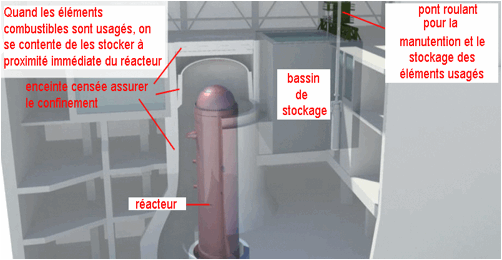
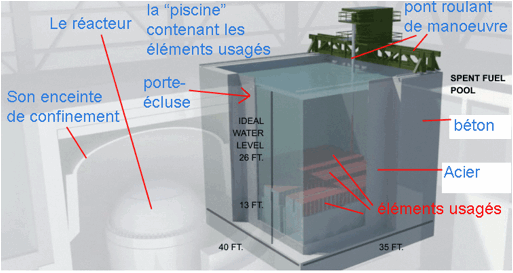
Spent Fuel Storage Pool
This pool is located directly beside the reactor, for ease of handling.
A close-up of these “structures” containing “rods”:
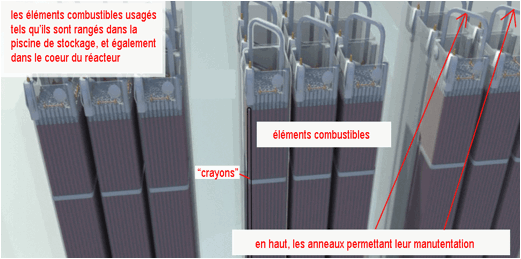
60 “rods” per “assembly” in Japanese reactors
Zooming in further, we can see the details of these “rods,” which form these “structures.” They are zirconium tubes (also called “gins”), filled with “fuel pellets”: uranium oxides, or, in the case of MOX fuel, a mixture of uranium and plutonium oxides. If the water surrounding these structures evaporates, the residual heat generated by these densely packed structures is sufficient to rapidly damage the zirconium tubes and allow the pellets to escape and accumulate at the bottom of the pool. Or else, an explosive event could disperse these materials around the reactor.
Source for the following:
http://allthingsnuclear.org/tagged/Japan_nuclear
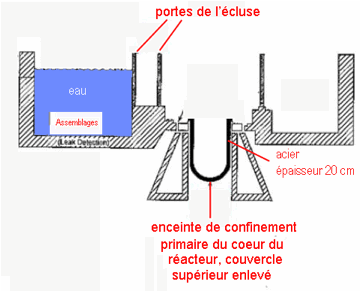
The vessel (here open) and the “pool” are connected by doors and locks
Periodically, “the reactor is shut down.” Control rods are withdrawn, reducing reactor activity to a minimum—though not zero, since fission products continue to decay and generate heat (60 megawatts, or one-tenth of nominal operating power). The lock isolating the top of the reactor from the storage pool is opened. Water fills all available space. Handling of the structures now occurs underwater, using cranes and telescopic arms, either to remove “spent” assemblies or to replace them with “new” ones. In any case, unless a reprocessing industry like La Hague takes over, the “spent” assemblies will be stored in a nearby pool, where they will continue to heat the water of the “pool storing spent and transit fuel for new fuel supply.”
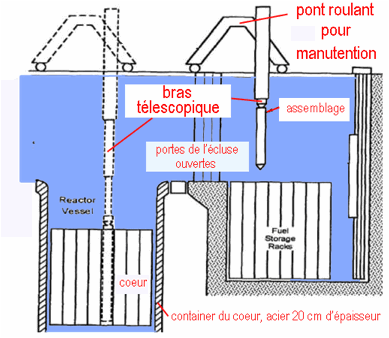
Handling and assembly, under a water cover, protection against radiation
Here is a photo showing such handling, taken at a nuclear power plant in the United States, at the Brown Ferry plant in Alabama.
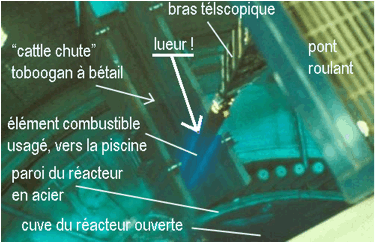
Transfer of a spent assembly to the storage pool
The term “livestock corridor” was chosen due to the resemblance between these walkways and the paths leading animals to slaughter.
This photo was taken by the crane operator. Under his feet: water protecting him from radiation. Just a few meters below, the blue glow corresponding to radiation emitted by the “spent” fuel elements is clearly visible. It’s obvious they are far from passive!
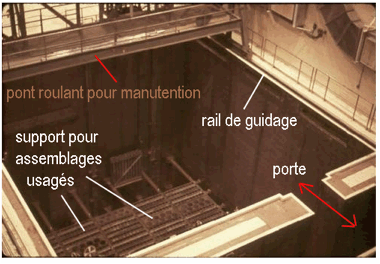
Another photograph of a U.S. reactor storage pool (Alabama), empty, before use.
Several decades ago, I visited the experimental Pégase reactor at Cadarache. Looking through that clear water, we saw “the entire interior of the reactor,” surrounded by a blue glow, located ten meters below. It was like facing death itself, nuclear poison right at hand. The speed of emitted particles was not greater than light in vacuum, but exceeded that speed in water, which is over 200,000 km/s. The ratio 200,000 / 300,000 = 1.5 corresponds to water’s refractive index. Thus, the particles were emitted at a “supersonic” speed relative to light in this medium, and we could clearly observe phenomena resembling “shock waves,” which is what we call Cherenkov radiation. In any medium other than vacuum, light propagation time is stretched due to absorption-emission delays of photons by atoms and molecules. But between atoms, photons travel at 300,000 km/s.
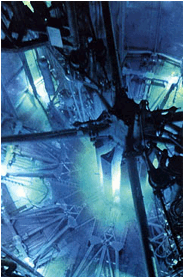
Pégase (35 thermal megawatts), a nuclear research and testing reactor commissioned at Cadarache in 1963, it is an atomic pile where tests are conducted on fuel for gas-cooled reactors.
The Pégase reactor pool was converted in 1980 to store 2,703 containers holding 64 kg of plutonium.
Sources for the following:
http://www3.nhk.or.jp/news/genpatsu-fukushima
http://allthingsnuclear.org/tagged/Japan_nuclear
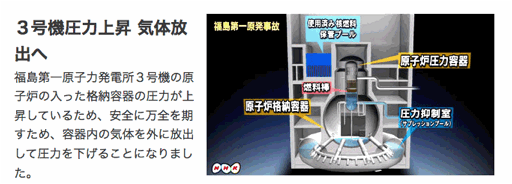
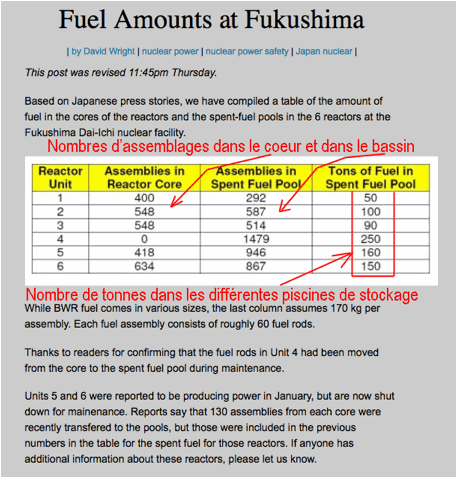
Each assembled element (see above) weighs 170 kg and contains 60 “rods.” The storage pool for reactor 3 held as many highly toxic “spent” rods as the reactor core itself.
Below, an image broadcast by NHK of Japan indicating that water spraying (seawater) must be done at a height of 22 meters.
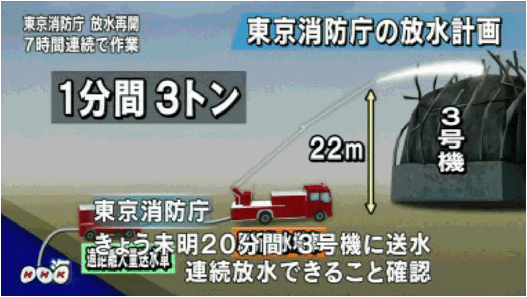
Spraying Japanese reactors requires projecting (seawater) to a height of 22 meters (source: Japanese TV NHK)
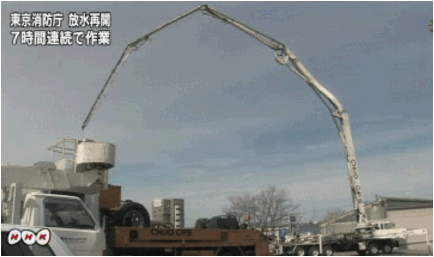 ** **Spraying crane mounted on a mobile vehicle
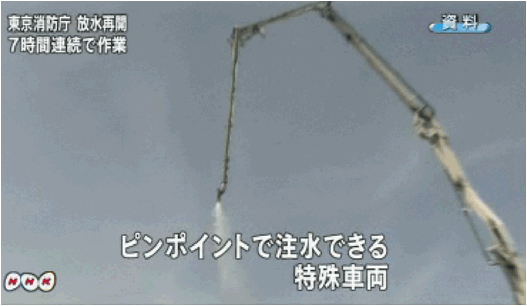
Test of this spraying crane
March 22, 2011: As reported by a reader, it appears to be a remote concrete pump, as shown in the photo he sent me (and I thank him):
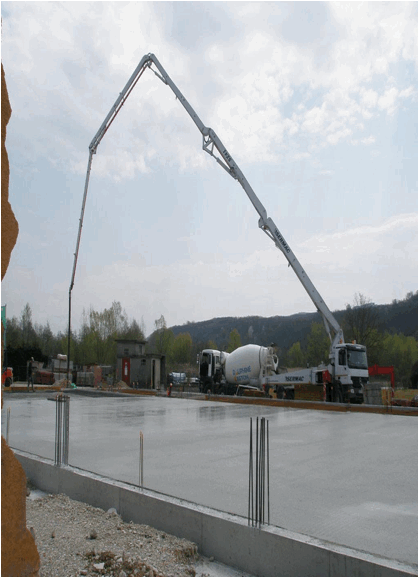
On the left: a concrete transport truck with its mixer rotating.
Of course, such a tube can be used to drop water to a height of 22 meters, where cooling would be most effective. If used to flood the reactor beneath concrete, that would be clearly worse. It would mean the reactor core’s cooling—possibly of one or more cores—could be irreparably compromised.
Wait...
We can only hope that the situation is not as critical as it appears, when speaking of nuclear energy (setting aside the fact that the number of tsunami victims has reached 20,000 so far).
The fact remains that these events brutally remind us of the risks of nuclear energy.
You must understand one thing. In the nuclear industry, waste products from electricity generation, highly radioactive and dangerous to handle, are simply stored very close to the reactor, in ordinary water pools. Water is sufficient to block various types of radiation. Afterwards, this waste will be transported to "reprocessing centers," such as La Hague, in order to extract fuel for future... fast breeder reactors. These wastes are by no means passive and constitute material just as dangerous as the reactor's contents themselves.
The spent fuel storage pool
This pool is located right next to the reactor, for ease of handling.
A close-up on these "structures" containing "pencils":
60 "pencils" per "assembly" in Japanese reactors
Zooming in slightly more, we can see the details of these "pencils," which make up these "structures." They are zirconium tubes (also called "gines"), filled with "fuel pellets": uranium oxides, or, in the case of "MOX," a mixture of uranium oxide and plutonium oxide. If the water in which these structures are submerged evaporates, the residual heat generated by these structures—stored in tightly packed rows—is sufficient to quickly damage the zirconium tubes and allow the pellets to escape and accumulate at the bottom of the pool. Unless an explosive event disperses these materials around the reactor.
Here is the source of what follows:
http://allthingsnuclear.org/tagged/Japan_nuclear
The reactor vessel (here, open) and the "pool" are connected by doors, locks acting
Periodically, "the reactor is shut down." The control rods are raised, reducing the reactor's activity to a minimum—though not zero—because fission products continue to evolve and decompose while releasing heat (60 megawatts, or one-tenth of the nominal operating power). The lock isolating the top of the reactor from the storage pool is opened. Water floods all available space. Handling of the structures is now performed underwater, using a crane and telescopic arm, either to remove "used" structures or replace them with "new" ones. In any case, unless a reprocessing industry like La Hague takes over, the "used" structures will be stored in a nearby pool, where they will continue to heat the water of the "storage pool for spent and transit elements awaiting new fuel supply."
Handling and assembly, under a water cover, radiation protection
Here is a photo showing such a manipulation, taken at a nuclear power plant in the United States, at Brown Ferry in Alabama.
Transfer of a used assembly to the storage pool
The name "cattle chute" was chosen due to the resemblance between these walkways and the passages that lead livestock to slaughter.
This photo was taken by the crane operator. Under his feet: water protecting him from radiation. A few meters below, we can clearly see the blue glow corresponding to radiation emitted by the "used" fuel elements. It is evident they are far from passive!
Here is another photograph of a storage pool for an American reactor (Alabama), empty, before use.
A few decades ago, I visited the experimental Pégase reactor installed at Cadarache. Looking through that clear water, we saw "the entire interior of the reactor," surrounded by a blue glow, located ten meters below. It was like staring death in the face—the naked nuclear poison so close. The speed of emitted particles was not greater than the speed of light in a vacuum, but exceeded that speed in water, which is over 200,000 km/s. The ratio 200,000 / 300,000 = 1.5 corresponds to water’s refractive index. Thus, the particles were emitted at "supersonic" speed relative to light in this medium, and we could clearly observe phenomena resembling "shockwaves," which is what we call "Cherenkov radiation." In any medium other than vacuum, light propagation time is extended due to the absorption-emission time of photons by atoms and molecules. But between two atoms, photons travel at 300,000 km/s.
Pégase (35 thermal megawatts), a nuclear research and test reactor, commissioned at Cadarache in 1963. It is an atomic pile where tests are conducted on fuels for gas-cooled reactors.
The Pégase reactor’s pool was converted in 1980 to store 2,703 containers containing 64 kg of plutonium.
Here are the sources of what follows:
http://www3.nhk.or.jp/news/genpatsu-fukushima
http://allthingsnuclear.org/tagged/Japan_nuclear
Each joint element (see above) weighs 170 kg and contains 60 "pencils." The storage pool of reactor No. 3 contained as much highly toxic "used" fuel as... its core.
Below is an image broadcast by Japan's NHK, indicating that watering (with seawater) must be done at a height of 22 meters.
Watering Japanese reactors requires projecting (seawater) to a height of 22 meters (source: Japanese TV NHK)
** **Watering crane mounted on a mobile vehicle
Test of this watering crane
March 22, 2011: As reported by a reader, it appears to be a remote concrete beam dump, as shown in the photo he sent me (and I thank him):
On the left: a concrete transport truck with its mixer rotating.
Of course, such a pipe can be used to drop water at a height of 22 meters, where cooling would be most effective. If used to flood the reactor beneath concrete, it would be clearly worse. This would mean that cooling of the reactor core—or one of its cores—could be destroyed.
Wait...
We can only hope—for the Japanese—that the situation is not as critical as it appears, when speaking of nuclear (setting aside the fact that the number of victims from this tsunami has reached 20,000 so far).
The fact remains that these events brutally remind us once again of the risks associated with nuclear power.