The weak points of Japanese nuclear reactors
The safety issue concerning Japanese reactors
(bubble reactor)
March 25, 2011
 reacteur_brw_eng.html
I've just finished a first ten-page paper, to be published in the next issue of Nexus, which previously published a ten-page article on the Z-machine, based on what I had posted on my website. Well, good. At last, people are talking about it. I've just sent them, at their request, the follow-up, also in the form of another ten-page article, expected to appear in the next issue (Nexus comes out every two months).
My readers sometimes wonder why they never find one of my articles in any of the numerous French or francophone popular science magazines (La Recherche, Pour la Science, Science et Vie, Science et Vie Junior, Ca m'intéresse, Ciel et Espace, etc.). They also wonder why they never see me participating in televised debates.
The reason is simple: I've been banned from the media for decades. My appearance on television can only be exceptional. Once, a managing editor of a small scientific and technical information magazine, which had published one of my articles on the Z-machine two or three years earlier, found himself at a meeting with other editors from various scientific magazines. Hervé This, deputy editor-in-chief of Pour la Science, told him outright:
- "Why did you publish his article? You know perfectly well we have instructions not to open our pages to him."
And his interlocutor replied to me:
- "I didn't realize it had reached that level."
Yes indeed, Hervé This, like so many others, is one of the
Epistémo-Tartuffes:
- Hide this science, I must not see it
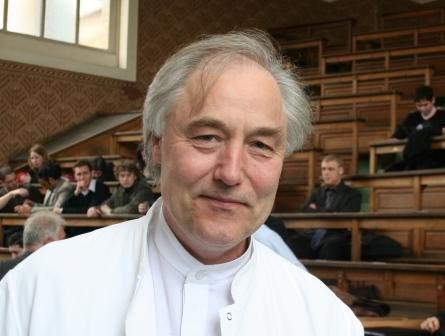
- Science is just cooking...
Check out his Wikipedia page. At the bottom, the list of his honorary distinctions.
Laugh until you cry, guaranteed. More decorated, you can't be.
Hervé This was my "coach" at Belin editions for over fifteen years. The publishing house had tasked him with "correcting" the albums of the Anselme Lanturlu Adventures series. Belin owned the magazine Pour la Science, which he eventually became deputy editor-in-chief of.
The son of a psychiatrist, This took great pleasure in making me rewrite manuscripts N times. The peak was reached with the album on astrophysics, Mille Milliards de Soleils, which went through seven successive versions, after which This finally told me: "In the end, the first version was better."
What a delight to play with a talented author, like a cat plays with a mouse. This odious game lasted fifteen years.
This position as "Collection Director" allowed This to say publicly: "You should see the state these Anselme Lanturlu albums arrive in. A lot of work is needed to format them properly."
Nonsense.
Censorship eventually fell even on Belin editions. Three albums remained blocked for two years: Le Logotron, Joyeuse Apocalypse, and Le Chronologicon. I went to Paris and asked the company's CEO what he found objectionable about these manuscripts. His reply:
- A publisher publishes books... of course... but above all, they publish works they like. And these don't appeal to us.
Then he threw the three manuscripts onto the table. I then found a small publisher in the Sisteron region. This time, I was cautious: I had included in the contract the clause that, "in case annual sales fell below 70 copies per year, the author would automatically regain his rights."
They never reached those figures.
I didn't know what else to do. In the meantime, I had drawn "Pour quelques Ampères de Plus." Publishing such a work with this kind gentleman seemed like wasted time. Since I was already doing it, I sent him a photocopy of the manuscript. He returned it covered in red marker comments. Dialogue:
This, I think you didn't understand—sending me back the manuscript covered in your comments.
What?...
I sent it to you, but you publish it exactly as it is. That's it or nothing. No changes to a single word or drawing.
But before, we used to do it differently...
Before, it was before. Now I'm fed up with this little game. You publish the album as it is, or we drop it.
In the end, the publishing house decided to publish the work. It was the last one. Many years later, I managed to reclaim my rights over the entire collection. The publisher, having sold only 10 to 20 copies per title annually, had eventually exhausted certain print runs. But contractually, a publisher is required to keep a book available to readers. They would have had to reprint it.
I have another anecdote to share, concerning the Alembert Prize, created to reward a popular science work on mathematics. Many people assumed I would automatically be the laureate, given works like Le Geometricon, Le Trou Noir, Le Topologicon.
During the meeting of the committee responsible for awarding the prize, one member proposed my name. But the others immediately replied:
Petit hasn't only done those works. He also did the Mur du Silence...
Oh really? In that case...
To take revenge for my increasingly arrogant behavior as an author, when I published my 1997 book "On a perdu la moitié de l'Univers," This published in Pour la Science a thorough demolition of it, spanning two columns, written by a certain Philippe Zarka from Meudon. This critique revealed the author's incompetence. I contacted a member of that laboratory, determined to respond in a seminar to a man I thought was a researcher. But I found myself facing not a researcher, but merely an engineer who "had read many popular science books." I felt like a tennis player trying to play a "rematch" against a ping-pong player. It was pointless to insist.
I then turned to This, asking for a right of reply in the pages of Pour la Science, which he refused, drunk on the power conferred by his status.
Yes indeed, for This, science is just... cooking.
To circumvent the issue, this committee awarded the prize to... Pour la Science itself, for publishing a book on mathematics, in which my 1979 article on sphere eversion remains, and still is, the crown jewel.
I have never received, and will never receive, the Alembert Prize.
So much for that.
As for This, it's enough to look at the staggering list of his decorations to discern the contours of the character—courtier at heart. How many bows, how many brush passes to collect such a laurel. He reminds me of Brassens' character "Cornes d'Auroch," and the final verse of the song:
And since he'd never done anything wrong,
They gave him a national funeral.Maybe This will end up in the Panthéon one day? Who knows?
For this same reason, you won't find in any of these media a mention of the existence of our association [Savoir s...