Definition of styles
The Stellarator
Wendelstein 7-X
December 17, 2015
Finally, the Germans, after 19 long years, have completed the assembly of this true technological nightmare that is a stellarator. At the beginning of December, this machine produced its first plasma, decades before ITER. Obviously, people who visit my site have bombarded me with questions about this machine.
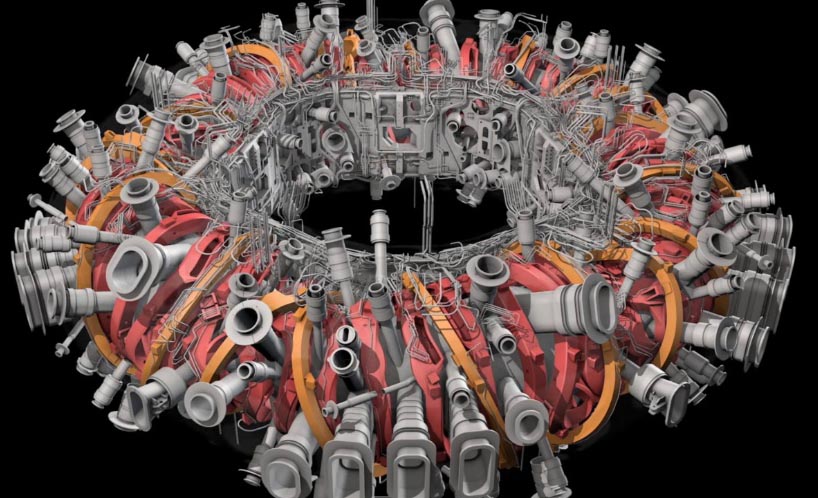
It took 19 years for this project to come to life and a million hours of work. It has 20 flat coils and 50 non-flat coils. Why this distinction? When you want to create a magnetic field in these coils, you have to pass a very strong current through them, which can reach twelve thousand amperes. However, when you pass a strong current through a coil, it is subject to centrifugal forces that tend to give it a circular shape. In such cases, these forces can cause the coil to break. The German Stellarator's chamber has a very twisted geometry.
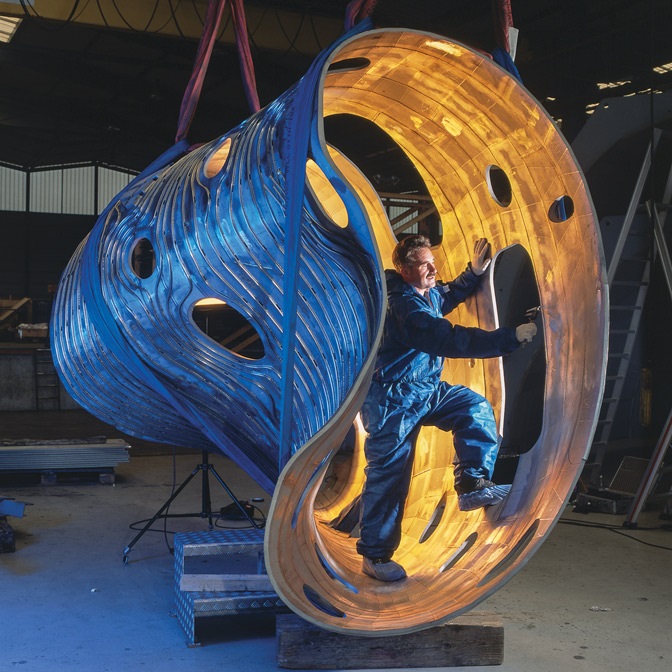
It was therefore necessary to design coils not only circular, but also twisted:
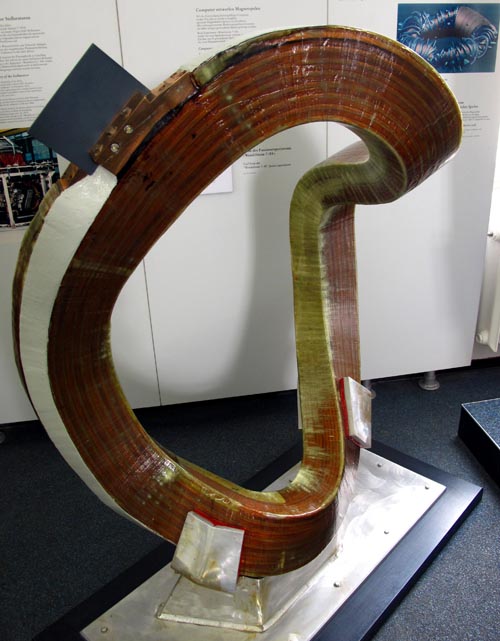
Why such a complicated geometry? If you watch the 5 videos I have installed on YouTube, the guiding principles of Tokamaks are presented. They start from an idea that came from the cold, due to Andrei Sakharov and Artsimovitch. If you equip a toroidal chamber with circular coils, regularly arranged, the magnetic field will be stronger near the axis of the machine, where the coils are closest to each other. Since plasmas tend to move towards regions where the field is minimal, this will cause the magnetic field to tend to expel the plasma created in the chamber towards the outside. The Tokamak represents a first solution. By using a solenoid arranged along the axis of the machine, which creates a slowly increasing field (which will reach 13 teslas on ITER), which bathes the test chamber, an induced current is generated that circulates circularly in the plasma. This current itself creates a field, called poloidal, which combines with the field created by the coils surrounding the chamber. As a result, the field lines take a spiral shape.
Since charged particles tend to spiral around the magnetic field lines, they will follow them. This will allow the plasma to be kept in the center of the chamber. The other solution, suggested by American Lyman Spitzer in the 1950s, is to make what he called a Stellarator. The Wendelstein X-7 machine is a Stellarator:
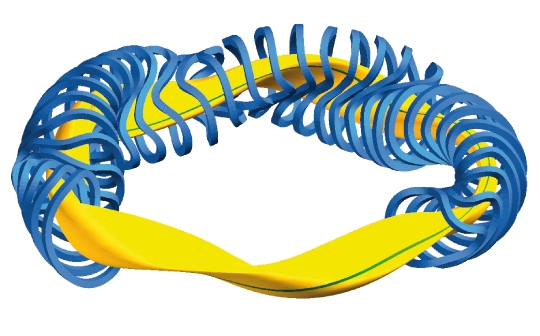
In yellow, the machine's chamber, in blue the numerous coils. During its design, the German Stellarator underwent numerous computer calculations to optimize the shape of its chamber as well as the design of its coils. All of this required enormous work and a million hours of work.
Why choose the Stellarator over the Tokamak? In the Tokamak (and ITER) the major problem is the possibility of disruptions. Inside the chamber, the "plasma current" (15 million amperes for ITER) can be imagined as a snake biting its tail. Very schematically, a disruption can be compared to the rupture of the way this current is wound. Then the snake lets go of its tail and goes "bite the wall". On ITER, this "bite" is estimated at 11 million amperes.
Cause: MHD turbulence. Worse still: this distortion of the magnetic field is accompanied by gradients that are regions accelerating the charged particles: mainly the electrons. These electrons acquire relativistic speeds, close to the speed of light, and gain very high energies. From a certain speed, they practically stop interacting with the ions. They are then called "de-coupled electrons". But by "avalanche effect" they accelerate other electrons. There is a multiplicative effect, considerable on ITER.
In a Stellarator, these phenomena do not exist. This does not mean that other instabilities cannot appear. Only experimentation will provide the answer to this question. For half a century, plasma machines have provided too many unpleasant surprises for it not to be essential to proceed gradually.
The German machine has a magnetization system where the field intensity reaches 3 teslas. The microwave heating system is designed to operate for 10 to 50 seconds. A neutral beam injection system provides an energy input of 8 MW. With this device, researchers hope to bring the plasma in the chamber, with a density of 3 × 10²⁰ nuclei per cubic meter, to a temperature of 60 to 120 million degrees.
The German Stellarator will not be able to produce an "autonomous" fusion plasma, where the energy from the fusion is sufficient to maintain the plasma temperature at a sufficient level. With these different machines, we are trying to ignite the "nuclear fire". You can compare this to an attempt to light "somewhat damp wood" with pieces of crate or a "starter" machine. As long as the damp wood burns, it participates in the exo-energetic process. When the dry wood pieces, or the starter, are consumed, two scenarios. Either the burning of the damp wood releases enough heat for the fire to be self-sustaining, or this released energy is insufficient and the fire will go out, and you will have to start the process again with a new starter.
No plasma machine in the world has so far been able to create such conditions. The most powerful one: JET managed to raise the Q coefficient = injected energy / produced energy to 0.6. The goal of ITER was to obtain a coefficient higher than one. By the way, we have no idea about how a suddenly self-sustaining fusion plasma would behave. As with everything related to these issues, it is very difficult to make theoretical predictions.
The German Stellarator represented a cost proportional to its complexity. I believe the expenses amount to one billion euros. But it is a project that has reached maturity. The machine has been built, its magnetization devices are operational, and at the beginning of December, the researchers obtained their first plasma. The next step will be to increase the energy input, which is negotiated, as in the Tokamaks, using microwaves and neutral injections. These are techniques that are mastered. The first question is: "Does this machine meet expectations in terms of plasma confinement?" It seems that a first positive answer has been obtained.
Does the Stellarator represent a solution for energy production by fusion? It is still too early to say. But its cost remains 16 times lower than that of ITER. The machine has a huge advantage over this pharaonic project: it works, and the researchers do not have to fear that it will be immediately damaged by a disruption, which is not the case for ITER.
This risk severely hampers this project. If you look at how ITER is designed, any component replacement can become an inextricable problem. The components that represent the favorite target of these disruptions are...