Terrorist Missiles and Protection of Commercial Aircraft
Why terrorist missiles have not hit commercial airliners
1 December 2002, updated 19 April 2003
There is a significant difference between military aircraft and commercial airliners. The former are generally not equipped with "bypass" engines, whereas the latter typically are. In a civil aircraft engine, a large turbine is present at the intake. Only the central portion of the airflow is directed toward the turbojet; the remainder forms a kind of cold air casing.
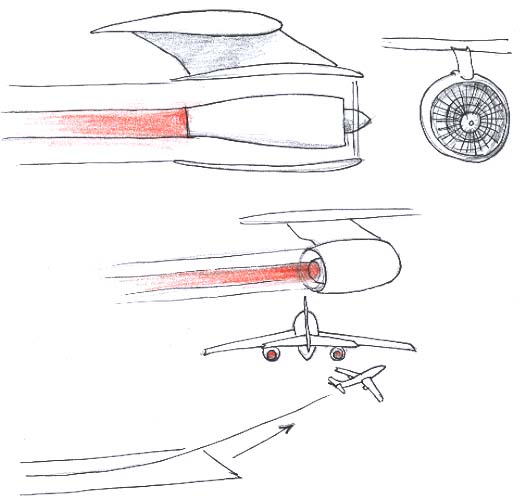
- Overall propulsion efficiency is increased.
- The engine is quieter because sound waves emitted by the turbojet nozzle are reflected by the cold air casing.
- The infrared radiation emitted by the nozzle is also reflected by this layer of cold air, due to the difference in refractive index between the hot jet and the surrounding gas envelope. As a result, the entire jet behaves like an "optical fiber," concentrating both infrared and acoustic emissions along the aircraft's flight axis, toward the rear.
This is why infrared-guided missiles—designed to home in on an aircraft’s engine nozzle(s) and even explode directly inside them—have difficulty tracking the jet exhaust from a bypass engine, unless they are fired from within the aircraft’s wake.
If airlines wish to protect themselves against terrorist attacks, they will need to carefully control the terrain areas located along the flight path of runways. Stinger missiles can hit targets up to an altitude of three thousand meters. As long as a civilian aircraft has not reached this altitude, it remains vulnerable, especially since it climbs in a highly nose-up attitude. Complicating matters further is the fact that aircraft often turn relatively early after takeoff, exposing their rear sections toward other areas of terrain.
In the long term, if this form of terrorism were to escalate, given its effectiveness, it would become necessary to equip civilian aircraft with countermeasures similar to those used on military planes—devices launched laterally, to the right and left of the aircraft. These are "fireworks" designed to lure infrared-guided missiles away.
19 April 2003. A "Missile Defense Act" was introduced to the U.S. Congress in February 2002. According to this proposal, between seven and ten million dollars would be required to protect only American aircraft. Currently, only aircraft carrying political leaders are equipped with systems capable of detecting incoming missiles and deploying countermeasures. One solution involves releasing thermal flares, though this carries the risk of starting ground fires (military flares burn for five seconds). An alternative is to release flares with shorter burn times at low altitudes. It should be remembered that 95% of aircraft hit by ground-launched missiles have been struck by MANPADS (man-portable air defense systems)—lightweight, easily transportable, and undetectable until fired.
The SAM-7 has an uncooled infrared seeker operating in the near-infrared range (wavelength: 1 to 2 microns). More advanced models, such as the SAM-14 "Gremlins," feature a more sensitive seeker. The American Stinger missiles are newer and use an indium antimonide detector operating in the medium infrared range (3 to 5 microns). These missiles can therefore "see" not only the engine exhaust gases but also the hot parts of the airframe.
The scale of the threat: During the time when the CIA supported Afghanistan against the Soviets, it supplied 250 launchers with 1,000 to 1,200 missiles. It is unknown how many were actually used. In 1989, the U.S. Air Force recorded 269 Soviet aircraft shot down by 340 missiles fired—giving a success rate of 80%. It is estimated that between 300 and 600 such weapons remain in circulation. Occasionally, recovered missiles are used against various aircraft—some targeting Indian planes flying over Kashmir. Stingers have been fired by Chechen rebels and Tamil Tigers. Twenty-seven guerrilla movements possess portable missiles. Fifty thousand SAM-7s have been produced. The weapon has been copied by, among others, the Chinese. Pakistani engineers developed their own version, the Anza, while Egyptians created their own, the Ayn as Saqr. The Russians produced more advanced models: the SA-14, SA-16, and SA-18. The SA-14 is particularly easy to transport. The unit possesses them, as does the Irish Republican Army. In 2001, Israeli forces discovered four examples aboard the seized vessel "Santorini."
Portable missiles could previously hit targets at altitudes not exceeding 3,000 meters. However, newer portable systems can now bring down aircraft flying at 6,000 meters. Protecting civilian aircraft would therefore require controlling a zone surrounding airports, extending up to a 50-kilometer radius...
The Third World War has already begun. A choice between Pax Americana and Pax Islamica.
Number of page views since 1 December 2002: