Untitled Document
Can one think like a crab?
February 27, 2009
We express ourselves, among other things, through a language, and this language is supposed to reflect our logical structure. In our language, we have created a bivalent structure, with YES and NO, TRUE and FALSE, which lead to "Aristotelian thought," according to which any statement (a logician would call it a "proposition") can only be TRUE or FALSE. This is called the principle of the excluded middle.
Unfortunately, experience does not follow the theory, and our phrasing is full of undecidable propositions, which are neither true nor false, such as
I am lying
For a good century, logicians have displayed great imagination in trying to build non-bivalent logics. Let us give an example of a trivalent logic, the fuzzy logic, whose truth values are
True Indeterminate False
a logic that has proven its operational character in automatism, process controls (in engineering)
Attempts to construct a tetralogic have also been made, the most classical one having the following truth values
| True | False | True and False | Neither True nor False |
|---|
An attempt at extension that has not proven fruitful.
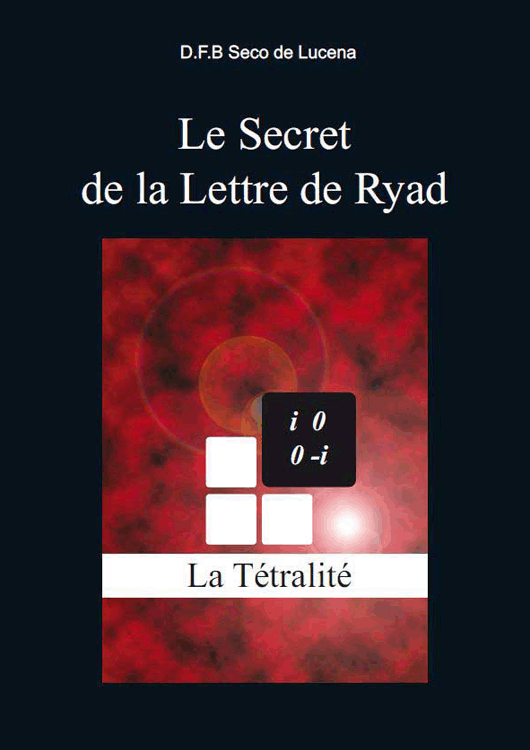
In his book:
To contact the author directly:

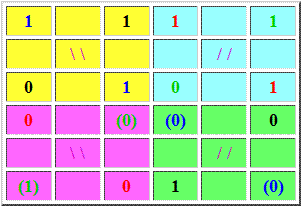
Erratum The author informs us that there is an erratum in one of the tables presented in his book. It is the one on page 29, whose color version is on page 135. First of all, thank you for your interest in this work, and for having chosen to purchase the book.
These things happen... There is a nice typo! Third row and column, instead of a 1 there is mistakenly a 0. This correction will be sent to everyone in a few days.
Moreover, the signs = and \ are found in the diagonals: these double bars, viewed from a diagonal, give the sign =, and from the other diagonal give \ which should be understood as "different," where they are found.
We hope this will allow you to continue your reading properly. Once again, our warmest thanks (and our apologies as well!), and we remain at your disposal if you are ever again confronted with a doubt... Or a new typo!
Figure 2.2, to be replaced by the table above
Denis Seco de Lucena invites us to a strange exploration, from which the reader may not emerge unscathed. Let us start with an examination of language, which is the approach of any logician. The author proposes to introduce what he calls the concept of transversality. From this perspective, any proposition, whatever it may be, would be susceptible of a declension in four forms, symmetric in pairs, consisting of "two symmetric couples." Many examples exist in language, but the "fourth proposition" is sometimes difficult to formulate, or does not correspond to any existing qualifier in language.
Let us first give examples where this "transversality" is clearly expressed. Take, for example, the concept of movement. There are thus four ways of "moving":
| Forward | Backward | Stagnate | Move |
|---|
It is immediately clear that the couples appear, with their symmetries. Backward is the opposite of forward, and vice versa. Move is the opposite of Stagnate, and vice versa.
If we refer to topology, we will introduce four adverbs or adverbial expressions:
| Outside | Inside | On the border | Elsewhere |
|---|
February 29, 2010: My friend Jacques Legalland suggests that the fourth proposition would be better formulated by writing:
| Outside | Inside | On the border | Nowhere |
|---|
If we refer to colors:
| White | Black | Gray | Tinted |
|---|
February 27, 2010: Jie suggests:
| White | Black | Gray | Transparent |
|---|
Playing with time:
| Before | After | Now | Never |
|---|
The adverb never is the temporal equivalent of the adverbial expression "nowhere" (see above)
This way of seeing things reminds me of the Ummite text on logic, which, if I remember correctly, mentioned four truth values:
| True | False | True and False | Untranslatable |
|---|
If we take the truth values of the classical tetralogic:
| True | False | True and False | Neither True nor False |
|---|
February 27, 2010: The fourth value should be reinterpreted as "does not correspond to this type of classification":
| True | False | True and False | Does not correspond to this type of classification |
|---|
Let us take the real numbers. We have:
| Positive | Negative | Zero (in the sense of positive and negative) |
|---|
The fourth proposition could be:
| Positive | Negative | Zero (in the sense of positive and negative) | Imaginary |
|---|
Moving on to implication:
| Implies | Is implied by | Contingent with respect to | Unrelated to |
|---|
We can see that four ways of "saying" emerge, which are different from the "classical" tetralogic mentioned above. The symmetry of the last two propositions is different. The author suggests that these pairs of propositions, of qualifiers, are "transverse."
The way we present things does not correspond to the way the author uses in his book, which I recommend you read. But at first, you will say "what is hidden behind this?" This question will take you far. The author, a scientist, found his starting point in a letter I received in 1992 from mysterious correspondents calling themselves "Ummites," a letter that had been addressed to me from Riyadh, Saudi Arabia. For those who do not know this story, it is good to recall the context. Among the documents brought back from Spain since the mid-1970s, the authors of these texts emphasized the need to abandon Aristotelian logic and move to a tetralogic.
For years, I struggled with different attempts. In 1992 I had a first-generation Mac Intosh running at 2 Mhz, and obviously completely devoid of a modem or any means of communication with the outside world. In this computer, I recorded reflections that were known only to me. Prompted by Gödel's theorem, I remembered that it was based on arithmetic (the manipulation of natural numbers), axiomatized at the end of the last century by the mathematician Peano. The mathematician Gauss invented what is now called "Gauss integers," that is, complex numbers with integer values.
I noticed that these Gauss integers were usually considered as pairs of natural integers (a, b), and no axiomatization had been attempted to construct them, other than deciding to give them "two integers."
A few days after putting these few reflections on my hard drive, I was surprised to receive a letter addressed to me from Saudi Arabia, mentioning the same reflections.