| 20 |
The "model"
of dark matter.
...We
saw above the impressive list of problems linked, if only
to astrophysics. Galaxies rotate too fast, for
example. The inventoried mass is 3 to 5 times too low to counterbalance
the centrifugal force. An even worse situation for galaxy clusters. An already
old problem, since it had been initially reported by Fritz Zwicky, dozens of years ago.
...How
to get out of it? Should Newton's law be revised? Some simply
suggested that galaxies, galaxy clusters and even
the entire universe, might harbor within themselves a mass (contributing
to the gravitational field) that would have until now escaped
observation. What could it be? For example, stars too
little emissive. A name was found for these objects: MACHOS (massive
compact halo objects, that is to say compact and massive objects, located
in the halo of galaxies: the portion of galactic space situated
inside and outside the "disk"). Detection method: occultation of
sources located in the background, essentially stars.
Method: carry out a tracking of a very large number of stars
and highlight decreases in luminosity, whose evolution
over time would differ from the fluctuations corresponding to variable
stars.
Results: disappointing.
...Another
hypothesis: "exotic particles", for example massive neutrinos
(endowed with a low mass). But no highlighting to
this day of a possible mass of neutrinos.
....Another
candidate, dear to the astrophysicist Françoise Combes: cold
hydrogen, at very low temperature, therefore practically unobservable.
...This
dark matter would then make it possible to account for the strong effects
of gravitational lensing, apparently linked to galaxies and
galaxy clusters (gravitational arcs). Many consider these effects
as an "irrefutable proof" of the existence of this undetected
matter.
...It
is then possible to account for anything and any other thing
by skillfully sprinkling the universe with dark matter, in the right places.
It is therefore a perfectly ad hoc theory. Some moreover do not even
care to justify the origin of this component, its nature,
its origin, nor even to describe its dynamics, being content
to say that it is a new astronomy, "where
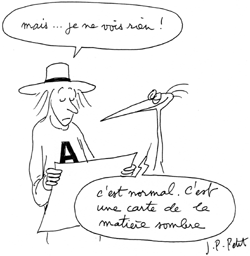
the invisible is now mapped". Teams are at work, which
have undertaken to draw up maps of the distribution of dark matter.
...This
makes it possible to tie together the large-scale structure of the universe,
and thus to "justify" it. Elsewhere a distribution of dark
matter is produced which makes it possible not only to justify the cohesion of galaxies,
but the shape of their rotation curves. All this is published abundantly
and without problems (astrophysical Journal, Astronomy and Astrophysics,
etc...). A distinction is made there between "cold dark matter" and "hot
dark matter".
Certain speculations
therefore seem "legitimate".
The question of the cosmological constant and the age of the universe.
Let us first situate its origin.
Equipped with his field equation:
S = c T
...Einstein
had immediately sought to construct a model of the universe
(1917) . But as he was unaware that this one was non-stationary he
had therefore sought to construct a stationary model.
He then came up against numerous problems and went to visit
the French mathematician Elie Cartan, who declared to him:
- One can modify your equation. I propose to you:
S = c T -Lg
where g is the metric tensor
and L a constant. That way the equation
remains well tensorial and your solution always invariant by change
of coordinates.
-
But, what is the
physical meaning of this constant L
? -
That, my dear, is
your problem. I, am a mathematician.....
Starting from a field equation, by placing oneself in the hypothesis
where the curvature is weak and the thermal agitation speeds weak
compared with the speed of light c one can recover Newtonian dynamics.
Newton's force is then endowed with a corrective term:

...This
corrective term was thus proportional to the distance. The name
"repulsive power of the vacuum" is commonly used (or attractive,
it all depends on the sign chosen for this arbitrary constant L).
...This
repulsive power of the vacuum was the keystone that allowed
Einstein's stationary universe to know an equilibrium
(unstable, moreover). But, very quickly:
-
Edwin Hubble's
discovery reported a red shift z, assimilated to
a general movement of cosmic expansion (Doppler Effect). So
farewell the stationary universe model. -
The Russian Friedmann
brought out at the same moment the non-stationary solutions of the field
equation, without cosmological constant.
Displeased, Einstein
withdrew under his tent saying:
- If I had known that
the universe was non-stationary, I would have found before Friedmann
!
...This
cosmological constant then sank into a quasi oblivion for decades.
Some put forward arguments advocating its necessary
nullity. The fact is that, referring to actions
at very great distances, it made its action felt only
in a late manner, when the characteristic dimension R(t)
of the universe had reached "a sufficient value".
...The
measurements of red shift, of radial velocity of galaxies, make it possible to calibrate
Hubble's law, which follows from the solution of the field
equation and which simply says:
The escape velocity
is proportional to the red shift z

The constant of proportionality
is called the Hubble constant Ho.
....A
parenthesis for those who are unaware of it. An atom, in the laboratory, motionless
relative to the measuring device, emits for example a radiation
corresponding to a wavelength l. As
a result of the Doppler effect the same atom, in movement, will give a wavelength
: l' = l+ D
l
We set:
| z = |
If D
l is positive
: the source is moving away: red shift.
If D
l is negative,
the source is approaching: "blue shift".
The Hubble constant
also appears in the expansion law R(t) as a function of
time:
...We
know that there are in fact three Friedmann models, which differ
only by the description they give of the distant future of the cosmos.

In the diagram
below, where one is supposed to be "far enough"
from this distant future of the universe the three curves are merged.

...So
the knowledge of the cosmic expansion law, of the Hubble constant,
makes it possible immediately, according to this model (with zero cosmological
constant) to deduce the age of the universe from it.
...Let us imagine
that we take an instantaneous photograph of the explosion of a
grenade. The exposure time would give a certain blur to the objects, which would make it possible
to evaluate their speed, therefore to calculate, by examining a simple photo
the moment when the explosion began. The cosmic explosion
is of course different from the explosion of a grenade, by
its dynamics, since the force of gravitation, by braking the expansion, slows
this one down progressively.
...The
objects of the cosmos are animated by proper motions , in
the manner of the molecules of a gas, which are animated by a
movement of thermal agitation. One speaks moreover of "cosmological fluid",
a "gas" whose molecules would be the galaxies.
...To
be able to evaluate the Hubble constant it was therefore necessary to base the
measurements on sufficiently distant objects, therefore animated by sufficiently
high speeds for these to exceed the average value of
the agitation speed of a galaxy in its cluster (of the order of 500 to
1000 kilometers per second).
...The
problem remained the evaluation of the distance. To see a galaxy
on a shot is one thing, to evaluate its distance is
another. To do this one must know its absolute magnitude ,
the quantity of light it is supposed to emit.
For a long time astronomers did not agree on the evaluation
of this Hubble constant (in this matter, a great contestant
was the French astronomer de Vaucouleurs, working in the USA).
...The
oldest stars of our own galaxy belong to star
clusters, like the Hercules cluster. Until now the astronomers were
all in agreement to situate their maximum age around 15 billion years
(but some went even up to 20 or even 22....).
The whole game then consisted in adjusting the evaluation of Ho so as
not to deviate too much from this age of the oldest stars.
...In 1993 the astronomers were able, with the help
of the Hubble space telescope, to observe cepheids
in extremely distant galaxies (55 and 48 million light-years).
The cepheid is the standard of distance par excellence,
since one is supposed to know the law linking their period
of fluctuation and the quantity of light they emit,
their absolute magnitude (law of Henrietta Leawitt, 1912). Measuring, with
the help of the telescope, their apparent magnitude , one deduces
their distance from it.
...The
measurements carried out on galaxies, in 93-94 divided the
distance that one had estimated until then by almost a factor of two.
As a result the age of the universe fell to 8 or 9 billion years
and this one became ... younger than the stars it contained.
And the journal Nature, in 1994, concluded "the model is going to have to be put back
on the workbench".
...Since then,
two new facts have occurred. The law on cepheids,
to be usable, must be calibrated. If one admits
that there exists a relation between the period of these variable stars
and their absolute magnitude, the quantity of light they emit,
one still needs to have independent distance measurements. These
are provided by the parallax method, of Bessel. One then uses
the seasonal displacement of the Earth around the sun, by taking
two diametrically opposite positions. For a given star,
relatively close, with respect to a background of very distant stars,
at the two epochs of the year one will have two different positions, corresponding to a certain
angular deviation Dq .

...This method has its limits. The more distant
the star is, the greater the margin of error. The measurements in distances
were recently recalibrated using the Hipparcos satellite.
According to the specialists the analysis of the data reported
by the satellite would have led to a revision of the distances
estimated for the cepheids classically serving
for the calibration of the law, their distance increasing by a factor
1.2 to 1.4. Thus the galaxies in which the Hubble satellite had
detected cepheids were "not
so close as that" therefore the universe "not so young as that". For their part,
those who evaluated the age of the oldest
stars of the star clusters of our galaxy made serious
efforts downwards and "everything falls back into order", estimate some.
Let us admit...
...The other
"classical" solution consists, as Lachièze-Rey had done, in
bringing out, in urgency, the cosmological constant L
from its mothballs. Endowed with the right sign (repulsive power of the vacuum)
this one has the effect of relaunching the expansion:

The law:

therefore ceases to be valid, or provides a shorter age. In fact,
through this "variable geometry" model
one can always choose a value of L that fits
with any value of the age of the universe, for example that
of its oldest stars. Some even went so far as to
say that this quite simply gave a measurement of L
.
...The
quarrel which divides the astronomers on the subject of the age of the universe seems
far from dying out. Between the optimists who, relying on a recent recalibration
of the cepheids dilate the whole of the nearby universe
(as for example the distance of the Andromeda galaxy) and
admit a downward reevaluation of the age
of the oldest stars and the alarmists, who think that Hubble's measurements
raise a real problem, what position
to adopt?
That of a prudent wait,
without doubt.

Summary of
article Summary
Science Home
Page
Return to
Guide-Sciences Number of consultations of this page since July 1, 2004
: