Magnetic Hydrodynamic (MHD) and Antimatter UFO Technology
Open letter from a group of French scientists to the founder of the Disclosure project.
Introduction.
We are a group of French scientists. We have read Dr. Greer's text on the Disclosure website and were impressed by his observations. We are convinced, like him, that some nations, and mainly the United States, have drawn from UFO files, recovered crashed UFOs and possible contacts with extraterrestrials, information that has led to new scientific knowledge. We will go further and discuss the assessment of the progress made based on this information. The question is: "How far have they gone?" We have precise information on secret American programs related to hypersonic aircraft, whether it be the satellite-capable spy ship Aurora or a long-range hypersonic bomber, the B2 being only a camouflage. The technical data we have allow us, in this specific case, to support our claims. These technologies have been directly derived from the analysis of the debris recovered at Roswell, which was a hypersonic spacecraft and not an interstellar vehicle. We regret that this reverse engineering has been applied only for military purposes, because these techniques could have found a much better use: on the one hand, a completely reusable space launcher, much more efficient and cheaper than conventional rockets; on the other hand, a hypersonic commercial aircraft.
Possible synthesis of antimatter.
Furthermore, it is highly likely that the Americans have mastered a technique for mass production of antimatter, which - and not the "vacuum energy" - constitutes the future quasi-magical, inexhaustible energy, coming from nowhere; unless one considers the transformation of matter into antimatter by thermonuclear compression as a means of "extracting energy from the vacuum." I clarify that once antimatter is produced in this way, it can be used to produce more. No nuclear explosion is necessary at each start. However, this technology puts in the hands of humanity incredibly destructive bombs, much more powerful than the most powerful thermonuclear weapons currently available. It also creates a risk of direct and immediate war, since very small amounts of antimatter can be stored in crystals under very stable electrostatic confinement; this allows the manufacture of small bombs - "buckminsterfullerene balls" - the size of an egg, including the thermal shield, with a power of 40 tons of TNT. Thanks to their relatively limited power and the fact that no waste is produced, these bombs could be easily used. Instead of dropping high-power bombs on isolated targets, which would cause large amounts of dust to rise into the upper atmosphere and cause nuclear winter effects, it would be possible to spread a large number of these small antimatter bombs and cause equivalent damage, while avoiding the dust from rising to high altitude and triggering a nuclear winter. We think that the United States already has a considerable number of such weapons, allowing them to completely reduce countries to ashes, and we fear that these devices will soon be used discreetly on a smaller scale. This takes us far away from the positive applications that humanity could benefit from through such technology, which would produce, as Dr. Greer rightly says, "deserts in bloom."
Problem of raw material and waste.
We think that the extraterrestrial ships that visit us use antimatter, stored on board or synthesized, as their main energy source. This basic energy could be used in a very varied way. One of the most useful applications would be to master the transmutation of materials, thus allowing the synthesis of any type of atom at will. Combined with a very advanced nanotechnology, this would allow the synthesis of the most complex systems without human intervention, that is, without "work." Conversely, any system composed of atoms could be converted into neutral waste such as helium, the typically ideal waste. If we survive the coming century, this will be our future technology. If such a set of techniques were completed by a more comprehensive biological approach than the one currently practiced on Earth, the human being would have the keys to a golden age within reach.
Current state of technology on Earth.
We do not know how far these technologies have been developed on Earth. To date, we can only strongly suspect that the synthesis of antimatter by thermonuclear compression was achieved in the United States towards the end of the sixties; we will return to this later. Another problem raised by Dr. Greer is the reduction, cancellation or even inversion (anti-gravity) of the weight of machines. We consider this as feasible. This is the technique used by UFOs when they hover without moving the air. In our opinion, this can only be understood through an important paradigm shift, a different way of conceiving space and matter. But this remains speculative, and we suggest returning to it later. The control of anti-gravity could obviously be applied to civil transport, but far beyond that, we think it would open the way to distant space travel. Again, we will return to this question at the end of this article.
Our comments on the Space Energy Access Systems.
Although the sentiment that motivated this project is commendable, we doubt its chances of success. We think that its applications (unlimited energy production, anti-gravity), although physically conceivable, would require extremely expensive advanced technologies. Compared to this, one could imagine the Foundation offering a full bag of gold to anyone who succeeded in making an airplane carrying three passengers fly above six miles. We are skeptical about the compatibility of such techniques with soft technologies accessible to amateurs or moderate-sized laboratories. In our opinion, such developments could only be considered by large laboratories with considerable funds, for which a million-dollar prize would appear as a trivial sum compared to the cost of these researches. Therefore, such laboratories would inevitably be linked to the military-industrial lobbies. At best, the supporters of such a project would be rewarded with interesting theoretical ideas, but without practical exploitable results. This is our opinion, of course, we could be wrong.
Our response to the Disclosure Manifesto.
While we are not able to submit to Dr. Greer plans for a machine producing unlimited energy or capable of canceling the force of gravity, we can, however, present solid arguments in favor of his campaign against the diversion of technologies by the military-industrial complexes, inaccessible to the American political power and dedicated to serving a few who seek to dominate the world by force. The elements we can produce are related to high-speed underwater propulsion and the construction of long-range hypersonic aircraft, these two techniques being based on what is called magnetohydrodynamics, or MHD.
General remarks on MHD.
MHD has been the subject of sustained research in the sixties, the civil sector having obviously not been accessible to the public. The objective at the time was to produce electricity by direct MHD conversion, using as primary energy fossil fuels - "open cycles" - or energy produced by high-temperature reactors (HTR). In both cases, the research teams encountered the fact that gases at "technological" temperatures, even seeded with substances with low ionization potential such as cesium, were not sufficiently electrically conductive. Below 3000°K, their electrical conductivity was too low. The Russians pushed this MHD electricity production technique as far as possible with their U-25 generator, which burns a mixture of hydrocarbons and pure oxygen. But this civil-oriented research was eventually abandoned. Another attempt was made with two-temperature gases (in which the electron gas has a higher temperature than the atom gas). This was not possible in a molecular environment containing a lot of carbon dioxide (result of combustion). Indeed, this molecule is easily excited by collisions with electrons. The result was a large loss of energy by radiation (radiative de-excitation). This two-temperature system was therefore limited to closed cycles where the conversion fluid was a rare gas: helium, seeded with cesium, used to cool the core of a high-temperature reactor (1500°K). It should be noted that these reactors were never built or tested. The atomic scientists only thought about their possible construction, and thank goodness, they were never built.
This research ran into something that completely destroyed the performance of the generators, making the plasma very heterogeneous: it was an instability discovered in 1964 by the Russian Velikhov. These preliminaries may seem strange, but they explain why civil MHD research was abandoned in many countries, except in the United States and Russia, where military MHD was developed in secret. In Russia, the father of military MHD was Andrei Sakharov. His student was none other than Velikhov, the innovator of the Soviet-style Star Wars, and the main advisor to Putin on advanced weapons.
Description of American and Russian hypersonic MHD torpedoes.
For a long time, the United States and the USSR had undeniable evidence that UFOs were of extraterrestrial origin. The United States had recovered at least one hypersonic vehicle crashed at Roswell, and it is very likely that the Russians also recovered an equivalent amount. It was not until the 1970s that the Americans understood that one of the key elements of the Roswell ship's operation was MHD. They also understood that military MHD had a strategic importance, and they launched an intense disinformation campaign, both inside and outside the country, to keep researchers away from what they claimed was a dead-end subject. I obtained this information because I have been closely involved, since 1965, in French civil MHD projects. I built a Faraday linear generator, based on a combustion shock tube, producing several megawatts of power for 200 microseconds, with a magnetic field of two teslas. Having overcome the Velikhov instability, we succeeded in obtaining the first stable two-temperature conditions, which was presented at the international Warsaw conference in 1967. But despite this success, in the early 1970s, in our own country as elsewhere, this research was abandoned. It is worth noting that our team achieved a jet gas speed gain of 5,500 m/s over a distance of less than 4 inches, with argon flows at 10,000°K injected into a Faraday accelerator at 2,750 m/s under a pressure of one bar. But at the time, no one in France understood the military implication of what would become, elsewhere, a very high specific impulse MHD propulsion.
If I remember correctly, I traveled to the United States in 1984 to participate in an international MHD meeting in Boston. The Russians presented their Pavlovsky generator, one of many versions of the flux compression generators tested as early as the 1950s by Sakharov's team, which later became the typical power system for their directed energy weapons (electron beams and lasers). In addition to this novelty, representatives from various countries, including American researchers (the conference was organized by J.F. Louis of AVCO), lamented the loss of interest from their governments. Yet, we were unaware that three years earlier, the Americans had already implemented their first MHD torpedoes at 1,000 knots; we found out many years later. Today, in countries possessing advanced technology, propeller torpedoes have been abandoned for exactly thirty years. The rocket propulsion proved to be more efficient and gave rise to vehicles such as the American Supercav or the Russian Sqwal.


Russian Rocket Torpedo Sqwal (250 knots)
The British currently have a similar weapon, the Spearfish. In these torpedoes, a hot gas is ejected from the nose of the device and vaporizes the surrounding seawater. The torpedo then moves through a water vapor envelope; the resulting reduction in friction allows speeds of 200 to 250 knots. The trajectory control is achieved by the pole exiting the nose after launch. The direction is ensured by modulating the flows of the nozzles surrounding the main propulsion nose, powered by the gas generator located at the front. Today, these machines are however outdated, even if countries like France have not yet adopted them. The American and Russian MHD torpedoes also have a solid fuel rocket engine. The divergent acts as an MHD converter, producing a large amount of electrical energy. This energy powers a wall accelerator whose main description is added here to reduce weight. This system strongly sucks in water; thus the concept of viscous drag is no longer appropriate, because the wake is not only eliminated, but even reversed; which opens the way to very high speeds. These speeds, estimated today at about 1,600 to 1,900 knots, allow the torpedoes to reach their targets in a few seconds. It is easy to understand the major strategic advantage brought to any nation possessing these torpedoes, because it could destroy strategic enemy nuclear submarines, the most dangerous weapons of all. They are generally positioned as close as possible to their potential targets to reduce the range of the ballistic flight, thus the chances of interception. In reality, the destruction of these missile-loaded submarines would probably be the very first act of war of any nation with advanced technology. The Chinese do not yet have this type of equipment. In 1996, the Russians tried to demonstrate their machine nicknamed "The Big One," of a one-meter caliber, because they hoped to sell it. Such a technological transfer would, in the long term, have constituted a great threat to world security, and informed of the transactions, the Americans boarded and sank the Kursk, which was to, in the presence of a Chinese general, make the demonstration. Fearing that this would be discovered, the Russians closed all the hatches of the submarine (by remote order via sonar emitted from the cruiser Peter the Great, flagship of the maneuvers), leaving the entire crew to perish and later recovering the survivor.
The MHD torpedo and its wall accelerator propulsion thus constitute one of the first military applications of MHD derived from the in-depth analysis of the Roswell debris.

American Hypersonic Machines. Aurora and the Antipodal Hypersonic Bomber.
Aerial transport machines have remained to be designed. From Mach 3, the heat generated by the air compression behind the shock wave is significant. By passing to the stator, it becomes possible to reach higher Mach levels. One can then consider, around Mach 6, a scramjet engine operating (hypersonic combustion), where the fuel and oxidant (hydrogen and liquid oxygen) circulate at the leading edge to cool it. But the examination of the Roswell vehicle allowed to find a better solution, which led to the machine Aurora, which made its first flight in 1990 at Groom Lake. This very ingenious device can take off by its own means, accelerate, gain altitude, reach 6,000 knots at 180,000 feet, and then be satellite with conventional rockets. Two very different operational modes are then required. Initially, Aurora - whose Russian version, Ajax, designed by Fraistadt, was never built due to lack of funding - resembles a conventional fighter jet. Four non-afterburning turbojets are suspended under a strongly curved wing, with a perfectly flat top and a highly raised canard tail.

Aurora in subsonic and moderate Mach flight
Aurora then reaches Mach 3 and the airflow at the engine changes. The lower air intakes close. The plane then flies in low-pressure air, which is easier to ionize. An air intake opens on the top, in front of which a set of parallel electrodes forms a wall MHD generator. Since this section functions as a generator, the air is slowed down and recompressed (by the Lorentz forces). A continuous slowdown occurs, without shock wave and with moderate heating, until the gas can be directed to the air intake of a conventional turbojet, even
The Americans have succeeded in separating the antimatter produced from the matter and confining it in "magnetic bottles." They finally used it for propulsion, notably in a disc-shaped drone, operational since 2000, capable of flying at Mach 10 in dense air, and which they try to keep secret. This object operates according to the principles described in the appendix &&&. If one excepts the stationary flight without aerodynamic airflow (related to "anti-gravity") and the sharp turns, it appears that the Americans have almost succeeded in reproducing, through HDm, the behavior of the UFOs crossing between the atmospheres. They are now trying to further develop this technology, which would give them access to interstellar travel. We do not know if they have made significant progress in this direction, although some think so. If this were the case, it would compromise the future of humanity, because the extraterrestrials would probably not tolerate that such barbarians as us could go bother the neighboring civilizations.
Meanwhile, the Americans use small amounts of antimatter to accelerate silicon vapor up to 500 km/s in HDm accelerators used for space propulsion. Thanks to such engines, they have been able to accelerate space probes up to 100 km/s and achieve a near-complete mapping of the Solar System in five years. They have also tested antimatter bombs, in which very powerful charges were synthesized on-site at the moment of impact. The first tests of these fully oversized bombs, too powerful to be tested on Earth, were carried out by sending them towards the Sun. For this, high specific impulse HDm bombs were launched on trajectories forming a wide angle with the plane of the ecliptic in order to make them collide with a known family of comets. The tests continued with shots on Jupiter. Again, the bomb modules were directed in such a way as to be confused with comet debris. Initially loaded on the military ship Atlantis, the modules were transported to the site by an HDm-propelled cargo ship, which then self-destructed. The modules created a simulated comet outgassing magnetosphere. They penetrated the high atmosphere of Jupiter at 100 km/s thanks to their HDm shield system. The compressed thermonuclear synthesis of antimatter, followed by an instantaneous explosion, ensured that the impacts were perceived as comet fragments.
Subsequent launches targeted Jupiter's satellites, such as Io and Europa. Each time, the Galileo probe, placed in orbit precisely to monitor these tests, did not transmit images to Earth, at least according to the official version. It suffered several failures depriving earthlings of close-up images of Jupiter's satellites.
An open question.
The purpose of these shots remains mysterious: are they anti-comet weapons? Some astronomers think that at the time of the formation of the Solar System, a terrestrial planet was ejected by tidal effect on a very eccentric and long-period orbit (2000 to 3000 years), at a wide angle relative to the plane of the ecliptic. This planet would have been reduced to a large number of fragments when passing through the Roche sphere of the object from which it had been ejected. The periodic return of this cloud of fragments, of cometary or asteroidal size and therefore undetectable at any distance beyond that of Jupiter, could cause certain problems. Would the extraterrestrials have provided the Americans with the means to accelerate their scientific and technical knowledge in order to enable them to master the destruction of such objects between 2020 and 2030? Was the Roswell crash a fake, deliberately abandoned to trigger this acceleration? Any hypothesis is possible. It should be kept in mind that if such a risk existed, it would be necessary to launch a projectile on a collision course with an object moving at 40 km/s; conventional propulsion would be useless, because the shot would then have to arrange to travel in escort with the target. It would then be necessary to drill a path using a several-kilometer antimatter jet to explode, at the center of the object, a charge of several thousand megatons, in order to turn it into debris each less than one meter in diameter, which would burn up in the atmosphere. Are the shots fired on Jupiter, Io and Europa part of such a plan?
Indeed, we know nothing about our Solar System or the future of our Earth. In France, our group has received more than one phone call warning of the approach of comets, the messages containing precise dates of perihelion, well before the objects could be detected by terrestrial telescopes.
About anti-gravity.
Our theoretical cosmology research, published by us, and inspired by information received through contacts with extraterrestrials, has led us to build a cosmological model based on two universes, developing ideas put forward by Andrei Sakharov in 1976: the cosmology of twin universes. We think that the latter also had contact with extraterrestrials. It is enough to read the strange terms of his speech, read by his friend Helena Bonaire in Sweden during the Nobel Prize ceremony. This model is based on a double or twin universe. Australian researchers Foot and Volkas are currently following a similar path, talking about "mirror universes" (articles published in Physical Review). We have demonstrated that the "apparent mass" of the "twin universe" was negative, that is, the twin matter repels ours, while two particles of twin matter attract each other mutually, in accordance with Newton's law. This repulsion explains the re-acceleration of the expansion of our universe, while it slows down that of the twin universe.
When interstellar ships travel great distances, they use the twin universe as a sort of "express subway." In this universe, extremely rarefied in the regions adjacent to ours, the distances are shortened and the speed of light is high. This makes space travel possible, provided the following principle is respected: "it is forbidden to exceed the speed of light of the universe in which you are located." An American research team is working on an idea to locally modify the value of the speed of light: the concept of "warp drive." Our approach is different and much more advanced. Thanks to the help of extraterrestrials, it took us years to begin to understand how it works, and it would take several pages to describe it. In principle, the mass of the vehicle must be transferred to the twin universe. When this operation occurs near the Earth, the Earth becomes invisible to the ship, but acts on it as a negative mass, repulsive. If the stations located in our universe and in the adjacent region of the twin universe are alternated rapidly, this is not detected by an external observer; however, during one phase, the ship falls under the Earth's gravitational attraction, while during the other, it rises under the Earth's repulsion. Overall, this amounts to an apparent cancellation of the ship's weight, regardless of its mass. This is how we interpret what people call anti-gravity. We do not know if the extraterrestrials have transmitted the clues of these techniques to the Earthlings.
Conclusion.
Let us stick to the known elements; we feel strongly concerned by Dr. Greer's text. It seems clear that a group of humans possesses elements of science and technology far ahead of the rest of the world. How did they acquire this knowledge, and why? Is it simply a consequence of the crash of an extraterrestrial ship at Roswell? Is there behind all this a much more complex project? Have there been contacts between the extraterrestrials and this human group? What is the agenda of each? Is the hegemonic domination of this human group over the entire planet the consequence of an attempt to help humanity survive the next passage of a planetary fragment cloud? We would like to know. Finally, by becoming aware that they are not alone, do people gain some wisdom and, through the technology that allows it, transform their planet into a paradise?
In any case, we think it is time for those who hold the secrets to reveal the truth, and it is precisely in this direction that our participation in the Disclosure project is situated.
December 2002
Prof. Jean-Pierre Petit,
Research Director at CNRS,
Astrophysicist, expert in MHD and theoretical cosmology.
(Translated by André Dufour)
Bibliography :
(1) J.P.Petit : « Is supersonic flight possible? » Eighth International Conference on Electric Power Production by MHD. Moscow, 1983.
(2) J.P.Petit & B.Lebrun : « Suppression of shock waves in a gas by the action of the Lorentz force ». Ninth International Conference on Electric Power Production by MHD. Tsukuba, Japan, 1986.
(3) B.Lebrun & J.P.Petit : « Suppression of shock waves by MHD action in supersonic flows. Quasi-one-dimensional stationary analysis and thermal blocking ». European Journal of Mechanics; B/Fluids, 8, n°2, pp.163-178, 1989.
(4) B.Lebrun & J.P.Petit : « Suppression of shock waves by MHD action in supersonic flows. Stationary two-dimensional non-isentropic analysis. Anti-shock criterion and simulations in a shock tube for isentropic flows ». European Journal of Mechanics, B/Fluids, 8, pp.307-326, 1989.
(5) B.Lebrun : « Theoretical approach to the suppression of shock waves forming around a sharp obstacle placed in an ionized argon flow ». Thesis n° 233. University of Poitiers, France, 1990.
(6) B.Lebrun & J.P.Petit : « Theoretical analysis of the suppression of shock waves by Lorentz force field ». International MHD Conference, Beijing, 1990.
Annex 1: MHD Annex
2 (other weapons) Annex
3 (MHD torpedo)
Original version (English)
Anti-matter technology MHD
Open letter from a group of French scientists to the founder of the Disclosure project.
Introduction.
We are a group of French scientists. We have read Dr. Greer's text on the Disclosure website and were impressed by his observations. We are convinced, as he is, that certain nations, and primarily the United States, have been able to extract from UFO files, recovered crashed UFOs, and possible contacts with extraterrestrials, information that has led to entirely new scientific knowledge. We will further discuss the assessment of the progress made based on this information. The question is: "How far have they gone?" We have precise information on the secret American programs related to hypersonic aircraft, whether it is the satellite-able spy plane Aurora or a long-range hypersonic bomber, of which the B2 is only a camouflage. The technical data we have allow us, in this specific case, to support our claims. These technologies were directly derived from the analysis of the debris recovered at Roswell, which was a hypersonic spacecraft and not an interstellar vehicle. We regret that this reverse engineering has been applied only for military purposes, as these techniques could have found much better applications: on one hand, an entirely reusable space launcher, much more efficient and cheaper than conventional rockets; on the other hand, a hypersonic commercial aircraft.
Possible synthesis of antimatter.
Moreover, it is highly likely that the Americans have mastered a technique for mass production of antimatter, which - and not the "vacuum energy" - is the future quasi-magical, inexhaustible energy coming from nowhere; unless one considers the transformation of matter into antimatter by thermonuclear compression as a means of "extracting energy from the vacuum." I clarify that once antimatter is produced in this way, it can be used to produce more. No nuclear explosion is necessary at each start. However, this technology puts into the hands of humanity bombs incredibly more destructive than the most powerful thermonuclear weapons currently available. It also generates a risk of direct and immediate war, because very small quantities of antimatter can be stored in crystals under very stable electrostatic confinement; this allows the production of small bombs - "buckminsterfullerene balls" - the size of an egg, including the thermal shield, with a power of 40 tons of TNT. Thanks to their relatively limited power and the fact that no waste is produced, these bombs could be easily used. Instead of dropping high-power bombs on isolated targets, which would cause large amounts of fine dust to rise into the upper atmosphere and cause nuclear winter effects, it would be possible to spread a large number of these small antimatter bombs and cause equivalent damage, while avoiding the dust from rising to high altitude and triggering a nuclear winter. We believe that the United States already has a considerable number of such weapons, capable of completely reducing countries to ashes, and we fear that these devices will soon be used discreetly on a smaller scale. This takes us far from the positive applications that humanity could benefit from through such technology, thus producing, as Dr. Greer rightly says, "flowers in the desert."
The problem of raw material and waste.
We believe that the extraterrestrial vehicles that visit us use antimatter, stored on board or synthesized, as their main energy source. This basic energy could be used for many purposes. One of the most useful is mastering the transmutation of materials and thus being able to synthesize any type of atom at will. Combined with a very advanced nanotechnology, this would allow the synthesis of complex systems without human intervention, that is, without "work." Conversely, any system composed of atoms could be converted into neutral waste such as helium, the typically ideal waste. If we survive the next century, this will be our future technology. If such a set of techniques were completed by a more comprehensive approach to biology than that practiced on Earth today, the human being would have the keys to an age of gold within reach.
Current state of technology on Earth.
We do not know how far these technologies have been developed on Earth. To date, we can only strongly suspect that the synthesis of antimatter by thermonuclear compression was achieved in the United States around the end of the sixties; we will return to this later. Another issue raised by Dr. Greer is the reduction, cancellation, or even inversion of the weight of machines (anti-gravity). We consider this feasible. It is the technique used by UFOs when they remain suspended without moving the air. In our opinion, this can only be understood through a significant change in paradigm, a different way of conceiving space and matter. But this remains speculative, and we also suggest returning to it later. The control of anti-gravity could obviously be applied to civil transport, but far beyond that, we think it would open the way to space travel. Again, we will return to this topic at the end of this article.
Our comments on the Space Energy Access Systems.
Although the sentiment that motivated this project is commendable, we doubt its chances of success. We think that its applications (unlimited energy production, suppression of the force of gravity), even if physically conceivable, would require extremely costly advanced technologies. Compared to this, one could imagine the Foundation offering a full bag of gold to anyone who succeeded in making a plane with three passengers fly more than six miles. We are skeptical about the compatibility of such techniques with soft technologies accessible to amateurs and moderate-sized laboratories. In our opinion, such developments could only be considered by large laboratories with considerable funds, for which a one million dollar prize would seem very small compared to the cost of these researches. Therefore, such laboratories would inevitably be linked to the military-industrial lobbies. At best, the supporters of this project would be rewarded with interesting theoretical ideas, but without practical exploitable results. This is our opinion, of course, we may be wrong.
Our response to the Disclosure Manifesto.
Although we are not able to submit to Dr. Greer plans for a machine producing unlimited energy or a machine capable of canceling the force of gravity, we are, however, able to present solid arguments in favor of his campaign against the drift of technologies by the military-industrial complexes, inaccessible to the American political power and dedicated to serving a few who seek to dominate the world by force. The elements we can
The British currently have a similar weapon, the Spearfish. In these torpedoes, a hot gas is ejected from the nose of the device and vaporizes the surrounding seawater. The torpedo then moves in a water vapor sheath; the reduction of friction thus obtained allows speeds between 200 and 250 knots. The trajectory control is ensured by a protruding rod that emerges from the nose after launch. The direction is obtained by modulating the flows from the nozzles surrounding the main propulsion nose and powered by a gas generator located at the front. However, such machines are now completely outdated, even if countries like France do not yet have them. The American and Russian MHD torpedoes also have a solid propellant rocket engine. The diver acts as an MHD convector, producing a large amount of electrical energy. This energy powers a wall accelerator whose main description is added here for lightness. Such a system strongly sucks in water; the concept of viscous drag is therefore no longer appropriate, because the wake is not only eliminated, but even reversed; which opens the way to very high speeds. These speeds, estimated today at about 1,600 to 1,900 knots, allow the torpedoes to reach their targets in a few seconds. It is easy to understand the major strategic importance brought to any nation possessing these torpedoes, as it would allow the destruction, in a few seconds, of strategic enemy nuclear submarines, the most dangerous weapons of all. They are generally positioned as close as possible to their potential targets in order to reduce the range of the ballistic flight, and therefore the chances of interception. In reality, the destruction of these missile-loaded submarines would probably be the initial act of war of any nation with high-level technology. The Chinese do not yet have such equipment. In 1996, the Russians tried to demonstrate their machine nicknamed "The Big One," a one-meter caliber, in the hope of selling it. Such a technological transfer would have, in the long term, constituted a great threat to global security, and informed of the transactions, the Americans boarded and sank the Kursk, which was to, in the presence of a Chinese general, perform the demonstration. Fearing that this would be discovered, the Russians closed all the hatches of the submarine (by remote control signal from the Peter the Great, flagship of the maneuvers), leaving the entire crew to perish and later recovering the wreck.
The MHD torpedo and its wall accelerator propulsion is therefore one of the first military applications of MHD derived from the in-depth analysis of the Roswell debris.
**
American hypersonic machines. Aurora and the antipodal hypersonic bomber.**
The flying machines with air remained to be designed from there. From Mach 3, the heat generated by the compression of air behind the shock wave is significant. By going into static, it becomes possible to reach higher Mach levels. Around Mach 6, one can then consider a scramjet engine operating (hypersonic combustion), where the fuel and oxidizer (hydrogen and liquid oxygen) circulate at the front edge to cool it. However, the examination of the Roswell vehicle provided a much better solution, which led to the machine Aurora, which made its first flight in 1990 at Groom Lake. This very ingenious craft can take off on its own, gain speed and altitude, reach 6,000 knots at 180,000 feet, and then become satellite by conventional rockets. Two very different operational modes are then used successively. Initially, Aurora - whose Russian version Ajax, designed by Fraistadt, was never built due to lack of funding - resembles a conventional fighter jet. Four post-combustionless turbojets are suspended under a highly curved wing, whose upper surface is entirely flat and whose rear end is strongly raised, in a "arrow tail" shape.
Aurora in subsonic and moderate Mach flight
Aurora then reaches Mach 3 and the airflow to the engine changes. The lower air intakes close. The plane then flies in a low-pressure air, more easily ionizable. An air intake opens on top, in front of which a set of parallel electrodes forms an MHD wall generator. Since this section functions as a generator, the air is slowed down and recompressed (by Lorentz forces). A continuous slowdown occurs, without shock waves and with moderate heating, until the gas can be directed to the inlet of a conventional turbojet, even though the plane is flying at 6,000 knots at about 180,000 feet altitude. Very high voltages are generated by the Hall effect. In these wall converters, the Americans use superconducting systems developing 12 teslas. The Velikhov instability is controlled by magnetic confinement. The high voltage is used to create a plasma cushion that protects the front edge. The electrical energy is then used to improve the specific impulse through a wall accelerator located behind the nozzle exits (MHD diversion system). It is then a "semi-guided" type.
Aurora, hypersonic flight
It is designed to operate with a fixed expansion coefficient at a given altitude. At lower altitudes, the jet expansion is too strong and it then presents a series of nodes and humps, typical of "over-pressurized" jets.
classic over-pressurized jet
This explains the mysterious photograph taken near Groom Lake, where the plane, seen exceptionally in daylight, had not yet reached its adaptation altitude.
Aurora jet photo
The lift of Aurora is obtained through the shock wave on which the plane "rides"; it is a "wave rider." But Aurora is not intended to operate this way for long, because the formation of this shock wave generates a drag that causes an energy loss. The rockets allow the machine to either become satellite at an altitude of 250,000 feet, or at the edge of the atmosphere, or to perform ballistic jumps, like a stone bouncing on a water surface. In these conditions, it becomes a kind of controllable semi-satellite, similar to the famous "silver surfer." The total plasma envelope also makes it completely invisible. Once satellite at a speed of 15,000 knots, it can re-enter the atmosphere with a very low angle of incidence, without the need for a degradable thermal shield; the entire surface then acts as an MHD generator. The high voltage produces a protective plasma cushion at the front; the energy is mainly dissipated by radiation. When the plane returns to its base, the entire process is reversed; and as it approaches, it is propelled like a conventional aircraft and can land on a normal runway.
All of this has been kept secret. The Americans try to deceive the vigilance of other countries with rather crude erroneous information. They lead the Europeans to believe that the hypersonic flight adventure is near, while they have mastered these techniques for the past twelve years.
The lift of Aurora is obtained through the shock wave on which the plane "rides"; it is a "wave rider." But Aurora is not intended to operate this way for long, because the formation of this shock wave generates a drag that causes an energy loss. The rockets allow the machine to either become satellite at an altitude of 250,000 feet, or at the edge of the atmosphere, or to perform ballistic jumps, like a stone bouncing on a water surface. In these conditions, it becomes a kind of controllable semi-satellite, similar to the famous "silver surfer." The total plasma envelope also makes it completely invisible. Once satellite at a speed of 15,000 knots, it can re-enter the atmosphere with a very low angle of incidence, without the need for a degradable thermal shield; the entire surface then acts as an MHD generator. The high voltage produces a protective plasma cushion at the front; the energy is mainly dissipated by radiation. When the plane returns to its base, the entire process is reversed; and as it approaches, it is propelled like a conventional aircraft and can land on a normal runway.
All of this has been kept secret. The Americans try to deceive the vigilance of other countries with rather crude erroneous information. They lead the Europeans to believe that the hypersonic flight adventure is near, while they have mastered these techniques for the past twelve years.
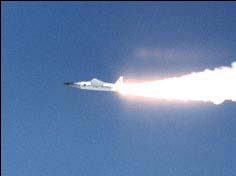
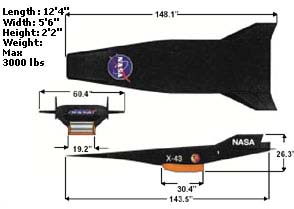
Model of the Aurora X-43A suspended under the wing of a B-52, and positioned in front of a powerful powder launcher
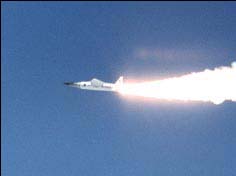
In flight
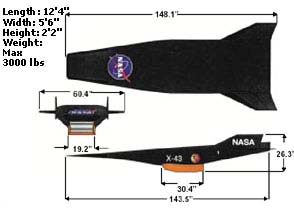
Test model "pseudo-Aurora".
Note that the vertical stabilizers contradict discretion. But the cut nose corresponds to the real Aurora. It is a concealment of technological progress. The civilian version of Aurora would not be a satellite-able spy plane, but a fully reusable launcher, much more economical than conventional rockets that depend solely on the thrust of their engines to overcome the drag related to the generation of a shock wave.
What the Westerners do not know, and which I will reveal in a book, is that the Americans also have a long-range hypersonic bomber, capable of flying at similar speeds and altitudes. Seen from above, these bombers look like a B2. The sawtooth shape of their rear edge is designed to ensure stability during landing. The shape creates vortices that prevent the loss of lift at the wingtip from rising toward the leading edge (shortly after the war, this phenomenon caused the crash of the flying wing designed by Jack Northrop). The B2s based at Whitman, supposedly costing two billion dollars each, are only fakes. The real plane is not subsonic and has no cockpit or covers above the four engines. These are entirely integrated into the wing, to prevent the turbine blades from being detected by radar.
American hypersonic bomber.
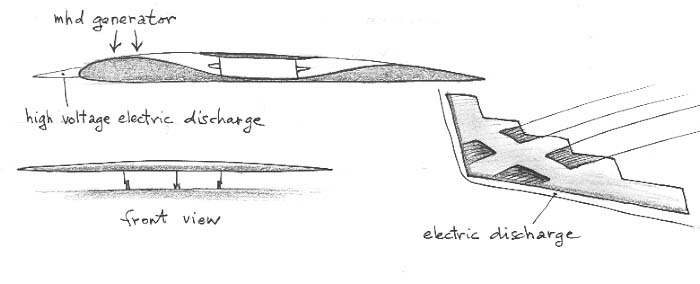
The wall converters are placed on the front parts of the wings, in front of the engines. These systems allow the re-compression of the incident air without generating a shock wave and channeling it toward the inlets of the conventional turbojets. The aircraft is a subtle combination of regions where the MHD wall converter is used to slow down the gas (as an electrical generator) and other regions where, on the contrary, the gas is accelerated. This system allows complete control of the gas flow and the elimination of any shock wave, and therefore of the shock wave drag. If this persisted, the aircraft would not be able to fly for long, considering the energy wasted to create it. The elimination of shock waves was achieved in 1997 and opened the way to the first antipodal flights. In fact, on several points, this bomber is more sophisticated than the Aurora. For example, the electrical discharge at the front has a better controlled geometry, resulting in a true "virtual front edge."
Long-range hypersonic bomber
Thus, the aircraft that the B2 hides is capable of taking off from the United States, reaching any point on the planet, and returning and landing in the United States in one night and four hours, even if the target is on the opposite side, 10,800 nautical miles away. Bombing missions have been planned in Europe and Afghanistan, the latter being mentioned as 40-hour subsonic flights, requiring six in-flight refuelings, most of which took place over Russia, which the planes had to cross. Considering the vulnerability of an aircraft during refueling, who could believe in such a version? Also note that the B2s shown have no cabin allowing the crew to rest. Could a pilot sit for forty hours on a seat? Consult on my website http://www.jp-petit.com a file on the B2.
In many areas, the United States tries to hide their military technological advances. They have a hypersonic drone whose air intake is controlled by a similar process. On the photos they show, the discreet air intakes could absolutely not function if the plane had to move at supersonic speeds.
The X-47A
American documents are generally silent on the speeds of these planes, but even if they were discreet, it is hard to imagine the Americans building subsonic combat drones!
These few elements (but there are many others, especially regarding microwave weapons, crowd control systems, etc.) can draw the reader's attention to the fact that the United States would have indeed gained a significant advantage in weaponry by using information from UFO observations and reverse engineering of recovered debris.
I agree with Dr. Greer. I think that as soon as the United States had directed energy weapons, they deliberately shot down UFOs to analyze them.
**
Why the United States are suspected of possessing antimatter bombs.**
The flux compression generators, such as those tested by Sakharov in the 1950s, are now known to the public. These are the generators that equipped the E bombs and cruise missiles used during the Gulf War. Specialists know that these generators (see appendix &&&) can also be used to compress objects at very high pressure (25 megabars in 1952) and accelerate them at very high speed (50 km/s in 1952). In the late 1960s, the Americans considered using these systems by using low-power atomic bombs (1 kt of TNT) as explosives. The pressures achieved were such that they managed, in this type of "laboratory," to reproduce conditions similar to the Big Bang, the matter then transforming into antimatter. The production of energy proved to be a hundred times higher than expected. This was kept secret. The Russians and the Chinese then tried to recreate these experiments, but failed due to the lack of adequate quality superconductors.
The Americans succeeded in separating the produced antimatter from the matter and confining it in magnetic bottles. They eventually used it for propulsion, for example, for a disc-shaped drone, operational since 2000, which can move at Mach 10 in dense air, and which they try to keep secret. This object functions according to the lines described in appendix &&&. Except for the stationary flight without air flow, which relates to "anti-gravity," and the sharp turns, it seems that the Americans have almost succeeded, through MHD, to reproduce the behavior of UFOs in inter-atmospheric cruise. They are now trying to further develop this technology, which would give them access to interstellar travel. We do not know if significant progress has been made in this direction, although some think that it has. If this were the case, it would endanger the future of humanity, because extraterrestrials would probably not tolerate that barbarians like us go causing trouble to neighboring civilizations.
In the meantime, the Americans use small amounts of antimatter to accelerate silicon vapor to 500 km/s in MHD accelerators used for space propulsion. Thanks to these propellers, they have been able to accelerate space probes to speeds of up to 100 km/s and accomplish almost a complete exploration of the Solar System in five years. They have tested antimatter bombs in which very powerful charges were synthesized in situ, at the moment of impact. The first tests of these fully oversized bombs, too powerful to be tested on Earth, were carried out by sending them toward the Sun. For this, high specific impulse rockets propelled by MHD were launched on trajectories at a large angle relative to the plane of the Ecliptic in order to merge into a known family of comets. The tests were continued with shots on Jupiter. Again, the bomb modules were directed in such a way as to be confused with comet debris. Initially loaded on the military shuttle Atlantis, the modules were transported to the site by an MHD-propelled cargo ship, then self-destructed. The modules created a magnetosphere that simulated the comet outgassing. They penetrated the high atmosphere of Jupiter at 100 km/s through their MHD shield system. The synthesis of antimatter by thermonuclear compression, followed by an instantaneous explosion, made the impacts indistinguishable from comet fragments.
Subsequent launches were directed towards Jupiter's satellites, such as Io and Europa. Each time, Galileo, which had been
Original version (English)
UFO technology antimatter MHD
Open letter from a group of French scientists to the founder of the Disclosure project.
Introduction.
We are a group of French scientists. We have read the text of Dr. Greer on the Disclosure website and were impressed by his observations. We are convinced, as he is, that certain nations, and primarily the United States, have been able to extract from UFO files, recovered crashed UFOs, and possible contacts with extraterrestrials, information that has led to entirely new scientific knowledge. We will further discuss the assessment of the progress made based on this information. The question is: "How far have they gone?" We have precise information on the secret American programs related to hypersonic aircraft, whether it is the satellite-able spy plane Aurora or a long-range hypersonic bomber, of which the B2 is only a camouflage. The technical data we have allow us, in this specific case, to support our claims. These technologies were directly derived from the analysis of the debris recovered at Roswell, which was a hypersonic spacecraft and not an interstellar vehicle. We regret that this reverse engineering has been applied only for military purposes, as these techniques could have found much better applications: on one hand, an entirely reusable space launcher, much more efficient and cheaper than conventional rockets; on the other hand, a hypersonic commercial aircraft.
Possible synthesis of antimatter.
Moreover, it is highly likely that the Americans have mastered a technique for mass production of antimatter, which - and not the "vacuum energy" - is the future quasi-magical, inexhaustible energy coming from nowhere; unless one considers the transformation of matter into antimatter by thermonuclear compression as a means of "extracting energy from the vacuum." I clarify that once antimatter is produced in this way, it can be used to produce more. No nuclear explosion is necessary at each start. However, this technology puts into the hands of humanity bombs incredibly more destructive than the most powerful thermonuclear weapons currently available. It also generates a risk of direct and immediate war, because very small quantities of antimatter can be stored in crystals under very stable electrostatic confinement; this allows the production of small bombs - "buckminsterfullerene balls" - the size of an egg, including the thermal shield, with a power of 40 tons of TNT. Thanks to their relatively limited power and the fact that no waste is produced, these bombs could be easily used. Instead of dropping high-power bombs on isolated targets, which would cause large amounts of fine dust to rise into the upper atmosphere and cause nuclear winter effects, it would be possible to spread a large number of these small antimatter bombs and cause equivalent damage, while avoiding the dust from rising to high altitude and triggering a nuclear winter. We believe that the United States already has a considerable number of such weapons, capable of completely reducing countries to ashes, and we fear that these devices will soon be used discreetly on a smaller scale. This takes us far from the positive applications that humanity could benefit from through such technology, thus producing, as Dr. Greer rightly says, "flowers in the desert."
Problem of raw material and waste.
We believe that the extraterrestrial vehicles that visit us use antimatter, stored on board or synthesized, as their main energy source. This basic energy could be used for many purposes. One of the most useful is mastering the transmutation of materials and thus being able to synthesize any type of atom at will. Combined with a very advanced nanotechnology, this would allow the synthesis of complex systems without human intervention, that is, without "work." Conversely, any system composed of atoms could be converted into neutral waste such as helium, the typically ideal waste. If we survive the next century, this will be our future technology. If such a set of techniques were completed by a more comprehensive approach to biology than that practiced on Earth today, the human being would have the keys to an age of gold within reach.
Current state of technology on Earth.
We do not know how far these technologies have been developed on Earth. To date, we can only strongly suspect that the synthesis of antimatter by thermonuclear compression was achieved in the United States around the end of the sixties; we will return to this later. Another issue raised by Dr. Greer is the reduction, cancellation, or even inversion of the weight of machines (anti-gravity). We consider this feasible. It is the technique used by UFOs when they remain suspended without moving the air. In our opinion, this can only be understood through a significant change in paradigm, a different way of conceiving space and matter. But this remains speculative, and we also suggest returning to it later. The control of anti-gravity could obviously be applied to civil transport, but far beyond that, we think it would open the way to space travel. Again, we will return to this topic at the end of this article.
Our comments on the Space Energy Access Systems.
Although the sentiment that motivated this project is commendable, we doubt its chances of success. We think that its applications (unlimited energy production, suppression of the force of gravity), even if physically conceivable, would require extremely costly advanced technologies. Compared to this, one could imagine the Foundation offering a full bag of gold to anyone who succeeded in making a plane with three passengers fly more than six miles. We are skeptical about the compatibility of such techniques with soft technologies accessible to amateurs and moderate-sized laboratories. In our opinion, such developments could only be considered by large laboratories with considerable funds, for which a one million dollar prize would seem very small compared to the cost of these researches. Therefore, such laboratories would inevitably be linked to the military-industrial lobbies. At best, the supporters of this project would be rewarded with interesting theoretical ideas, but without practical exploitable results. This is our opinion, of course, we may be wrong.
Our response to the Disclosure Manifesto.
Although we are not able to submit to Dr. Greer plans for a machine producing unlimited energy or a machine capable of canceling the force of gravity, we are, however, able to present solid arguments in favor of his campaign against the drift of technologies by the military-industrial complexes, inaccessible to the American political power and dedicated to serving a few who seek to dominate the world by force. The elements we can
The British currently have a similar weapon, the Spearfish. In these torpedoes, a hot gas is ejected from the nose of the device and vaporizes the surrounding seawater. The torpedo then moves in a water vapor sheath; the reduction of friction thus obtained allows speeds between 200 and 250 knots. The trajectory control is ensured by a protruding rod that emerges from the nose after launch. The direction is obtained by modulating the flows from the nozzles surrounding the main propulsion nose and powered by a gas generator located at the front. However, such machines are now completely outdated, even if countries like France do not yet have them. The American and Russian MHD torpedoes also have a solid propellant rocket engine. The diver acts as an MHD convector, producing a large amount of electrical energy. This energy powers a wall accelerator whose main description is added here for lightness. Such a system strongly sucks in water; the concept of viscous drag is therefore no longer appropriate, because the wake is not only eliminated, but even reversed; which opens the way to very high speeds. These speeds, estimated today at about 1,600 to 1,900 knots, allow the torpedoes to reach their targets in a few seconds. It is easy to understand the major strategic importance brought to any nation possessing these torpedoes, as it would allow the destruction, in a few seconds, of strategic enemy nuclear submarines, the most dangerous weapons of all. They are generally positioned as close as possible to their potential targets in order to reduce the range of the ballistic flight, and therefore the chances of interception. In reality, the destruction of these missile-loaded submarines would probably be the initial act of war of any nation with high-level technology. The Chinese do not yet have such equipment. In 1996, the Russians tried to demonstrate their machine nicknamed "The Big One," a one-meter caliber, in the hope of selling it. Such a technological transfer would have, in the long term, constituted a great threat to global security, and informed of the transactions, the Americans boarded and sank the Kursk, which was to, in the presence of a Chinese general, perform the demonstration. Fearing that this would be discovered, the Russians closed all the hatches of the submarine (by remote control signal from the Peter the Great, flagship of the maneuvers), leaving the entire crew to perish and later recovering the wreck.
The MHD torpedo and its wall accelerator propulsion is therefore one of the first military applications of MHD derived from the in-depth analysis of the Roswell debris.
**
American hypersonic machines. Aurora and the antipodal hypersonic bomber.**
The flying machines with air remained to be designed from there. From Mach 3, the heat generated by the compression of air behind the shock wave is significant. By going into static, it becomes possible to reach higher Mach levels. Around Mach 6, one can then consider a scramjet engine operating (hypersonic combustion), where the fuel and oxidizer (hydrogen and liquid oxygen) circulate at the front edge to cool it. However, the examination of the Roswell vehicle provided a much better solution, which led to the machine Aurora, which made its first flight in 1990 at Groom Lake. This very ingenious craft can take off on its own, gain speed and altitude, reach 6,000 knots at 180,000 feet, and then become satellite by conventional rockets. Two very different operational modes are then used successively. Initially, Aurora - whose Russian version Ajax, designed by Fraistadt, was never built due to lack of funding - resembles a conventional fighter jet. Four post-combustionless turbojets are suspended under a highly curved wing, whose upper surface is entirely flat and whose rear end is strongly raised, in a "arrow tail" shape.
Aurora in subsonic and moderate Mach flight
Aurora then reaches Mach 3 and the airflow to the engine changes. The lower air intakes close. The plane then flies in a low-pressure air, more easily ionizable. An air intake opens on top, in front of which a set of parallel electrodes forms an MHD wall generator. Since this section functions as a generator, the air is slowed down and recompressed (by Lorentz forces). A continuous slowdown occurs, without shock waves and with moderate heating, until the gas can be directed to the inlet of a conventional turbojet, even though the plane is flying at 6,000 knots at about 180,000 feet altitude. Very high voltages are generated by the Hall effect. In these wall converters, the Americans use superconducting systems developing 12 teslas. The Velikhov instability is controlled by magnetic confinement. The high voltage is used to create a plasma cushion that protects the front edge. The electrical energy is then used to improve the specific impulse through a wall accelerator located behind the nozzle exits (MHD diversion system). It is then a "semi-guided" type.
Aurora, hypersonic flight
It is designed to operate with a fixed expansion coefficient at a given altitude. At lower altitudes, the jet expansion is too strong and it then presents a series of nodes and humps, typical of "over-pressurized" jets.
classic over-pressurized jet
This explains the mysterious photograph taken near Groom Lake, where the plane, seen exceptionally in daylight, had not yet reached its adaptation altitude.
Aurora jet photo
The lift of Aurora is obtained through the shock wave on which the plane "rides"; it is a "wave rider." But Aurora is not intended to operate this way for long, because the formation of this shock wave generates a drag that causes an energy loss. The rockets allow the machine to either become satellite at an altitude of 250,000 feet, or at the edge of the atmosphere, or to perform ballistic jumps, like a stone bouncing on a water surface. In these conditions, it becomes a kind of controllable semi-satellite, similar to the famous "silver surfer." The total plasma envelope also makes it completely invisible. Once satellite at a speed of 15,000 knots, it can re-enter the atmosphere with a very low angle of incidence, without the need for a degradable thermal shield; the entire surface then acts as an MHD generator. The high voltage produces a protective plasma cushion at the front; the energy is mainly dissipated by radiation. When the plane returns to its base, the entire process is reversed; and as it approaches, it is propelled like a conventional aircraft and can land on a normal runway.
All of this has been kept secret. The Americans try to deceive the vigilance of other countries with rather crude erroneous information. They lead the Europeans to believe that the hypersonic flight adventure is near, while they have mastered these techniques for the past twelve years.
The lift of Aurora is obtained through the shock wave on which the plane "rides"; it is a "wave rider." But Aurora is not intended to operate this way for long, because the formation of this shock wave generates a drag that causes an energy loss. The rockets allow the machine to either become satellite at an altitude of 250,000 feet, or at the edge of the atmosphere, or to perform ballistic jumps, like a stone bouncing on a water surface. In these conditions, it becomes a kind of controllable semi-satellite, similar to the famous "silver surfer." The total plasma envelope also makes it completely invisible. Once satellite at a speed of 15,000 knots, it can re-enter the atmosphere with a very low angle of incidence, without the need for a degradable thermal shield; the entire surface then acts as an MHD generator. The high voltage produces a protective plasma cushion at the front; the energy is mainly dissipated by radiation. When the plane returns to its base, the entire process is reversed; and as it approaches, it is propelled like a conventional aircraft and can land on a normal runway.
All of this has been kept secret. The Americans try to deceive the vigilance of other countries with rather crude erroneous information. They lead the Europeans to believe that the hypersonic flight adventure is near, while they have mastered these techniques for the past twelve years.
Model of the Aurora X-43A suspended under the wing of a B-52, and positioned in front of a powerful powder launcher
In flight
Test model "pseudo-Aurora".
Note that the vertical stabilizers contradict discretion. But the cut nose corresponds to the real Aurora. It is a concealment of technological progress. The civilian version of Aurora would not be a satellite-able spy plane, but a fully reusable launcher, much more economical than conventional rockets that depend solely on the thrust of their engines to overcome the drag related to the generation of a shock wave.
What the Westerners do not know, and which I will reveal in a book, is that the Americans also have a long-range hypersonic bomber, capable of flying at similar speeds and altitudes. Seen from above, these bombers look like a B2. The sawtooth shape of their rear edge is designed to ensure stability during landing. The shape creates vortices that prevent the loss of lift at the wingtip from rising toward the leading edge (shortly after the war, this phenomenon caused the crash of the flying wing designed by Jack Northrop). The B2s based at Whitman, supposedly costing two billion dollars each, are only fakes. The real plane is not subsonic and has no cockpit or covers above the four engines. These are entirely integrated into the wing, to prevent the turbine blades from being detected by radar.
American hypersonic bomber.
The wall converters are placed on the front parts of the wings, in front of the engines. These systems allow the re-compression of the incident air without generating a shock wave and channeling it toward the inlets of the conventional turbojets. The aircraft is a subtle combination of regions where the MHD wall converter is used to slow down the gas (as an electrical generator) and other regions where, on the contrary, the gas is accelerated. This system allows complete control of the gas flow and the elimination of any shock wave, and therefore of the shock wave drag. If this persisted, the aircraft would not be able to fly for long, considering the energy wasted to create it. The elimination of shock waves was achieved in 1997 and opened the way to the first antipodal flights. In fact, on several points, this bomber is more sophisticated than the Aurora. For example, the electrical discharge at the front has a better controlled geometry, resulting in a true "virtual front edge."
Long-range hypersonic bomber
Thus, the aircraft that the B2 hides is capable of taking off from the United States, reaching any point on the planet, and returning and landing in the United States in one night and four hours, even if the target is on the opposite side, 10,800 nautical miles away. Bombing missions have been planned in Europe and Afghanistan, the latter being mentioned as 40-hour subsonic flights, requiring six in-flight refuelings, most of which took place over Russia, which the planes had to cross. Considering the vulnerability of an aircraft during refueling, who could believe in such a version? Also note that the B2s shown have no cabin allowing the crew to rest. Could a pilot sit for forty hours on a seat? Consult on my website http://www.jp-petit.com a file on the B2.
In many areas, the United States tries to hide their military technological advances. They have a hypersonic drone whose air intake is controlled by a similar process. On the photos they show, the discreet air intakes could absolutely not function if the plane had to move at supersonic speeds.
The X-47A
American documents are generally silent on the speeds of these planes, but even if they were discreet, it is hard to imagine the Americans building subsonic combat drones!
These few elements (but there are many others, especially regarding microwave weapons, crowd control systems, etc.) can draw the reader's attention to the fact that the United States would have indeed gained a significant advantage in weaponry by using information from UFO observations and reverse engineering of recovered debris.
I agree with Dr. Greer. I think that as soon as the United States had directed energy weapons, they deliberately shot down UFOs to analyze them.
**
Why the United States are suspected of possessing antimatter bombs.**
The flux compression generators, such as those tested by Sakharov in the 1950s, are now known to the public. These are the generators that equipped the E bombs and cruise missiles used during the Gulf War. Specialists know that these generators (see appendix &&&) can also be used to compress objects at very high pressure (25 megabars in 1952) and accelerate them at very high speed (50 km/s in 1952). In the late 1960s, the Americans considered using these systems by using low-power atomic bombs (1 kt of TNT) as explosives. The pressures achieved were such that they managed, in this type of "laboratory," to reproduce conditions similar to the Big Bang, the matter then transforming into antimatter. The production of energy proved to be a hundred times higher than expected. This was kept secret. The Russians and the Chinese then tried to recreate these experiments, but failed due to the lack of adequate quality superconductors.
The Americans succeeded in separating the produced antimatter from the matter and confining it in magnetic bottles. They eventually used it for propulsion, for example, for a disc-shaped drone, operational since 2000, which can move at Mach 10 in dense air, and which they try to keep secret. This object functions according to the lines described in appendix &&&. Except for the stationary flight without air flow, which relates to "anti-gravity," and the sharp turns, it seems that the Americans have almost succeeded, through MHD, to reproduce the behavior of UFOs in inter-atmospheric cruise. They are now trying to further develop this technology, which would give them access to interstellar travel. We do not know if significant progress has been made in this direction, although some think that it has. If this were the case, it would endanger the future of humanity, because extraterrestrials would probably not tolerate that barbarians like us go causing trouble to neighboring civilizations.
In the meantime, the Americans use small amounts of antimatter to accelerate silicon vapor to 500 km/s in MHD accelerators used for space propulsion. Thanks to these propellers, they have been able to accelerate space probes to speeds of up to 100 km/s and accomplish almost a complete exploration of the Solar System in five years. They have tested antimatter bombs in which very powerful charges were synthesized in situ, at the moment of impact. The first tests of these fully oversized bombs, too powerful to be tested on Earth, were carried out by sending them toward the Sun. For this, high specific impulse rockets propelled by MHD were launched on trajectories at a large angle relative to the plane of the Ecliptic in order to merge into a known family of comets. The tests were continued with shots on Jupiter. Again, the bomb modules were directed in such a way as to be confused with comet debris. Initially loaded on the military shuttle Atlantis, the modules were transported to the site by an MHD-propelled cargo ship, then self-destructed. The modules created a magnetosphere that simulated the comet outgassing. They penetrated the high atmosphere of Jupiter at 100 km/s through their MHD shield system. The synthesis of antimatter by thermonuclear compression, followed by an instantaneous explosion, made the impacts indistinguishable from comet fragments.
Subsequent launches were directed towards Jupiter's satellites, such as Io and Europa. Each time, Galileo, which had been
We believe that the extraterrestrial vessels visiting us use antimatter, stored on board or synthesized, as their main energy source. This basic energy could be used in a very diverse way. One of the most useful applications would be mastering the transmutation of materials, thus allowing the synthesis of any type of atom at will. Combined with very advanced nanotechnology, this would make it possible to synthesize the most complex systems without human intervention, that is, without "work." Conversely, any system composed of atoms could be converted into neutral waste, such as helium, the typically ideal waste. If we survive the coming century, this will be our future technology. If such a set of techniques were completed by a more comprehensive biological approach than currently practiced on Earth, humans would have the keys to an era of prosperity within reach.
Current state of technology on Earth.
We do not know how far these technologies have been developed on Earth. To date, we can only strongly suspect that antimatter synthesis by nuclear fusion was achieved in the United States towards the end of the 1960s; we will return to this later. Another issue raised by Dr. Greer is the reduction, cancellation, or even inversion (anti-gravity) of the weight of machines. We consider this feasible. It is the technique used by UFOs when they hover without displacing air. In our opinion, this can only be understood through a major paradigm shift, a different way of conceiving space and matter. But this remains speculative, and we suggest returning to it later. The control of anti-gravity could obviously be applied to civil transport, but far beyond that, we think it would open the way to distant space travel. Again, we will return to this question at the end of this article.
Our comments on the Space Energy Access Systems.
Although the motivation behind this project is commendable, we doubt its chances of success. We believe its applications (unlimited energy production, anti-gravity), although physically conceivable, would require extremely costly advanced technologies. Compared to this, one could imagine the Foundation offering a full bag of gold to anyone who succeeded in making a plane carrying three passengers fly above six miles. We are skeptical about the compatibility of such techniques with soft technologies accessible to amateurs or moderate-sized laboratories. In our opinion, such developments could only be considered by large laboratories with considerable funds, for which a one-million-dollar prize would appear as a trivial sum compared to the cost of these researches. Therefore, such laboratories would inevitably be linked to military-industrial lobbies. At best, supporters of such a project would be rewarded with interesting theoretical ideas, but without practical exploitable results. This is our opinion, of course, we could be wrong.
Our response to the Disclosure Manifesto.
While we are unable to submit to Dr. Greer plans for a machine producing unlimited energy or capable of canceling the force of gravity, we can, however, present strong arguments in favor of his campaign against the diversion of technologies by the military-industrial complexes, inaccessible to the American political power and dedicated to serving a few who seek to dominate the world by force. The elements we can produce are related to high-speed underwater propulsion and the construction of long-range hypersonic aircraft, these two techniques being based on what is called magnetohydrodynamics, or MHD.
General comments on MHD.
MHD has been the subject of sustained research in the 1960s, the civilian sector obviously not being accessible to the public. The objective at the time was to produce electricity by direct MHD conversion, using as primary energy fossil fuels - "open cycles" - or energy produced by high-temperature reactors (HTR). In both cases, the research teams encountered the fact that gases at "technological" temperatures, even seeded with substances of low ionization potential such as cesium, were not sufficiently electrically conductive. Below 3000°K, their electrical conductivity was too low. The Russians pushed this MHD electricity production technique as far as possible with their U-25 generator, which burns a mixture of hydrocarbons and pure oxygen. But this civilian-oriented research was eventually abandoned. Another attempt was made with two-temperature gases (in which the electron gas has a higher temperature than the atom gas). This was not possible in a molecular environment containing a lot of carbon dioxide (result of combustion). Indeed, this molecule is easily excited by collisions with electrons. The result was a large loss of energy by radiation (radiative de-excitation). This two-temperature system was therefore limited to closed cycles where the conversion fluid was a rare gas: helium, seeded with cesium, used to cool the core of a high-temperature reactor (1500°K). It should be noted that these reactors were never built or tested. The atomic scientists only thought about their possible construction, and thank goodness, they were never built.
This research ran into something that completely destroyed the performance of the generators, making the plasma very heterogeneous: it was an instability discovered in 1964 by the Russian Velikhov. These preliminaries may seem strange, but they explain why civilian MHD research was abandoned in many countries, except in the United States and Russia, where military MHD was developed in the utmost secrecy. In Russia, the father of military MHD was Andrei Sakharov. His student was none other than Velikhov, the innovator of the Soviet-style Star Wars, and the main advisor to Putin on advanced weapons.
Description of American and Russian hypersonic MHD torpedoes.
For a long time, the United States and the USSR had undeniable evidence that UFOs were of extraterrestrial origin. The United States had recovered at least one hypersonic vehicle that crashed at Roswell, and it is very likely that the Russians also recovered an equivalent amount. It was only from the 1970s that Americans realized that one of the key elements of the Roswell ship's operation was MHD. They also realized that military MHD had a strategic importance, and they launched an intense disinformation campaign, both inside and outside the country, to steer researchers away from what they declared to be an unproductive subject. I obtained this information because I have been closely involved, since 1965, in French civilian MHD projects. I built a Faraday linear generator, based on a combustion shock tube, producing several megawatts of power for 200 microseconds, with a magnetic field of two teslas. Having overcome the Velikhov instability, we succeeded in obtaining the first stable two-temperature conditions, which was presented at the international Warsaw conference in 1967. But despite this success, in the early 1970s, in our own country as elsewhere, this research was abandoned. It is worth noting that our team achieved a gas jet speed gain of 5,500 m/s over a distance of less than 4 inches, with argon flows at 10,000°K injected into a Faraday accelerator at 2,750 m/s under a pressure of one bar. But at the time, no one in France understood the military implications of what would become, elsewhere, a very high specific impulse MHD propulsion.
If I remember correctly, I traveled to the United States in 1984 to participate in an international MHD meeting in Boston. The Russians presented their Pavlovsky generator, one of many versions of the flux compression generators tested as early as the 1950s by Sakharov's team, which later became the typical power system for their directed energy weapons (electron beams and lasers). In addition to this novelty, representatives from various countries, including American researchers (the conference was organized by J.F. Louis of AVCO), lamented the loss of interest from their governments. And yet, we were unaware that three years earlier, the Americans had already implemented their first 1,000-knot MHD torpedoes; we found out about it many years later. Today, in countries possessing advanced technology, propeller torpedoes have been abandoned for exactly thirty years. The rocket propulsion proved to be more effective and gave rise to vehicles such as the American Supercav or the Russian Sqwal.


Russian Rocket Torpedo Sqwal (250 knots)
The British currently have a similar weapon, the Spearfish. In these torpedoes, a hot gas is ejected from the nose of the device and vaporizes the surrounding seawater. The torpedo then moves through a water vapor envelope; the resulting reduction in friction allows speeds of 200 to 250 knots. Trajectory control is achieved through the pole emerging from the nose after launch. The direction is ensured by modulating the flows from the nozzles surrounding the main propulsion nose, powered by the gas generator located at the front. Today, however, these machines are outdated, even though countries like France have not yet adopted them. The American and Russian MHD torpedoes also have a solid propellant rocket engine. The divergent acts as an MHD converter, producing a large amount of electrical energy. This energy powers a wall accelerator, the main description of which is added here to reduce weight. This system strongly sucks in water; thus, the concept of viscous drag is no longer appropriate, because the wake is not only eliminated, but even reversed; which opens the way to very high speeds. These speeds, estimated today at about 1,600 to 1,900 knots, allow the torpedoes to reach their targets in a few seconds. It is easy to understand the major strategic advantage brought to any nation possessing these torpedoes, as it could destroy strategic enemy nuclear submarines, the most dangerous weapons of all. They are generally positioned as close as possible to their potential targets to reduce the range of the ballistic flight, thus the chances of interception. In reality, the destruction of these missile-carrying submarines would probably be the very first act of war for any nation with advanced technology. The Chinese do not yet have this type of equipment. In 1996, the Russians tried to demonstrate their machine nicknamed "The Big One," with a one-meter caliber, because they hoped to sell it. Such a technological transfer would, in the long run, constitute a great threat to world security, and informed of the transactions, the Americans boarded and sank the Kursk, which was to, in the presence of a Chinese general, make the demonstration. Fearing that this would be discovered, the Russians closed all the hatches of the submarine (by remote order via sonar emitted from the Peter the Great, flagship of the maneuvers), leaving the entire crew to perish and later recovering the survivor.
The MHD torpedo and its wall accelerator propulsion thus constitute one of the first military applications of MHD derived from the in-depth analysis of the Roswell debris.

American Hypersonic Machines. Aurora and the Antipodal Hypersonic Bomber.
Aerial transport machines have remained to be designed. From Mach 3, the compression of air behind the shock generates significant heat. By passing to the stator, it becomes possible to reach higher Mach levels. One can then consider, around Mach 6, a scramjet engine operating (hypersonic combustion), where the fuel and oxidizer (hydrogen and liquid oxygen) circulate at the leading edge to cool it. But the examination of the Roswell vehicle provided a much better solution, which led to the machine Aurora, which made its first flight in 1990 at Groom Lake. This very ingenious craft can take off on its own, accelerate, gain altitude, reach 6,000 knots at 180,000 feet, and then be satellite with conventional rockets. Two very different operational modes are then required. Initially, Aurora - whose Russian version, Ajax, designed by Fraistadt, was never built due to lack of funding - resembles a conventional fighter jet. Four non-afterburning turbojets are suspended under a strongly curved wing, with a perfectly flat top and a highly raised canard tail.

Aurora in subsonic and moderate Mach flight
Aurora then reaches Mach 3 and the air flow at the engine changes. The lower air intakes close. The plane then flies in low-pressure air, which is easier to ionize. An air intake opens on top, in front of which a set of parallel electrodes forms a wall MHD generator. Since this section functions as a generator, the air is slowed down and recompressed (by Lorentz forces). A continuous slowdown occurs, without shock wave and with moderate heating, until the gas can be directed to the air intake of a conventional turbojet, even if the plane is flying at 6
Thus, the machine that the B2 hides is capable of taking off from the United States, reaching any point on the planet, and landing back in a single night and four hours, even if the target is on the opposite side, 10,800 nautical miles away. Bombing missions have been carried out in Europe and Afghanistan, the latter being mentioned as involving 40-hour subsonic flights, requiring six in-flight refuelings, most of which took place above Russia, which the planes had to cross. Considering the vulnerability of an airplane during an in-flight refueling, which could be sufficiently gullible to believe such a version? Also note that the B2s presented have no cabin allowing the crew to rest. Can a pilot sit for forty hours on an ejection seat? See on my website http://www.jp-petit.com a dossier dedicated to the B2.
In many areas, the United States tries to conceal its military technological advances. They have a hypersonic drone whose air intake is controlled by a similar process. On the photographs they show, the air intakes designed to reduce radar signature could not possibly function if the plane was moving at supersonic speeds.
The X-47A
American documents are generally silent about the speeds of these planes, but even if they were stealthy, it is hard to imagine that the Americans could have built subsonic combat drones!
These few elements (but there are many others, especially regarding microwave weapons, crowd control systems, etc.) should draw the reader's attention to the fact that the United States may have indeed acquired a significant advantage in weaponry, thanks to information extracted from UFO observations and reverse engineering of recovered debris.
I agree with Dr. Greer. I think that as soon as the United States had directed energy weapons, they deliberately shot down UFOs to analyze them.
Why the United States is suspected of possessing antimatter bombs.
The flux compression generators, such as those tested by Sakharov in the early 1950s, are now known to the general public. These are the generators that equipped the E-bombs and cruise missiles used during the Gulf War. Specialists know that these generators (see appendix &&&) can also be used to compress objects to very high pressures (25 megabars in 1952) and accelerate them to very high speeds (50 km/s in 1952). Towards the end of the 1960s, the Americans considered using small atomic bombs (1 kt of TNT) as an explosive to drive these systems. The pressures achieved were so considerable that they succeeded, in this kind of "laboratory," to reproduce conditions similar to those of the Big Bang, the matter then transforming into antimatter. The energy production proved to be a hundred times higher than expected. This fact was kept secret. The Russians and the Chinese then tried to reproduce these experiments, but they failed due to the lack of adequate quality superconductors.
The Americans succeeded in separating the produced antimatter from the matter and confining it in "magnetic bottles." They finally used it for propulsion, notably in a disc-shaped drone, operational since 2000, capable of flying at Mach 10 in dense air, and which they try to keep secret. This object operates according to the principles described in appendix &&&. If one excepts the stationary flight without aerodynamic thrust (related to "anti-gravity") and the sharp turns, it appears that the Americans have almost succeeded in reproducing, through HDm, the behavior of UFOs crossing between atmospheres. They are now trying to develop this technology further, which would give them access to interstellar travel. We do not know if they have made significant progress in this direction, although some think so. If this were the case, it would compromise the future of humanity, because the extraterrestrials would probably not tolerate that barbarians like us could go bother neighboring civilizations.
Meanwhile, the Americans use small amounts of antimatter to accelerate silicon vapor to 500 km/s in HDm accelerators used for space propulsion. Thanks to such engines, they have been able to accelerate space probes to 100 km/s and achieve a near-complete mapping of the Solar System in five years. They have also tested antimatter bombs, in which very powerful charges were synthesized on-site at the moment of impact. The first tests of these fully oversized bombs, too powerful to be tested on Earth, were carried out by sending them toward the Sun. For this, high specific impulse HDm bombs were launched on trajectories forming a wide angle with the plane of the ecliptic to make them collide with a known family of comets. The tests continued with shots on Jupiter. Again, the bomb modules were directed to be confused with comet debris. Initially loaded aboard the military ship Atlantis, the modules were transported to the location by an HDm-propelled cargo ship, which then self-destructed. The modules created a simulated comet outgassing magnetosphere. They penetrated the upper atmosphere of Jupiter at 100 km/s thanks to their HDm shield system. The compressed thermonuclear synthesis of antimatter, followed by an instantaneous explosion, ensured that the impacts were perceived as comet fragments.
Subsequent launches targeted Jupiter's satellites, such as Io and Europa. Each time, the Galileo probe, placed in orbit precisely to monitor these tests, did not transmit the images to Earth, at least according to the official version. It suffered several malfunctions, depriving Earthlings of close-up images of Jupiter's satellites.
An open question.
The purpose of these shots remains mysterious: are they anti-comet weapons? Some astronomers think that at the time of the formation of the Solar System, a terrestrial planet was ejected by tidal effect on a very eccentric and long-period orbit (2000 to 3000 years), at a wide angle relative to the plane of the ecliptic. This planet would have been reduced to a large number of fragments when passing through the Roche sphere of the object from which it was ejected. The periodic return of this cloud of fragments, of cometary or asteroidal size and therefore undetectable at any distance beyond that of Jupiter, could cause certain problems. Would the extraterrestrials have provided the Americans with the means to accelerate their scientific and technical knowledge to allow them to master the destruction of such objects between 2020 and 2030? Was the Roswell crash a deception, deliberately abandoned to trigger this acceleration? Any hypothesis is possible. It should be kept in mind that if such a risk existed, a projectile would have to be launched on a collision course with an object moving at 40 km/s; conventional propulsion would be useless, because the shot would then have to travel in escort with the target. Then a path would have to be drilled using a several-kilometer antimatter jet to explode, at the center of the object, a charge of several thousand megatons, to turn it into debris each less than one meter in diameter, which would burn up in the atmosphere. Are the shots fired on Jupiter, Io and Europa part of such a plan?
Indeed, we know nothing about our Solar System or the future of our Earth. In France, our group has received more than one phone call warning of the approach of comets, the messages containing at each time precise dates of perihelion, well before the objects could be detected by terrestrial telescopes.
About anti-gravity.
Our theoretical cosmology research, published by us, and inspired by information received through contacts with extraterrestrials, has led us to build a cosmological model based on two universes, developing ideas put forward by Andrei Sakharov in 1976: the cosmology of twin universes. We think that the latter was also in contact with extraterrestrials. It is enough to read the strange terms of his speech, delivered by his friend Helena Bonaire in Sweden at the Nobel Prize ceremony. This model is based on a double or twin universe. Australian researchers Foot and Volkas are currently following a similar path, talking about "mirror universes" (articles published in Physical Review). We have shown that the "apparent mass" of the "twin universe" was negative, that is, that the twin matter repels ours, while two particles of twin matter attract each other mutually, in accordance with Newton's law. This repulsion explains the re-acceleration of the expansion of our universe, while it slows down that of the twin universe.
When interstellar vessels travel great distances, they use the twin universe as a sort of "express subway." In this universe, extremely rarefied in the regions adjacent to ours, the distances are shortened and the speed of light is high. This makes space travel possible, provided the following principle: "it is forbidden to exceed the speed of light of the universe in which you are located." An American research team is working on an idea to locally modify the value of the speed of light: the concept of "warp drive." Our approach is different and much more advanced. Thanks to the help of extraterrestrials, it took us years to begin to understand how it works, and it would take several pages to describe it. In principle, the mass of the vehicle must be transferred to the twin universe. When this operation occurs near the Earth, the Earth becomes invisible to the ship, but acts on it as a negative mass, repulsive. If the stations located in our universe and in the adjacent region of the twin universe are alternated rapidly, this is not detected by an external observer; however, during one phase, the ship falls under the Earth's gravitational attraction, while during the other, it rises under the Earth's repulsion. Overall, this amounts to an apparent cancellation of the ship's weight, regardless of its mass. This is how we interpret what people call anti-gravity. We do not know if the extraterrestrials have transmitted to humans the clues of these techniques.
Conclusion.
Let us stick to the known elements; we feel strongly concerned by Dr. Greer's text. It seems clear that a group of humans possesses elements of science and technology far ahead of the rest of the world. How did they acquire this knowledge, and why? Is it simply a consequence of the crash of an extraterrestrial vessel at Roswell? Is there behind all this a much more complex project? Have contacts occurred between the extraterrestrials and this human group? What is the agenda of each? Is the hegemonic domination of this human group over the entire planet the consequence of an attempt to help humanity survive the next passage of a planetary fragment cloud? We would like to know. Finally, by becoming aware that they are not alone, would humans gain some wisdom and, through the technology that allows it, transform their planet into an Eden?
In any case, we think it is time for those who hold the secrets to reveal the truth, and it is precisely in this direction that our participation in the Disclosure project is situated.
December 2002
Prof. Jean-Pierre Petit,
Research Director at CNRS,
Astrophysicist, expert in MHD and theoretical cosmology.
(Translated by André Dufour)
Bibliography :
(1) J.P.Petit : « Is supersonic flight possible? » 8th International Conference on MHD electricity production. Moscow, 1983.
(2) J.P.Petit & B.Lebrun : « Suppression of shock waves in a gas by the action of the Lorentz force ». 9th International Conference on MHD electricity production. Tsukuba, Japan, 1986.
(3) B.Lebrun & J.P.Petit : « Suppression of shock waves by MHD action in supersonic flows. Quasi-one-dimensional stationary analysis and thermal blocking ». European Journal of Mechanics; B/Fluids, 8, n°2, pp.163-178, 1989.
(4) B.Lebrun & J.P.Petit : « Suppression of shock waves by MHD action in supersonic flows. Stationary two-dimensional non-isentropic analysis. Anti-shock criterion and simulations in a shock tube for isentropic flows ». European Journal of Mechanics, B/Fluids, 8, pp.307-326, 1989.
(5) B.Lebrun : « Theoretical approach to the suppression of shock waves forming around a streamlined obstacle placed in an ionized argon flow ». Thesis n° 233. University of Poitiers, France, 1990.
(6) B.Lebrun & J.P.Petit : « Theoretical analysis of the suppression of shock waves by Lorentz force field ». International MHD Conference, Beijing, 1990.
Annex 1: MHD Annex
2 (other weapons) Annex
3 (MHD torpedo)
UFOlogy, antimatter technology, MHD
Open Letter from a group of French scientists to the Initiator of the Disclosure Project. Introduction.
We are a group of French scientists. We have read Dr. Greer's text on the Disclosure Web site and have been impressed by his remarks. We are convinced, as he is, that certain nations, and chiefly the US, have been able to derive from the UFO files, from crashed UFO retrievals and from possible contacts with aliens, information which has led to entirely new scientific knowledge. We shall farther discuss the assessment of developments achieved on the basis of these information. The question is : "how far have they reached ?". We hold accurate information about the American black programs linked with hypersonic planes, be it the satellisable Aurora spy craft or a hypersonic long range bomber for which the B2 is but a cover-up. Technical data in our possession allow us, in this particular case, to sustain our assertions. These technologies were directly derived from the analysis of the wreck retrieved at Roswell, which was a hypersonic space shuttle and not an interstellar vehicle. We deplore the fact that this reverse engineering has only been applied to military ends, since these techniques could have found better use, the one as a completely re-reusable space launcher - much more efficient and cheaper than the customary rockets - the other as a hypersonic commercial plane.
Possible antimatter synthesis.
Besides the above, it is highly presumable that the Americans have mastered a massive antimatter production technique, this - and not the "void energy" - being the near magic, inexhaustible future energy coming out of nowhere; unless one considers the transformation of matter into antimatter by thermonuclear compression as a means of "extracting energy from the void". I shall ad that once antimatter has been produced in this way, it can farther be used to produce more. No nuclear explosion is needed at every start. However this technology lays in the hands of humanity incredibly more destructive bombs than the most powerful thermonuclear weapons presently available. It also generates a potential straightforward war hazard through the fact that very small quantities of antimatter can be stocked in crystals under very stable electrostatic confinement; this allows the production of tiny bombs - "bucky balls" - , the size of an egg, thermal shield included, of 40 ton TNT power. Thanks to their relatively limited power and the fact that no waste is produced, these bombs could readily be used. Instead of dropping high power bombs on isolated targets, which would throw up great quantities of pulverulent matter into the high atmosphere and generate nuclear winter effects, it would be possible to scatter a great number of these mini antimatter bombs and cause equal damage, whilst avoiding that the dust should rise at high altitudes and generate a nuclear winter. We believe that the US already possess a considerable number of such weapons with which they would be capable of reducing whole countries to ashes, and we fear that these devices will soon be discreetly brought into action on more restricted scales. This takes us far out of sight of the positive applications of which Humanity could benefit from such a technology and thus produce, as Dr. Greer rightly puts it, "flowering deserts".
The raw material and waste problem.
We believe that the ET vehicles visiting us use antimatter, stocked on board or synthesised, as primary source of energy. This basic energy could be put to a wide range of uses. One of the most useful is to master the transmutation of materials and be thus able to synthesise at will any type of atom. Coupled with a very advanced nano-technology, this would allow the most complex systems to be synthesised without human intervention, i.e. without "work". Inversely, any system composed of atoms could be converted into neutral waste such as helium, the typically ideal waste. If we survive the next century, this is the picture of our future technology. If such a set of techniques were completed with a more comprehensive approach of biology then that which is practised on Earth today, the Human being would have the keys of a Golden Age within arm's reach.
Present state of technology on Earth.
We do not know how far these technologies may have been developed on Earth. To this date we may only strongly suspect that antimatter synthesis through thermonuclear compression has been obtained in the US towards the end of the sixties; we shall farther come back to this. Another problem raised by Dr. Greer is machine weight reduction, suppression or even inversion (anti-gravity). We consider this as feasible. This is the technique used by UFO's when they hover without any air displacement. In our opinion this can only be understood via an important paradigm shift, a different way of comprehending space and matter. But this is still speculative and we suggest also coming back to it farther on. Anti-gravity control could obviously be applied to civilian transportation, but far beyond this, we think it would open the way to outer space travel. Here again, we shall postpone the subject to the end of this paper.
Our comments on the Space Energy Access Systems.
However commendable the feeling from which this project arises, we are doubtful as to its chances of success. We think that its applications (unlimited energy production, anti-gravity), even though physically conceivable, would call for very expensive advanced technologies. By comparison one could imagine the Foundation offering men of the Antiquity a full purse of gold to whomever would fly a plane with three passengers over more than six miles. We are sceptical as to the compatibility of such techniques with soft technologies within reach of amateurs and moderately sized laboratories. Such developments may, to our mind, only be envisaged by large scale laboratories with considerable funds for which a million dollar prize would seem but a derisory sum compared with the cost of such research. Consequently, laboratories of that size would inevitably be part of the military-industrial lobbies. At best would the supporters of such a project be rewarded with interesting theoretical ideas, but no exploitable practical results. Such is our opinion, but of course we may be mistaken.
Our answer to the Disclosure Manifest.
Whilst we are not in a state to submit to Dr. Greer plans for an unlimited energy producing machine or one that could suppress the force of gravity, we are, on the other hand, able to present strong arguments in support of his campaign against the diversion of technologies by military-industrial complexes elusive to American political power and dedicated to serve a few who seek world domination by force. The elements we are in a state to produce are related to underwater high velocity propulsion and construction of very long range hypersonic planes, both these techniques being based on what is called magneto-hydro-dynamics, or MHD.
General remarks about MHD.
MHD has been the object of sustained research in the sixties, the civilian sector only having obviously been accessible to the public. The purpose at the time was to produce electricity through direct MHD conversion, using as primary energy either fossil fuels - so-called "open cycles" -, or energy produced by high temperature reactors (HTR). In both cases, research teams came up against the fact that gases at "technological" temperatures, even when seeded with low ionisation potential substances such as caesium, are not sufficiently electrically conductive. Below 3000°K, their electric conductivity is too low. The Russians have led this technique of MHD electricity production as far as possible with their U-25 generator, which burns a mixture of hydrocarbons and pure oxygen. But this civilian oriented research was finally abandoned. Another trial took place where two-temperature gases were used (in which the electron gas has a higher temperature than the atom gas). This was not possible in a molecular environment which contained a lot of carbon dioxide (as a result of combustion). Indeed, this molecule is readily excited by the chocks with electrons. The result was a great loss of energy through radiation (radiative un-excitation). This two-temperature system was thus limited to closed cycles where the conversion fluid was a rare gas : helium, seeded with caesium, used to cool down the heart of a reactor working at high temperature (1500°K). Let us point out that these reactors were neither built nor tested. Atomic scientists only thought they might be constructed and, thank God, they never were.
This research came up against something which completely annihilated the generators' performances by making the plasma very non-homogeneous : it was an instability discovered in 1964 by the Russian Velikhov. These preliminaries may seem strange, but they explain why civilian MHD research was abandoned in many countries, except in the US and Russia, where military MHD was at the same time being developed in great secret. In Russia, the father of military MHD was Andrei Sakharov. His pupil was none other than Velikhov, innovator of the soviet style star war, and Poutine's chief consultant for leading edge weapons.
Description of high velocity US and Russian MHD torpedoes.
Since a long time ago, the USA and USSR possessed indubitable evidence that UFO's were of extraterrestrial origin. The US had retrieved at least one crashed hypersonic vehicle at Roswell and it is highly probable that the Russians also collected an equal supply. It was not until the seventies that the Americans understood that one of the key operating elements of the Roswell shuttle was MHD. They also grasped that military MHD was of prime strategic importance and they launched an intense disinformation campaign, at home and abroad, to lure researchers away from what they declared to be a dead end subject. I hold this information from the fact that I was closely implied , since 1965, in French civilian MHD projects. I built a Faraday linear generator, based on a combustion shock tube, producing a power of several megawatts during 200 microseconds; with a two tesla magnetic field. The Velikhov instability having been overcome, we succeeded in obtaining the first two-temperature stable running conditions, and this was presented at the 1967 Warsaw international colloquium. But notwithstanding this success, in the early seventies, in our own country as in others, this research was abandoned. It is worth mentioning that our team obtained a gas blast speed gain of 5,500 m/s over a distance of less than 4", with argon fluxes at 10,000°K input into a Faraday accelerator at 2,750 m/s under a one bar pressure. But at the time nobody in France realised the military implication of what was to become, elsewhere, an MHD propulsion with high specific impulse.
If I remember correctly, I travelled to the United States in 1984, to take part in an international MHD meeting in Boston. The Russians presented their Pavlovsky generator, one of the various versions of the flux compression generators tested in the early 50's by Sakharov's team, which was later to become the typical feed system to their directed energy weapons (electron and laser beams). Besides this novelty, representatives of various countries, American researches included, (the colloquium had been organised by J.F. Louis of AVCO), deplored the loss of interest of their governments. And yet we were ignorant of the fact that, three years earlier, the Americans had operated their first MHD torpedoes at 1,000 knots; we got wind of this many years later. Today, in countries possessing leading technology, propeller torpedoes have been abandoned since exactly thirty years. The powder rocket propulsion was soon found to be more efficient and gave rise to such machines as the American Supercav or the Russian Sqwal.
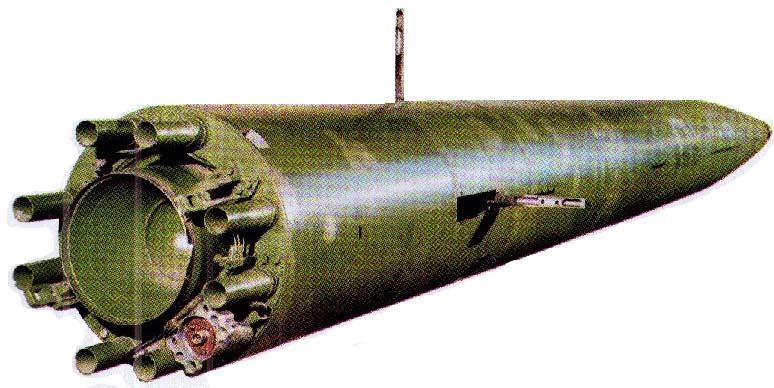
The russian Sqwal rocket torpedo (250 knots)
The British today possess a similar weapon, the Spearfish. In these torpedoes, hot gas is ejected from the machine's nose and vaporises the neighbouring sea water. The torpedo then moves in a sheath of water vapour; the resulting friction reduction allowing speeds of 200 to 250 kn. Course control is achieved through the protruding pole which telescopes out of the nose after launching. Steering is obtained by modulating the exhausts of nozzles which encircle the main propulsion nozzle and are fed by the forward situated gas generator. Today however are such machines quite out of date, even though countries such as France do not even have them yet. American and Russian MHD torpedoes also have a solid propellant rocket engine. The divergent works like an MHD convector, producing a large amount of electric energy. This energy feeds a wall accelerator of which, for the sake of lightness, the principle description is appended. Such a system sucks the water in very strongly; hence is the viscous drag concept no longer appropriate since the wake is not only suppressed, but even reversed; which opens the path to very high speeds. Such speeds, reckoned today to be able to reach about 1,600 to 1,900 kn., enable the torpedoes to reach the targets in matters of seconds. It is easy to see the major strategic asset brought to any nation possessing these torpedoes, since it would enable the destruction, in a few seconds, of the enemy's strategic nuclear submarines, which are the most dangerous of all weapons. They are generally positioned as close as possible to their potential targets in order to reduce the range of the ballistic flight, hence the chances of interception. In fact, the destruction of these missile loaded submarines would probably be the very first act of war of any nation with a high technological level of equipment. The Chinese do not possess such an equipment yet. In 1996, the Russians attempted to make a demonstration of their machine nicknamed "the Fat One", of a one meter calibre, because they were hoping to sell them the torpedoes. Such a technology transfer would, in the long run, have meant a great menace to world security and, informed of the transactions, the Americans boarded and sank the Koursk which was due, in presence of a Chinese general, to make the demonstration. Fearing this should be discovered, the Russians closed all of the submarine's hatches (by remote sonar order issued from the Peter the Great cruiser, flagship of the manoeuvres), letting the entire crew perish and recovering the wreck later.
The MHD torpedo and its parietal accelerator propulsion is thus one of the first applications of the military MHD derived from the close analysis of the Roswell wreck.
American hypersonic machines. Aurora and the antipodal hypersonic bomber.
Air travelling machines remained, from there on, to be designed. From Mach 3 up, the air compression aft of the chock wave generates an important heating. By shifting to stato it is possible to go up in Mach levels. One can then, around Mach 6, envisage a scramjet functioning (hypersonic combustion), where fuel and oxidiser (hydrogen and liquid oxygen) circulate in the leading edge to cool it down. But the examination of the Roswell vehicle was to yield a much better solution, which would lead to the Aurora machine, which took its first flight in 1990 at Groom Lake. This very clever craft can take off by its own means, pick up speed and altitude, reach 6,000 kn. at 180,000 ft., then become sattelised with conventional rockets. Two very different successive operating modes are then called upon. At the start, Aurora - of which Ajax, the Russian version designed by Fraistadt, was never built through lack of funding - looks like a conventional jet plane. Four turboreactors without post combustion are suspended under a very cambered wing with a completely flat top and a sharply lifted "duck tail" trailing edge.
Aurora in subsonic and moderate Mach fligh
Aurora then reaches Mach 3 and the motor air feed changes. The bottom air intakes close up. The plane then flies in low pressure air which ionises more easily. An air inlet opens on the top side, in front of which a set of parallel electrodes form an MHD wall generator. Since this section works as a generator, the air is slowed down and re-compressed (by Lorenz forces). A continuous slowing down then takes place, without shock waves and with moderate heating, to such a point that the gas can be directed to the conventional turboreactor air intake, even though the plane flies at 6,000 kn. at about 180,000 ft altitude. Very high tensions are generated by the Hall effect. In these parietal converters, the Americans use superconductor systems developing 12 teslas. The Velikhov instability is mastered by magnetic confinement. The high voltage is used to create a plasma cushion which protects the leading edge. The electric power is next used to enhance the specific impulse thanks to a wall accelerator located aft of the nozzle outlets (MHD by-pass system). This is then of the "semiguided" type.
Aurora, hypersonic flight
It is designed to function with a fixed expansion coefficient at a given altitude. At lower altitudes, the expansion of the jet is too strong and it then exhibits a succession of knots and bumps, typical of "over-depressed" jets.
classical over-depressed jet
This explains the mysterious photograph taken near Groom Lake, where the plane, seen exceptionally in daylight, had not yet reached its adaptation altitude.
photograph of Aurora jet
Aurora's lift is obtained through the generated shock wave on which the plane surfs; it is a wave rider. But Aurora is not meant to function that way a long time because the formation of this shock wave generates a drag which entails a waste of energy. Rockets enable the machine either to become sattelised at an altitude of 250,000 ft., i.e. the atmosphere's limit, or to execute ballistic leaps, like a pebble bouncing on a water pond. Under those condition it becomes a kind of pilotable semisattelite, such as the well known silver surfer. The total plasma envelope makes it also completely stealthy. Once sattelised at a speed of 15,000 kn. it can reenter at a very slight angle of incidence without the need of a degradable thermal shield; the whole surface then works as an MHD generator. The high tension produces a forward protecting plasma cushion; the energy being dissipated mainly through radiation. When the plane returns to its base, the whole process is gone through in reverse order; and when approaching it is propelled like a conventional plane and can land on a normal runway.
This has all been kept secret. The Americans attempt to lull the awareness of other countries by rather gross misinformation. They lead Europeans into thinking that the adventure of hypersonic flight is near at hand, whilst in fact they have been mastering those techniques for the last twelve years.
Aurora's lift is obtained through the generated shock wave on which the plane surfs; it is a wave rider. But Aurora is not meant to function that way a long time because the formation of this shock wave generates a drag which entails a waste of energy. Rockets enable the machine either to become sattelised at an altitude of 250,000 ft., i.e. the atmosphere's limit, or to execute ballistic leaps, like a pebble bouncing on a water pond. Under those condition it becomes a kind of pilotable semisattelite, such as the well known silver surfer. The total plasma envelope makes it also completely stealthy. Once sattelised at a speed of 15,000 kn. it can reenter at a very slight angle of incidence without the need of a degradable thermal shield; the whole surface then works as an MHD generator. The high tension produces a forward protecting plasma cushion; the energy being dissipated mainly through radiation. When the plane returns to its base, the whole process is gone through in reverse order; and when approaching it is propelled like a conventional plane and can land on a normal runway.
This has all been kept secret. The Americans attempt to lull the awareness of other countries by rather gross misinformation. They lead Europeans into thinking that the adventure of hypersonic flight is near at hand, whilst in fact they have been mastering those techniques for the last twelve years.
Model of Aurora X-43A slung under the wing of a B-52, and poised in front of a large powder booster
In flight
**The "pseudo-Aurora" test model. **
Notice that vertical tails contradicts stealthyness. But the cut nose corresponds to the real Aurora. This is a cover-up on technological progress. The civilian version of Aurora would not be a sattelisable spy plane, but a completely reusable launcher, much cheaper than the classical rockets which depend solely on the thrust of their motors to overcome the drag linked with the generation of a chock wave.
What Occidentals ignore, and which I shall reveal in a book, is that Americans also have a hypersonic long range bomber which can fly at similar speeds and altitudes. Seen from above, these bombers look like a B2. The saw-tooth shape of their trailing edge is designed to give stability when landing. The shape causes eddies which prevent the wing tip loss of lift to creep up towards the leading edge (short after the war, this phenomenon caused the crash of the flying wing designed by Jack Northrop). The B2's based at Whitman, supposed to have cost $2 billion each, are just decoys. The real plane is not subsonic and has neither cockpit nor any hoods above the four motors. These are completely included in the wing, so as to avoid the turbine vanes from being detected by radar's.
US hypersonic bomber.
Wall convectors sit on the front parts of the wings ahead of the motors. These systems enable incident air to be re-compressed without shock wave generation and funnelled into the inlets of classical turboreactors. The machine is a subtle combination of regions where the MDH wall converter is used to slow down the gas (as an electrical power generator) and others where, on the contrary, the gas is accelerated. This system allows complete control over the gas flux and suppression of any shock wave and hence wave drag. If the latter were to remain, the plane could not fly a long time considering the energy wasted in creating it. This elimination of shock waves was obtained in 1997 and opened the path to the first antipodal flights. In fact, on more than one item this bomber is more sophisticated than the Aurora. For instance, the electrical discharge at the leading edge has a better mastered geometry which gives rise to a real "virtual" leading edge.
Hypersonic long-range bomber
Thus the machine, which the B2 dissimulates, is able to take off from the US, reach any point on the globe, and come back and land again in the US all in one night and four hours, even if the target lies in the antipodes at 10,800 nautical miles. Bombing assignments have been enacted in Europe and Afghanistan, the latter being mentioned as subsonic 40 hour flights, necessitating six in-flight refuellings, most of which took place over Russia which the planes had to cross. Considering the vulnerability of a plane while refuelling, who would be gullible enough to believe such a version ? Notice also that the B2's which are shown have no bunk of any kind to allow crew members to take some rest. Could any pilot remain seated for forty hours on an ejector seat ? See on my web site http://www.jp-petit.com a file on the B2.
In numerous realms, the US attempt to disguise their military technology progress. They possess a hypersonic drone whose air intake is controlled by a similar process. On the photographs they show, the stealth inducing air intakes could absolutely not function if the plane were to move at supersonic speeds.
The X-47A
American documents are generally mute about the speeds of these planes, but even if they were stealthy, one can hardly imagine the Americans constructing subsonic combat drones !
These few elements, (but there are many more, particularly concerning microwave weapons, crowd control systems, etc.), may attract the reader's attention to the fact that the US might indeed well have acquired a considerable lead in matters of weaponry by using information extracted from UFO observation and reverse engineering of retrieved wrecks.
I agree with Dr. Greer. I think that as soon as the United States disposed of directed energy weapons, they deliberately shot down UFO's in order to analyse them.
Why the US are suspected to possess antimatter bombs.
The 'flux compression" generators, such as those tested by Sakharov in the early 50's, are now reaching public knowledge. They are the generators which equipped the E-bombs and cruise missiles used during the Gulf war. Specialists are aware that these generators (see annex &&&) can also be used to compress objects at very high pressures (25 megabars in 1952) and to accelerate them at very high speeds (50 km/s in 1952). Towards the end of the 60's, the Americans considered working these systems by using low power atom bombs (1kt of TNT) as explosive. The pressures reached were so considerable that they managed, in this kind of "laboratory", to reproduce conditions similar to the Big Bang, matter then muting into antimatter. The energy production turned out to be one hundred times greater than what was expected. This was kept secret. The Russians and the Chinese later tried to re-enact those experiences, but they failed because of lack of superconductors of adequate quality.
The Americans managed to separate the produced antimatter from matter and to confine it in magnetic bottles. They eventually used it for propulsion, for such as a disc shaped drone, operational since 2000, which can travel at Mach 10 in dense air, and which they attempt to keep secret. This object works along the lines described in annex &&&. If one excepts stationary flight without air blast, which comes under "antigravitation", and sharp angle turns, it appears that Americans have almost managed to reproduce, thanks to MHD, the behaviour of inter-atmospheric cruising UFO's. They are now attempting farther to develop this technology, which would give them access to star to star travel. We do not know if they have made any significant progress in that direction, though some believe they have. If such were the case, this would jeopardise the future of humanity because extraterrestrials would probably not tolerate that such barbarians as we are should go and give neighbouring civilisations a pain in the neck.
In the mean time, Americans use small quantities of antimatter to accelerate silicon vapour up to 500 km/s in MHD accelerators used for space propulsion. With such boosters, they have been able to accelerate space probes at speeds of up to 100 km/s and accomplish a survey of the Solar System, nearly complete since five years. They have been testing antimatter bombs in which very powerful charges were synthesised in situ, at the moment of impact. The first trials of these entirely oversized bombs, too powerful for Earth tests, were done by sending them off to the Sun. To do this, very high specific impulse MHD propelled bombs have been launched on trajectories at a wide angle to the Ecliptic plane in order to get merged with a known family of comets. Trials were continued with shots on Jupiter. There again, the bomb modules were directed in such a way as to be mistaken for cometary debris. Initially loaded on board the military Atlantis shuttle, the modules were conveyed on site by an MHD propelled cargo which was then self-destroyed. The modules created a magnetosphere which simulated cometary degassing. They penetrated Jupiter's high atmosphere at 100 km/s thanks to their MHD shield system. Thermonuclear compressed antimatter synthesis, followed by instantaneous explosion caused the impacts to be mistaken for comet fragments.
Later launches were aimed at Jupiter's satellites, such as Io and Europa. On each of those occasions, Galileo, which had been sent into orbit precisely to monitor the trials, failed to transmit the pictures to Earth, at least according to the official version. It suffered a number of failures depriving earthlings of close images of Jupiter's satellites.
An open question.
The purpose of such firings remains mysterious; are they meant to be anti-comet weapons ? Some astronomers believe that, when the Solar System was formed, a telluric planet has been ejected by tide effect on a very eccentric, long period orbit (2000 - 3000 years), at a wide angle to the Ecliptic. This planet would in addition have been reduced to a vast number of fragments while passing inside the Roche sphere of the object from which it was ejected. The periodic return of this swarm of fragments, the size of comets or asteroids and thus undetectable at any greater distance than that of Jupiter, might cause some problems. Would aliens have delivered to the Americans means of accelerating their scientific and technical know-how in order to enable them to master the destruction of such objects between 2020 and 2030 ? Would the Roswell wreck have been a fake, purposely abandoned to trigger off this acceleration ? Every hypothesis may be considered. One must bear in mind that if such a risk were to exist it would be necessary to launch on a collision course with an object moving at 40 km/s; a conventional propulsion would be useless because the shot would next have to turn around to travel in convoy with the target. It would then have to bore a pathway with an antimatter spurt of several kilometres to go and explode a payload of several thousand megatons at the centre of the object in order to transform it into debris each less than one meter in diameter, which would burn out in the atmosphere. Are the shots fired at Jupiter and Io and Europa part of such a plan ?
As a matter of fact, we know nothing about our Solar System and the future of our Earth. Here in France, our group has received more than one telephone call warning of approaching comets, the messages each time including accurate perihelion dates long before the objects could be detected by Earth-bound telescopes.
About anti-gravitation.
Research in theoretical cosmology which we have published, inspired by information received through alien contacts, has led us to build a cosmological model based on two universes, which develops ideas put forward by Andrei Sakharov in 1976: the twin universe cosmology. We believe the latter also to have been in contact with aliens. Just read the strange end terms of his speech, which was read by his lady friend Helena Bonaire in Sweden on receiving the Nobel Prize. This model consists of a two-fold universe or double-universe. Australian researchers Foot and Volkas today follow a similar path, calling it "mirror-universes" (papers published in Physics Review). We have shown that the "apparent mass" of the "twin universe" was negative, i.e. twin matter repels ours while two particles of twin matter attract each other, in accordance with Newton's law. This repulsion explains the re-acceleration of the expansion of our universe, while it slows down the expansion of the twin.
When interstellar vessels cruise over huge distances, they use the twin as a sort of "express subway". In this universe, which is extremely rarefied in regions adjacent to ours, distances are shortened and the speed of light is high. This makes space travel possible, subject to the principle: "it is illegal to exceed the speed of light of the universe in which one is travelling". One American research team is working on an idea based on attempting locally to modify the value of the speed of light; the "warp driving concept". Our approach is different and far more advanced. With the help of aliens, it has taken us years just to begin understanding how it works and it would require pages to describe. In principle, the vehicle's mass must be transferred to the twin universe. When this operation takes place near the Earth, the latter becomes invisible to the craft but acts on it as a negative, repulsive mass. If the stations in our universe and in the adjacent region if the twin are rapidly alternated, this is not detected by an observer, however in one phase the vessel drops under the Earth's attraction, while in the other it rises under the Earth's repulsion. Globally this amounts to an apparent cancellation of the vessel's weight, whichever it's mass may be. This is our interpretation of what people call anti-gravitation. We do not know whether aliens have given earthlings the tip about those techniques.
Conclusion.
Let us stick to what we know already; we feel highly concerned with Dr. Greer's text. It seems clear that a group of humans are holders of elements of science and techniques which are far ahead of the rest of the world. How did they acquire this knowledge and why? Is it just a consequence of the crash of an alien craft at Roswell? Is there some much more complex plan behind all this? Have there been contacts between aliens and this group? What is the agenda of the ones and the others? Is the hegemony and domination of this group of humans over the rest of the planet just the consequence of an attempt at helping Humanity to survive the next passage of a swarm of planet fragments? We care to know. Becoming conscious, at last, that they are not alone, would men acquire some wisdom and, using the technology which makes it possible, turn their planet into an Eden?
Whichever way, we think the time has come to bring those who hold the secrets to come clean and such is the meaning of our approach to the Disclosure Project.
December 2002
Pr. Jean-Pierre Petit,
Directeur de Recherche au CNRS,
Astrophysicist, specialist in MHD and theoretical cosmology.
(André Dufour, translator)
Bibliographie :
(1) J.P.Petit : "Is supersonic flight possible ?" Eigth Inter. Conf. on MHD Electr. Power Generation. Moscow 1983.
(2) J.P.Petit & B.Lebrun : "Shock wave cancellation in a gas by Lorentz force action". Ninth Inter. Conf. On MHD Electr. Power Generation Meeting. Tsukuba, Japan, 1986
(3) B.Lebrun & J.P.Petit : "Shock wave annihilation by MHD action in supersonic flows. Quasi-one dimensional steady analysis and thermal blockage". European Journal of Mechanics; B/Fluids, 8 , n°2, pp.163-178, 1989
(4) B.Lebrun & J.P.Petit : "Shock wave annihilation by MHD action in supersonic flows. Two-dimensional steady non-isentropic analysis. Anti-shock criterion, and shock tube simulations for isentropic flows". European Journal of Mechanics, B/Fluids, 8 , pp.307-326, 1989
(5) B.Lebrun : "Approche théorique de la suppression des ondes de choc se formant autour d'un obstacle effilé placé dans un écoulement d'argon ionisé. Phd n° 233. Université de Poitiers, France, 1990.
(6) B.Lebrun & J.P.Petit : "Theoretical analysis of shock wave anihilation by lorentz force field". International MHD symposium, Pékin 1990.